
Politics
2015 And Electoral Violence In Nigeria

There is no agreeable
‘definition of electoral violence. This is because of the contentious issue of “violence begets violence” developed by Frantz Fanon in the era of anti-colonial struggles. The Fanonian argument is predicated on the fact that ‘violence provokes violence’. So those who retaliate to the first violence of political opponent do not agree that they are perpetrating violence. They sirnply argue that they are countering violence.
From the array of definitions available, one can glean an operational definition. Operationally, electoral violence connotes all forms of violence (physical, psychological, administrative, legal and structural) at different stages engaged in by particiipants, their supporters and sympathizers (including security and election management body staff) in the electoral process. These forms of violence take place before elections, during elections and after or post-election, and could also be intra- or inter-party.
Since Nigeria became independent on October 1st 1960, the history of election has been written in violence. The Human Rights Watch (2007) in its follow up of post-independence events in Nigeria describes the nation’s post-independence history as being overshadowed by the depredations of a series of corrupt, abusive, and unaccountable governments. This description is apt because it appears that Nigerians seem to have acquired a culture of electoral violence as seven of the eight general elections conducted since independence in 1960 have been violence-ridden -1964/1965,1979,1983,1999,2003, 2007 and 2011.
For example, at independence, the country adopted a parliamentary system of government akin to the British type. The first post-independence election organized by that government led by Prime Minister Tafawa Balewa\President Nnamdi Azikiwe in 1964 and 1965 were characterized by widespread complaints of fraud, violence and intimidation. Protests in the wake of the regional elections, which in some areas degenerated into a violent exercise in competitive rigging, led to widespread violence and inter-communal rioting that claimed more than 200 lives.
Later in January 1966, the military struck and the fledging Nigerian democracy was thwarted by the action of its very own practitioners. From 1966, the military held sway until 1979 when they handed over to another civilian government headed by Alhaji Shehu Shagari of the National Party of Nigeria (NPN). The Shagari-Ied government organized a civilian to civilian transition election but again like its First Republic counterparts, repeated history and massively rigged the 1983 general elections through very violent means in connivance with the election management body, Federal Election Commission (FEDECO) and security forces. That again set the stage for the second wave of military intervention in the nation’s politics on December 31, 1983. The military from then remained in power until May 29, 1999 after, several attempts to democratize.
Suffice it to say that between independence in 1960 and 1999 when civilian rule was restored, Nigeria produced only two elected governments and both were overthrown in military coup de’tats before completing a second term in office. In all, Nigeria’s military ruled the country for nearly 30 of its first 40 years of independence, excluding the three months of short-lived Interim National Government (ING)
Since the restoration of civil rule, attempts have not been made by politicians to deepen and strengthen democracy. Instead, Nigeria has only added to its history fraudulent and violent elections. The 1999, 2003 and 2007 general elections that brought President Olusegun Obasanjo and later late President Umaru Yar’ Adua to power were marred by such widespread violence and fraud.
For example, the US-based Jimmy Carter Centre for Democracy which monitored the 1999 election as an international observer concluded its report on the outcome of the presidential election like the others before it thus: “It is not possible for us to make an accurate judgment about the outcome of the presidential election”. In the same vein, the 2003 elections were more pervasively and openly rigged than the flawed 1999 polls, and far more bloody.
These events set the stage for the 2007 elections which both domestic and foreign observers succinctly described as the worst in Nigeria’s history ranking among the worst conducted anywhere in the world in recent times. For instance, the US-based National Democratic Institute (NDI) stated in its post-election statement that the electoral process “failed the Nigerian people”.
The Human Rights Watch (2007) which monitored the election in its report said the Nigeria’s failed April 2007 polls cast a harsh and very public light on patterns of violence, corruption and outright criminality that have come to characterize Nigeria’s political system-and on the extent to which officials and institutions at all levels of government accept, encourage and participate in those abuses. The 2007 and 2011 general elections had come and gone with some cases still in courts, Nigerians .are afraid of future elections especially the 2015 elections that is a stone throw away.
There are plethora of reasons that account for the causes of electoral violence.
These include rigging, ineffectiveness of security forces and culture of impunity, partisan disposition of the security forces detailed to monitor elections, weak penalties against defaulters and poor handling of election petitions, among others.
It is true that electoral violence has characterized our political elections since independence. This trend can be reversed only if we can change our mindsets on what politics and governance is all about. Politics should not be conceived as the most lucrative industry in Nigeria. It is this mindset that makes aspirant or political office seekers to exhaust “all means” in capturing the position. It should be seen as a service to humanity and protecting the lives and the welfare of our prosperity.
Governance should be transparent at all levels. Electoral rules should be enforced. Political positions should be made unattractive by downward review of their take-home salary/allowances. Within our constituencies, we should be our brothers’ keeper. Electoral officials should devoid themselves of corrupt practices, while law enforcement agents should remain neutral. Politicians found parading thugs should be disqualified from the race. Violence free election is achievable in 2015
Being an excerpt of a public lecture delivered at the sensitisation/awareness campaign by the Rundele Peoples Assembly in Port Harcourt, recently.
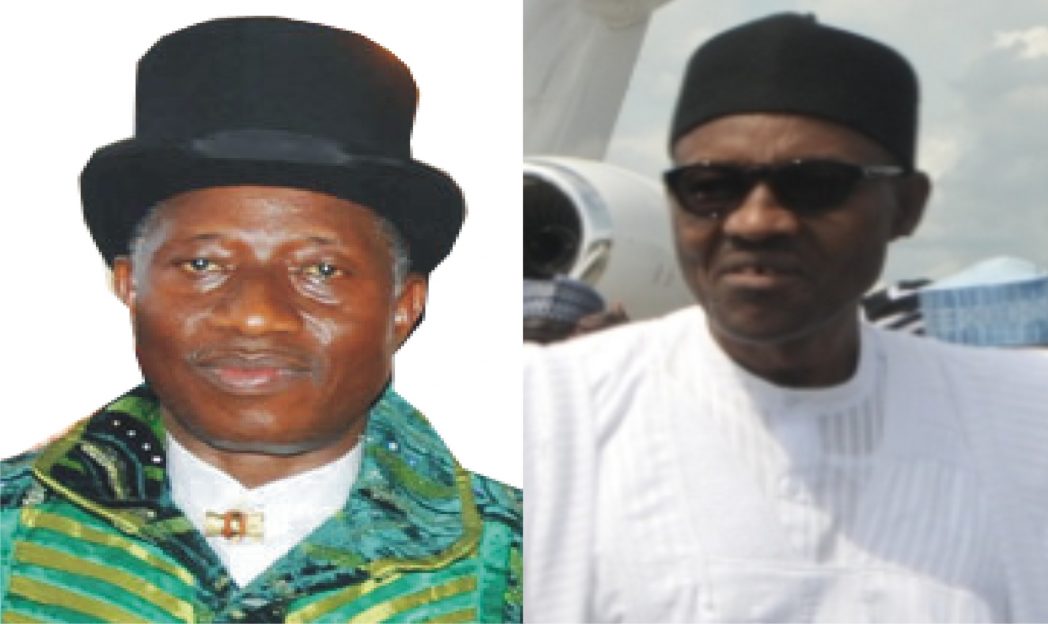
President Goodluck Jonathan and Buhari
Ben Thom-Otuya


The Senate yesterday urged President Bola Tinubu to remove the Registrar-General of the Corporate Affairs Commission, Hussaini Magaji, over what lawmakers described as a persistent refusal to appear before its Committee on Finance.
The resolution followed a motion raised by Senator Orji Uzor Kalu during a session where members of the President’s economic team were present for engagement with the committee.
Tension rose at the commencement of the meeting when agency heads were introduced and senators observed the absence of the CAC Registrar-General, who had been invited to account for the commission’s activities, particularly on revenue matters.
Moving the motion, Kalu expressed anger over what he termed repeated disregard for legislative oversight, accusing the CAC boss of consistently avoiding invitations to appear before the committee.
He said, “Since I came to the Senate, this CAC man has always given excuses that he is in the Villa or going to London. He is not above the law. This man is not coming to the Senate. Look at the ministers of finance and budget. They are both here. We summoned them and they came.
“But this man thinks he’s bigger than the Senate. We’re not going to take that rubbish again. He had refused on so many occasions to honour our invitation to appear before this committee. We have issues with the reconciliation of the revenue of CAC.
“I move a motion that the man should be reported to Mr President and ask for immediate removal because we cannot continue with him. Is that what we’re doing here? He should come and give us an account of what he had done.”
The Chairman of the Senate Committee on Finance, Senator Sani Musa, corroborated the concerns, pointing to unresolved discrepancies in the reconciliation of the commission’s revenues.
He noted that despite several invitations, the registrar-general had failed to show up to address the issues raised by senators.
“The registrar-general of the Corporate Affairs Commission has refused on so many occasions to honour the calls, invitations or summons of this most important committee.
“There are only about three committees that are in the constitution of the Federal Republic of Nigeria and the Committee of Finance is one of those committees. Sections 88, and 89 have given us these powers.
“And as registrar-general, we have issues with the reconciliation of their revenue. Anytime he is invited, he will give us one reason or another, and he will send junior officers to come and talk to the Senate. That cannot be accepted,” he said.
In a further show of frustration, Senator Adams Oshiomhole proposed that the Senate escalate the matter by withholding approval of the CAC’s 2026 budget pending the registrar-general’s personal appearance before the committee.
Oshiomhole also suggested that the commission be restrained from spending its internally generated revenue without prior approval of the national assembly.
“This senate should decline to appropriate anything in the 2026 budget until we are satisfied that he has accounted for previous money and spending properly.
“And should he spend money that is not appropriated, he should be heading to Kuje prison,” Oshiomhole said.
The motion urging the President to remove the CAC Registrar-General was subsequently put to a voice vote and adopted.
The development underscores renewed assertiveness by the Senate in exercising its constitutional oversight functions, particularly over revenue-generating agencies.
The Corporate Affairs Commission, which regulates companies and business registrations in Nigeria, is a key contributor to non-oil revenue, making accountability and transparency central to its operations.

President Bola Tinubu has appealed to the leadership of the 10th Senate to amend the constitution to provide a legal framework for the establishment of State Police to tackle insecurity nationwide.
President Tinubu made the appeal during an interfaith breakfast with senators at the Presidential Villa in Abuja, yesterday.
The president said that the creation of State Police has become urgent to address Nigeria’s evolving security challenges, strengthen grassroots policing, and enhance states’ capacity to respond swiftly to threats within their jurisdictions.
He noted that a decentralised policing structure would complement existing federal security architecture and promote intelligence-led, community-focused law enforcement.
“We are facing terrorism, banditry, and insurgency. But we will never fail to make a right response to this cause. What I will ask for tonight is for you (Senators) to start thinking how best to amend the constitution to incorporate the State Police for us to secure our country, take over our forests from marauders, and free our children from fear,” he said.
The president commended the cordial relationship between the Executive and the Senate, saying that unity is needed to defeat terrorism and banditry in the country.
“It is a good thing that we are working in harmony, we are looking forward to a country that evolves, a country that takes care of its citizens and protects all.
Tinubu thanked the Senate for its unflinching support towards achieving various economic reforms of his administration, especially the fuel subsidy removal and tax reform policy.
“I have a lot of credit for bold reforms. Without your collaboration and inspiration, those reforms would not be possible. We are reformists together. What we gave up and what we stopped is monumental corruption in the subsidy system. We don’t want to participate in monumental corruption and arbitrage foreign exchange.
You don’t have to chase me for dollars; you could see what Nigeria is today. You should be proud, and I am glad you are. What we are enjoying is a stable economy, and prosperity is beckoning us. We need to work hard, and this attendance means a lot to me,” the president said.
President of the Senate, Godswill Akpabio, commended the president for hosting the leadership of the Senate to the Interfaith breaking of fast.
He commended President Tinubu for providing the visionary leadership the nation needs at this critical time, stating that the administration’s bold reforms have now brought more revenue to governors at the sub-national level for the development of critical infrastructure.
The Senate President prayed for the administration, and for the nation’s peace and prosperity.

Alhaji Mohammed Kasim, the candidate of the Peoples Democratic Party (PDP), has won the Gwagwalada Area Council chairmanship election in the Federal Capital Territory (FCT).
Philip Akpeni, the Returning Officer of the Independent National Electoral Commission (INEC), announced the results on Sunday morning.
Alhaji Kasim polled 22,165 votes to defeat Alhaji Yahaya Shehu of the All Progressives Congress (APC), who polled 17,788 votes.
Alhaji Biko Umar of the All Progressives Grand Alliance (APGA) scored 1, 687 to come in third place.
“I am the returning officer for the 2026 FCT Area Council, Gwagwalada chairmanship held on Feb. 21, 2026,” Akpeni said.
“That Mohammed Kasim of PDP, having certified the requirements of the law, is hereby declared the winner and is returned elected.”
In the Abuja Municipal Area Council (AMAC), Hon. Christopher Maikalangu, the APC candidate, was declared the winner of the chairmanship poll with 40,295 votes.
Andrew Abue, the Collation Officer for AMAC, said Hon. Maikalangu, who is the incumbent AMAC chairman, was returned elected having scored the highest number of votes cast.
The African Democratic Congress (ADC) came second with 12,109 votes, while the Peoples Democratic Party (PDP) polled 3,398 votes.
According to Abue, the total number of valid votes in the chairmanship poll was 62,861, while the total votes cast stood at 65,197.
He added that the number of registered voters in AMAC was 837,338, while the total number of accredited voters was 65,676.
Meanwhile, the Independent National Electoral Commission (INEC) has declared Mr. Joshua Ishaku of the All Progressives Congress (APC) as the winner of the Bwari Area Council Chairmanship election.
Announcing the result on Sunday in Bwari, the Returning Officer for the election, Prof. Mohammed Nurudeen, stated that Ishaku polled a total of 18,466 votes to emerge victorious in the February 21, 2026 poll.
“I am the Returning Officer for the 2026 FCT Area Council, Bwari chairmanship held on Feb. 21, 2026. That Joshua Ishaku, having satisfied the requirements of the law, is hereby declared the winner and is returned elected,” Nurudeen said.
According to the results declared, the candidate of the African Democratic Congress (ADC) secured 4,254 votes, while the Zenith Labour Party (ZLP) polled 3,515 votes to place second and third respectively.
The declaration adds to the series of results emerging from the 2026 FCT Area Council elections, as political parties assess their performance ahead of future contests.
INEC UPLOADS 2,602 OF 2,822 FCT CHAIRMANSHIP RESULTS ON IReV
The Independent National Electoral Commission (INEC) had uploaded 2,602 out of the 2,822 expected polling unit results from Saturday’s chairmanship elections in the Federal Capital Territory (FCT) as at 5:55am on Sunday, data retrieved from its Result Viewing Portal (IReV) showed.
According to The Tide source, the figure represents an overall upload rate of about 92.2 per cent across the six area councils of the territory.
A council-by-council breakdown indicates that Municipal Area Council recorded the highest number of submissions in absolute terms, with 1,309 of 1,401 polling unit results uploaded, representing 93.43 per cent.
In Gwagwalada Area Council, 330 of the expected 338 polling unit results had been uploaded, representing 97.63 per cent — the highest upload rate among the six councils.
In Bwari Area Council, INEC uploaded 463 of 485 polling unit results, translating to 95.46 per cent.
In Abaji Area Council, 129 of 135 polling unit results had been uploaded as at 5:55am, representing 95.56 per cent.
In Kwali Area Council, 164 of the expected 201 polling unit results were available on the portal, representing 81.59 per cent.
In Kuje Area Council, 207 of 262 polling unit results had been uploaded, representing 79.01 per cent — the lowest rate among the six councils as at the time of review.
-
 News2 days ago
Amend Constitution To Accommodate State Police, Tinubu Tells Senators
-
 Politics2 days ago
Senate Urges Tinubu To Sack CAC Boss
-

 News2 days ago
Disu Takes Over As New IGP …Declares Total War On Corruption, Impunity
-
Business2 days ago
President Tinubu Extends Raw Shea Nuts Export Ban To 2027
-
Business2 days ago
Crisis Response: EU-project Delivers New Vet. Clinic To Katsina Govt.
-
Business2 days ago
President Tinubu Approves Extension Ban On Raw Shea Nut Export
-
Sports2 days ago
NDG: Rivers Coach Appeal To NDDC In Talent Discovery
-
Rivers2 days ago
Etche Clan Urges Govt On Chieftaincy Recognition