
News
Confab: S’South Opts For 22.5%-50% Derivation

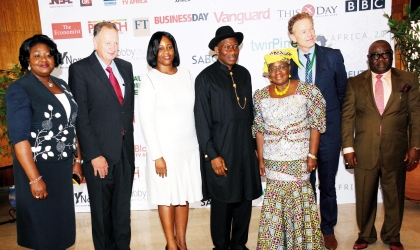
L-R: Chairman, World Pension Summit for Africa, Mrs Grace Usoro; Co-chairman, World Pension Summit, Mr Harry Smorenberg; Acting Director-General of Pencom, Ms Chinelo Anohu-Amazu; President Goodluck Jonathan; Minister of Finance, Dr Ngozi Okonjo-Iweala; Co-chairman, World Pension Summit, Mr Eric Eggink and Chairman, Senate Committee on Pencom, Sen. Aloysius Etuk, at the World Pension Summit in Abuja last Monday.
At last, the National Conference, Monday and yesterday debated the thorny issues of resource control, derivation principle and devolution of powers, as it considered the report of its Committee of Devolution of Power, with South-South delegates opting for between 22.5 per cent and 50 per cent derivation.
As fervent debates flourished during the plenary session of the conference following conferees commencement of debate on the report of the Committee on Devolution of Power, expectations were high, and tension beclouded the plenary but the sagacity of the Conference Chairman, Justice Idris Kutugi, who presided, doused the tension.
The committee’s slim-volume submission, loaded with serious issues, focused principally on devolving power from the centre to the federating units; and the issue of resource control.
The report was however applauded by the delegates shortly after it was presented by the co-chairmen, the former governor of Akwa Ibom State, Obong Victor Attah, and the former Inspector General of Police, Alhaji Ibrahim Coomassie.
Critically examined in the report, whose recommendations would be subjected to vote by the conference later, were the issues of resource control, derivation principle, revenue sharing formula, and the development and exploitation of mineral resources nationwide.
The report also examined 68 items cited in the Second Schedule, Part One of the 1999 Constitution, which deals with the Exclusive Legislative List; and 30 items contained in Part Two of the Fourth Schedule bordering on the Concurrent Legislative List.
While most delegates from the South, particularly, the South-South and South-East said derivation should be increased from the present 13 per cent to between 22.5 per cent and 50 per cent, others suggested that it should be reduced further from 13 per cent.
Resource control, perhaps, was the most debated aspect of the report.
Each delegate, depending on where he or she comes from, wanted considerable level of control of resources in view of the adoption of true federalism by the conference while others said the issue did not arise as far as they were concerned.
Those who canvassed the view that states should control their resources said they did so in the spirit of devolution of power which allows the states to only pay taxes or make appropriate financial contributions to the Federal Government.
Others argued that mineral resources in Nigeria are owned in law by the Federal Government as contained in Section 44(3) of the 1999 Constitution, as amended.
Section 44(3) states that: “Notwithstanding the foregoing provisions of this section, the entire property in and control of all minerals, mineral oil and natural gas in, under or upon any land in Nigeria or in, under or upon the territorial waters and the Exclusive Economic Zone of Nigeria shall vest in the Government of the Federation and shall be managed in such manner as may be prescribed by the National Assembly.”
In its report, which is still subject to ratification by the conference, the committee said that after heated discussion on resource control, it unanimously agreed that the issue of derivation should rather be discussed instead of resource control.
It said its decision was informed by the emotive nature of the issue, which in the committee’s view was capable of destabilising the country.
On derivation, the committee said some delegates were of the view that derivation should be increased either in a quantum or gradual manner; while others were opposed to any form of increase.
Instead, some members had proposed the reintroduction of the off-shore/on-shore oil dichotomy in derivation payments; at the same time, while others kicked against it.
The committee said that even the abolition of intervention measures such as the Ministry of Niger Delta Affairs, Niger Delta Development Commission and the Amnesty Programme were robustly discussed.
After long debates which spanned four days, the report indicated that a consensus was reached on the issue to the effect that the status quo be maintained in order to avoid upsetting the existing peace and equilibrium in the polity, which it described as a product of years of political engineering and craftsmanship.
On fiscal federalism which basically deals with how revenues are generated and distributed among the federating units in the federation, the committee concluded that the powers conferred on the Federal Government to keep custody of and determine the terms and manner of fund allocation from the Federation Account negate the principles of fiscal federalism.
The committee spotted what it called imbalance in favour of the Federal Government in the sharing formula, and maintained that the imbalance has adversely affected the performance of the federating units, and therefore asked for a review.
It recommended that the powers of the Federal Government under Section 162(3) of the 1999 Constitution, as amended, to prescribe the terms and manner of sharing national revenue should be exercised through the Revenue Mobilization, Allocation and Fiscal Commission (RMAFC).
The committee argued that RMAFC should at the same time consult the federal and state governments before presenting a draft bill on the matter to the National Assembly for enactment into law.
On vertical revenue sharing, which deals with how revenue is disbursed to federating units, the committee emphasised the need for equilibrium between the central government and the federating units, comprising states and local governments.
It said that it conducted examination of specific development challenges of states and local governments, and concluded that to a great extent, rapid economic and social development could be achieved in the country if the percentage of revenues allocated to states and local governments were reviewed upwards.
It recommended that the sharing formula for funds accruing to the Federation Account among the three tiers of government should be: Federal Government 42.5 per cent instead of the present 52.68 per cent; state governments 35 per cent instead of the current 26.72 per cent; and the local governments 22.5 per cent to replace the current 20.60 per cent.
The committee further recommended that the percentage given to population and equity of states in the existing sharing formula be reduced while that assigned to social development factor should be increased to a higher percentage to ensure accelerated development of all parts of the country.
The proposed sharing formula by the committee is based on: diminished emphasis on principles of equality of states and population; increased emphasis on social development factor; and internally generated revenue.
On mines and minerals including oil fields, oil mining, geological surveys and natural gas, the committee recommended that they should be retained on the Exclusive Legislative List as specified in the 1999 Constitution but should be amended to read thus: “The governments of states where the mining activities take place shall be involved in matters relating thereto; (and that) the government of the federation shall create a special fund to develop mines and minerals in states where such resources are undeveloped.”
According to the committee, the overriding need to bring all other mineral resources of the country, hitherto undeveloped, into the mainstream development by activating National Strategic Plan for exploitation of minerals to boost their contribution to Gross Domestic Product (GDP), were considered in making this recommendation.
Still on mineral development, the committee recommended a constitutional provision for the establishment of a Special Fund for the development of mineral resources in the country.
It further proposed that 4.5 per cent of the total revenue accruing to the federation should be devoted to this special fund when established.
In addition, the committee wants the Special Fund to be in the form of a Venture Capital Fund, advising that a competent body should be established to administer the fund according to the guidelines that shall be specified by the National Assembly.
Before the presentation of the committee’s report to plenary, a delegate, Professor Awalu Yadudu, addressed the conference to “state his own part of the story” on the raging controversy of “consensus group and the existence of position paper”.
Yadudu debunked insinuations that he was primed to “scatter” the conference as claimed by another delegate but rather insisted that his decision to opt out of the consensus committee was informed by the fact that most of the decisions adopted in the position paper presented to plenary were not part of the recommendations of any committee.
Earlier, an elder statesman, Chief Edwin Clark, had addressed the conference, and harped on the need to put the interest of the country above sectional and personal interest.
Clark expressed regret that the consensus committee constituted to resolve contentious issues that may arise in the course of adoption of the recommendations of committees was “scattered” midway.
The Ijaw leader said he was sad that issues that could scatter or dent the credibility of the conference were being raised close to the end of the parley.
He said everyone must understand that Nigeria “is made up of equal citizens. Nobody is superior to the other. We came to this conference in order to have consensus on contentious issues.”
He appealed to delegates to see the National Conference as an ample opportunity to contribute their quota to the task of reforming Nigeria.
Justus Awaji, Abuja


The Rivers State Government has commended the Church of Nigeria (Anglican Communion) for its outstanding contributions to the development of Rivers State, particularly in the areas of peacebuilding, education, healthcare, and moral development.
Governor of Rivers State, Siminalayi Fubara, stated that the Church has remained a dependable partner in promoting peace, unity, justice, moral discipline, and social harmony across society.
The Governor, who was represented by the Secretary to the State Government, Dr. Dagogo Wokoma, made the remarks during the thanksgiving service marking the 30th Anniversary and First Session of the 11th Synod of the Diocese of Niger Delta North, held at St. Peter’s Anglican Church on Sunday.
Governor Fubara described the Synod’s theme, “Kingdom Advancement: The Priority of Every Believer,” as timely and relevant, considering the prevailing realities in society.
According to him, the Church continues to play a vital role in shaping societal values and inspiring hope among citizens.
“The Church remains a vital partner in promoting peace, unity, justice, and moral discipline. Its role in shaping values and inspiring hope cannot be overemphasized,” he stated.
The Governor further acknowledged the Anglican Communion’s contributions in education, healthcare delivery, youth empowerment, humanitarian services, and spiritual guidance across communities in Rivers State.
“The Rivers State Government appreciates the invaluable contributions of the Anglican Communion in education, healthcare, youth development, humanitarian support, and spiritual guidance. Your impact across communities in Rivers State continues to strengthen families and promote peaceful coexistence among our people,” he added.
Governor Fubara reaffirmed his administration’s commitment to building a peaceful, united, and prosperous Rivers State where all citizens can thrive irrespective of religion, ethnicity, or social background.
He also urged the Synod to continue praying for sustainable development and progress in Rivers State and Nigeria at large.
Earlier in his sermon, the Guest Minister, Joseph Olushola, spoke on the topic, “Kingdom Investment and Internal Rewards,” urging Christians to remain faithful stewards of God’s blessings and committed to advancing God’s kingdom through service and generosity.
The cleric emphasized that believers are custodians of the virtues and resources entrusted to them by God, stressing that divine rewards are based on faithfulness and impact rather than material possessions.
The Shell Nigeria Gas Limited, in partnership with the Manufacturers Association of Nigeria (MAN), has reaffirmed support for efforts to expand gas distribution infrastructure in Rivers State as part of initiatives aimed at improving access to affordable, cleaner and more reliable energy for industries across the South-South region.
The commitment was highlighted during the SNG–MAN Business Forum held in Port Harcourt, where stakeholders from the industrial and public sectors examined the role of natural gas in driving industrialisation, boosting local production and strengthening energy security.
Speaking at the forum on behalf of the Managing Director of Shell Nigeria Gas Limited, the company’s Head of Gas Distribution, Mr. Chukwuka Amos Ejesi, described natural gas as a critical component of Nigeria’s energy mix and a key driver of sustainable industrial growth.
According to him, Nigeria’s gas development agenda has reached a stage where policy direction must be matched with practical implementation capable of addressing the energy challenges confronting manufacturers.
He noted that pipeline gas offers industries a cleaner, more dependable and cost-effective energy alternative capable of supporting uninterrupted operations, reducing emissions and improving production efficiency.
“Gas is the backbone of manufacturing, and we are encouraged by the growing recognition among stakeholders of the need for cleaner and more reliable energy solutions,” he said.
Ejesi stressed the need for sustained collaboration among energy providers, government institutions and industrial stakeholders to maximise the country’s gas resources for economic development.
He added that improved gas infrastructure would strengthen manufacturing value chains, enhance productivity and promote more competitive industrial operations across Rivers State and the wider South-South region.
Participants at the forum also emphasised the importance of expanding energy infrastructure as a pathway to unlocking industrial capacity, reducing operating costs and promoting sustainable industrial development.
Representing Governor Siminalayi Fubara, the Director-General of the Rivers State Investment Promotion Agency, Dr. Chamberlain Peterside, reaffirmed the state government’s commitment to partnering with private sector investors to revitalise industrial activities in the state.
He identified key projects targeted under the initiative to include the revival of the Ahoada Industrial Park, the New Port City project and the proposed Bonny Industrial Park, all aimed at stimulating economic growth and expanding industrial opportunities along the Bonny corridor.
According to the governor, the long-term vision is to position Rivers State as a leading manufacturing hub in Southern Nigeria through strategic public-private partnerships.
Governor Fubara also commended Shell Nigeria Gas and MAN for sustaining engagements geared towards improving industrial energy access, noting that gas infrastructure development remains central to the state’s economic recovery plans.
He further observed that the gas sector presents enormous opportunities for economic growth, especially as global energy systems continue to shift towards cleaner energy sources.
The governor called on stakeholders to work collectively towards developing a practical and sustainable gas framework capable of supporting the state’s industrial and energy development objectives.
By; Kevin Nengia
Rivers State Deputy Governor, Prof. Ngozi Nma Odu, has charged newlywed couples to build their marriages on the virtues of love and submission as taught in the Word of God.
Prof. Odu gave the charge at the wedding ceremony of Amblessed Favour Sunny-Cookey and Samson Jesuganji at Lifegate Power Ministries, Dominion Cathedral, in Port Harcourt on Saturday, 16th May 2026.
The Deputy Governor congratulated the couple on beginning a new phase of life together and prayed for God’s blessings upon their union, noting that the couple had been raised by godly parents and encouraged them to uphold the Christian values instilled in them.
Referring to the sermon delivered during the ceremony, Prof. Odu emphasized that the principles of love and submission remain fundamental to a successful marriage.
According to her, genuine love reflects the nature of God, stressing that love should remain the foundation of the couple’s relationship as they journey through life together.
Prof. Odu further prayed for enduring peace, happiness, and progress in the home, expressing confidence that the marriage would continue to flourish under God’s guidance.
The Deputy Governor also commended the families of the couple for their support and upbringing, while urging the newlyweds to always remember the significance of the day and the commitment they had made before God and witnesses.
In his sermon at the wedding, the Founder and Presiding Pastor of Salvation Ministries, Pastor David Ibiyeomie, stated that marriage did not originate from Western culture, traditions, or human ideas, but from God, whom he described as the “manufacturer” of marriage.
According to the cleric, couples seeking lasting and peaceful homes must rely on biblical principles rather than societal trends or assumptions.
He explained that many marital crises and rising divorce rates stem from ignorance and failure to apply scriptural teachings in family life.
Drawing from the biblical parable of building a house on a rock, Pastor Ibiyeomie said the Word of God remains the only solid foundation capable of sustaining marriages through challenges and difficult times.
He noted that marriage naturally comes with unexpected realities and pressures, stressing that religious ceremonies or cultural practices alone are not enough to sustain a home without proper understanding of God’s instructions.
The pastor further warned that ignorance of scripture remains one of the greatest weapons against believers, urging Christians to study and practice the Word of God rather than merely attending church services.
It would be recalled that the bride is the daughter of Pastor Sunny Cookey the Founder and Presiding Pastor of Lifegate Ministries. The Ceremony had lots of Ministers in attendance which includes Apostle Zilly Aggrey, Pastor George Izunwa, and Bishop Winston Iwo