
News
NJC Recommends 22 Judges For Supreme Court, Others

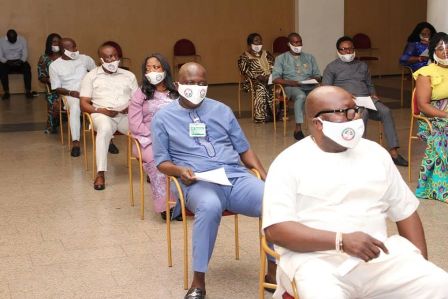
The National Judicial Council (NJC) has recommended appointment of more judges for the Supreme Court and other various courts.
A statement by the Director of Information at the NJC, Mr. Soji Oye, yesterday, stated that the council made the recommendation at its second virtual meeting held on August 11 and 12, 2020.
Oye said the council at the meeting presided by its chairman who is also the Chief Justice of Nigeria, Justice Tanko Muhammad, recommended a total of 22 judicial officers across various courts, including the Supreme Court, which has been seeing a steady decline in the number of its justices in the last two years.
The recommended candidates for the Supreme Court bench, which currently has 12 justices, will add to the list of four others whom the NJC had recommended to President Muhammadu Buhari, since last year.
The 22 judicial officers newly recommended by the NJC are for appointment as justices of the apex court, and as heads of other courts, judges of state High Courts, Kadis of state Sharia courts and judges of Customary Courts of Appeal.
The statement did not disclose the names of the nominees.
But it stated that their recommendation for appointment followed the council’s consideration of “the report of its interview committee.”
Their appointments are to take effect after the approval of either Buhari or the governors of the relevant states, as the case may be.
The statement added that the council also issued “a warning letter to Hon. Justice K. N. Ogbonnaya of the High Court of the Federal Capital Territory following its findings on the petition written against him by Dr. Uchechukwu Samson Ogah, OON, that His Lordship refused to release a copy of judgment delivered to the petitioner within the constitutionally prescribed period of seven days.”
The statement, however, added that the council dismissed the petition sent against 17 judges.
“In the same vein, council also dismissed a petition written by Mrs. Ademujimi Adenike Nancy against Hon. Justice Sunday Olorundahunsi for want of merit.
“Council also considered the Report of Preliminary Complaints Assessment Committee on petitions written against the following 16 Judicial Officers and dismissed the allegations levelled against” them, on the grounds that the petitions were “either lacking in merit or being subjudice.”
The 16 other exonerated judges include, the Chief Judges of Ekiti and Kwara states, Justices Ayodele Daramola and Sulyman Kawu, respectively.
The rest include four judges of the Federal High Court, Justices I. N. Oweibo, Hadiza R. Shagari, Ijeoma L. Ojukwu, Ambrose Lewis-Allagoa; two Lagos State High Court judges – Justices B. A. Oke-Lawal, O. A. Ogala; a judge of the Cross River State High Court, Justice Augusta Uche Kingsley-Chukwu, a judge of the Nasarawa State High Court, Justice Mustapha A. Ramat; as well as two judges of the Kaduna State High Court, Justices M. M. Ladan and Muhammed Lawal Bello.
The rest are a judge of the Bauchi State High Court, Justice Adamu M. Kafin Madaki, a Bayelsa State High Court judge, Justice L. M. Boufini, as well as a Kadi of the Sharia Court of Appeal, Borno State, and Kadi Goni Kur.
According to the statement, the council “also received the final report of the Judicial Ethics Committee and other Ad-Hoc Committees set up.”
It added, “Council also received the notification of retirement of thirteen judges and notification of death of six judges of States High Courts and Sharia Court of Appeal.”



The Chief of Army Staff (COAS), Lt.-Gen. Waidi Shaibu, has tasked troops of Operation SAVANNAH SHIELD to dominate the battlespace and intensify offensive operations against kidnappers, bandits and other criminal elements in the North Central region.
Shaibu gave the directive yesterday during his maiden operational visit to the Headquarters, Joint Task Force North Central (JTF-NC), at Sobi Barracks, Ilorin.
This is contained in a statement by the Acting Director, Army Public Relations, Col. Appolonia Anele, in Abuja, yesterday.
Shaibu said the Nigerian Army would remain resolute in its constitutional responsibility of safeguarding lives and property, stressing that troops must sustain pressure to decisively deny criminal elements freedom of action.
He assured personnel of continued deployment of combat enablers and operational resources to enhance clearance operations and dismantle criminal hideouts across Kwara and Niger states.
The COAS reaffirmed his commitment to troop welfare, noting that improved welfare remained critical to sustaining morale, operational effectiveness and combat readiness.
He urged the troops to remain disciplined, professional and loyal to the Constitution and the democratically elected government.
Earlier, the Theatre Commander, JTF-NC Operation SAVANNAH SHIELD, Maj.-Gen. Yakubu Yahaya, commended the COAS for his strategic leadership and support.
Yahaya assured that troops would remain committed and steadfast in restoring peace and stability in the region.

The Nigerian Navy says it is expanding training and infrastructure to address emerging security threats and strengthen operational efficiency across formations and units nationwide.
The Chief of Naval Staff, Vice Adm. Idi Abbas, spoke during the inauguration of projects at the Nigerian Navy Basic Training School (NNBTS) in Onne, Rivers as part of activities marking the Nigerian Navy’s 70th anniversary.
Abbas, represented by the Flag Officer Commanding, Naval Training Command (NAVTRAC), Rear Adm. Ebiobowei Zipele, said the projects reflected significant progress made by the navy since its establishment in 1956 from the British Royal Navy.
“Training and infrastructure have improved significantly to meet contemporary security challenges and fulfil the navy’s constitutional responsibilities.”
According to him, the anniversary provides the navy an opportunity to reflect on its achievements and contributions over the past seven decades.
Projects inaugurated included a remodelled female trainees’ hostel accommodating more than 500 occupants and an expanded golf course upgraded from one to nine holes.
Others were the NNBTS fuel dump, Chief Boatswain’s Mate House, renovated pharmacy department and a new theatre block at the Naval Medical Centre, Onne.
Abbas described the new theatre as a major milestone for the navy’s medical services.
“Previously, injured personnel requiring surgeries were referred outside the facility.
“With this theatre, surgeries can now be conducted within the base.’’
He added that a 30KVA inverter had also been installed to guarantee uninterrupted electricity supply at the training school.
The naval chief assured officers, ratings and trainees that the navy leadership remained committed to their welfare and wellbeing.
“These infrastructure upgrades show the commitment of the Chief of Naval Staff to addressing operational and welfare challenges promptly,” he said.
In addition, NAVTRAC distributed educational materials to pupils of Community Primary Schools One and Two, Ogale, in Ebubu-Eleme area of Rivers.
Items distributed included exercise books, school bags and other writing materials as part of the navy’s civil-military engagement initiative.
Zipele said the outreach was designed to strengthen relations between the navy and host communities while supporting children’s education.
“Education remains critical to national growth and youth empowerment. Some of these pupils may eventually serve in the Nigerian Navy,” he said.
He noted that the initiative demonstrated the navy’s commitment to educational development, peace, security and sustainable community relations.
Zipele urged the pupils to remain disciplined, focused and committed to their studies while embracing patriotism, integrity and hard work.
He thanked the Ebubu community for its continued support for the naval training command headquarters and the navy.
-
News2 days ago
Obuah’s Victory Excites Former Lawmaker as APC Primaries Conclude in Rivers West
-

 Politics4 days ago
APC PRIMARIES: FUBARA’S WITHDRAWAL, HISTORIC SACRIFICE FOR NATIONAL STABILITY ……. GROUP
-

 News4 days ago
Court Sentences Seven To Death Over Murder Of Cleric In Rivers
-
News2 days ago
105 Nigerians Killed In S/Africa In Seven Years
-

 Sports4 days ago
PH Arsenal Community Set For Streets Procession, Saturday
-

 Niger Delta2 days ago
Royal Father Endorses PH Arsenal Community, Pledges To Support
-

 Politics4 days ago
IPAC Flays INEC Over Election Guidelines Judgement
-

 Politics4 days ago
NDC To Adopt Electronic Voting For Future Primaries