Connect with us

Featured

COVID-19: Rivers State Inter-Ministerial C’ttee, UNICEF Partner In Community Mobilization

Published

on

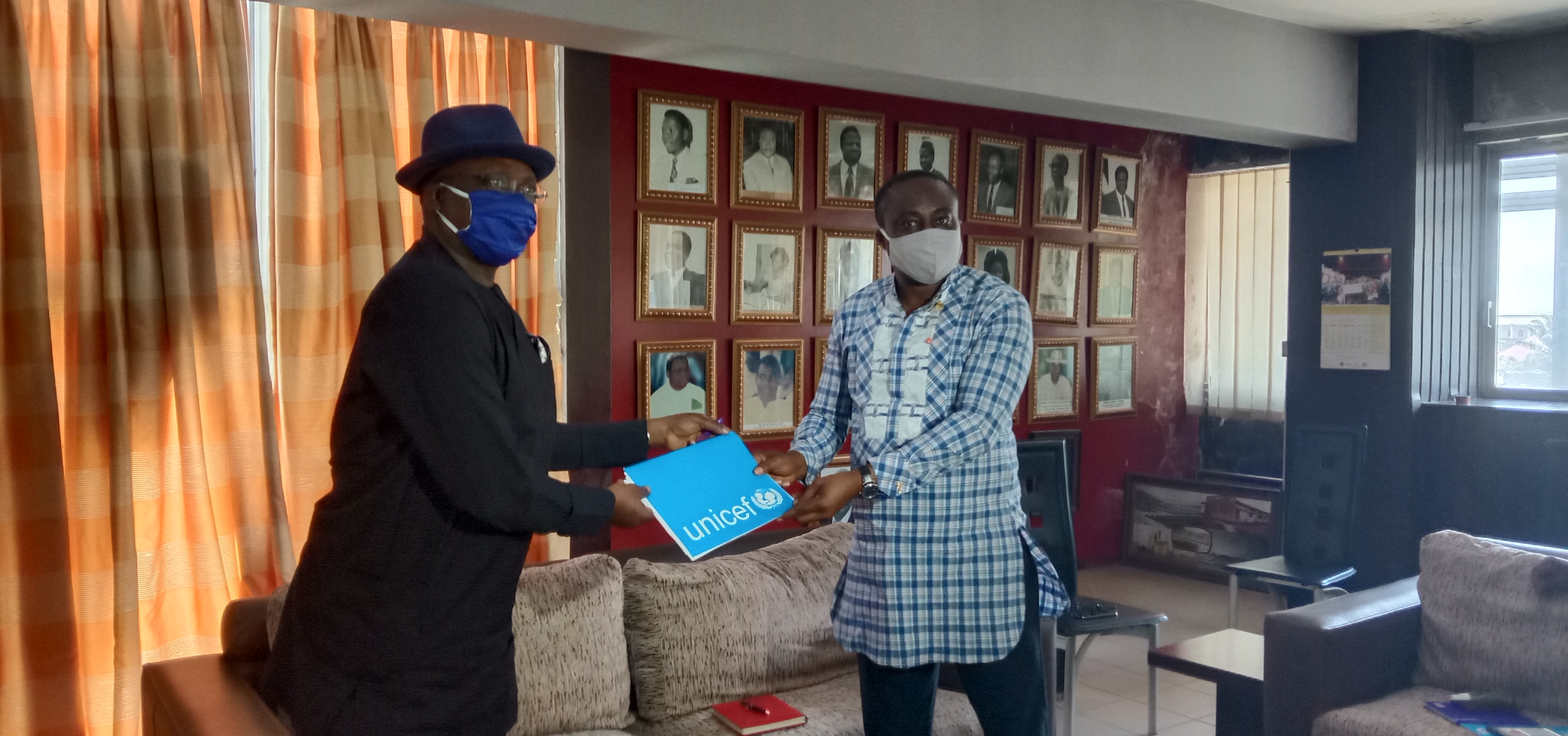
The Rivers State Inter-ministerial Committee on COVID-19 and UNICEF have agreed to partner in creating more awareness and mobilizing Rivers people in the fight against the coronavirus pandemic through the communities in the 23 Local Government Areas.
Taking the decision for the partnership on Saturday in his office during a meeting with a delegation of the UNICEF Field Office in Rivers State and its partners, the Rivers State Commissioner for Information and Communications, Pastor Paulinus Nsirim, siad the community sensitisation and mobilization is one the Committee had planned as its next line of action.
This, the Commissioner explained, is because of the realisation that in spite of the impact of the COVID-19 pandemic in the world and Nigeria, and the level of awareness creation made by the Interministarial Committee, some people still do not believe it exist.
He said: “Consistently we (the Committee) have been working round the clock to ensure that people are sensitised and mobilized. In fact,  the next project we want to emback on now is to get vehicles … that will be going round the communities to broadcast prevention messages. It will shock you to know that there are still people who don’t believe that this virus is here.

“So, we want to see how UNICEF will partner with us. Let’s get these open vans that would go round into the 23 LGAs of the State to ensure that this prevention message gets to everyone, just to lend weight to what we have done with the Traditional  Rulers Council, because we had a strategic meeting with them, where we gave them tips on how to use town announcers, which a good number of them have been doing”, he said.
He noted that not long ago, the State Governor, Nyesom Wike, had ensured that communities in the State are brought into the fight against the pandemic by setting up the Local Government Task Forces for COVID-19, saying, “there’s no State in this country that has gotten this kind of model of leadership in this season”.
Responding to the level of partnership UNICEF proposed, Nsirim clearly outlined the areas within the purview of the Committee and the extent to which the Committee will go in the partnership.
According to him, in “scaling up of awareness and how to create community watchdogs in electronic platforms for surveillance and all, we’re ready to partner with you in this direction. The only area that may not be within our purview is the one of empowering communities for socio-economic impact.
“What we can do with you along that line is to also create some messages that would make people to accept the social impact things that will come, and also encourage them to prepare for post-COVID-19, like you said.
“Everything that would be required to make our people to survive post-COVID, We’re ready to partner with you, because you spoke extensively on the things they can produce, and also noted that we had Ebola some time, nobody knew there’ll be coronavirus.
“Whatever way we can partner with you to drive that behaviour change Communication in a manner that our people will not just only imbibe the appropriate behaviour change, but also be empowered to be able to cope, peradventure any strange ailment comes again, we, this committee, are prepared, because we’re here to serve Rivers people”, he stated.
This, the Commissioner noted,  is in line with the Governor’s determination “to ensure that this State does not enter community transmission”, saying that, “that’s why he is the Chairman of the Monitoring Task Force. He does it in both day and night. No Governor has shown that kind of passion in this country”.
Earlier in his speech, the leader of the delegation and UNICEF Chief of Field Office, Rivers State, Dr Guy Yogo, had commended the State Governor over steps taken in checking the COVID-19 pandemic, noting that it has set the stage for a successful partnership.
Dr Yogo, who is the leader of the Risk Communication and Community Engagement Pillar on COVID-19 in UNICEF, stated the areas in which they seek partnership with the Interministarial Committee.
Such areas, he said, include “to scale up, raising public awareness, and listening to communities on how best every citizen in Rivers State can be fully informed and empowered for the right behaviour change that we need to do it.
“We want to be able to do an extensive network with knowledge management and monitoring of what is going on in each of the communities in Rivers State, establishing in each community what we call ‘Community Watchdog’ to survey anything going on in that community, provide the necessary solidarity framework, because we might be moving into the need to prevent Community transmission”, he stated.
What this means, he explained, is that “we’re going to set up an electronic platform that the entire Inter-ministerial Committee will be able to monitor on a daily basis exactly everything that is going on at alert in our communities. To provide the necessary proactivity for other teams: surveillance team, Case Management team, to act quickly and decisively to prevent and isolate and assist our communities”.
He also stated that among other things, they will also empower members of communities to be able to produce such items as soap, hand sanitizers, masks, hand washing facilities, and to improve on all supplies that are necessary at this critical time to prevent the spreading of COVID-19 and community transmission.
“What will happen in the future? We need to organise ourselves and get those kind of responses that will be lasting and sustained. In terms of the quality of response, to add to what the State has already done, we’re ready to deploy some additional technical support to the State, taking further the response team that we have currently to 23”,he said.
Meanwhile, they will also make sure that each LGA has its Rapid Response Team, they will “deploy 250 technical Social mobilizers to support the LGA Chairmen and committies to set up in every LGA, every Ward, what we need at the platform of stakeholders coming together”.
Other members of the Interministarial Committee present at the meeting were the Commissioner for Environment, Dr Igbiks Tamuno, and his Chieftaincy Affairs and Community Development counterpart, Barr Olisaelloka Tasie-Amadi.
Also in the entourage of the UNICEF delegation were the Lead Coordinator, Risk Communication and Community Engagement, Mr Modekai Oluwole, and the General Manager, Rural  Water Supply and Sanitation Agency (RUWASA), Rivers State, Mr Napoleon Ada.

Featured

JUNE 12: Democracy Remains Nigeria’s Strongest Path To Unity, Progress, Says Fubara ….Extols Abiola, Wife

Published

on

Governor of Rivers State, Sir Siminalayi Fubara, has reaffirmed that democracy remains the most effective system of government for Nigeria, given the country’s rich diversity of ethnic, religious, and cultural identities.

In a goodwill message to Nigerians on the occasion of the 2026 Democracy Day celebration, Governor Fubara said June 12 represents far more than a historic date; as it embodies the enduring struggle, sacrifice, and collective aspiration of Nigerians for freedom, justice, and representative governance.

The Governor extended warm felicitations to Nigerians at home and in the Diaspora, paying tribute to the heroes and heroines of the democratic struggle, particularly Chief MKO Abiola, his wife, Kudirat Abiola, and countless others whose courage and sacrifices helped secure the democratic freedoms Nigerians enjoy today.

According to him, “June 12 is a reminder of the price paid for the democracy we enjoy today. The sacrifices made by Chief MKO Abiola, Kudirat Abiola, and many other patriots who laid the foundation for the democratic journey we continue to enjoy today. Their commitment to the principle that power must ultimately reside with the people remains a source of inspiration for every generation of Nigerians.”

Governor Fubara noted that thirty-three years after the historic June 12, 1993 election, Nigeria’s democratic experiment has continued to evolve despite challenges and setbacks.

“Our democratic journey has not been without difficulties, but the resilience of our institutions and the determination of our people have kept the nation moving forward. The ability to express differing opinions, engage in constructive debate, and peacefully choose leaders through the ballot remains one of the greatest achievements of our nation,” he said.

Governor Fubara stressed that democracy provides the best framework for managing Nigeria’s diversity and transforming it into a source of national strength.

“Nigeria’s diversity should never be seen as a weakness. Properly harnessed, it is our greatest asset. Democracy offers us the opportunity to build consensus, promote inclusion, strengthen national unity, and create the conditions for sustainable development and shared prosperity,” he said.

Governor Fubara commended President Bola Ahmed Tinubu, for his commitment to the Renewed Hope Agenda and ongoing efforts aimed at economic revitalization, strengthening security, and deepening democratic institutions across the country.

He reiterated the readiness of Rivers State to continue partnering with the Federal Government in advancing policies and programmes that improve the lives of citizens through infrastructure development, job creation, enhanced security, quality education, healthcare delivery, and good governance.

The Governor further called on Nigerians, regardless of political affiliation, ethnic background, or religious belief, to use the occasion of Democracy Day to renew their commitment to the Nigerian project and the ideals that underpin democratic governance.

“Democracy must not be viewed merely as a periodic electoral exercise. It must be reflected in our daily commitment to accountability, transparency, tolerance, justice, respect for the rule of law, and responsible leadership. As citizens and leaders, we all share a collective responsibility to strengthen our democracy and build a nation that future generations will be proud to inherit,” he said.

Governor Fubara expressed optimism about Nigeria’s future, urging citizens to remain united, hopeful, and committed to the values of peace, dialogue, and national development.

“Together, we can build a stronger, more inclusive, and more prosperous Nigeria where every citizen has the opportunity to thrive and contribute meaningfully to national progress,” he said.


Continue Reading

Featured

Fubara Reaffirms Commitment To Peace, Development

Published

on

Governor of Rivers State, Sir Siminalayi Fubara, has reaffirmed the unwavering commitment of his administration to peace, unity, security, and inclusive development as Rivers State marked its 59th anniversary, last Wednesday.


In a goodwill message issued on Wednesday to commemorate the anniversary, Governor Fubara stated that despite the challenges faced over the years, the people of Rivers State have continued to demonstrate resilience, strength, and an enduring spirit of unity that has sustained the state since its creation.


The Governor noted that the strong bond of brotherhood among the various ethnic nationalities of the state, including the Ijaw, Ikwerre, Ogoni, Etche, Ekpeye, Andoni, Kalabari, and others, remains one of Rivers State’s greatest strengths and a critical foundation for peace, stability, and progress.


He further observed that Rivers State has remained a major driver of Nigeria’s economy for decades, not only because of its abundant oil and gas resources, but also because of the exceptional contributions of its people across diverse sectors including academia, jurisprudence, business, entertainment, public service, and sports.


Governor Fubara assured the people that his administration will continue to prioritize policies and programmes that promote peace, protect lives and property, and expand development across all parts of the state. He emphasized that governance must be people centered and impactful, with equal attention given to every Local Government Area of the state.


The Governor also paid tribute to the elders and founding leaders of the state for preserving the spirit of unity and coexistence over the years, while urging the youths to remain hopeful, responsible, and actively committed to building a greater Rivers State through innovation, hard work, and patriotism.


He equally acknowledged the invaluable role of women in strengthening families, communities, and society, describing them as indispensable partners in the continued growth and stability of the state.


Governor Fubara called on all Rivers people to use the occasion of the anniversary as a moment of reflection and renewed commitment to peaceful coexistence, mutual respect, dialogue, and collective progress, stressing that the unity and future of Rivers State must always rise above personal interests and political differences.


Rivers State was created on May 27, 1967, by General Yakubu Gowon.

Continue Reading

Editorial

Nigeria’s 27 Years of Civil Rule Journey

Published

on

Nigeria returned to civil rule on May 29, 1999, after several years of military intervention in politics. The transition marked a major turning point in the nation’s history and raised hopes for freedom, stability, economic growth and accountable leadership. Citizens expected that elected governments would strengthen institutions, improve living conditions and unite the country after years of authoritarian rule. Twenty-seven years later, civil rule has survived without interruption, making it the longest uninterrupted civilian administration since independence in 1960.
Since 1999, Nigeria has witnessed six administrations at the federal level. Olusegun Obasanjo governed from 1999 to 2007, followed by Umaru Musa Yar’Adua from 2007 until his death in 2010. Goodluck Jonathan served from 2010 to 2015, while Muhammadu Buhari led the country between 2015 and 2023. Since May 2023, Bola Ahmed Tinubu has been in office. Though democracy has remained stable, governance outcomes have produced mixed reactions among Nigerians.
The country has made some notable progress over the past 27 years. Democratic institutions such as the National Assembly, judiciary, political parties and the media have become stronger than they were during military rule. Elections are now regular, though still imperfect. Telecommunications, banking, entertainment and digital technology have expanded greatly. Nigerian youths have also become more politically aware and active. The country’s economy, despite its difficulties, remains one of the largest in Africa.
However, many of the expectations that came with democracy remain unmet. Corruption, unemployment, poverty, insecurity and poor infrastructure continue to trouble the nation. Public confidence in government institutions has weakened over time because many citizens believe political leaders have not done enough to improve their welfare. Ethnic and religious tensions also remain major challenges. While democracy has endured, good governance has not always matched the hopes of the people.
President Tinubu’s administration began with bold economic decisions aimed at reforming the nation’s finances. His government removed fuel subsidy and unified the foreign exchange system. Supporters argue that these measures were necessary to reduce waste and attract investment. The government also increased revenue allocation to states and sought to improve tax administration. Yet the immediate impact has been severe hardship for millions of Nigerians. Inflation, high transport costs and the falling value of the naira have placed enormous pressure on households and businesses.
In education, the Tinubu administration has promised reforms through student loan schemes, support for technical education and efforts to reduce strikes in tertiary institutions. Some progress has been recorded with the establishment of the Nigerian Education Loan Fund. However, public schools still face poor funding, inadequate facilities and shortage of teachers. Many students continue to struggle with rising school fees and declining quality of education.
The health sector under the current administration has also recorded both efforts and challenges. Government has pledged to improve health insurance coverage. Nevertheless, hospitals across the country still suffer from inadequate equipment, shortage of medical personnel and brain drain as doctors and nurses continue to leave Nigeria for better opportunities abroad. Access to affordable healthcare remains difficult for many rural communities.
The power sector remains one of Nigeria’s biggest disappointments after nearly three decades of democracy. Despite repeated promises and reforms, electricity supply is still unstable. Businesses and households spend heavily on generators and fuel. The Tinubu administration has introduced policies aimed at decentralising power generation and encouraging investment, but ordinary Nigerians are yet to feel significant improvement in electricity supply.
The rising cost of living has become the greatest concern for many Nigerians today. Food prices, transportation costs and rent have increased sharply. Though the Federal Government introduced palliative programmes and cash transfer initiatives to cushion the effects of reforms, many citizens believe the interventions have been inadequate or poorly distributed. There is growing demand for more effective social protection programmes targeted at vulnerable citizens.
On national security, the government continues to battle terrorism, banditry, kidnapping and communal violence. Security agencies have recorded some successes in parts of the country, yet insecurity remains widespread. Farmers in many rural communities still face attacks, affecting food production and increasing fear among citizens. Regional stability in West Africa has also become more uncertain due to political crises in neighbouring countries. Nigeria continues to play a leading diplomatic role in the region, but internal security challenges weaken its influence.
In infrastructure and other key sectors, the Tinubu administration has continued several road, rail and housing projects inherited from previous governments. Investments in ports, gas and digital technology have also been encouraged. In agriculture, government has promoted mechanised farming, dry season cultivation and access to credit. Yet food insecurity remains high because insecurity, inflation and poor rural infrastructure continue to affect agricultural productivity. Nigeria still imports many food items despite its vast agricultural potential.
To improve national conditions, the Federal Government must place greater attention on job creation, industrialisation and support for small businesses. More investment is needed in agriculture, healthcare, education and electricity. Anti-corruption institutions should be strengthened while government spending must become more transparent. Leaders must also prioritise national unity and reduce political divisions. Nigerians expect reforms that produce visible improvements in their daily lives, not only policy announcements.
In Rivers State, the 27 years of civilian rule have produced substantial development alongside political tensions. The state has remained economically important because of its oil and gas resources. Different administrations since 1999 have invested in roads, schools, healthcare facilities and urban renewal projects. However, political conflicts and struggles for power have often affected governance and slowed development in parts of the state.
Governor Siminalayi Fubara assumed office in May 2023 amid high expectations and intense political disagreements. In infrastructure, his administration has initiated projects such as massive road construction, bridge rehabilitation and urban development schemes in parts of the state. Ongoing works on major roads and public facilities have been presented as efforts to improve transportation and economic activities. Critics, however, argue that political instability in the state has distracted government’s attention from faster project delivery.
In education and health, the Rivers State Government has continued support for public schools and healthcare centres. Efforts have reportedly been made to improve learning environments and sustain payment of workers’ salaries. In health, there have been interventions in hospitals and primary healthcare services. On security, the administration has worked with security agencies to maintain peace, although political tensions in the state have created uncertainty. In the civil service, workers and pensioners have largely continued to receive salaries, stipends, and welfare support. The state government has also shown interest in agriculture and power development, though these sectors still require stronger investment and clearer long term strategies.
Going forward, Rivers State needs greater political stability to achieve meaningful development. The government should focus more on rural roads, youth employment, agricultural expansion and uninterrupted healthcare services. Investments in independent power projects and industrial development would help attract businesses and reduce unemployment. Above all, political leaders in the state must place the interest of the people above personal or factional battles. Democracy can only succeed when governance delivers peace, development, and hope to ordinary citizens.
Continue Reading

Trending