
Politics
A Nation In Despair

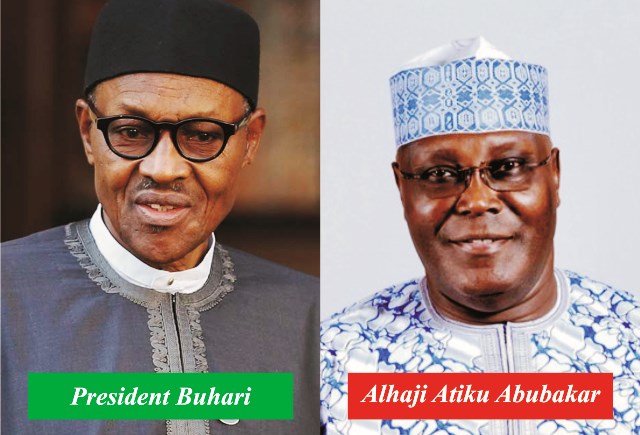
Fifteen days from now, millions of Nigerians will troop to the polling booths to cast their votes for who will be the President of the Federal Republic of Nigeria. But this every-four-year ritual has many obstacles of which security is one.
Just few days ago, the National Security Adviser to the President, General Babagana Monguno held a crucial meeting with state governors on the issue of security during the forthcoming elections and to chart a way forward.
General Monguno, worries in his bid to ensure that the elections went as planned, warned against the use of thugs by politicians.
He said government will demonstrate zero tolerance to political thuggery and illegal bearing of fire arms.
This show of concern was apt and very necessary as experience had shown over the years that in every election in Nigeria, there was always tension and reports of acts of violence in virtually every geo-political region in the country.
Although the 1999 elections which ushered in the present democratic dispensation was peaceful, subsequent ones were not so, especially those of 2011 and 2015.
In 2011, aftermath of the elections in which former President Goodluck Jonathan emerged victorious witnessed acts of violence leading to the killing of some youth corpers and even the burning of the Kaduna City residence of former Vice President Namadi Sambo.
Apart from that, there were reported killings in other parts of the country.
The worst of such incidents was the brutal killing of the Resident Electoral Commissioner for Kano State with his entire family.
In all these acts of violence, no one was arrested, prosecuted or jailed. Even the then Police Commissioner who was supposed to have provided adequate security for all electoral officers in Kano State did nothing to apprehend the culprits but was rewarded with the position of inspector-general of Police.
The problem with Nigeria is that it is quite easy to scream insecurity but when it comes to taking critical actions, sentiments come in.
The issue of political thuggery is nothing new as it has existed right from the late 1950s to early 1960s in the first republic.
Today, in the 21st century after almost 60 years of Independence, we are still talking of “Political Thuggery” as if it is something new that challenges.
Yes, it is challenging but the issue should not be addressed to the governors alone, but to all stakeholders in the electoral process. The use of thugs in elections is not only shameful and embarrassing but shows the level of desperation some politicians will go to ensure that they win elections. Again even some security operatives behave as “Thugs” during elections. In Rivers Sate, during the re-run elections in 2016, a very senior police officer was captured on video manhandling a female electoral officer while demanding for the result sheets of the election.
Similarly in Ekiti and Osun States elections, there were reports of security men chasing away potential voters.
Furthermore the verbal threats of the political actors, hate speeches with that of the body language of the president did not help matters. Although every Nigerian wants a free, fair and credible elections, have the gladiators and those who want the vote of the electorate really abreast of the chain reactions of their negative actions on the polity?
As the count-down tickles on, as Nigerians, we need to ask questions and find solutions to electoral violence and rigging. Most people who engage thugs to intimidate voters and inflict bodily harm on them are well known in the society. Even the thugs are identifiable. Then why were they not arrested in the past. If actions needed to be taken, then the Police should be allowed to do its work but in a situation where power is concentrated in few hands, the police or other security agencies cannot be effective.
From all observations of the trend in politics and power play, no police commissioner or inspector-general of police has ever resigned over policies by the government that undermines the electoral process.
This time around that the polity is already heated up with the world watching us, the national security Adviser should not just warn but ensure that the problem of thuggery was nipped in the bud and he should liaise with all security agencies to ensure that anyone caught in acts of violence was not just arrested but prosecuted, no matter the party affiliation of the individual. It is then and only then that we can say the government is serious in tracking down acts of violence during elections.
In Nigeria, we seem to treat vital issues with levity, especially on electoral matters. In other climes town hall meetings and outside engagements with the electorate help score candidates in public opinion which really translate into actual election results. Maybe they think that public enlightenment programmes are not for them.
Every electoral violence is politically motivated and the key actors are the various party chieftains and their followers who did not witness the presence of any of the political parties.
Also as part of the efforts to ensure that Nigeria departed from the past, the national orientation agency had embarked upon a massive enliftment programme, geared towards a hitchfree election devoid of violence and thuggery.
Various speakers who participate at the south-south zonal flag-off of stakeholders dialogue for peace and violence free 2019 general elections harped on the need for electorate and the political actors to shun violence. The concept which was apt surprisingly did not witness the presence of any of the political parties.
The political parties ought to have sent representatives. One begins to wonder how the 91 political parties could not even send a single representative to know the feelings of the civic society and other non governmental organizations in the south south. Maybe they will give the excuse of the campaigns, but this is not tenable.
It is the potlicians who are being accused of sponsoring thugs and equipping them with arms and ammunition. So the platform to address some of these issue is not campaign rallies but for them to meet at a neutral venue where they will dialogue with each other and the larger society.
Here in Rivers State there is urgent need to disabuse the mind of the international community that the place is volatile as being painted by those who don’t see anything good in the present administration.
The provision of adequate security is the duty of everyone and not just the duty of the police and her sister agencies.
If we recall, some few weeks back, some group of politicians threatened to ensure that elections would not hold in Rivers State if the court injuction barring them from presenting candidates in the gubernatorial, state and National assembly elections was not rescinded. This level of disdain for the collective well being of the larger society should be taken seriously by the security agencies. But however, since the threat was issued not one single individual who made that threat has been arrested and questioned.
This brings us to ask the question of whether we have two Nigeria? One for the ruling party and one for the opposition.
For the public to have trust in the system and for the issue of violence not to rear its ugly head ahead of the forthcoming elections, there should not be favouritism whereby those who commit crimes but belong to the ruling party are never arrested, whereas those in the opposition who cough are treated as armed robbers and murderers.
Let us begin to implement policies that will discourage violent tendencies. And again youths who allow themselves to be used by politicians are not just stupid but destroying their future.
Electoral violence destroys a country’s image and hinders economic growth.
No investor will like to tie his funds in a volatile environment and now is the right time for Nigerians to say a big no to thuggery and electoral manipulations.
Tonye Ikiroma-Owiye



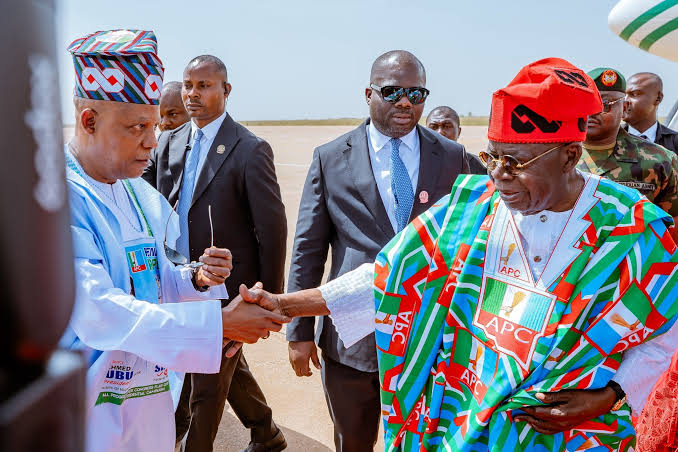
The campaign rally, held at the Kaduna Township Stadium, attracted Vice-President Kashim Shettima, APC governors, party leaders, federal and state lawmakers, political stakeholders and supporters from across the country.
The flag-off marks the beginning of the APC’s drive to secure a second presidential term for President Tinubu, with the party expected to promote its achievements, defend its economic reforms and outline its policy priorities under the proposed Renewed Hope 2.0 agenda.
Kaduna’s selection for the campaign launch underscores the strategic importance of the North-West, a region with a substantial voting population and considerable influence on presidential election outcomes.
The APC faces a significant challenge in Kaduna, where the Peoples Democratic Party’s presidential candidate, Alhaji Atiku Abubakar, defeated President Tinubu in the 2023 election. The rally therefore provides the ruling party an opportunity to strengthen its grassroots structures and regain electoral support in the state.
Addressing supporters, Vice-President Shettima appealed to Northern voters, highlighting President Tinubu’s political relationships with prominent Northern leaders, including Alhaji Abubakar, Mallam Nuhu Ribadu and the late President Muhammadu Buhari.
The Vice-President’s appeal reflects the APC’s determination to consolidate its support in the North as the party intensifies preparations for the presidential contest.
The Renewed Hope 2.0 agenda is expected to feature prominently in the campaign, providing a platform for President Tinubu to explain his administration’s economic policies and outline plans for another term.
However, the President’s record on economic reforms, rising living costs, petrol prices, employment, infrastructure and insecurity is expected to attract considerable scrutiny during the electioneering period.
-

 Education1 day ago
FCE Yola Graduates 3,555 Teachers , Seeks Upgrade to University
-

 Sports1 day ago
Nigerian Trio Target Titles At PFL Africa Finals
-

 Niger Delta1 day ago
Diri Restates Stance On Lagos-Calabar Coastal Highway
-

 Niger Delta1 day ago
C’River, NUJ Pay Tribute To Late Guardian Editor
-

 News1 day ago
NDLEA Recovers Tons Of Illicit Drug Consignments In Nine States
-

 Opinion1 day ago
Checking Voter Apathy In Nigeria’s Electoral Process
-

 Politics1 day ago
2027: DICKSON’S EX-ALLY VOWS TO WORK AGAINST NDC INTEREST IN BAYELSA
-

 Politics1 day ago
2027: GROUP PLEDGES 40,000 SUPPORTERS FOR COALITION CANDIDATES IN RIVERS