
Politics
Ihedioha: Obasanjo Sowed Seed Of Discord In N’Assembly

Deputy Speaker, House of Representatives, Hon. Emeka Ihedioha, has said that the seed of discord that is presently prevalent in the National Assembly was sown by former President, Chief Olusegun Obasanjo, in his bid to assert control over the legislature as far back as 1999.
Ihedioha, who spoke at a public lecture organised by the Department of Political Science, University of Lagos, noted that the leadership crisis that attended the inauguration of the fourth National Assembly was largely due to external interference by the executive.
His words: “The political leadership that emerged in 1999 was coming from a military background where the idea of a legislature was totally unknown or greatly detested. Under succeeding military regimes, the ruling military High Command always combined executive and legislative powers. Government policies and programmes were carried out with “immediate effect”.
The military had no patience for “too much grammar” and debates often associated with parliamentary democracy, he said.
“So, for a military leader who is used to issuing out orders and getting things done, it is inconceivable for him to be sharing powers with “idle civilians” who constitute the legislature in a democratic setting. The tendency to assert total control was ever present. This mental construct or military hang-over was primarily responsible for the adversarial relationship that was witnessed between the Executive and the Legislature between 1999 and 2007,” he said.
The lawmaker explained that the desire of the Executive to exercise total control over the Legislature had led to the imposition of leadership in the two chambers of the National Assembly against the preferences of majority of members. He recalled the wobbly start of the legislature in 1999.
“Through acts of subterfuge, the Executive infiltrated the ranks of the Senators-elect, used a splinter group of the PDP caucus and members of the opposition parties (APP and AD) to frustrate the choice of Dr. Okadigbo as Senate President. Instead the Executive propped up Chief Evan Enwerem and rallied support for him, thereby enthroning him as the President of the Senate contrary to popular expectations. With this development, the seed of discord and instability was sown in the National Assembly.
“The House of Representatives similarly witnessed a crisis of leadership which also had its origin in the meddlesomeness of the Executive. The undisguised and open support by the Executive for Hon. Salisu Buhari compelled other major contenders for the post of speaker like Hon. Farouk Lawan and Hon. Sadiq Yar’Adua to step-down their ambitions, thus paving the way for the emergence of Buhari. But due diligence was not conducted on his background, and that eventually proved costly.”
He said the bad blood generated through the imposition of leadership in the National Assembly continued to work against the cohesiveness and unity of members in the two chambers, with the resultant mutual distrust and suspicions.
“Nocturnal meetings became the order of the day. Before long, the internal contradictions arising from the morbid desire of the Executive to emasculate the National Assembly led to regime change in the two chambers of the National Assembly, “ he said.
Ihedioha, who claimed the present assembly is doing everything possible to change the situation cited the intervention during the fuel subsidy crisis as timely and inevitable.
“The timing of the removal of subsidy from petroleum products by the Executive was most inauspicious. No one anticipated such sudden sharp increase as Nigerians had planned the budget for their trips based on existing cost parameters and indices.
“Confronted with such a terrible situation, the House of Representatives had to convene an emergency session on a Sunday, January, 8 2012. This culminated in the decision of the House to set up the Hon. Farouk Lawan-led Ad-Hoc Committee on the Investigation and Monitoring of the Fuel Subsidy regime. To address the urgent matter of the impending strike, we set up the Patrick Ikhariale Committee to reach out to Labour and arrest the situation.
“The findings of the Committee have since revealed that the huge funds being misapplied by a privileged few in our society in the name of oil subsidy could have been better and wisely deployed in funding the national budget to provide critical infrastructure and tackle mass poverty. I want to assure Nigerians that in spite of the alleged bribery scandal, the report of the Subsidy Committee as adopted by the House remains sacrosanct. We urge the Executive to implem ent it without further delay,” Ihedioha said.



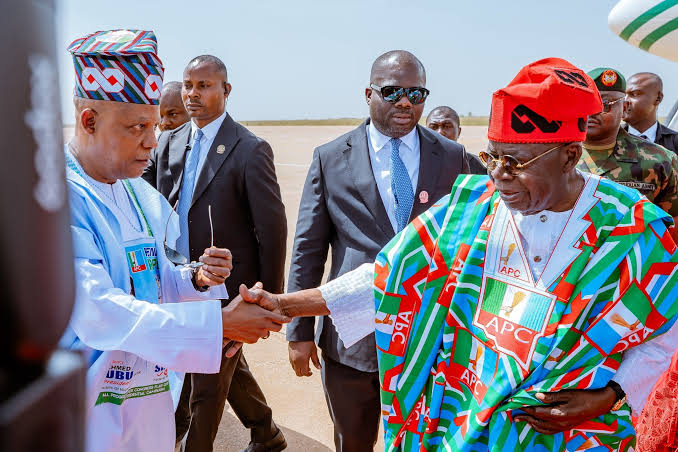
The campaign rally, held at the Kaduna Township Stadium, attracted Vice-President Kashim Shettima, APC governors, party leaders, federal and state lawmakers, political stakeholders and supporters from across the country.
The flag-off marks the beginning of the APC’s drive to secure a second presidential term for President Tinubu, with the party expected to promote its achievements, defend its economic reforms and outline its policy priorities under the proposed Renewed Hope 2.0 agenda.
Kaduna’s selection for the campaign launch underscores the strategic importance of the North-West, a region with a substantial voting population and considerable influence on presidential election outcomes.
The APC faces a significant challenge in Kaduna, where the Peoples Democratic Party’s presidential candidate, Alhaji Atiku Abubakar, defeated President Tinubu in the 2023 election. The rally therefore provides the ruling party an opportunity to strengthen its grassroots structures and regain electoral support in the state.
Addressing supporters, Vice-President Shettima appealed to Northern voters, highlighting President Tinubu’s political relationships with prominent Northern leaders, including Alhaji Abubakar, Mallam Nuhu Ribadu and the late President Muhammadu Buhari.
The Vice-President’s appeal reflects the APC’s determination to consolidate its support in the North as the party intensifies preparations for the presidential contest.
The Renewed Hope 2.0 agenda is expected to feature prominently in the campaign, providing a platform for President Tinubu to explain his administration’s economic policies and outline plans for another term.
However, the President’s record on economic reforms, rising living costs, petrol prices, employment, infrastructure and insecurity is expected to attract considerable scrutiny during the electioneering period.
-

 Niger Delta11 hours ago
Diri Restates Stance On Lagos-Calabar Coastal Highway
-

 Niger Delta11 hours ago
C’River, NUJ Pay Tribute To Late Guardian Editor
-

 News12 hours ago
NDLEA Recovers Tons Of Illicit Drug Consignments In Nine States
-

 Opinion11 hours ago
Checking Voter Apathy In Nigeria’s Electoral Process
-

 Sports8 hours ago
Nigerian Trio Target Titles At PFL Africa Finals
-

 Education9 hours ago
FCE Yola Graduates 3,555 Teachers , Seeks Upgrade to University
-

 Politics8 hours ago
2027: DICKSON’S EX-ALLY VOWS TO WORK AGAINST NDC INTEREST IN BAYELSA
-

 Politics8 hours ago
2027: GROUP PLEDGES 40,000 SUPPORTERS FOR COALITION CANDIDATES IN RIVERS