
Featured
We’ve Made RSUTH Best Teaching Hospital In Nigeria, Wike Declares

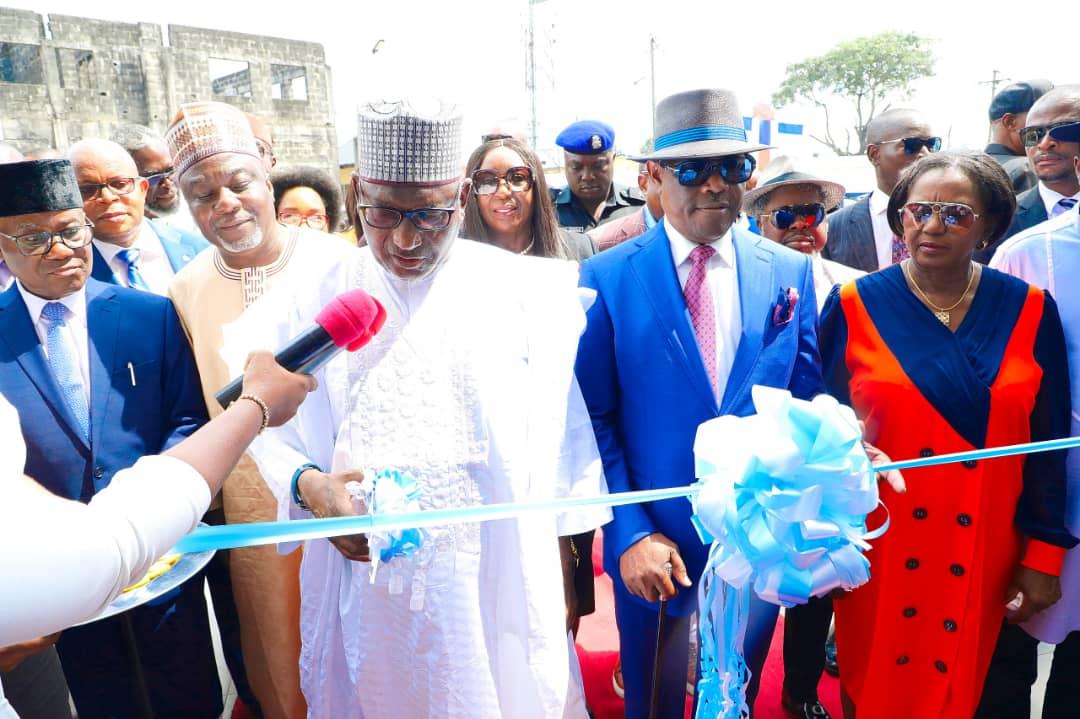
Rivers State Governor, Chief Nyesom Wike, has declared the Rivers State University Teaching Hospital (RSUTH) as the best of such medical facility in Nigeria.
Wike made the declaration given the huge investment his administration has made that was strengthening the capacity of the specialist hospital in the training of medical personnel, research and medical innovations.
The governor spoke at the inauguration of the twin buildings housing the Faculty of Basic Clinical Sciences and the Faculty of Clinical Sciences, performed by the Chairman of Medical and Dental Council of Nigeria, Prof. Abba Hassan in Port Harcourt, yesterday.
“Go to the university teaching hospital, you have the best of equipment you can talk about. I don’t see any teaching hospital in this country today that can compare with what we have at Rivers State University Teaching Hospital.”
Wike noted the several other separate health service providing facilities that are integrated into the teaching hospital for holistic service delivery.
The governor enthused that even the medical personnel and students alike do have the best of medical equipment that would expose them to contemporary medical practice.
Wike explained that soon, the Renal Centre and the hostel for medical house officers that have been completed would soon be inaugurated.
With such huge investment made, Wike charged the teachers and students to take their work and studies seriously so that there would be sustained excellence in the health sector.
“We are commissioning the Renal Centre and the house officers’ hostel, which have been completed and furnished soon.
“But it beats my imagination that a teaching hospital has no Renal Centre. Go and see the Mother and Child Hospital; the gynaecology and paediatric sections. Those of you who will be using the teaching hospital for your learning, you are getting the best equipment for your practical. What you see overseas is what you are seeing here.
“So, you must count yourselves to be lucky that you came at a time you won’t say we don’t have laboratory. You have everything now. So, there will be no excuse from you. All you need to do is to concentrate.”
Wike also reassured that he would not leave office without completing projects his administration has awarded, but noted that should any be left without being inaugurated, he was confident that his successor would, in the spirit of continuity, complete them for inauguration.
“I will not leave any project unfinished. I will make sure all the projects we have started are finished. If they are not finished, maybe at 90 or 95oercent completion, when my successors, Siminialayi Fubara and Prof. Ngozi Ordu come, they should use them for their first 100 days in office projects and commission them.
“This isbecause; they are part of what we are doing. When I say my successor, you know they will win. You know they will win because our report card is there to show what we have done. We are in the period of operation show your report card.”
Speaking further, Wike directed the commissioner for special projects to visit the site for building of hostels for medical students of the Rivers State University, and assess what was required to complete the project in the next two months.
Wike also insisted that the Pathology Department of the university should be ready for inauguration in January, 2023.
Performing the inauguration of the project, Chairman of Medical and Dental Council of Nigeria (MDCN), Prof. Abba Hassan, noted the audacity of Wike to sustain regular training of over 300 medical and other auxiliary staff.
These, he said, were also paid regularly higher than any government, including the Federal Government.
“Governor Wike has invested satisfactorily in this entire tripod starting with the development of manpower in the health sector, giving a foundation to sustain the investment in the infrastructure and equipment procurement.
“It will also provide opportunity for research and invention. I learned that over 300 medical and staff had been trained and are being paid regularly higher than any government, including the Federal Government. This will certainly help to forestall the cancerous brain drain in this sector.”
Hassan expressed his excitement to be part of the event when he said, “I’m privileged to be invited on this occasion to commission one of the projects in health sector among several projects that had been commissioned so far.
“For us in the Medical and Dental Council of Nigeria as regulator in training and practice of medicine and dentistry, wish to note with satisfaction the developmental so far done in this sector by your government.
“Healthcare training and services are anchored on a tripod of consisting of personnel, infrastructure and equipment procurement.”
On his part, the Pro-Chancellor and Chairman, Governing council of the university, Justice IcheNdu (rtd), recalled how on November 29, 2019, representatives of the National University Commission (NUC) were on resource verification at RSU College of Medical Sciences.
During the visit, they insisted, he said, that before the university would be accredited by the Medical and Dental Council of Nigeria to proceed to the clinicals, commitments should be shown in building such faculty building.
He thanked Wike for his support that has actualised the requirement needed for full accreditation.
In his speech, Vice Chancellor of Rivers State University, Prof. Nlerum Okogbule, said the university was appreciative of the sagacity and commitment shown by Wike towards the improvement of medical study and services in the institution.
In his address, Commissioner for Education, Prof Chinedu Mmom, said it took the audacity of the governor to break the jinx by establishing the College of Medical Sciences at the Rivers State University.

Featured
JUNE 12: Democracy Remains Nigeria’s Strongest Path To Unity, Progress, Says Fubara ….Extols Abiola, Wife


Governor of Rivers State, Sir Siminalayi Fubara, has reaffirmed that democracy remains the most effective system of government for Nigeria, given the country’s rich diversity of ethnic, religious, and cultural identities.
In a goodwill message to Nigerians on the occasion of the 2026 Democracy Day celebration, Governor Fubara said June 12 represents far more than a historic date; as it embodies the enduring struggle, sacrifice, and collective aspiration of Nigerians for freedom, justice, and representative governance.
The Governor extended warm felicitations to Nigerians at home and in the Diaspora, paying tribute to the heroes and heroines of the democratic struggle, particularly Chief MKO Abiola, his wife, Kudirat Abiola, and countless others whose courage and sacrifices helped secure the democratic freedoms Nigerians enjoy today.
According to him, “June 12 is a reminder of the price paid for the democracy we enjoy today. The sacrifices made by Chief MKO Abiola, Kudirat Abiola, and many other patriots who laid the foundation for the democratic journey we continue to enjoy today. Their commitment to the principle that power must ultimately reside with the people remains a source of inspiration for every generation of Nigerians.”
Governor Fubara noted that thirty-three years after the historic June 12, 1993 election, Nigeria’s democratic experiment has continued to evolve despite challenges and setbacks.
“Our democratic journey has not been without difficulties, but the resilience of our institutions and the determination of our people have kept the nation moving forward. The ability to express differing opinions, engage in constructive debate, and peacefully choose leaders through the ballot remains one of the greatest achievements of our nation,” he said.
Governor Fubara stressed that democracy provides the best framework for managing Nigeria’s diversity and transforming it into a source of national strength.
“Nigeria’s diversity should never be seen as a weakness. Properly harnessed, it is our greatest asset. Democracy offers us the opportunity to build consensus, promote inclusion, strengthen national unity, and create the conditions for sustainable development and shared prosperity,” he said.
Governor Fubara commended President Bola Ahmed Tinubu, for his commitment to the Renewed Hope Agenda and ongoing efforts aimed at economic revitalization, strengthening security, and deepening democratic institutions across the country.
He reiterated the readiness of Rivers State to continue partnering with the Federal Government in advancing policies and programmes that improve the lives of citizens through infrastructure development, job creation, enhanced security, quality education, healthcare delivery, and good governance.
The Governor further called on Nigerians, regardless of political affiliation, ethnic background, or religious belief, to use the occasion of Democracy Day to renew their commitment to the Nigerian project and the ideals that underpin democratic governance.
“Democracy must not be viewed merely as a periodic electoral exercise. It must be reflected in our daily commitment to accountability, transparency, tolerance, justice, respect for the rule of law, and responsible leadership. As citizens and leaders, we all share a collective responsibility to strengthen our democracy and build a nation that future generations will be proud to inherit,” he said.
Governor Fubara expressed optimism about Nigeria’s future, urging citizens to remain united, hopeful, and committed to the values of peace, dialogue, and national development.
“Together, we can build a stronger, more inclusive, and more prosperous Nigeria where every citizen has the opportunity to thrive and contribute meaningfully to national progress,” he said.

Governor of Rivers State, Sir Siminalayi Fubara, has reaffirmed the unwavering commitment of his administration to peace, unity, security, and inclusive development as Rivers State marked its 59th anniversary, last Wednesday.
In a goodwill message issued on Wednesday to commemorate the anniversary, Governor Fubara stated that despite the challenges faced over the years, the people of Rivers State have continued to demonstrate resilience, strength, and an enduring spirit of unity that has sustained the state since its creation.
The Governor noted that the strong bond of brotherhood among the various ethnic nationalities of the state, including the Ijaw, Ikwerre, Ogoni, Etche, Ekpeye, Andoni, Kalabari, and others, remains one of Rivers State’s greatest strengths and a critical foundation for peace, stability, and progress.
He further observed that Rivers State has remained a major driver of Nigeria’s economy for decades, not only because of its abundant oil and gas resources, but also because of the exceptional contributions of its people across diverse sectors including academia, jurisprudence, business, entertainment, public service, and sports.
Governor Fubara assured the people that his administration will continue to prioritize policies and programmes that promote peace, protect lives and property, and expand development across all parts of the state. He emphasized that governance must be people centered and impactful, with equal attention given to every Local Government Area of the state.
The Governor also paid tribute to the elders and founding leaders of the state for preserving the spirit of unity and coexistence over the years, while urging the youths to remain hopeful, responsible, and actively committed to building a greater Rivers State through innovation, hard work, and patriotism.
He equally acknowledged the invaluable role of women in strengthening families, communities, and society, describing them as indispensable partners in the continued growth and stability of the state.
Governor Fubara called on all Rivers people to use the occasion of the anniversary as a moment of reflection and renewed commitment to peaceful coexistence, mutual respect, dialogue, and collective progress, stressing that the unity and future of Rivers State must always rise above personal interests and political differences.
Rivers State was created on May 27, 1967, by General Yakubu Gowon.

-

 Niger Delta2 days ago
Warri Airport Manager Disputes Air Peace Bird Strike Claim
-

 News2 days ago
Nigeria Won’t Surrender Any Territory To Criminals -Tinubu
-

 News2 days ago
FG Begins Trial Of Over 600 Terrorism Suspects
-

 Rivers2 days ago
79th IAUE Inaugural Lecture: Prof Anero Advoctes Tuition-Free Education For Children
-

 Politics2 days ago
Parties’ Deregistration: How Justice Lifu Overruled Appeal Court Justices
-

 Politics2 days ago
ADC: Okonkwo Rejects Amaechi As Presidential Running Mate, Withdraws Support
-

 News2 days ago
Rivers Judges Commence Annual Vacation, July 20
-

 Politics2 days ago
2027: Tinubu’s Projects Give APC Edge In South East – Yilwatda