
News
Ganduje Tasks Editors To Be Conflict Sensitive

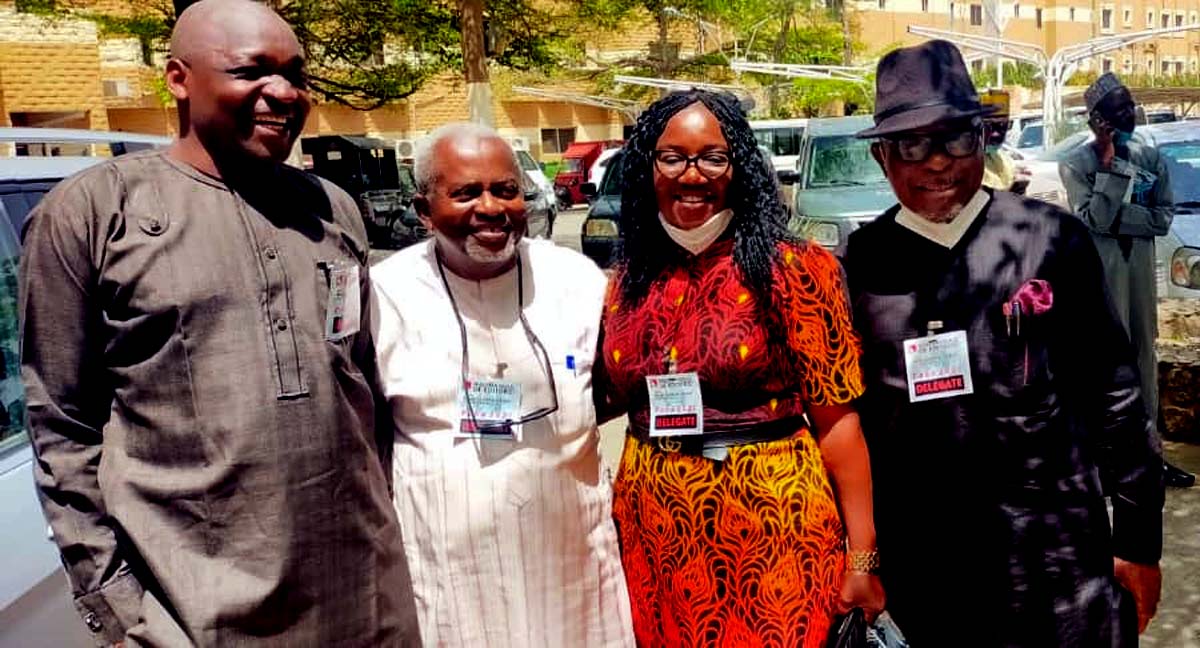
Governor Abdullahi Umar Ganduje of Kano State has declared open 2021 Nigerian Guild of Editors Biennial Convention, themed “The Media in COVID-19 Era: Challenges and Opportunities,” with a charge on editors to be conflict sensitive.
Describing the event as an opportunity to look into national development as it relates to media practice, he urges that, “It is very important at this time that we should use the media for the promotion of peace and stability and change the viewpoints that could alter public views and sentiment toward a more peaceful resolution of our multi-faceted current crises.”
Adding that, “If and only if we as a nation are interested in peace and harmony, we must reject hate propaganda machinery. In the main, this is a time Editors should be conflict-sensitive about our nation.”
He observed that, crossing of redlines by some media organisations in recent times has impacted on the nation’s unity, harmony and integration.
Urging that, “Our brave, collective pursuit in uniting this nation, underscores the fact that for as long as we have a common purpose, we will find no obstacle big enough to stop us from marching on. The media and particularly our gatekeepers have a role to play in this regard.”
While urging media to ensure looking into social responsibility aspect of their practice for national development, he maintains that, the call for freedom of the Press, observance of ethical standard must also be seen to be respected.
Ganduje also said that his government took bold steps in fighting the Covid-19 pandemic to a standstill, adding that the development was informed by the priority placed on the health of the people.
According to him such measures includes prevention, curative and palliative in line with the NCDC guidelines adding that if such measures were not quickly put in place, ,the consequences of Covid-19 on the people of the state would have been detrimental.
He said Kano was one of the states that took the Covid-19 pandemic very seriously and tackled it squarely in a manner which earned it commendation from the National Center for Disease Control NCDC.
Ganduje charged the Media to imbibe the theory of Social Responsibility especially in the reportage of issues concerning health.
The governor decried the misuse of press freedom by Journalists in the area of fake news and advised that they reflect on the true state of the nation.
Ganduje who assured the Guild of the safety of the state asked that as the watchdog of society,it is expected to live above board in the conduct of its election.
He told the Editors about his government ‘s numerous projects, and programmes as well as the appointment of members of the Press into key positions in his administration.
Prof Umar Pate, Vice Chancellor Federal University, Kashere, commended Ganduje’s effort in maintaining good working relationship with the media.
He explained in clearer terms that fake news now affects media credibility and development. He therefore called on media practitioners to stick to ethical standard and also follow suit in using technology, as it is obtained presently.
Present at the event were, former governor of Ogun state, Chief Aremu Olusegun Osoba, Senior Special Assistant to the President of Media and Publicity, Garba Shehu, Prof Umar Pate, former Presidents of the Nigerian Guild of Editors (NGE), former and serving Presidents of the Nigeria Union of Journalists (NUJ), among many other captains of the media industry.
Delivering his address, the President of the Guild, Mustapha Isah brought the challenges of press freedom in the country to the front burner.
Isah wondered if there was indeed press freedom in the country as recent clampdown on media houses recently by the National Broadcasting Commission NBC suggested the contrary.
“ It is rather unfortunate that Nigeria has consistently retrogressed in the Global Press Freedom Index since 2005 To think that this is happening in a democracy makes it more worrisome.
“ Yes, the 1999 Constitutiion gives the media the responsibility to hold the government accountable to the people. That means our duty is to ask pertinent questions about governance on behalf of the people and unearthed what the government is trying to hide.
“ This is what creates the friction between the government and the media.but government’s resort to self- help through arrest of Journalists and clampdown on media houses are not the solution.” he said.
The president spoke on fake news attributing the menace to the advent of the social media.
While he noted that the social media was not completely bad, he said its abuses were important for immediate solution through government and requisite agencies with service providers.
Isah said that practitioners of fake news” are not members of the NGE as members are trained Journalists and responsible gatekeepers”.
On the State of the Nation, the guild president described the prevailing insecurity in the country as frightening saying too many lives have been lost.
He said while it was the responsibility of the government to secure lives, it was incumbent on the guild to liase with security agencies through the provision of credible information on the activities of criminals.
However, a new Executive Committee to pilot the affairs of the Nigeria Guild of Editors (NGE) for the next two years has emerged.
This is the outcome of the Guild’s 2021 Convention held at the Tahir Guest Palace Hotel, Kano, last Monday night.
In a keenly contested election, devoid of acrimony and rancour, in which 241 delegates from various parts of the country voted, the incumbent President, Mustapha Isah was returned.
He scored 176 votes to defeat Victoria Ibanga, who got 54 votes; just as Ali Ali emerged Deputy President unopposed.
Samuel Egbala got 132 votes to beat Sheddy Ozoene, who scored 88 votes for the position of vice president, East.
Bolaji Adebiyi emerged as VP West with 151 votes; beating Ken Ogbechie, who garnered 80 votes.
For the position of VP, North, Habibi Nuhu emerged unopposed, just as Iyobosa Uwugianren was elected unopposed as General Secretary.
Assistant National Secretary’s position was clinched by Austeen Elewodalu, who got 126 votes; to beat Rose Moses, who got 86 votes.
Steve Nwosu won the election as Treasurer with 150 votes. Catherine Agbo scored 51 votes while Juliet Chinda Njiowhor scored 26 votes.
Others are Social/Publicity Secretary, with Eze Anaba winning with164 votes; while Chooks Oko got 53 votes.
For the two positions of Standing Committee Member, East, Ngwuoke Ngwuoke and Boma Nwuke we’re returned unopposed.
Fir Standing Committee Member, West, Onuoha Ukeh got 174 votes; Gabriel Akinadewo scored 174 votes; Woke Shogunle got 172 votes; and duly elected while Abimbola Tooki who got 61 votes, lost the election.
For Standing Committee Member, North, Umoru Ibrahim got 202 votes; and Gbenga Adeshina got 113 votes to emerged victorious while Mark Amarere scored 99 votes.
Earlier, the 2021 Biennial Convention of the Nigerian Guild of Editors (NGE) had kicked off in Kano with about 300 delegates.
Malam Sule Yau-Sule, the Chairman of the Local Organising Committee (LOC), confirmed to the News Agency of Nigeria (NAN) in Kano.
Yau-Sule disclosed that more than 278 had so far registered as against 250 expected by the committee, adding that more participants were being expected before the end of the day.
“People are happy with the peaceful atmosphere of the state, that is why the turn out is every impressive,” he said.
According to him, the challenges they are facing now is over shooting of expectation and they are able to take care of it.
The LOC chairman described the theme of the convention: “The media in COVID -19 Era: Challenges and Opportunities” as very apt and timely, and urged media practitioners and journalists to make use of the presentation to their advantage.
NAN reports that the NGE convention would last from May 31 to June 2, 2021.
It is the first to be hosted in Kano.



Nigeria’s crude oil production has surged to an 11-month high in May, 2026, with the country exceeding its Organisation of the Petroleum Exporting Countries (OPEC) production quota.
The average crude oil production recorded during the month of May represents 102 per cent of Nigeria’s 1.5mbpd of production quota allocated by the OPEC.
The production report released by the Nigerian Upstream Petroleum Regulatory Commission (NUPRC), yesterday, disclosed that Nigeria’s oil production averages 1,530,354 barrels of crude oil and 170,446 barrels of condensates per day (bpd).
According to the report, this brings the total combined production to 1, 700, 800 barrels per day and consolidating Nigeria’s position as Africa’s largest oil producer.
The report said the production performance during the review period remained robust, with combined crude oil and condensate output ranging between a low of 1.51 million bpd and a peak of 1.86 million bpd.
It said the May 2026 production figures represented the highest recorded by Nigeria since July 2025, when output surged to 1,712,282.
“In strict crude oil terms (excluding condensates), the 1.53 million barrels recorded in May 2026 represents the highest Nigeria has witnessed since January 2025 when crude oil production hit 1.538mbpd.
“The latest crude oil production statistics thus represents a 15-month high on a month on month basis, production rose by 2.77 per cent in May 2026 as against 1.48mbpd in April,” it said.
The report said the broader production trend over the last five months had also remained positive.
It said combined crude oil and condensate output increased from 1.48 million bpd in February to 1.54 million bpd in March, 1.66 million bpd in April, and then 1.7 million bpd in May, underscoring sustained growth in Nigeria’s hydrocarbon production levels.
According to the report, among production streams, Bonny Terminal led the pack with a total blend of 293,870 bpd, closely followed by Forcados Terminal at 289,900 bpd, Qua Iboe ranked third with 173,360 bpd, while Escravos Oil Terminal contributed 135,470 bpd.
It said the Odudu (Amenam Blend) completed the top five production streams, accounting for 63,250 bpd during the month under review.
The NUPRC attributes the rise in production to a sustained positive momentum as operations remained stable throughout the reporting period with no significant pipeline or facility outages recorded.
Additionally, all previously scheduled turnaround maintenance activities had been successfully completed, contributing to improved operational reliability and production efficiency.
The House of Representatives, yesterday passed a landmark constitutional amendment bill to establish state police nationwide, marking a significant milestone in Nigeria’s decades-long debate over decentralising policing and strengthening internal security.
The bill, titled “A Bill for an Act to Alter the Constitution of the Federal Republic of Nigeria, 1999 to Provide for the Establishment of State Police and for Related Matters (Sixth Alteration) Bill, 2026,” was approved during consideration at the Committee of the Whole, presided over by Speaker of the House, Rt. Hon. Tajudeen Abbas.
Voting commenced after the Deputy Speaker and Chairman of the House Committee on Constitution Review, Hon. Benjamin Kalu, presented the report on the proposal and canvassed support from lawmakers, stressing the need for a more decentralised policing framework to effectively address the country’s growing security challenges.
The exercise was conducted manually, with members raising their hands to indicate their positions. At the end of the voting, 289 lawmakers voted in support of the bill, one member abstained, while none voted against it, reflecting overwhelming bipartisan backing for the far-reaching reform.
The proposed amendment seeks to fundamentally restructure Nigeria’s policing architecture by creating both Federal and State Police formations.
One of the bill’s key provisions amends Section 214 of the 1999 Constitution to formally establish the Federal Police and the State Police. Under the proposal, the National Assembly would be empowered to prescribe the structure, organisation, administration and powers of the Federal Police, while also providing the legal framework and minimum standards for the establishment and operation of state police services.
The bill stipulates that no state police formation shall commence operations unless it is established by a law enacted by the relevant State House of Assembly and certified as complying with national minimum standards prescribed by an Act of the National Assembly.
It further provides that until a state police force becomes operational, the Federal Police shall continue to exercise policing powers and responsibilities within such states.
In a bid to preserve the autonomy of state police formations and prevent undue federal interference, the bill limits federal intervention in states’ internal security affairs. Under the proposal, the Federal Police may intervene only where there is a complete breakdown of law and order, upon the request of a governor or where a state police force becomes unable to function due to administrative, financial or other operational challenges.
The amendment also proposes significant changes to the police’s appointment and command structure.
Under the amended Section 215 of the Constitution, the Inspector-General of Police would be appointed by the President on the advice of the Nigeria Police Council from among serving members of the Federal Police, subject to confirmation by the National Assembly.
Similarly, a State Commissioner of Police would be appointed by a governor on the advice of the Nigeria Police Council from among serving officers of the State Police, subject to confirmation by the respective State House of Assembly.
The bill empowers governors to issue lawful directives to State Commissioners of Police on matters relating to public safety and the maintenance of law and order. However, where a commissioner considers such directives unlawful or inconsistent with accepted policing standards, the matter may be referred to the Nigeria Police Council, whose decision shall be final.
The proposal also amends Section 84 of the Constitution by replacing references to the “National Police Council and the Federal Police Service Commission” with the “Nigeria Police Council and the Police Service Commission.”
The passage of the bill by the House represents one of the most far-reaching security reforms contemplated since the return to democratic rule in 1999 and is expected to rekindle nationwide debate on issues relating to funding, accountability, operational control and safeguards against abuse.
With the House’s approval, the constitutional amendment bill will now proceed to the Senate for concurrence. Thereafter, it must secure the endorsement of at least two-thirds of the State Houses of Assembly and receive presidential assent before becoming part of the Constitution of the Federal Republic of Nigeria.
If eventually enacted, the legislation would usher in a new era of multi-layered policing in Nigeria and could redefine the country’s approach to tackling banditry, terrorism, kidnapping and other forms of violent crimes through a more localised security architecture.
The Federal Government has declared today, public holiday to commemorate Nigeria’s 27 years of unbroken democratic rule.
This is contained in a statement in Abuja, by the Permanent Secretary, Ministry of Interior, Magdalene Ajani.
Ajani said that the Minister of Interior, Dr Olubunmi Tunji-Ojo, made the declaration on behalf of the federal government.
Tunji-Ojo reaffirmed the federal government’s commitment to the preservation of democratic ideals, rule of law, transparency, accountability and inclusive governance.
He assured that the ministry in collaboration with relevant security agencies woulsd continue to take appropriate measures in maintaining and strengthening Nigeria’s internal security.
The minister noted that a secured and stable environment was essential to democracy and national development.
He urged Nigerians to see the holiday as an opportunity for civic reflection.
“As we mark this historic day, every Nigerian is encouraged to remain law-abiding, uphold the institutions that sustain our democracy, and remember that the strength of any democracy lies ultimately in the character of its citizens,” he said.
He also said that June 12 every year remained a significant day in Nigeria’s history in honour of the courage, resilience and sacrifices of Nigerians whose efforts made democratic governance possible.
“Their legacies continue to inform the values and responsibilities of the Nigerian state,”Tunji-Ojo added.
-
Nation3 days ago
Asarama Kingdom Condemns Gruesome Murder of A Commercial Vehicle Driver
-
Rivers3 days ago
Monarch Raises Alarm Over Defamatory Politics … Urges For Unity In Ogoni
-
News3 days ago
Nigeria, Ethiopia Seal Agreement To Transfer 100 Nigerian Prisoners
-
News3 days ago
Nigeria No Longer Safe For Drug Cartels – Marwa
-
News3 days ago
Xenophobia: 268 Nigerian Returnees Arrive In Lagos From S’Africa
-
 News3 days ago
FG Declares Today Public Holiday To Mark Democracy Day
-
Women3 days ago
Nigerian Women And Dividends Of Democracy
-
Business3 days ago
FG Approves $1 Bn AFCFTA Credit Facility For Nigerian Exporters