
News
Religious Intolerance: My Conscience Is Clear, Buhari Tells US …Islamic Group Warns US, Nigerian Christians

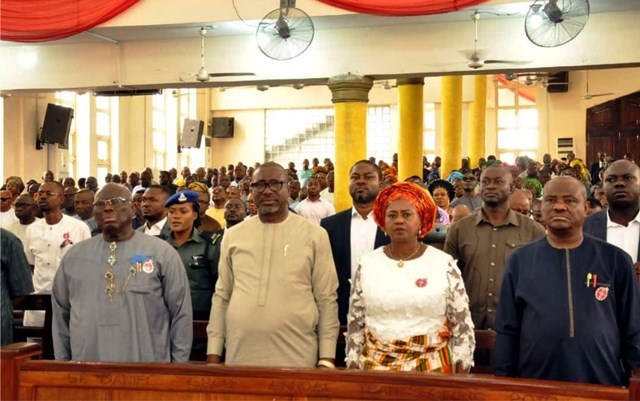
President Muhammadu Buhari, yesterday, in Abuja said he is sitting in his office, working with a clear conscience.
Buhari also said he took some time to explain the situation in Nigeria to US President, Donald Trump, when they met in Washington DC as the American President expressed concern with reports of attacks on segments of the society.
He also urged the US to ensure that its sources of information on Nigeria cut across all sectors.
The President said this is because some people might provide misleading and manipulative narratives for self-serving purposes, ignoring the larger picture of a united country.
President Buhari, who spoke when he received Letters of Credence of United States of America Ambassador to Nigeria, Ms Mary Beth Leonard, said the recent listing of Nigeria for human rights concerns created an impression that some people were being unfairly treated or marginalized in the country.
“I know that those with access have created an impression of being marginalized. I sit here with a clear conscience. I took an oath and I am honouring the office.
“It is not an easy task to work for the unity of the country, and I am doing my best. During your stay in the country I am asking you to ensure that your sources of strategic information cut across,’’ he said.
The President urged the envoy to use the opportunity of her posting to Nigeria, with her experience, knowledge and energy to get the facts on the country.
In her remarks, the United States Ambassador said Nigeria was listed on a watch list to deepen conversation on the humanitarian situation in the country, accepting that some people could “flare the flames and crystalize issues’’ that could affect peaceful-coexistence.
“There are people who make things less attractive than they seem,’’ she said, noting that the report will deepen conversation of the situation in the country, especially with religious leaders and mediators.
“I want to assure that the United States recognizes and celebrates the integration in Nigeria.’’
She said the United States will always side with transparent processes.
The Ambassador said Nigerians and America have a lot in common in terms of “being big among neighbours, enthusiastic and entrepreneurial”.
Leonard assured President Buhari of support from the United States, especially on the humanitarian challenges, while appreciating the willingness to always share useful information and intelligence with her country.
“I feel it’s a privilege and great honour to be here; coming to see the giant of Africa. I have worked for 30 decades before coming to Nigeria. We will do a lot together for peace, security and delivering humanitarian assistance,’’ she added.
President Buhari also received Letters of Credence from the High Commissioner of Sri Lanka to Nigeria, Ahamed Lebbe Sabarullah Khan.
The President appreciated the country for supporting Nigeria to produce the President of the United Nations General Assembly.
In his remarks, the High Commissioner said, “Our countries face similar challenges and we will support each other.’’
He said Sri Lanka will also strengthen bilateral relations with Nigeria on trade and investments.
In another development, the Muslim Rights Concern (MURIC) yesterday reacted to United States’ declaration of religious intolerance in Nigeria.
While condemning the US inclusion of Nigeria on its watch-list, as well as the endorsement of the action of the Christian Association of Nigeria (CAN), MURIC called on them not to use their utterances to cause chaos in Nigeria.
In a statement by Professor Ishaq Akintola, the body faulted US democratic status and described its role in global matters as the height of double standard and also accused CAN of shedding crocodile tears.
The group said it was not bothered by the US latest ranking of Nigeria as religiously biased, noting that the world power has never seen anything good about the country.
“Some foreign powers are always eager to discredit developing nations. It is a game mastered by imperialists. We can see the signs. Instead of breaking up in 2015 as predicted, Nigeria is waxing strong. The war against corruption is on course. Infrastructure is growing at a fast rate. Therefore, a spanner must be thrown at the works to justify forceful intervention and a grip on Nigerian oil”, Akintola noted.
“America should do some introspection. Those who claim to be the champion of democracy in the world cannot, in good conscience, beat their chests and say, ‘We have been fair to all’.
“America complains to Nigeria that Christians are being killed even when it is well known that Muslims are the greatest victims of the killings. America invited former CAN President to address Congress a few years ago. But no Muslim leader has ever been invited to the same platform. Yet America has been using the lies told before Congress to judge our country. Is this fair?
“Muslims of Southern Nigeria have been complaining of persecution for decades but America turned its deaf ears. America pretends nothing is happening to Nigerian Muslims even when the Muslim girl child is locked out of school over an ordinary headscarf which is even allowed in US schools.
“US human rights record outside Nigeria is even nothing to write home about particularly regarding its attitude to issues affecting Muslim nations and Muslims in general. Sanctions are used selectively against Muslim nations in order to weaken them militarily and economically.
“Israel is free to kill and maim Palestinian children while America uses vetoes to frustrate resolutions of the United Nations against Israel. In fact, democracy is a sham if assessed against the backdrop of happenings in the UN where America alone can stop any decision made by the rest of the world. The US invaded Iraq without approval from the UN. So what moral right has America to judge other nations?
“If America is truly the world’s champion of democracy and the chief promoter of human rights, why is that country always silent each time Muslims are at the receiving end? More than 8,000 Muslims were massacred in the Bosnia genocide, particularly in Srebrenica and Zepa in 1995.
“What did America say? What did America do when Muslims were being killed in their hundreds in Myanmar? Even right now hundreds of thousands of Uyghur Muslims are being detained in Western Xinjiang, China, but America cannot be bothered. Since last week, Muslim demonstrators are being killed over anti-Muslim Indian citizenry laws but the White House is only interested in bullying Nigeria.
“Our message to CAN is this, allow America to set fire to your country and we can assure you that it is not the Muslims alone who will face turmoil. Our people say that when a hen perches on a rope, neither the hen nor the rope will enjoy stability.
“Whether to avoid foreign interference in your country and live in peace with your Muslim neighbours while you watch your children and grandchildren play peacefully in the garden or to open the doors wide for an army of occupation which will bring general pandemonium, the choice is yours.
“CAN should remember that religion or no religion, America’s national interest is America’s priority. America has no permanent friends. Neither should anyone blame Americans for loving their own country. The blame goes to those who open the doors of their country for foreign forces to support them in eliminating or, at least, in undermining their perceived rivals or oppressors.
“CAN has only manifested its naivety in modern international politics. The US has thrown religious persecution as bait. Unfortunately, CAN has swallowed it, hook, line and sinker. It is not the first time that America will fly a kite. What was America’s excuse for invading Iraq?
“Was it not weapons of mass destruction (WMD)? Was any WMD found at the end of the day? Did America apologise? Iraq’s infrastructure paid for it. It was completely demolished. But above all, Iraq’s oil paid for it and that was the real target ab initio.
“The same America is now talking of religious bias in order to create tension. If nothing like religious bias is found after Nigerians have killed themselves in their thousands, America will never apologise and we will be suckers for it. CAN is free to bring in America. After all, if the heavens will fall, we are all under it. But history will remember our warning to CAN.”



Nigeria’s crude oil production has surged to an 11-month high in May, 2026, with the country exceeding its Organisation of the Petroleum Exporting Countries (OPEC) production quota.
The average crude oil production recorded during the month of May represents 102 per cent of Nigeria’s 1.5mbpd of production quota allocated by the OPEC.
The production report released by the Nigerian Upstream Petroleum Regulatory Commission (NUPRC), yesterday, disclosed that Nigeria’s oil production averages 1,530,354 barrels of crude oil and 170,446 barrels of condensates per day (bpd).
According to the report, this brings the total combined production to 1, 700, 800 barrels per day and consolidating Nigeria’s position as Africa’s largest oil producer.
The report said the production performance during the review period remained robust, with combined crude oil and condensate output ranging between a low of 1.51 million bpd and a peak of 1.86 million bpd.
It said the May 2026 production figures represented the highest recorded by Nigeria since July 2025, when output surged to 1,712,282.
“In strict crude oil terms (excluding condensates), the 1.53 million barrels recorded in May 2026 represents the highest Nigeria has witnessed since January 2025 when crude oil production hit 1.538mbpd.
“The latest crude oil production statistics thus represents a 15-month high on a month on month basis, production rose by 2.77 per cent in May 2026 as against 1.48mbpd in April,” it said.
The report said the broader production trend over the last five months had also remained positive.
It said combined crude oil and condensate output increased from 1.48 million bpd in February to 1.54 million bpd in March, 1.66 million bpd in April, and then 1.7 million bpd in May, underscoring sustained growth in Nigeria’s hydrocarbon production levels.
According to the report, among production streams, Bonny Terminal led the pack with a total blend of 293,870 bpd, closely followed by Forcados Terminal at 289,900 bpd, Qua Iboe ranked third with 173,360 bpd, while Escravos Oil Terminal contributed 135,470 bpd.
It said the Odudu (Amenam Blend) completed the top five production streams, accounting for 63,250 bpd during the month under review.
The NUPRC attributes the rise in production to a sustained positive momentum as operations remained stable throughout the reporting period with no significant pipeline or facility outages recorded.
Additionally, all previously scheduled turnaround maintenance activities had been successfully completed, contributing to improved operational reliability and production efficiency.
The House of Representatives, yesterday passed a landmark constitutional amendment bill to establish state police nationwide, marking a significant milestone in Nigeria’s decades-long debate over decentralising policing and strengthening internal security.
The bill, titled “A Bill for an Act to Alter the Constitution of the Federal Republic of Nigeria, 1999 to Provide for the Establishment of State Police and for Related Matters (Sixth Alteration) Bill, 2026,” was approved during consideration at the Committee of the Whole, presided over by Speaker of the House, Rt. Hon. Tajudeen Abbas.
Voting commenced after the Deputy Speaker and Chairman of the House Committee on Constitution Review, Hon. Benjamin Kalu, presented the report on the proposal and canvassed support from lawmakers, stressing the need for a more decentralised policing framework to effectively address the country’s growing security challenges.
The exercise was conducted manually, with members raising their hands to indicate their positions. At the end of the voting, 289 lawmakers voted in support of the bill, one member abstained, while none voted against it, reflecting overwhelming bipartisan backing for the far-reaching reform.
The proposed amendment seeks to fundamentally restructure Nigeria’s policing architecture by creating both Federal and State Police formations.
One of the bill’s key provisions amends Section 214 of the 1999 Constitution to formally establish the Federal Police and the State Police. Under the proposal, the National Assembly would be empowered to prescribe the structure, organisation, administration and powers of the Federal Police, while also providing the legal framework and minimum standards for the establishment and operation of state police services.
The bill stipulates that no state police formation shall commence operations unless it is established by a law enacted by the relevant State House of Assembly and certified as complying with national minimum standards prescribed by an Act of the National Assembly.
It further provides that until a state police force becomes operational, the Federal Police shall continue to exercise policing powers and responsibilities within such states.
In a bid to preserve the autonomy of state police formations and prevent undue federal interference, the bill limits federal intervention in states’ internal security affairs. Under the proposal, the Federal Police may intervene only where there is a complete breakdown of law and order, upon the request of a governor or where a state police force becomes unable to function due to administrative, financial or other operational challenges.
The amendment also proposes significant changes to the police’s appointment and command structure.
Under the amended Section 215 of the Constitution, the Inspector-General of Police would be appointed by the President on the advice of the Nigeria Police Council from among serving members of the Federal Police, subject to confirmation by the National Assembly.
Similarly, a State Commissioner of Police would be appointed by a governor on the advice of the Nigeria Police Council from among serving officers of the State Police, subject to confirmation by the respective State House of Assembly.
The bill empowers governors to issue lawful directives to State Commissioners of Police on matters relating to public safety and the maintenance of law and order. However, where a commissioner considers such directives unlawful or inconsistent with accepted policing standards, the matter may be referred to the Nigeria Police Council, whose decision shall be final.
The proposal also amends Section 84 of the Constitution by replacing references to the “National Police Council and the Federal Police Service Commission” with the “Nigeria Police Council and the Police Service Commission.”
The passage of the bill by the House represents one of the most far-reaching security reforms contemplated since the return to democratic rule in 1999 and is expected to rekindle nationwide debate on issues relating to funding, accountability, operational control and safeguards against abuse.
With the House’s approval, the constitutional amendment bill will now proceed to the Senate for concurrence. Thereafter, it must secure the endorsement of at least two-thirds of the State Houses of Assembly and receive presidential assent before becoming part of the Constitution of the Federal Republic of Nigeria.
If eventually enacted, the legislation would usher in a new era of multi-layered policing in Nigeria and could redefine the country’s approach to tackling banditry, terrorism, kidnapping and other forms of violent crimes through a more localised security architecture.
The Federal Government has declared today, public holiday to commemorate Nigeria’s 27 years of unbroken democratic rule.
This is contained in a statement in Abuja, by the Permanent Secretary, Ministry of Interior, Magdalene Ajani.
Ajani said that the Minister of Interior, Dr Olubunmi Tunji-Ojo, made the declaration on behalf of the federal government.
Tunji-Ojo reaffirmed the federal government’s commitment to the preservation of democratic ideals, rule of law, transparency, accountability and inclusive governance.
He assured that the ministry in collaboration with relevant security agencies woulsd continue to take appropriate measures in maintaining and strengthening Nigeria’s internal security.
The minister noted that a secured and stable environment was essential to democracy and national development.
He urged Nigerians to see the holiday as an opportunity for civic reflection.
“As we mark this historic day, every Nigerian is encouraged to remain law-abiding, uphold the institutions that sustain our democracy, and remember that the strength of any democracy lies ultimately in the character of its citizens,” he said.
He also said that June 12 every year remained a significant day in Nigeria’s history in honour of the courage, resilience and sacrifices of Nigerians whose efforts made democratic governance possible.
“Their legacies continue to inform the values and responsibilities of the Nigerian state,”Tunji-Ojo added.
-
Nation4 days ago
Asarama Kingdom Condemns Gruesome Murder of A Commercial Vehicle Driver
-
Rivers4 days ago
Monarch Raises Alarm Over Defamatory Politics … Urges For Unity In Ogoni
-
News4 days ago
Nigeria, Ethiopia Seal Agreement To Transfer 100 Nigerian Prisoners
-
News4 days ago
Nigeria No Longer Safe For Drug Cartels – Marwa
-
News4 days ago
Xenophobia: 268 Nigerian Returnees Arrive In Lagos From S’Africa
-
 News4 days ago
FG Declares Today Public Holiday To Mark Democracy Day
-
Women4 days ago
Nigerian Women And Dividends Of Democracy
-
Business4 days ago
FG Approves $1 Bn AFCFTA Credit Facility For Nigerian Exporters