
News
FG’s Deceit Worries MOSOP – Gives Buhari Six Weeks To Begin Clean-Up

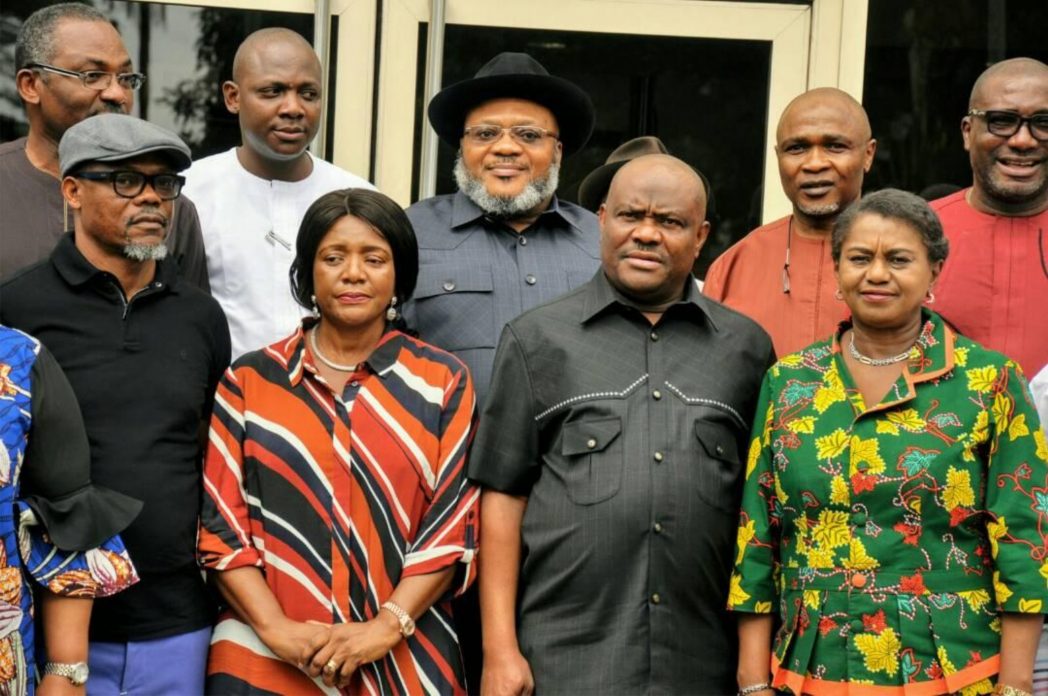
Front row: Rivers State Governor, Chief Nyesom Wike (2nd right), with his Deputy, Dr (Mrs) Ipalibo Harry Banigo (right), member representing Abua/Odual/Ahoada East Federal Constituency, Mrs Betty Apiafi (2nd left), member representing Eleme/Tai/Oyigbo Federal Constituency, Mr Barry Mpigi (left) and other dignitaries, after the solidarity visit of Rivers Caucus of the House of Representatives at the Government House, Port Harcourt, last Friday.
As the people of Ogoni reflect on the killing of the Ogoni Nine, 22 years after, the Movement for the Survival of Ogoni People (MOSOP) has issued a fresh ultimatum of six weeks to the Federal Government within which to practically commence the clean-up of Ogoniland in line with the United Nations Environment Programme (UNEP) report.
It would be recalled that key component of the UNEP report recommendations submitted the President Goodluck Jonathan-led Federal Government in August, 2011, was the scientific clean-up, remediation and restoration of hydrocarbons polluted Ogoni environment, including provision of emergency measures to restore normal livelihoods in the area.
Giving the ultimatum during an interactive session to kick-start a two-day event to mark the 22nd anniversary of the killing of the nine Ogoni heroes at the Peace and Freedom Centre, Bori, headquarters of Ogoni people, last Thursday, MOSOP’s Public Relations Officer, Fegalo Nsuke insisted that the clean-up must commence before the end of December, 2017, otherwise, MOSOP would mobilise all Ogonis to protest against the Federal Government and the polluter, Shell Petroleum Development Company of Nigeria.
Nsuke hinted that MOSOP was working out modalities to actualise its decision to protest against the international oil company offices in Port Harcourt, Lagos and Abuja, saying that MOSOP was in agreement with the two-week ultimatum given Shell by the National Youth Council of Ogoni People (NYCOP) threatening to occupy Shell offices in Nigeria to force the oil giant to vacate the area.
At a separate event to mark the 22nd anniversary of the Ogoni Martyrs’ Day in Bori, the vociferous MOSOP affiliate, NYCOP had given SPDC a 14-day ultimatum to vacate Ogoniland or face retooled persistent protests reminiscence of the non-violent resistance of MOSOP in the late 1980s and 1990s.
Speaking in an exclusive interview with The Tide on the sidelines of the Ogoni Day celebrations in Bori, Acting President of NYCOP, Comrade Norteh Morgan said that the only language the Federal Government and its ally, SPDC understand was civil disobedience, peaceful resistance and protests that threaten productive operations of the company, and expose staff and facilities to risks, and assured the readiness of Ogoni people to send the message direct to the highest leadership of Shell.
“Today, the Ogoni youth are here to review events of the past years and to ask the Federal Government, SPDC and Nigerian National Petroleum Corporation’s subsidiary – Nigerian Petroleum Development Company – some vital questions. But expectedly, they are not here, so, we have chosen to start working with 3Cs that represents – Consultation, Conciliation and Confrontation.
“When consultation fails, conciliation comes in, and when conciliation fails, confrontation follows. We are being taken for granted by the multinational oil companies, especially SPDC, since they know that the Ogoni people are non-violent,” he stressed.
Morgan stated that the 14-day ultimatum given SPDC to vacate the area was as a result of wrong approaches used by the company in addressing issues affecting the generality of Ogoni people.
“What we expect SPDC to do is to organize a roundtable discussion with all strata of the leadership of Ogoni people, where all parties would agree on the various steps going forward, so that everybody would be carried along,” Morgan said.
He lamented the 60 years of neglect and 22 years of struggle against marginalization and exclusion of Ogoni people by SPDC, saying “The people feel cheated by SPDC over the last 60 years in Ogoniland. All the people have received from SPDC is gas pollution, oil spillage and environmental degradation. In spite of the fact that we had declared Shell persona-non-granta in Ogoniland more than 25 years ago, they have returned through the back door, and are now laying pipes in Tai and Eleme.”
He stressed that the people can no longer tolerate the divide and rule, and selective consultations used by SPDC in Ogoniland, and warned the company to steer clear of the area for good.
Also speaking, a guest lecturer at the Department of History and Diplomatic Studies, University of Port Harcourt, Prof Ben Naanen stated that the UNEP report was not the answer to all the problems of Ogoni people, but described it as a critical step towards addressing some critical aspects of the challenges facing Ogonis.
Naanen, who was spoke on the topic: ‘The Ogoni Struggles: Ruminations and Future Unfold,’ noted that Ogoniland was the first that oil was discovered in 1958, but regretted that the people’s voice could not be heard by the Federal Government because they were of the minority.
He described the government’s treatment of Ogoni demands as ‘total injustice’ in view of the massive despoliation of Ogoniland, saying that the agitations for justice and equity initiated by Ogoni leaders as enunciated in the Ogoni Bill of Rights in the 1980s and form the fulcrum of the resistance against SPDC, have completely enveloped the entire Niger Delta, reawakening their consciousness towards resource control, fiscal federalism and self-determination.
He, therefore, urged the Federal Government to urgently restructure the country along those lines to guarantee peace, stability and unity of the Nigerian state.
In an exclusive interview with The Tide, Khana Caretaker Committee Chairman, Chief Gbene Lekue Zini stated that the significance of November 10 in the life of Ogoni people resides in the fact that it points the way inclusiveness and participation of Niger Deltans in the socio-political and economic calculations of the Nigerian state.
Zini used the opportunity to intimate Ogoni youth on the need to remain united and speak with one voice to attract development and growth to the area.
“As an Ogoni person, emulate what our fathers died for and appreciate that they did not for their selfish interests but for the overall good of all Ogonis,” Zini added.
“Conflicts, crises, cultism are not what the Ogoni people are known for; we are known for straightforwardness and that is why our Ogoni nine died, because they wanted equal treatment, fairness and justice to Ogoniland,” he lamented.
He urged Federal Government, Shell, Hydrocarbons Pollution Remediation and Restoration Project (HYPREP) and all parties in the Ogoni clean-up to urgently do the needful, adding that the people were tired of failed promises.
It would be recalled that on November 10, 1995, environmental rights activist, Kenule Beeson Saro-Wiwa and other eight Ogoni leaders were executed by the Gen Sani Abacha-led military junta following their role in the Ogoni demands for equity, justice in the sharing of oil revenue and inclusion in the political space.
By: Susan Serekara-Nwikhana.



Nigeria’s crude oil production has surged to an 11-month high in May, 2026, with the country exceeding its Organisation of the Petroleum Exporting Countries (OPEC) production quota.
The average crude oil production recorded during the month of May represents 102 per cent of Nigeria’s 1.5mbpd of production quota allocated by the OPEC.
The production report released by the Nigerian Upstream Petroleum Regulatory Commission (NUPRC), yesterday, disclosed that Nigeria’s oil production averages 1,530,354 barrels of crude oil and 170,446 barrels of condensates per day (bpd).
According to the report, this brings the total combined production to 1, 700, 800 barrels per day and consolidating Nigeria’s position as Africa’s largest oil producer.
The report said the production performance during the review period remained robust, with combined crude oil and condensate output ranging between a low of 1.51 million bpd and a peak of 1.86 million bpd.
It said the May 2026 production figures represented the highest recorded by Nigeria since July 2025, when output surged to 1,712,282.
“In strict crude oil terms (excluding condensates), the 1.53 million barrels recorded in May 2026 represents the highest Nigeria has witnessed since January 2025 when crude oil production hit 1.538mbpd.
“The latest crude oil production statistics thus represents a 15-month high on a month on month basis, production rose by 2.77 per cent in May 2026 as against 1.48mbpd in April,” it said.
The report said the broader production trend over the last five months had also remained positive.
It said combined crude oil and condensate output increased from 1.48 million bpd in February to 1.54 million bpd in March, 1.66 million bpd in April, and then 1.7 million bpd in May, underscoring sustained growth in Nigeria’s hydrocarbon production levels.
According to the report, among production streams, Bonny Terminal led the pack with a total blend of 293,870 bpd, closely followed by Forcados Terminal at 289,900 bpd, Qua Iboe ranked third with 173,360 bpd, while Escravos Oil Terminal contributed 135,470 bpd.
It said the Odudu (Amenam Blend) completed the top five production streams, accounting for 63,250 bpd during the month under review.
The NUPRC attributes the rise in production to a sustained positive momentum as operations remained stable throughout the reporting period with no significant pipeline or facility outages recorded.
Additionally, all previously scheduled turnaround maintenance activities had been successfully completed, contributing to improved operational reliability and production efficiency.
The House of Representatives, yesterday passed a landmark constitutional amendment bill to establish state police nationwide, marking a significant milestone in Nigeria’s decades-long debate over decentralising policing and strengthening internal security.
The bill, titled “A Bill for an Act to Alter the Constitution of the Federal Republic of Nigeria, 1999 to Provide for the Establishment of State Police and for Related Matters (Sixth Alteration) Bill, 2026,” was approved during consideration at the Committee of the Whole, presided over by Speaker of the House, Rt. Hon. Tajudeen Abbas.
Voting commenced after the Deputy Speaker and Chairman of the House Committee on Constitution Review, Hon. Benjamin Kalu, presented the report on the proposal and canvassed support from lawmakers, stressing the need for a more decentralised policing framework to effectively address the country’s growing security challenges.
The exercise was conducted manually, with members raising their hands to indicate their positions. At the end of the voting, 289 lawmakers voted in support of the bill, one member abstained, while none voted against it, reflecting overwhelming bipartisan backing for the far-reaching reform.
The proposed amendment seeks to fundamentally restructure Nigeria’s policing architecture by creating both Federal and State Police formations.
One of the bill’s key provisions amends Section 214 of the 1999 Constitution to formally establish the Federal Police and the State Police. Under the proposal, the National Assembly would be empowered to prescribe the structure, organisation, administration and powers of the Federal Police, while also providing the legal framework and minimum standards for the establishment and operation of state police services.
The bill stipulates that no state police formation shall commence operations unless it is established by a law enacted by the relevant State House of Assembly and certified as complying with national minimum standards prescribed by an Act of the National Assembly.
It further provides that until a state police force becomes operational, the Federal Police shall continue to exercise policing powers and responsibilities within such states.
In a bid to preserve the autonomy of state police formations and prevent undue federal interference, the bill limits federal intervention in states’ internal security affairs. Under the proposal, the Federal Police may intervene only where there is a complete breakdown of law and order, upon the request of a governor or where a state police force becomes unable to function due to administrative, financial or other operational challenges.
The amendment also proposes significant changes to the police’s appointment and command structure.
Under the amended Section 215 of the Constitution, the Inspector-General of Police would be appointed by the President on the advice of the Nigeria Police Council from among serving members of the Federal Police, subject to confirmation by the National Assembly.
Similarly, a State Commissioner of Police would be appointed by a governor on the advice of the Nigeria Police Council from among serving officers of the State Police, subject to confirmation by the respective State House of Assembly.
The bill empowers governors to issue lawful directives to State Commissioners of Police on matters relating to public safety and the maintenance of law and order. However, where a commissioner considers such directives unlawful or inconsistent with accepted policing standards, the matter may be referred to the Nigeria Police Council, whose decision shall be final.
The proposal also amends Section 84 of the Constitution by replacing references to the “National Police Council and the Federal Police Service Commission” with the “Nigeria Police Council and the Police Service Commission.”
The passage of the bill by the House represents one of the most far-reaching security reforms contemplated since the return to democratic rule in 1999 and is expected to rekindle nationwide debate on issues relating to funding, accountability, operational control and safeguards against abuse.
With the House’s approval, the constitutional amendment bill will now proceed to the Senate for concurrence. Thereafter, it must secure the endorsement of at least two-thirds of the State Houses of Assembly and receive presidential assent before becoming part of the Constitution of the Federal Republic of Nigeria.
If eventually enacted, the legislation would usher in a new era of multi-layered policing in Nigeria and could redefine the country’s approach to tackling banditry, terrorism, kidnapping and other forms of violent crimes through a more localised security architecture.

The Federal Government has declared today, public holiday to commemorate Nigeria’s 27 years of unbroken democratic rule.
This is contained in a statement in Abuja, by the Permanent Secretary, Ministry of Interior, Magdalene Ajani.
Ajani said that the Minister of Interior, Dr Olubunmi Tunji-Ojo, made the declaration on behalf of the federal government.
Tunji-Ojo reaffirmed the federal government’s commitment to the preservation of democratic ideals, rule of law, transparency, accountability and inclusive governance.
He assured that the ministry in collaboration with relevant security agencies woulsd continue to take appropriate measures in maintaining and strengthening Nigeria’s internal security.
The minister noted that a secured and stable environment was essential to democracy and national development.
He urged Nigerians to see the holiday as an opportunity for civic reflection.
“As we mark this historic day, every Nigerian is encouraged to remain law-abiding, uphold the institutions that sustain our democracy, and remember that the strength of any democracy lies ultimately in the character of its citizens,” he said.
He also said that June 12 every year remained a significant day in Nigeria’s history in honour of the courage, resilience and sacrifices of Nigerians whose efforts made democratic governance possible.
“Their legacies continue to inform the values and responsibilities of the Nigerian state,”Tunji-Ojo added.
-
Nation24 hours ago
Asarama Kingdom Condemns Gruesome Murder of A Commercial Vehicle Driver
-
Politics5 days ago
I DIDN’T PROMISE YOU TICKETS, AKPABIO TELLS APC SENATORS WHO FAILED PRIMARIES
-

 Rivers5 days ago
Police arrest 3 suspects over killing of driver in Rivers
-
Rivers24 hours ago
Monarch Raises Alarm Over Defamatory Politics … Urges For Unity In Ogoni
-
News23 hours ago
Nigeria, Ethiopia Seal Agreement To Transfer 100 Nigerian Prisoners
-
News23 hours ago
Nigeria No Longer Safe For Drug Cartels – Marwa
-
News23 hours ago
Xenophobia: 268 Nigerian Returnees Arrive In Lagos From S’Africa
-

 News22 hours ago
FG Declares Today Public Holiday To Mark Democracy Day