
Politics
2015 And Electoral Violence In Nigeria

There is no agreeable
‘definition of electoral violence. This is because of the contentious issue of “violence begets violence” developed by Frantz Fanon in the era of anti-colonial struggles. The Fanonian argument is predicated on the fact that ‘violence provokes violence’. So those who retaliate to the first violence of political opponent do not agree that they are perpetrating violence. They sirnply argue that they are countering violence.
From the array of definitions available, one can glean an operational definition. Operationally, electoral violence connotes all forms of violence (physical, psychological, administrative, legal and structural) at different stages engaged in by particiipants, their supporters and sympathizers (including security and election management body staff) in the electoral process. These forms of violence take place before elections, during elections and after or post-election, and could also be intra- or inter-party.
Since Nigeria became independent on October 1st 1960, the history of election has been written in violence. The Human Rights Watch (2007) in its follow up of post-independence events in Nigeria describes the nation’s post-independence history as being overshadowed by the depredations of a series of corrupt, abusive, and unaccountable governments. This description is apt because it appears that Nigerians seem to have acquired a culture of electoral violence as seven of the eight general elections conducted since independence in 1960 have been violence-ridden -1964/1965,1979,1983,1999,2003, 2007 and 2011.
For example, at independence, the country adopted a parliamentary system of government akin to the British type. The first post-independence election organized by that government led by Prime Minister Tafawa Balewa\President Nnamdi Azikiwe in 1964 and 1965 were characterized by widespread complaints of fraud, violence and intimidation. Protests in the wake of the regional elections, which in some areas degenerated into a violent exercise in competitive rigging, led to widespread violence and inter-communal rioting that claimed more than 200 lives.
Later in January 1966, the military struck and the fledging Nigerian democracy was thwarted by the action of its very own practitioners. From 1966, the military held sway until 1979 when they handed over to another civilian government headed by Alhaji Shehu Shagari of the National Party of Nigeria (NPN). The Shagari-Ied government organized a civilian to civilian transition election but again like its First Republic counterparts, repeated history and massively rigged the 1983 general elections through very violent means in connivance with the election management body, Federal Election Commission (FEDECO) and security forces. That again set the stage for the second wave of military intervention in the nation’s politics on December 31, 1983. The military from then remained in power until May 29, 1999 after, several attempts to democratize.
Suffice it to say that between independence in 1960 and 1999 when civilian rule was restored, Nigeria produced only two elected governments and both were overthrown in military coup de’tats before completing a second term in office. In all, Nigeria’s military ruled the country for nearly 30 of its first 40 years of independence, excluding the three months of short-lived Interim National Government (ING)
Since the restoration of civil rule, attempts have not been made by politicians to deepen and strengthen democracy. Instead, Nigeria has only added to its history fraudulent and violent elections. The 1999, 2003 and 2007 general elections that brought President Olusegun Obasanjo and later late President Umaru Yar’ Adua to power were marred by such widespread violence and fraud.
For example, the US-based Jimmy Carter Centre for Democracy which monitored the 1999 election as an international observer concluded its report on the outcome of the presidential election like the others before it thus: “It is not possible for us to make an accurate judgment about the outcome of the presidential election”. In the same vein, the 2003 elections were more pervasively and openly rigged than the flawed 1999 polls, and far more bloody.
These events set the stage for the 2007 elections which both domestic and foreign observers succinctly described as the worst in Nigeria’s history ranking among the worst conducted anywhere in the world in recent times. For instance, the US-based National Democratic Institute (NDI) stated in its post-election statement that the electoral process “failed the Nigerian people”.
The Human Rights Watch (2007) which monitored the election in its report said the Nigeria’s failed April 2007 polls cast a harsh and very public light on patterns of violence, corruption and outright criminality that have come to characterize Nigeria’s political system-and on the extent to which officials and institutions at all levels of government accept, encourage and participate in those abuses. The 2007 and 2011 general elections had come and gone with some cases still in courts, Nigerians .are afraid of future elections especially the 2015 elections that is a stone throw away.
There are plethora of reasons that account for the causes of electoral violence.
These include rigging, ineffectiveness of security forces and culture of impunity, partisan disposition of the security forces detailed to monitor elections, weak penalties against defaulters and poor handling of election petitions, among others.
It is true that electoral violence has characterized our political elections since independence. This trend can be reversed only if we can change our mindsets on what politics and governance is all about. Politics should not be conceived as the most lucrative industry in Nigeria. It is this mindset that makes aspirant or political office seekers to exhaust “all means” in capturing the position. It should be seen as a service to humanity and protecting the lives and the welfare of our prosperity.
Governance should be transparent at all levels. Electoral rules should be enforced. Political positions should be made unattractive by downward review of their take-home salary/allowances. Within our constituencies, we should be our brothers’ keeper. Electoral officials should devoid themselves of corrupt practices, while law enforcement agents should remain neutral. Politicians found parading thugs should be disqualified from the race. Violence free election is achievable in 2015
Being an excerpt of a public lecture delivered at the sensitisation/awareness campaign by the Rundele Peoples Assembly in Port Harcourt, recently.
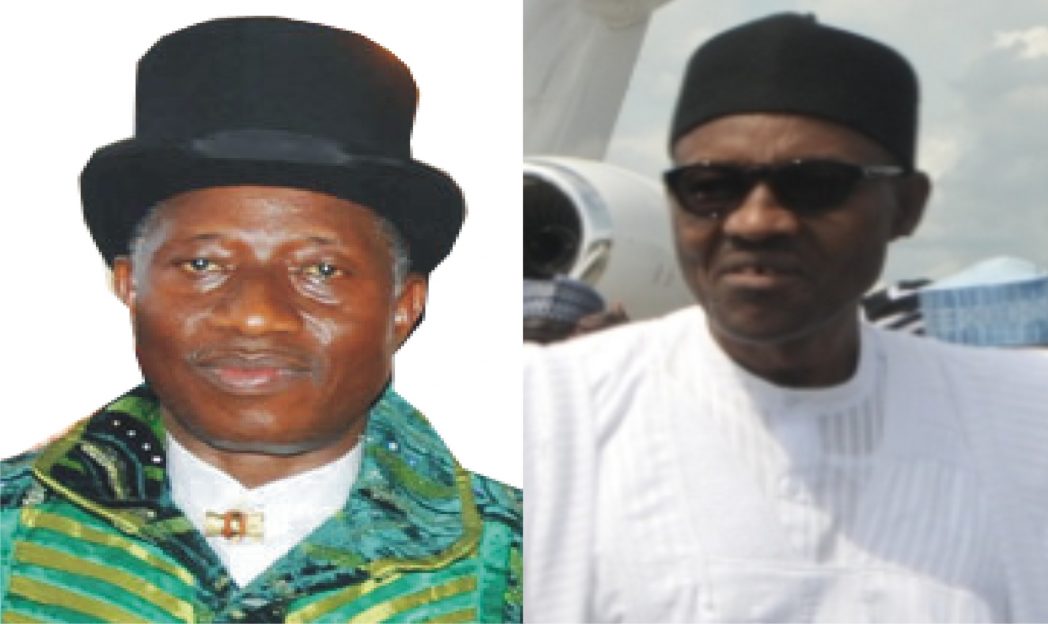
President Goodluck Jonathan and Buhari
Ben Thom-Otuya



Senate has again approved a three-month extension implementation period for capital component of the 2025 Appropriation Act from June 30 to Sept 30.
This followed the adoption of a motion moved by Senate Chief Whip, Mohammed Monguno (APC- Borno) at plenary yesterday.
Monguno, moving the motion, said the extension became necessary given the unutilsed substantial funds released to Ministries, Departments and Agencies (MDAs) for implementation of projects under the 2025 budget.
According to him, delays caused by procurement processes, project implementation challenges and administrative procedures had slowed the execution of several critical government projects.
Monguno said many strategic projects across key sectors of the economy were already at advanced stages of completion and required additional time for execution, certification and payment.
“Failure to extend the implementation period of the 2025 Appropriation Act may result in the abandonment of critical projects, the wastage of already committed public resources and the disruption of ongoing government interventions,” he said.
He argued that some allocations contained in the budget might not be accommodated in subsequent appropriation cycles if the implementation window expired.
This, he said would create funding gaps and ultimately undermine development objectives.
He said that extending the validity period of the budget would improve budget performance, facilitate the efficient utilisation of released funds and support economic growth.
“Granting a further extension of the implementation period is in the national interest and will ensure value for money in public expenditure,” he said.
Chairman, Senate Committee on Appropriations, Sen. Solomon Adeola (APC-Ogun), supporting the motion, explained that the extension was specifically targeted at the capital component of the budget.
According to him, when President Bola Tinubu presented the 2025 budget to the National Assembly, there is an understanding that 30 per cent of the budget implementation will be completed by March 31, while the remaining 70 per cent will be rolled into the 2026 budget.
Adeola said that the implementation timeline was not fully achieved, prompting the National Assembly to earlier extend the budget’s lifespan to June 30.
“While we were passing the 2026 budget, due to the non-implementation of that promise, we were forced to extend the budget to June 30,” he said.
He said although payments had commenced, significant obligations remained outstanding.
“There is a need to extend this budget beyond June 30 to September 30, by then, we are hopeful that the outstanding 30 per cent will have been paid in full, while implementation of the components transferred to the 2026 budget can commence.”
Adeola urged senators to support the extension to ensure proper implementation of projects and prevent disruptions to government programmes.
Sen.Victor Umeh (NDC-Anambra), who seconded the motion cited the need to sustain the execution of projects captured under the 2025 Appropriation Act.
“In view of the need to sustain the continued execution of the projects covered in the 2025 Appropriation Act, as amended, I hereby second the motion,” Umeh said.
Following deliberations, Senate President Akpabio put the proposal to a voice vote and it was overwhelmingly adopted by the lawmakers..
Akpabio in his remarks said the decision was necessary to prevent interruptions in payments and project execution.
“The payment would have stopped halfway if this was not done,” he said.
The Senate President commended the Chairman of the Appropriations Committee and other lawmakers involved in handling the matter.
He directed that the Senate’s resolution be transmitted to the executive for implementation.
“Accordingly, the resolution of the Senate is being communicated to the Executive that the 2025 Appropriation Act has been extended to Sept 30.
The National Assembly had earlier extended the implementation period of the 2025 budget to June 30, following delays in the release and utilisation of capital funds.
Senate, thereafter, adjourned plenary to July 7.

The member representing Sagbama/Ekeremor Federal Constituency of Bayelsa State, Frederick Agbedi, yesterday emerged as the new Minority Leader of the House of Representatives.
Agbedi’s emergence follows the resignation of former Minority Leader, Kingsley Chinda of Rivers State, who recently defected from the Peoples Democratic Party to the ruling All Progressives Congress, creating a vacuum in the leadership structure of the opposition caucus in the Green Chamber.
His nomination was contained in a letter transmitted to the Speaker of the House, Tajudeen Abbas, by the minority caucus during plenary, yesterday.
In the letter, the caucus announced that its members had reached a consensus on the replacement of vacant principal offices allocated to opposition parties in the House.
Abbas, while reading the letter said, “The election of the House of Representatives, Federal Republic of Nigeria, the minority members of the 10th Assembly hereby unanimously nominate the following members by consensus to fill the vacant positions of the minority in the parliament.
“Number one is the Minority Leader, Hon Frederick Agbedi.
“Number two is the position of minority whip, and the person they have endorsed is Hon Mansur Soro (APM, Bauchi).
“The last but not the least is my brother from the North-West, Hon Abdussamad Dasuki (ADC, Sokoko) for the position of Deputy Minority Leader.
“Honourable colleagues, today the body of principal officers is complete, and I want to seize this opportunity on behalf of the whole entire House to congratulate the three people and to wish them all the best in their new positions.”
With the development, Agbedi assumes the responsibility of coordinating opposition lawmakers in the House and articulating the position of minority parties on legislative matters before the chamber.
A ranking lawmaker and one of the longest-serving members of the House, Agbedi has represented Sagbama/Ekeremor Federal Constituency since 2011.
His appointment is expected to strengthen the voice of the opposition caucus at a time when defections and realignments continue to reshape the political landscape ahead of the 2027 general elections.
Also announced was the emergence of Hon Mansur Soro of the Allied Peoples Movement as Minority Whip and Hon Abdussamad Dasuki of the African Democratic Congress as Deputy Minority Leader, completing the minority leadership structure in the 10th House.
Speaking after the announcement, Abbas congratulated the newly appointed principal officers and pledged the cooperation of the House leadership.
“The leadership of the House will work with them assiduously in ensuring that we achieve our legislative agenda objectives of this very important 10th Assembly,” he added.
The emergence of the new minority leadership comes amid recent changes to the House Rules governing the selection of principal officers. The amendments, which introduced fresh eligibility requirements, have generated debate within opposition ranks and influenced the contest for key leadership positions.
Shortly after the announcement, a lawmaker from Imo State who had been nominated for the position of Minority Leader last week, Ikenga Ugochinyere, formally withdrew from the race.
He cited the amended House Rules and the new eligibility criteria for principal officers as the basis for his decision.
The latest appointments are expected to restore stability within the opposition bloc following weeks of uncertainty triggered by Chinda’s defection and the subsequent scramble for leadership positions.
Political observers believe the new leadership team will face the immediate challenge of forging unity among lawmakers drawn from different opposition parties while providing effective legislative scrutiny of the executive and the ruling APC-dominated parliament.
For the PDP, which remains the largest opposition party in the House despite recent defections, Agbedi’s emergence is seen as a strategic move aimed at maintaining cohesion within the minority caucus and strengthening its influence in parliamentary proceedings.
In a letter titled, “An Open Letter to Former President Goodluck Jonathan,” the observer said Dr Jonathan should be careful not to allow himself to be drawn into partisan calculations driven by ambition rather than national interest.
He cautioned the former president against allowing himself to be used by what he described as desperate political interests.
“I believe this is the time to protect the good name and legacy you have built over the years. You should not allow yourself to be used by desperate political elements who may be more interested in their own ambitions than in the future of Nigeria,” the letter read.
The Social Commentator further warned Dr Jonathan to be wary of those advocating for his comeback, claiming many of them were previously opposed to his administration.
“Many of those calling for your return today were your antagonists, those who frustrated your government back then. You should be careful not to become a pawn in a game designed by others or else they will stain your white with their ‘roforofo’,” he said.
He maintained that Dr Jonathan’s legacy remains defined by his decision to concede defeat in 2015, which he described as a landmark moment in Nigeria’s democratic history.
“Your legacy was built through years of public service and your decision to put the country’s peace above personal ambition at a critical moment in Nigeria’s history. That legacy should not be put at risk because of the desperation of a few politicians,” he added.
Mr Adenuga also alleged that some of the promoters of Dr Jonathan’s return have lost credibility in the public space.
“The truth is that some of the people pushing you to contest have already damaged their own reputations. They should not be allowed to stain your legacy with their soiled hands. What they could not achieve on their own should not be pursued through your name and goodwill,” he stressed.
He concluded by urging the former president to remain above political manoeuvring and protect his place in history.
“History has been kind to you. Preserve that honour and remain above the political games of those who want to use your name for their own purposes,” he wrote.
Recall that former President Goodluck Jonathan recently emerged as the presidential candidate of the Kabiru Turaki-led Interim National Working Committee of the Peoples Democratic Party (PDP) following a special convention held in Abuja, where delegates ratified his nomination ahead of the 2027 general elections.
-
Nation4 days ago
Asarama Kingdom Condemns Gruesome Murder of A Commercial Vehicle Driver
-
Rivers4 days ago
Monarch Raises Alarm Over Defamatory Politics … Urges For Unity In Ogoni
-
News4 days ago
Nigeria, Ethiopia Seal Agreement To Transfer 100 Nigerian Prisoners
-
News4 days ago
Nigeria No Longer Safe For Drug Cartels – Marwa
-
News4 days ago
Xenophobia: 268 Nigerian Returnees Arrive In Lagos From S’Africa
-

 News4 days ago
FG Declares Today Public Holiday To Mark Democracy Day
-
Women4 days ago
Nigerian Women And Dividends Of Democracy
-
Business4 days ago
FG Approves $1 Bn AFCFTA Credit Facility For Nigerian Exporters