
News
FG Apologises Over Poor Power Supply

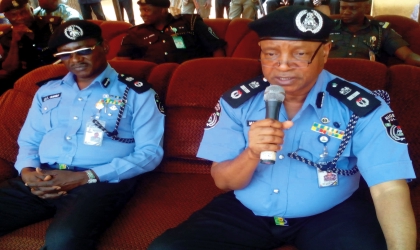
Assistant Inspector-General of Police Zone 10, Alhaji Mamman Sule (right), addressing officers and men of the Sokoto State Police Command last Thursday. With him is Sokoto State Commissioner of Police, Shuaibu Gambo.
The Minister of Power, Prof. Chinedu Nebo, said yesterday in Abuja that the worsening power situation in the country was as a result of gas pipeline vandalism.
Nebo, who said this at a media briefing on the current challenges of power supply in the country, also apologised to customers for the difficulties they “are all going through, particularly at this time of the year”.
The minister, who decried the spate of gas pipeline vandalism in the country, said power generation had dropped to about 3,200MW from a little above 4,000MW as a result of sabotage.
“The recent dip in power supply has been due mainly to inadequate gas supply to thermal power plants,” he said.
He explained that about 2,300MW had been lost in the past few months due to the vandalism of five different gas pipelines that supply power to the national grid.
According to him, the affected pipelines include the Escravos-Lagos Gas Pipeline System with a generation capacity of 800MW and the Trans-Forcados pipeline with capacity of 800MW.
He said the Trans-Niger Pipeline with capacity of 500MW, the Alakiri-Onne gas pipeline and Chevron gas plant with capacity of 2,672MW were also affected.
He said the damage to some transmission lines and towers of the Transmission Company of Nigeria had also adversely affected power situation in the country.
“Other factors that recently impacted on service delivery in the sector include loss of transmission lines and substations across the country.
“You are aware of the collapse of 12 towers on the Sapele/Delta 330KV transmission line that occurred on March 9, thus constraining evacuation of power from the Delta power plant,
“The other incident includes the fire accident at Osogbo in which a 150MVA transformer was completely lost.
“The Federal Government, in collaboration with stakeholders in the sector, has commenced rehabilitation of the affected pipelines and transmission infrastructure,” he said.
He noted that President Goodluck Jonathan, recently pledged $1billion to address pipeline vandalism and crude oil theft.
On hydropower dams, the minister said the current low water level had greatly affected the use of the dams.
He gave the assurance that rehabilitation work was ongoing at the Kainji and Shiroro dams to upgrade them.
Nebo apologised to Nigerians for the inconveniences the epileptic power situation had caused and called on stakeholders to join government in transforming the sector.
“We also wish to use this opportunity to call on members of the press and the general public to join the fight against acts of vandalism,” he added.
Jonathan never confirmed NNPC withholding $10bn — Presidency
The Presidency on Tuesday refuted reports quoting President Goodluck Jonathan as ‘’confirming’’ in Amsterdam that Nigerian National Petroleum Corporation (NNPC) wrongly withheld 10 billion Dollars from the Federation Account.
Dr Reuben Abati, the Senior Special Adviser to the President Media and Publicity, made the denial in a statement in Abuja.
The statement described the report as ‘‘completely false and a total distortion of the president’s comments during his meeting with the Nigerian community in The Netherlands.
‘’Sensational reports in the media to that effect are reckless, mischievous and unprofessional misrepresentations of the president’s restatement to the Nigerian community of the Federal Government’s position on the allegation that 20 billion Dollars is “missing” from the NNPC or the Federation Account by reporters who were not at the event or even in Holland at all,’’ it said.
The statement said the president’s speech while responding to questions from members of the community on the allegation and other domestic issues were clear and unambiguous.
It said the president asserted that the allegation that various sums – 49.8 billion Dollars, 12 billion Dollars or 20 billion Dollars – were missing were inconsistent and lacked credibility.
The statement quoted the president as saying: “As at the time, the Finance Ministry was saying they had not been able to reconcile only 10 billion Dollars. There are issues in NNPC but we are on it.”
It added: ‘‘the president went on to say that to reassure Nigerians of his administration’s continued commitment to openness, transparency and probity in the aftermath of the unsubstantiated allegations, the Federal Government had authorised a professional forensic audit of NNPC accounts to clear the air.’’
The statement urged the media to show greater regard for truth and accuracy when reporting on the president.



Nigeria’s crude oil production has surged to an 11-month high in May, 2026, with the country exceeding its Organisation of the Petroleum Exporting Countries (OPEC) production quota.
The average crude oil production recorded during the month of May represents 102 per cent of Nigeria’s 1.5mbpd of production quota allocated by the OPEC.
The production report released by the Nigerian Upstream Petroleum Regulatory Commission (NUPRC), yesterday, disclosed that Nigeria’s oil production averages 1,530,354 barrels of crude oil and 170,446 barrels of condensates per day (bpd).
According to the report, this brings the total combined production to 1, 700, 800 barrels per day and consolidating Nigeria’s position as Africa’s largest oil producer.
The report said the production performance during the review period remained robust, with combined crude oil and condensate output ranging between a low of 1.51 million bpd and a peak of 1.86 million bpd.
It said the May 2026 production figures represented the highest recorded by Nigeria since July 2025, when output surged to 1,712,282.
“In strict crude oil terms (excluding condensates), the 1.53 million barrels recorded in May 2026 represents the highest Nigeria has witnessed since January 2025 when crude oil production hit 1.538mbpd.
“The latest crude oil production statistics thus represents a 15-month high on a month on month basis, production rose by 2.77 per cent in May 2026 as against 1.48mbpd in April,” it said.
The report said the broader production trend over the last five months had also remained positive.
It said combined crude oil and condensate output increased from 1.48 million bpd in February to 1.54 million bpd in March, 1.66 million bpd in April, and then 1.7 million bpd in May, underscoring sustained growth in Nigeria’s hydrocarbon production levels.
According to the report, among production streams, Bonny Terminal led the pack with a total blend of 293,870 bpd, closely followed by Forcados Terminal at 289,900 bpd, Qua Iboe ranked third with 173,360 bpd, while Escravos Oil Terminal contributed 135,470 bpd.
It said the Odudu (Amenam Blend) completed the top five production streams, accounting for 63,250 bpd during the month under review.
The NUPRC attributes the rise in production to a sustained positive momentum as operations remained stable throughout the reporting period with no significant pipeline or facility outages recorded.
Additionally, all previously scheduled turnaround maintenance activities had been successfully completed, contributing to improved operational reliability and production efficiency.
The House of Representatives, yesterday passed a landmark constitutional amendment bill to establish state police nationwide, marking a significant milestone in Nigeria’s decades-long debate over decentralising policing and strengthening internal security.
The bill, titled “A Bill for an Act to Alter the Constitution of the Federal Republic of Nigeria, 1999 to Provide for the Establishment of State Police and for Related Matters (Sixth Alteration) Bill, 2026,” was approved during consideration at the Committee of the Whole, presided over by Speaker of the House, Rt. Hon. Tajudeen Abbas.
Voting commenced after the Deputy Speaker and Chairman of the House Committee on Constitution Review, Hon. Benjamin Kalu, presented the report on the proposal and canvassed support from lawmakers, stressing the need for a more decentralised policing framework to effectively address the country’s growing security challenges.
The exercise was conducted manually, with members raising their hands to indicate their positions. At the end of the voting, 289 lawmakers voted in support of the bill, one member abstained, while none voted against it, reflecting overwhelming bipartisan backing for the far-reaching reform.
The proposed amendment seeks to fundamentally restructure Nigeria’s policing architecture by creating both Federal and State Police formations.
One of the bill’s key provisions amends Section 214 of the 1999 Constitution to formally establish the Federal Police and the State Police. Under the proposal, the National Assembly would be empowered to prescribe the structure, organisation, administration and powers of the Federal Police, while also providing the legal framework and minimum standards for the establishment and operation of state police services.
The bill stipulates that no state police formation shall commence operations unless it is established by a law enacted by the relevant State House of Assembly and certified as complying with national minimum standards prescribed by an Act of the National Assembly.
It further provides that until a state police force becomes operational, the Federal Police shall continue to exercise policing powers and responsibilities within such states.
In a bid to preserve the autonomy of state police formations and prevent undue federal interference, the bill limits federal intervention in states’ internal security affairs. Under the proposal, the Federal Police may intervene only where there is a complete breakdown of law and order, upon the request of a governor or where a state police force becomes unable to function due to administrative, financial or other operational challenges.
The amendment also proposes significant changes to the police’s appointment and command structure.
Under the amended Section 215 of the Constitution, the Inspector-General of Police would be appointed by the President on the advice of the Nigeria Police Council from among serving members of the Federal Police, subject to confirmation by the National Assembly.
Similarly, a State Commissioner of Police would be appointed by a governor on the advice of the Nigeria Police Council from among serving officers of the State Police, subject to confirmation by the respective State House of Assembly.
The bill empowers governors to issue lawful directives to State Commissioners of Police on matters relating to public safety and the maintenance of law and order. However, where a commissioner considers such directives unlawful or inconsistent with accepted policing standards, the matter may be referred to the Nigeria Police Council, whose decision shall be final.
The proposal also amends Section 84 of the Constitution by replacing references to the “National Police Council and the Federal Police Service Commission” with the “Nigeria Police Council and the Police Service Commission.”
The passage of the bill by the House represents one of the most far-reaching security reforms contemplated since the return to democratic rule in 1999 and is expected to rekindle nationwide debate on issues relating to funding, accountability, operational control and safeguards against abuse.
With the House’s approval, the constitutional amendment bill will now proceed to the Senate for concurrence. Thereafter, it must secure the endorsement of at least two-thirds of the State Houses of Assembly and receive presidential assent before becoming part of the Constitution of the Federal Republic of Nigeria.
If eventually enacted, the legislation would usher in a new era of multi-layered policing in Nigeria and could redefine the country’s approach to tackling banditry, terrorism, kidnapping and other forms of violent crimes through a more localised security architecture.

The Federal Government has declared today, public holiday to commemorate Nigeria’s 27 years of unbroken democratic rule.
This is contained in a statement in Abuja, by the Permanent Secretary, Ministry of Interior, Magdalene Ajani.
Ajani said that the Minister of Interior, Dr Olubunmi Tunji-Ojo, made the declaration on behalf of the federal government.
Tunji-Ojo reaffirmed the federal government’s commitment to the preservation of democratic ideals, rule of law, transparency, accountability and inclusive governance.
He assured that the ministry in collaboration with relevant security agencies woulsd continue to take appropriate measures in maintaining and strengthening Nigeria’s internal security.
The minister noted that a secured and stable environment was essential to democracy and national development.
He urged Nigerians to see the holiday as an opportunity for civic reflection.
“As we mark this historic day, every Nigerian is encouraged to remain law-abiding, uphold the institutions that sustain our democracy, and remember that the strength of any democracy lies ultimately in the character of its citizens,” he said.
He also said that June 12 every year remained a significant day in Nigeria’s history in honour of the courage, resilience and sacrifices of Nigerians whose efforts made democratic governance possible.
“Their legacies continue to inform the values and responsibilities of the Nigerian state,”Tunji-Ojo added.
-
Nation4 days ago
Asarama Kingdom Condemns Gruesome Murder of A Commercial Vehicle Driver
-
Rivers4 days ago
Monarch Raises Alarm Over Defamatory Politics … Urges For Unity In Ogoni
-
News4 days ago
Nigeria, Ethiopia Seal Agreement To Transfer 100 Nigerian Prisoners
-
News4 days ago
Nigeria No Longer Safe For Drug Cartels – Marwa
-
News4 days ago
Xenophobia: 268 Nigerian Returnees Arrive In Lagos From S’Africa
-

 News4 days ago
FG Declares Today Public Holiday To Mark Democracy Day
-
Women4 days ago
Nigerian Women And Dividends Of Democracy
-
Business4 days ago
FG Approves $1 Bn AFCFTA Credit Facility For Nigerian Exporters