Connect with us

Oil & Energy

Resource Wars Are Here and Oil Is the First Casualty

Published

on

In just over a year, the world saw several instances of a choked supply of commodities indispensable for today’s economies and military capabilities.
From China’s restrictions on rare earths and critical minerals supply to the de facto closure of the Strait of Hormuz, policymakers and analysts began to realize that the control of oil, critical minerals, rare earths, and magnets is as important as building and maintaining stockpiles of advanced weapons. It also became clear that without these resources, defense and military capabilities could be weakened. The actual arms race goes hand in hand with the new battle for the resources that underpin economic, manufacturing, and advanced military development.
“Great-power competition has returned to basics: who controls the physical resources that modern economies and militaries run on,” Alice Gower, a partner at London-based political-risk advisory firm Azure Strategy, told the Wall Street Journal.
“Energy, critical minerals and industrial capacity are leverage, not just economic assets,” Gower added.
The war in the Middle East and the blockage at the Strait of Hormuz laid bare the reality of choked energy supply. The world’s most vital oil and LNG chokepoint, through which 20% of daily global trade flowed before the Iran war, has been essentially closed for most tanker traffic for more than three weeks.
The massive supply shock, the worst disruption in the oil market in history, showed that the world is dependent on energy resources, and that geography and actual physical supply matter. With so much oil and gas stranded in the Middle East, oil prices spiked to above $100 per barrel, natural gas prices in Europe doubled, and Asian spot LNG prices hit multi-year highs.
The precarious situation in the Middle East is reverberating across Asia, the region most dependent on oil and LNG supply from the Persian Gulf. Asian refiners pay sky-high premiums for non-Middle Eastern crude, many are considering cutting or have already cut processing rates, and countries have started to enact fuel-preserving measures, from four-day work weeks to bans on fuel exports.
In Europe, the gas refilling season will be the toughest yet, as Asia is outbidding Europe for spot LNG supply after Qatar’s LNG is effectively sidelined and full capacity may not return for up to five years following Iranian missile attacks last week.
Even the ‘energy independent’ United States, the world’s top oil producer, is not independent when it comes to global supply shocks of such magnitude.
The national average price of gasoline is approaching $4 per gallon nationwide, more than $1 a gallon compared to a month ago, before the start of the war.
Oil is a global resource, traded on a global market, and prices reflect fundamentals, although they have been driven by hectic trading activity on geopolitics in recent weeks. But the fundamentals show that there is no resource available to plug the gap that has opened in Middle Eastern supply. Producers are slashing output due to a lack of storage capacity, which further delays a rapid recovery in supply when this mess ends.
All this goes to show that whoever controls the Strait of Hormuz has enormous leverage on inflicting global economic pain.
While the world is focused on the Strait of Hormuz, the race for rare earths and critical minerals continues, with the U.S. and Western countries scrambling to dent China’s dominance.
Since China restricted exports of rare earth elements early in 2025, Western countries have raced to create mine-to-magnet supply chains to reduce dependence on Chinese supply in the key military and automotive industries.
China holds a 59% share of the mining of rare earths, 91% in refining, and a whopping 94% in magnet manufacturing, the International Energy Agency (IEA) estimates.
The U.S. has responded by taking stakes in minerals mining companies, the launch of a U.S. Strategic Critical Minerals Reserve, known as Project Vault, and is leading efforts to break the Chinese stronghold on the pricing of these minerals critical for the defense and auto industries and national security.
Chinese dominance could be eroded, but it would take years.
Still, rising neodymium-praseodymium (NdPr) supply from countries like the U.S. and Australia is set to reduce China’s market share to 69% by 2030 from 90% in 2024, Bloomberg Intelligence (BI) said in new research this month.
“We’re seeing a surge in rare-earth investment as modern technologies demand more critical materials,” said Jack Baxter, Global Metals & Mining Analyst at BI and co-author of the report.
“That said, we anticipate a significant shortfall in supply due to trade uncertainties, with lead times as long as 10 years to get new material out of the ground,” Baxter added.
“This will give pricing power to the few producers that currently are able to supply critical materials outside of China, fracturing the globalized market.”
Amid fractured markets and high geopolitical uncertainty, one thing is certain – the next arms race, alongside the actual arms race, will be for control of key resources such as oil and critical minerals.
By Tsvetana Paraskova
Continue Reading

Oil & Energy

Renewable Energy Investment Forum Begins Nov. 25

Published

on

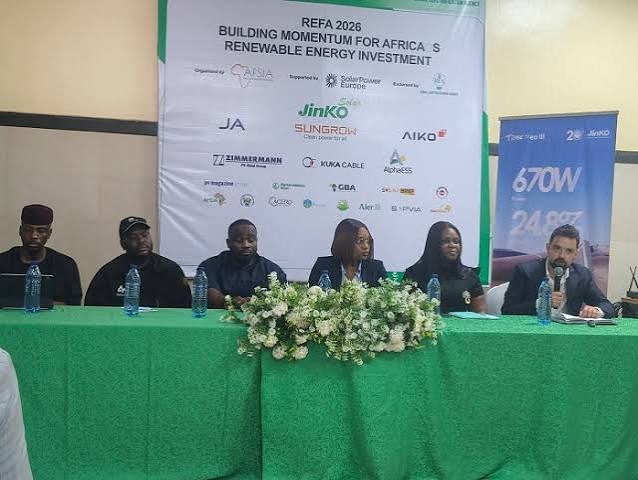
Nigeria’s growing solar market will take centre stage as the Renewable Energy Forum Africa (REFA) 2026 holds in Lagos on November 25-26 with the backing of the Rural Electrification Agency (REA).

Organised by the Africa Solar Industry Association (AFSIA) and supported by SolarPower Europe, the forum would bring together investors, developers, regulators, utilities and policymakers at the Radisson Blu Anchorage Hotel, Victoria Island.

The agency said the forum would strengthen partnerships, attract investment and support Nigeria’s clean energy and local manufacturing ambitions.

REA Managing Director, Abba Abubakar Aliyu, is billed to deliver the keynote address at the opening plenary.

The forum would also examine local manufacturing following the launch of Nigeria’s first privately owned 100MW solar module assembly plant in Ibeju-Lekki, Lagos.
The event would also feature B2B meetings, an exhibition and the AFSIA Awards on November 25.
It would be noted that Nigeria is West Africa’s leading solar market, with about 618MWp operational capacity, ranking first in the region and eighth in Africa, according to AFSIA.

The country also leads the continent in mini-grid capacity with 132MWp, while its commercial and industrial (C&I) solar capacity stands at 385MWp.

The market is receiving fresh support through the $750m World Bank-backed Distributed Access through Renewable Energy Scale-up (DARES) programme, targeting 1,350 mini-grids and electricity access for 17.5 million Nigerians.

Continue Reading

Oil & Energy

CBN Appoints Eight New Pre-shipment Agents For Crude Oil And Gas Exports

Published

on

The Central Bank of Nigeria (CBN) has appointed eight pre-shipment inspection agents to monitor crude oil and gas exports, alongside two monitoring and evaluation agents to oversee their activities.
The appointments, announced in a notice signed by Aderinola Shonekan, Director of the CBN’s Trade and Exchange Department, took effect on October 2, 2026, under the Nigerian Export Supervision Scheme.
The notice directs authorised dealer banks, the Nigeria Customs Service, petroleum regulators, terminal operators and oil and gas companies to comply with the revised arrangements.
The CBN assigned the eight inspection agents to specific crude oil and gas export terminals as part of the revised framework.
The allocations are as follows:
Dakee Engineering and Construction Ltd.: LNG, Escravos (Gas), Bonny River Terminal (BRT) and EGTL.
Trexem Energy Services Limited: Egina, Qua-Iboe and Tulja. Geoscape Limited: Escravos, ERHA, Odudu and FSO Cawthorne.
617 Limited: Bonga, Brass, Usan and Eagle.Robinson International Energy Ltd.: Ugo-Cha, Penington, Aje, Ima, Oyo and Nembe. Trobell International Nigeria Limited: Forcados, Bonny and Okwori.
Integrated Shipping Services Nigeria Ltd.: Akpo, Antan, Okoro, Anyala-Madu and Ebok.
Kephren Business Ltd.: Ukpokiti, Utapate, Yoho, Abo, Agbami, Ajapa, Okono, Okwok and additional marginal streams designated by the Nigerian Upstream Petroleum Regulatory Commission (NUPRC).
The CBN also appointed two monitoring and evaluation agents, the Q&Q Control Services Limited and the Arlington Securitas Nigeria Limited to oversee the inspection companies.
The Q&Q Control Services Ltd. would monitor 617 Limited, Trexem Energy Services Limited, Geoscape Limited and Kephren Business Ltd while the Arlington Securitas Nigeria Limited would monitor Dakee Engineering and Construction Ltd., Trobell International Nigeria Limited, Robinson International Energy Ltd. and Integrated Shipping Services Nigeria Ltd.
The latest appointments follow previous changes to the CBN’s monitoring arrangements for crude oil and gas exports.
The latest changes update the companies responsible for inspecting export cargoes and the terminals assigned to them. The notice requires the relevant institutions and operators to comply with the new allocations from October 2, 2026.
The appointments also come amid growth in Nigeria’s gas export earnings.
According to the CBN, Nigeria’s gas export earnings rose to $2.53 billion in the first quarter of 2026, reflecting stronger earnings from the country’s natural gas sector and contributing to its external trade position.
The revised inspection arrangements place designated agents in charge of specified export terminals, while the monitoring and evaluation companies oversee the inspection agents’ activities under the scheme.
Recall that in May 2024, the apex bank appointed 11 pre-shipment inspection and monitoring agents under the export supervision scheme.
The government subsequently reviewed the allocation of oil export terminals in March 2025, assigning additional terminals to nine inspection agents appointed under the scheme.
In July 2026, the CBN also appointed Candid Oil Services Limited as the pre-shipment inspection agent for the Taurus Oil and Gas Depot.
Continue Reading

Oil & Energy

What’s Next for Global Natural Gas Demand?

Published

on

The Iran war and the lack of LNG supply from the Middle East have upended forecasts of near-term natural gas demand and import costs.
So far this year, economies in Europe and Asia have relied more on renewables and coal for power generation to offset reduced gas supplies procured at very high prices.
This year’s crisis has prompted governments to rethink energy policies with energy security the top priority, again, after the 2022-2023 energy crisis.
After the decline in global gas demand this year, due to prices at four-year highs, the obvious question for gas market participants is where demand is going after the current crisis ends. Has the second gas crisis in four years permanently undermined expectations of long-term gas demand growth?
Gas cannot be replaced in many industrial processes, yet. Electricity-generating systems in major economies that have relied on gas for power cannot have a reliable electricity supply without gas.
Still, this year and over the past four years, key gas markets in Europe and Asia have seen the share of gas in their electricity mix decline.
The UK, the Netherlands, and Turkey, and major Asian economies China, Japan, and South Korea, have all seen the share of gas-fired electricity drop, according to data from think tank Ember cited by Reuters columnist Gavin Maguire.
The spike in natural gas prices has accelerated Europe’s renewables rollout, which took off in earnest earlier this decade when Russia invaded Ukraine in 2022 and cut off pipeline gas supply to most of Europe. The share of renewables has surged in the EU and the UK in recent years, gradually sidelining gas as the reliable backup fuel rather than the one meeting growing electricity demand.
Globally, “Gas is losing its share in the global power mix as renewables increasingly meet rising electricity demand,” Ember said in a report earlier this year. The analysis found that the share of gas in the global power mix declined for the fifth consecutive year in 2025, despite a small rise in absolute gas generation. Strong growth in clean power, led by solar and wind, met around 68% of global electricity demand growth over the five years to 2025, reducing the need for a significant rise in gas power generation
Related: Mexico’s Richest Man Sells $1.15 Billion in Oil Stocks
According to Ember, 61 out of 124 economies generating electricity from gas had passed their gas generation peak.
However, these countries accounted for around one-fifth of global gas-fired electricity generation in 2025. So the large gas-generating economies, albeit a smaller group, haven’t seen their peak in gas power generation.
The biggest emerging economies, China, India, and Brazil, have actually met their surging electricity demand without turning to gas, Ember noted.
China’s gas share remained close to 3% of the electricity mix in 2025 despite rapid demand growth, while gas power generation in India and Brazil plays a more limited balancing role, the think tank said.
“The economics and energy security case for electricity are increasingly moving in the same direction,” said Malgorzata Wiatros-Motyka, ?Senior Electricity Analyst at Ember.
“As renewables lower costs and reduce exposure to fuel price shocks and geopolitical disruptions, gas is steadily losing the advantages that once made it the default fuel for power system growth.”
The writing may have been on the wall for natural gas producers and exporters if natural gas was only used in power generation.
But natural gas key uses include as feedstock in industrial manufacturing, including cement and steel, as a chemical feedstock for fertilizer, or as the start of the supply chain of manufacturing plastics, paints, synthetic fabrics, and medicine, to name a few.
And then comes the biggest twist in energy and electricity demand forecasts in recent years—the AI boom. Data centers will drive a large part of the rise in global electricity demand, which has returned to growth even in the U.S. and Europe after a decade or so of flatlining. Renewable energy alone will not meet the surge in power demand, and gas will play a key role in America and in most of Asia, where many countries are positioning to become AI and data center hubs.
The biggest LNG producers, exporters, and traders see long-term gas demand growth intact despite this year’s supply shock that is reducing consumption amid spiking prices.
For example, Shell, the world’s biggest LNG trader, said in its annual LNG Outlook 2026 this summer that surging gas demand in South and Southeast Asia would push global LNG demand up by 65% by 2050 from 2025 levels, although growth this year has been stalled by the Strait of Hormuz crisis.
Shell sees global LNG demand increasing to nearly 700 million tons annually by 2050, up by around 65% from the 2025 levels of 422 million tons.
“The conflict created a system-wide shock with disruption cascading across all segments of the economy, but the LNG industry has proved resilient and able to adapt to changing market conditions,” Cederic Cremers, President of Integrated Gas at Shell, commented in the outlook.
“While more investment in both supply and demand infrastructure is needed, the long-term outlook remains strong and LNG will continue to be a stabilising force in the global energy system.”
The International Gas Union (IGU) said in its 2026 World LNG Report in July that “while LNG industry is not immune from the challenges of operating in an era of heightened geopolitical uncertainty, its unique ability to re-distribute large quantities of clean-burning energy from a broadening supply base only enhance LNG’s role as a ‘shock absorber’ to the global economy.”
By; Tsvetana Paraskova

Continue Reading

Trending