Connect with us

Opinion

Parental Honour: Recipe for Longevity

Published

on

Quote:”For those whose parents have passed away, honour can still be expressed by preserving the values they taught, caring for the family they left behind and becoming the kind of parent, grandparent or community member whose life blesses others”
 
Longevity is one of humanity’s oldest desires. Across generations, people have searched for the secret of living long, healthy and meaningful lives. Some have looked to medicine, others to healthy diets, exercise, wealth and modern technology. While these are important ingredients for a healthy life, Scripture presents another powerful principle that is sometimes overlooked: honour your parents.The Bible does not present honouring parents merely as a social obligation. It connects this virtue directly with the blessing of longevity. In Exodus 20:12, God commands, “Honour thy father and thy mother,” and immediately attaches a promise: “that thy days may be long upon the land which the Lord thy God giveth thee.” The same principle is repeated in Ephesians 6:2-3, where Apostle Paul describes it as “the first commandment with promise.”
This raises an important question: What does it mean to honour our parents, and why would God connect it with long life? Honour begins with respect. Parents may not be perfect, and children may sometimes disagree with their decisions, but their position in the family deserves recognition. To honour parents is to treat them with dignity, speak to them respectfully and acknowledge the sacrifices they made in raising their children. In a society where the elderly can sometimes be regarded as burdens, this biblical command is particularly relevant. Modern life can make people so preoccupied with careers, financial responsibilities and personal ambitions that they forget those who nurtured them when they had nothing to offer in return. Honour is not merely expressed through words. It is demonstrated through actions. A child who checks on an ageing parent, provides food and medicine when necessary, listens patiently and offers companionship is demonstrating honour.
Sometimes, the greatest gift an ageing parent needs is not money but the assurance that he or she has not been forgotten.Honouring parents also involves gratitude. Nobody chooses the circumstances into which he or she is born, and not every family story is perfect. Yet, where parents have genuinely sacrificed, protected, taught and provided for their children, those efforts should not be taken for granted. There is also a lesson here for parents. While children are commanded to honour their parents, parents are equally instructed to raise their children responsibly. Ephesians 6:4 warns fathers not to provoke their children to wrath but to bring them up “in the nurture and admonition of the Lord.” Honour is therefore best sustained in an atmosphere of love, discipline, understanding and mutual respect. The promise of long life, however, should not be interpreted as a guarantee that everyone who honours his parents will never experience illness, hardship or an early death.
Scripture contains many righteous people who experienced suffering and difficult circumstances. Rather, the command reveals a divine principle: a life characterised by respect, obedience, gratitude and responsible relationships is generally a healthier and more orderly way to live. Indeed, honouring parents can protect people from many destructive behaviours. Children who grow up learning respect for authority, gratitude and responsibility may be less inclined to embrace recklessness, violence, substance abuse and other behaviours that can shorten life. In this sense, the biblical command has both spiritual and practical wisdom. Longevity is also about the quality of the years we live, not merely the number of years we accumulate. A person may live to an advanced age but leave behind a legacy of bitterness and broken relationships.
 Another may live fewer years but touch countless lives through love, service and kindness. The real blessing is to live long enough—and well enough—to make our years meaningful. Honouring parents can therefore become part of a broader recipe for longevity: faith in God, respect for parents, moderation in lifestyle, healthy relationships, purposeful work, compassion and responsible living. Medical science can help us understand how to protect our bodies, but Scripture reminds us that the wellbeing of the whole person involves more than physical health. For those whose parents are still alive, there is no better time to demonstrate honour than now. Call them. Visit them. Listen to their stories. Assist them when they are weak. Forgive where forgiveness is needed. Do not wait until a funeral before expressing appreciation that should have been spoken while they were alive.
For those whose parents have passed away, honour can still be expressed by preserving the values they taught, caring for the family they left behind and becoming the kind of parent, grandparent or community member whose life blesses others.The recipe for longevity, therefore, may contain more than good food, exercise and medical care. It also contains a quality of heart that God values deeply. Honour your father and your mother. It is not merely an ancient command. It is a timeless principle of gratitude, family responsibility and godly living—and Scripture attaches to it a remarkable promise: “that thy days may be long.
Sylvia ThankGod-Amadi
Continue Reading

Opinion

Abduction In Nigeria: Musa’s Critical Question

Published

on

Quote: “Nigeria cannot continue to celebrate the rescue of kidnapping victims while leaving untouched the networks that finance, arm, feed and protect their abductors. The real war is not only against the gunmen in the forest; it is against everyone who makes their criminal enterprise possible.” 
During a media interview recently, the Minister of Defence, Gen. Christopher Musa (rtd.), asked a question that deserves serious national reflection: “How come any time there is going to be an election, there seems to be a spike in insecurity? Is it intentional? Are people trying to make it seem as if the government is not working?” That question should not be dismissed as mere rhetoric. It captures a troubling pattern Nigerians have observed over the years. Why does insecurity often appear to intensify as elections approach? Why do kidnapping, political violence and attacks on communities seem to become more frequent during politically sensitive periods? Is it coincidence, or is there a connection between politics and Nigeria’s security challenges?
The recent wave of abductions and violent attacks across the country provides a painful backdrop to the Minister’s question. Despite repeated assurances and military operations, many Nigerians still live at the mercy of armed criminal gangs. In late August 2026, armed gangs reportedly attacked communities around Dekera village in Borgu Local Government Area of Niger State, abducting hundreds of people, including worshippers. Earlier, in July, attackers reportedly struck Government Day Secondary School in Lassa Town, Borno State, killing some people and leaving several students and a member of staff missing. These incidents are part of a disturbing national reality. Nigerians have been kidnapped on highways, in schools, farms, places of worship and even in their homes. Farmers are afraid to cultivate their lands. Parents worry whenever their children leave for school. Travellers undertake journeys wondering whether they will reach their destinations safely.
Kidnapping has consequently grown beyond ordinary criminality. It has become a lucrative and organised enterprise. While government rescue operations are necessary, they cannot be the country’s permanent solution. Every victim deserves to be rescued, but the nation must go beyond rescuing victims to dismantling the structures that make kidnapping possible. The questions are straightforward: Who supplies the criminals with weapons? Who provides them with food, fuel and information? Who identifies vulnerable targets? Who negotiates ransom? Who finances the operations? And who are the sponsors? Nigerians deserve answers. It is not enough for authorities to announce after every attack that investigations have commenced. Investigations must lead to arrests, prosecution and conviction. Sponsors, financiers, informants and collaborators must be exposed and punished according to law.
Criminal gangs cannot survive without support. They require food, water, fuel, weapons, information and sometimes safe havens. Somewhere, people are supplying these necessities. Somewhere, people know what these criminals are doing and choose to look away. Such collaborators must understand that their actions help perpetuate the insecurity destroying communities across the country. The fight against insecurity therefore cannot be left entirely to the military and other security agencies. Communities have a responsibility to stop shielding criminals because they are relatives, friends, neighbours or members of the same ethnic or religious group. The political dimension must equally be confronted. Ahead of elections, politicians and political parties routinely sign peace accords. Such agreements are useful, but they will achieve little if politicians continue to arm thugs, encourage violence or recruit unemployed and vulnerable youths as instruments of political ambition.
Weapons distributed for electoral purposes do not disappear when elections are over. They remain in circulation and can subsequently fuel robbery, cultism, kidnapping and other violent crimes. Politicians must therefore understand that the youths they arm today could become a threat to society tomorrow. Political leaders must also be mindful of their words. Inflammatory statements can deepen divisions and create an atmosphere in which violence thrives. The recent controversy surrounding the Chairman of Kuje Area Council of the Federal Capital Territory, Samuel Danjuma Shekwolo, who was reportedly accused of directing residents to support the All Progressives Congress (APC) ahead of the 2027 elections or leave the area, should concern every Nigerian who values democratic freedoms. Nigeria must investigate allegations of political sponsorship of violence without fear or favour. Where evidence exists, both perpetrators and sponsors must face the law. Peace accords must not become substitutes for accountability.
The Federal Government must strengthen intelligence gathering and coordination among security agencies. Security personnel must be adequately equipped and motivated, while communities that provide credible information should receive adequate protection. Most importantly, the government must follow the money. For every criminal gang neutralised, another could emerge if the financiers and support networks remain untouched. Nigeria must move beyond celebrating the rescue of victims. It must dismantle the entire criminal enterprise—from the gunmen in the forests to the financiers, informants, suppliers and political collaborators who sustain them. As another election season approaches, politicians must remember that political ambition is not worth the blood of any Nigerian. Elections should be contests of ideas and competence, not opportunities to unleash violence on citizens.
Nigeria has mourned too many victims. The country cannot afford another cycle of attacks, abductions, rescue operations and condolences without addressing the roots of the problem. The time has come to stop merely reacting to insecurity. Nigeria must identify who benefits from it, dismantle the networks that sustain it and prevent the next tragedy before it happens.
By Calista Ezeaku
Continue Reading

Metro

From Himalayan Ice to Niger Delta Floods: How Melting Glaciers Will Reshape Nigeria’s Coastline
Published

on

On Wednesday August, 26, 2026, the world watched Nepal as glacial collapse sent a wall of water tearing through the Nepal-China border mountain villages, swallowing homes, schools, roads, bridges and hydropower plants and causing significant loss of lives. All these were gone in minutes.

According to reports, the first indication that something was amiss came at 8.37 am local time,when the earth started shaking along the Nepal-China border, north of Kathmandu.

Scientists later established the fact that an enormous chunk of glacier sheared off from high on a mountain.This plunged into the river below. The section of the glacier that fell was approximately 2,000 feet wide.

A Professor of Hydrology at the Imperial College, London, Wouter Buytaert said, “this is the type of event that is triggered by climate change. Global warming strinks glaciers making it more likely for them to break apart.”

So far, more than 1000 people are found dead, 4,267 individuals rescued. As at Tuesday, 1st September, 2026, more than 4,400 people still reported missing and and more than 65,000 people affected in Nepal and Tibet. There are fears that the numbers of dead may still rise exponentially.

That disaster in the Himalayas feels far from the Niger Delta. But climate science tells us it is connected. The ice that melts in the Antarctica, Arctic, Andes, Himalayas,Alaska,Alps,Mt. Kilimanjaro and Mt. Kenya does not stay there. It flows into our oceans, and our oceans decide what happens to the Niger Delta.

For a proper understanding, we need to put this in perspective. What are glaciers?Glaciers and ice sheets are large masses of ice that form when fallen snow is compressed and recrystallised over the course of thousands of years. The two types of glaciers are the continental glaciers and the alpine (mountain)glaciers. The glaciers exist on all the world’s continent except Australia.These glaciers hold about 68-70% of the world’s freshwater. Together, they cover approximately 10 percent of the Earth’s total land mass.

For 10,000 years they were relatively stable. That changed in the 1900s. Since 1990, glaciers have lost over 9 trillion tonnes of ice. The World Meteorological Organization (WMO) and the World Glacier Monitoring Service confirms that global glacier mass loss has accelerated, and 2022-2024 were the 3 largest loss years on record.

All 19 of the world’s major glacier regions reported a net annual loss of ice mass, though, year 2023 set an individual annual record for single-year water loss with glaciers shedding approximately 600 gigatons of water.

In October of 2023, during a visit to the Everest region in Nepal, the United Nations Secretary-General, Antonio Guterres called on the world to “stop the madness” of climate change, warning that the disappearance of glaciers altogether looms even larger.

However, researchers in recent projections show that mountain glaciers will lose one quarter to one half of their mass by 2100 for global temperature change scenarios. A third of glaciers in the World Heritage sites are set to disappear by 2050.

Also, many mountain regions have already witnessed radical glacier loss with many low elevation and small glaciers around the world, including all of Africa’s remaining glaciers at risk of disappearing within this century.

The ice is melting because global temperatures have risen to almost 1.4°C since pre-industrial times. The extra heat turns ice to water. As a result, the gradual disappearance of glaciers contributes to rising sea levels, increased risk of drought in densely populated plains and atmospheric pollution,where ancient greenhouse gases like methane trapped deep beneath the ice are released.

Glaciers in Greenland, Antarctica, Alaska and the Himalayas melt into rivers into the Atlantic, Arctic and Pacific Oceans.
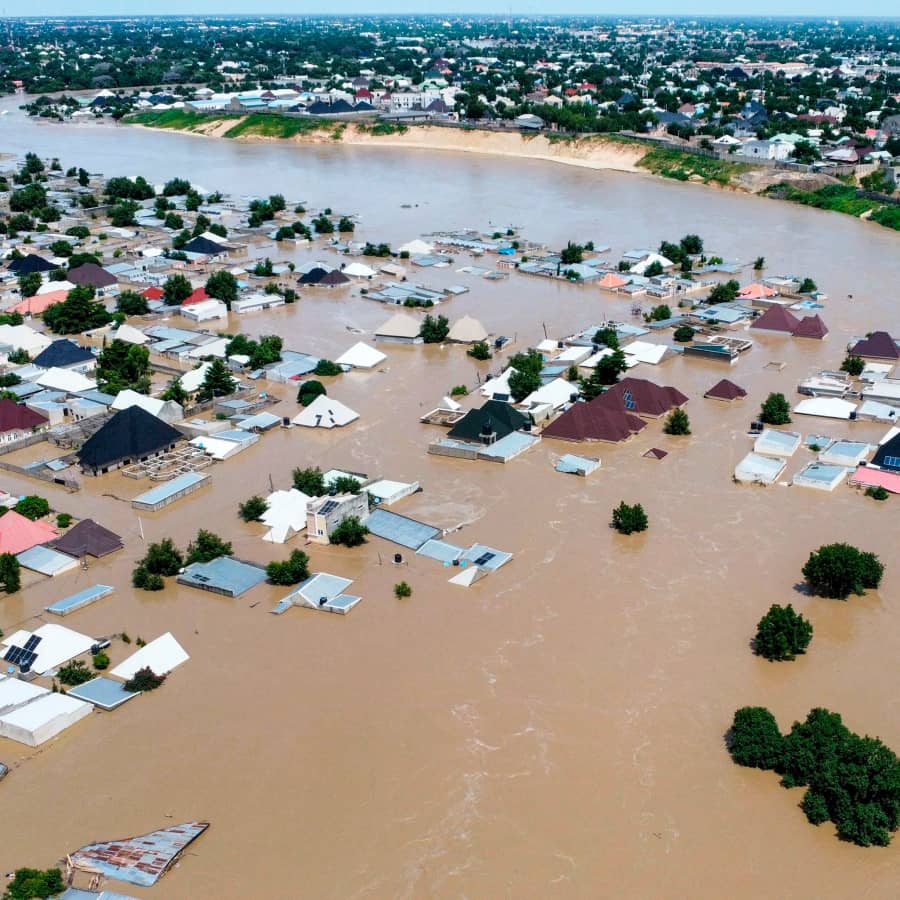
The meltwater adds volume to the ocean. Thermal expansion of warmer seawater adds more water. Global mean sea level has risen from 21-24cm since 1900, and the rate has doubled since 2006. All this add up to the pressure in Nigeria’s Niger Delta, which over the years has witnessed severe flooding.

The Niger Delta Coast of Nigeria has 853km of coastline facing the Atlantic Ocean along the Gulf of Guinea.It stretches to a total of nine states including Rivers,Bayelsa, Akwa Ibom, Cross River, Delta, Edo, Lagos, Ogun and Ondo. The coastline comprises inshore waters, coastal lagoons, estuaries and mangroves especially in the Niger Delta. The Niger Delta is a low-lying, sediment-based delta. Bonny, Brass, Okrika, Warri and Lagos Island generally sit across low-lying coastal terrain. .

So the meltwater from thousands of kilometers away ends up pushing against the shorelines of the Niger Delta, raising tides, and pushing saltwater into our creeks and groundwater.

The impact of the melting glaciers are enormous on the Niger Delta.The glacier melt may not cause a Himalayan-style flood, but may cause slow, compounding damage.

This is mainly due to the fact that higher sea levels mean king tides which now reach further inland. Communities in Okrika, Nembe, and Lagos Bar Beach already lose land yearly. With 0.5m rise by 2050, 30-50% of the Delta could face annual inundation.

Furthermore, as sea level rises, salt pushes into coastal aquifers and surface water. This is critical for the Niger Delta where people depend on shallow hand-dug wells and boreholes 10-20m deep for drinking water. Salinity ruins drinking water and kills agricultural crops.

Also, it will lead to worsened flooding and extreme rainfall. Climate change makes rains heavier. When high tides meet heavy rain with poor drainage in most Niger Delta communities and urban cities, floodwater has nowhere to go.

The critical impact will be the loss of livelihoods in the area. Fishing and farming in the Niger Delta area depend on brackish water balance. More salt from floods results to fish migration, and also crop failure.

The massive inflow of water may lead to Infrastructural damage: roads, refineries, industries and businesses at the coastal line are affected, while repeated flooding corrodes and disrupts production.

With the continuous melting of the glaciers, the next five years and beyond for people of the Niger Delta region is ominous.

By 2031, scientists evisage more “nuisance flooding” during high tide with 10-15cm additional sea level rise globally. And by 2050, according to the Intergovernmental Panel on Climate Change (IPCC) projects 0.28-0.55m sea level rise even if countries cut down on emissions. This will translate to more flooding and moderate coastal flooding will happen 10 times more often than it does today.

High tide will routinely flood coastal streets, damaging local infrastructure and threatens fresh water supplies. For the Niger Delta, that means displacement of communities and billions in damage.

What is worse? By 2100, if emissions continue, 1-2m sea rise is possible and this will make parts of the Niger Delta to become uninhabitable, if there are no massive defenses put in place.

While the rest of the world are preparing to abate disasters, the Niger Delta and Nigeria as a whole seem to be asleep to the reality that is beckoning.

The rest of the world are developing early warning systems for disasters, community evacuation drills and placements.

The UN 2025 report shows that 119 countries are now covered by a multi- Hazard Early Warning System. Launched in 2022 by United Nations Secretary-General, Antonio Guterres, Early Warning for All is a ground breaking initiative to ensure that every one on Earth is protected from hazardous weather, water or climate events through life saving early warning systems by the end of 2027.

In the Netherlands the government used a technique known as Delta Works. They have built a country below sea level. The Delta Works is a massive network of dams, slluices, locks and storm surge barriers built to protect the Southern part of the Netherlands from catastrophic flooding after the 1953 floods.

The Dutch also use a system to strategically open and close dams that redirect massive volumes of river water to flush salt water back into the North Sea.

The United Nations (UN) and IPCC have begun the Global Stocktake-monitoring and inventory of climate issues of countries. There is the Loss and Damage Fund under the UN Framework Convention on Climate Change agreed at the 28th annual United Nations Climate Change Conference in Dubai 2023 to help vulnerable developing countries facing climate-induced impacts.

It is important to commend the African Union for the Climate Change and Resilient Development Strategy which it is delivering on African goal for inclusive and sustainable development. Aslo, the Great Green Wall project to combat land degradation, desertification and climate change across the Sahel region. They must find a way to bridge the funding gap for the projects, which is huge.

Nigeria has to wake up from its deep slumber on these issues. What Is The solution?
If we cannot build Dutch sea walls tomorrow, we can do “smart adaptation”.

Research is key in this direction. Research institutes and the Nigerian Meteorological Agency (NIMET) must monitor sea levels, salinity in boreholes, and map vulnerable communities.You cannot adapt what you do not measure.

We must return to nature-based solutions, such as restoration of mangroves in the Niger Delta. Thick mangrove forests act as natural wall against storms, hurricanes and rising sea levels One hectare of mangrove absorbs waves better than concrete and costs less. It also stores carbon.

Another solution is Water Safety,thereby investing in rainwater harvesting, deeper boreholes >40m above saltwater intrusion, and household water treatment for communities. This tackles Sustainable Development Goal 6.

We must adopt early warning. SMS flood alerts for communities like what Nepal is doing. Recently, the Federal Government of Nigeria issued alerts that over 2000 communities would face flood risk across 30 states. Seven states were identified as critical hot-spots.

In a statement, the Director of the Erosion, Flood and Coastal Zone Management Department, Mr. Usman Bokani said Akwa Ibom, Delta, Kogi, Benue, Rivers, Bayelsa and Ebonyi states could be critical areas during the forecast period. Also, Adamawa, Kwara,Taraba and Kebbi states had been categorised as high risk locations. Some communities in Borno, the FCT, Plateau, Nasarawa and Yobe states are expected to experience moderate flooding during this period. This is a good start.

Nigerian government must do all it takes to access funds in the area of foreign policy and finance and use it appropriately. Government should access the United Nations Loss and Damage Fund. Also, integrate climate into the Niger Delta Development Commission(NDDC) Masterplan and push for “polluter pays” from oil companies to fund adaptation.

Communities ought to be involved in this through information and education. Let them be enlightened about the consequences of their actions that lead to climate change. Government must mobilze communities in this regard. Climate adaptation works when people own it.

In conclusion, it is important to stress that
the ice in Greenland and the water in the Niger Delta are linked by one ocean. Nepal’s glacier burst was a warning. Our warning may be slower, salt in our wells, water in our streets, people moving from their ancestral homes, and more.

But we still have time. If Nigeria invests now in monitoring, growing mangroves, and community resilience, we can reduce the damage. Climate change is global. The response must be local.


By: Dr. Ibinabo Ogolo

Dr. Ibinabo Ogolo is a Research Fellow at the Institute of Geosciences and Environmental Management, Rivers State University, Port Harcourt, Nigeria.
Continue Reading

Opinion

What Do Nigerians Want?

Published

on

Quote:” … that is a vicious cycle; government provides, vandals destroy, government repairs, and citizens pay again.”
Sometimes, one is forced to ask a painful question: What exactly do Nigerians want? We complain when the government fails to provide infrastructure. We demand good roads, functional hospitals, electricity, railways, bridges, water and other public amenities. But when these facilities are eventually provided, some Nigerians turn around to steal, vandalize, destroy or misuse them. So, what exactly do we want? The contradiction is disturbing. Recently, a report stated that Sa’ad Abdullahi, an APC member of the Nasarawa State House of Assembly representing Umaisha/Ugya Constituency, donated 50 ceiling fans, 40 standing fans and 50 orthopedic mattresses to Umaisha General Hospital in Toto Local Government Area. According to the report, when he returned to the hospital a few days later for a follow-up visit, he discovered that all the items had allegedly been sold.
If the report is accurate, it is simply outrageous. A hospital is supposed to serve the sick, particularly poor Nigerians who cannot afford expensive private healthcare. How can equipment donated to improve healthcare delivery suddenly become somebody’s merchandise? And this is not an isolated case. A video currently circulating on social media shows a man raising the alarm over the alleged theft of bolts from the First Niger Bridge. We have also seen reports of people breaking concrete pavements to remove iron rods. Railway components such as bolts, nuts, clips and fish plates have reportedly been stolen in different parts of the country. Electrical cables and wires are also routinely stolen, disrupting electricity supply and sometimes exposing entire communities to danger. Then there are manhole covers. In many cities across the country, stealing manhole covers has become so common that it hardly generates outrage anymore.
 Yet an uncovered manhole can become a death trap. A pedestrian, cyclist, motorcyclist or driver could plunge into one at night and suffer serious injury or even death. Why do we keep doing this to ourselves? Perhaps the person stealing a bridge bolt thinks it is only a small piece of metal. The person removing a railway component may think it is just another piece of scrap. The person stealing an electricity cable may see only the money he will make from selling it. But public infrastructure does not work that way. A single missing bolt may appear insignificant, but hundreds of missing components can compromise the integrity of a structure. Tampering with railway tracks can cause derailments and mass casualties. Stealing electricity cables can disrupt power supply and cause electrocution. Removing iron rods from public structures can weaken them.
Infrastructure vandalism is therefore not ordinary theft. It is a crime against human life. What is even more disturbing is that those who engage in these acts often steal from facilities they themselves complain are inadequate. We complain about poor healthcare, yet hospital equipment is stolen. We complain about bad roads, yet drainage infrastructure is vandalized. We complain about insecurity, yet streetlights and electricity installations are destroyed. We complain about poor transportation, yet railway infrastructure is vandalized. We complain about government waste, yet public property is treated as though it belongs to nobody. This mentality must change. Government property is not really “government property”. It is our property. It is paid for with public funds. When a public facility is destroyed, taxpayers ultimately pay for its repair or replacement.
 Every vandalized facility means money that could have been used to build something new must instead be spent replacing what we already had. That is a vicious cycle: government provides, vandals destroy, government repairs, and citizens pay again. Of course, poverty is often cited as a reason for stealing public infrastructure. Poverty is real, and the economic hardship confronting many citizens cannot be ignored. But poverty cannot justify an action that deliberately endangers the lives of others. A hungry man stealing food is one thing. A person removing a bolt from a bridge or railway track, knowing that its absence could cause an accident, is something entirely different. There must be a line between economic hardship and criminality. Government must also take enforcement seriously. Those caught vandalizing critical infrastructure should face the full consequences of the law.
But enforcement must not stop with the person physically removing the material. Who bought it? Who financed the operation? Where was it taken? Who is making money from the trade? There is often a market behind every stolen piece of infrastructure. Scrap dealers and other buyers who knowingly purchase stolen government property must therefore be investigated and held accountable. If there is no buyer, there will be little incentive for the vandal. Technology can also help. Critical infrastructure such as bridges, railway lines and electricity installations should, where practicable, be protected with surveillance cameras, alarms and other monitoring systems. Regular inspections should be carried out to identify missing or damaged components before they become hazards. Engineers should equally explore practical anti-vandalism measures, including securing vulnerable bridge and railway components in ways that make unauthorised removal more difficult.
But the government cannot do everything. Citizens must become the first line of defence. Community leaders, traditional rulers, religious organisations, youth groups, transport unions and residents’ associations should encourage people to report suspicious activities. Nobody should watch someone dismantling a public facility and simply walk away because “it is government property”. It is not. It is our property. If we want good infrastructure, we must protect it. If we want functional hospitals, we must safeguard their equipment. If we want safe roads, bridges and railways, we must stop stealing their vital components. And perhaps, before asking what the government can do for Nigerians, we should also ask ourselves: What are we doing to protect what belongs to all of us?
By: Calista Ezeaku
Continue Reading

Trending