Connect with us

Business

‘Nigerians Imported N903bn Worth Food In Three Months’

Published

on

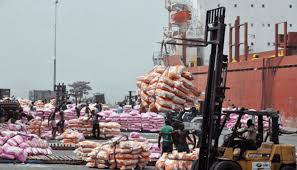
The Central Bank of Nigeria released $689.88million (N903.95billion) at the official exchange rate of N1,309/$ as of March 31, 2024 to Nigerians for importing food items in the first quarter of 2024.
The amount of food imported into Nigeria increased by 16.37 per cent within the first six months of 2024, The Tide’s source gathered.
According to the monthly Consumer Price Index data released by the National Bureau of Statistics (NBS), the average price index for imported food rose to 806.0 points in June 2024, up from 692.6 recorded in January 2024.
On a month-on-month basis, imported food inflation jumped to 36.38 per cent in June 2024, from 34.83 per cent recorded in the previous month, which represents a 1.55 per cent increase as the naira weakened following the unification of all segments of the forex exchange market by the CBN.
The unification process in June 2023, aimed at creating a more transparent and efficient foreign exchange market, resulted in a steep naira depreciation.
Further analysis by the source showed that imported inflation has increased consecutively for over four years, largely driven by both internal and external factors.
Data from the NBS on imported food inflation from January to June 2024 reveals a troubling and steady increase in costs. In January, Nigeria recorded an imported inflation rate of 26.29 per cent. This increased to 29.81 per cent in February, marking a notable jump of 3.52 per cent in the inflation rate from January.
The trend continued in March, with the imported food inflation rate climbing to 32.89 per cent, an increase of 3.08 per cent from February.
In April, the inflation rate further increased to 34.01 per cent, growing by 1.12 per cent from March, showing a slight deceleration in the rate of increase.
May recorded an imported food inflation rate of 34.83 per cent, indicating a continued upward trend. The increase in the inflation rate is 0.82 per cent from April.
By June, the imported food inflation rate had hit 36.38 per cent, marking an increase of 1.55 per cent from May.
While the overall trend is upward, the rate of increase in inflation shows signs of gradual deceleration from March to May before picking up again in June.
Recently, the Federal Government approved a 150-day duty-free window to allow the importation of maize, husked brown rice and wheat as part of efforts to tackle rising inflation which had impoverished many Nigerians.
Consequently, the government suspended duties, tariffs and taxes for the importation of certain food commodities through land and sea borders.
However, the President of the African Development Bank, Dr Akinwunmi Adesina, raised concerns over the federal government’s plan to import food, stating that the policy is depressing. According to him, Nigeria cannot rely on food imports to stabilize prices, and resorting to it could destroy the country’s agricultural policy.

Also, the National President of the All Farmers Association of Nigeria, Kabir Ibrahim, said the duty-free importation of food items would lead to the erosion of gains made in local maize, rice and wheat production.

He called on governments to invest through the provision of subsidies on inputs such as machines, fertilizers and chemicals to have a sustainable food system in the country.

Nigeria’s inflation rate in June 2024 surged from 33.95 per cent in May 2024 to 34.19 per cent in June. The headline inflation rate in June 2024 was 11.40 percentage points higher compared to June 2023, rising from 22.79 per cent.

On a month-on-month basis, the headline inflation rate in June 2024 was 2.31 per cent, an increase of 0.17 per cent from May 2024’s rate of 2.14 per cent.

Similarly, the quarterly statistics of CBN have shown that the country exported large amounts of food from foreign countries despite being touted as the food basket of Africa.

An analysis showed that its citizens spent $689.88m on import bills between January and March 2024. This was an increase of $12m or 1.77 per cent from $677.61m recorded in the same period of the previous year.

The high food import bill is a concern for the government. The country has a large agricultural sector, and there have been efforts to boost local production to reduce the dependence on food imports. However, factors such as inadequate infrastructure, insecurity, and climate change have hindered progress in the sector.
###


Bayelsa Urges Cooperatives To Apply Global Best Practices
… Make Investment in Social Capital

Ariwera Ibibo-Howells, Yenagoa

Bayelsa State Deputy Governor, Senator Lawrence Ewhrudjakpo, has restated the need for cooperative societies in the country to follow global trends in their operations to contribute meaningfully to the growth and development of the national economy.

Senator Ewhrudjakpo, who spoke recently during a courtesy visit by the Former Legislators’ Wives Association (FLEWA) to his office in Government House, Yenagoa, described cooperative societies as strategic engines of growth and stabilization of any economy.

The Deputy Governor opined that, apart from pooling resources together and sharing same among their members, cooperatives could do a lot more to impact society by investing in both profitable and non-profit making ventures.

He encouraged cooperatives in Bayelsa to imbibe global best practices by partnering government and other well-meaning organizations to invest in education and other areas of social capital.

While expressing appreciation to the women for supporting the re-election of the Governor and himself, Senator Ewhrudjakpo urged the Association to key into the policies and programmes of the Governor Diri-administration, especially those on women and youth empowerment.

He also called on FLEWA to take their public enlightenment programmes against drug addiction, cultism and other antisocial vices to the primary schools, which according to him, have become breeding grounds for such societal ills.

”Cooperatives, as far as I am concerned, are the engines of growth and stability of the economy. Most of the big economies and companies you see started off as cooperatives.

“The biggest football clubs in Europe were cooperatives that have become very mega investments.

“So, while I will really want to encourage you with your cooperative, I want you to have more than one area of focus. Our cooperatives should do more than contributing money for members in turns.

“We will match forward with our agenda, and expect you to match behind the state. I encourage you to come up with programmes that will help fight against cultism and other vices in our primary schools.

“Don’t always focus your enlightenment programmes on the secondary and tertiary learning institutions alone because our primary schools have become the breeding ground for all the vices we have mentioned here”, he said.

Speaking earlier, the President of FLEWA, Mrs. Margaret Boye Debekeme, said the goal of the association was to foster unity and collective development, through the pooling of resources for financial self-reliance.

Mrs Debekeme, who lauded the development strides of the present administration in the state, solicited the support of government for their programmes lined up for the year, including enlightenment campaign against cultism in schools.

Continue Reading

Business

Nigeria’s Inflation Drops to 15.06%

Published

on

Three States Record Lowest rates Published 16 Mar 2026 By  Dave Ibemere 3 min read The NBS has revealed that inflation rates dropped again in February 2026 The bureau noted that both headline and food inflation eased on a year-on-year basis Inflation was lowest in Katsina, Imo, and Ebonyi, while the highest was recorded in Kogi.
 Nigerian economy, the stock market, and broader market trends. The National Bureau of Statistics (NBS) has revealed that Nigeria’s inflation rate slowed further in February 2026. According to the bureau in its latest CPI report, the headline inflation dropped slightly to 15.06% from 15.10% in January 2026. Nigeria’s inflation eases to 15%, offering relief to households. It was 11.21 percentage points lower than the 26.27% recorded in February 2025. From breaking news to viral moments.  On a month-on-month basis, inflation stood at 2.01% in February, up from -2.88% in January, showing that prices rose at a faster pace than the previous month. Nigerian stock market records weekly gain as turnover hits N164.8billion Urban vs Rural Inflation NBS noted that urban inflation stood at 15.53% year-on-year, down from 28.49% in February 2025, while rural inflation was 13.93%, compared with 22.73% in the same period last year. Every month, urban inflation rose to 2.55% in February from 2.72% in January, while rural inflation eased to 0.71% from -3.29%. Food Inflation Food inflation dropped to 12.12% year-on-year in February, down sharply from 26.98% in February 2025. Monthly, food prices rose by 4.69%, higher than the -6.02% recorded in January. The NBS attributed the moderation to slower price increases in staples such as beans, cassava tuber, yam flour, crayfish, millet flour, cowpeas, and okazi leaf. The twelve-month average for food inflation was 19.08%, compared with 37.40% in February 2025. States breakdown for All Items The states with the highest all-items inflation rates were: Kogi (23.57%) Benue (22.85%) Anambra (22.09%) The lowest rates were recorded in: READ ALSO Naira appreciates by N27 against US dollar as external reserves cross $50bn Katsina (7.78%) Imo (11.66%) Ebonyi (11.71%) On a month-on-month basis, the highest increases were in Enugu (5.92%), Ogun (4.39%), and Anambra (4.11%), while declines were seen in Zamfara (-2.14%), Bauchi (-1.23%), and Katsina (-1.06%). Food staples contribute less to inflation as prices moderate in February. Photo: Bloomberg Source: Getty Images State Breakdown for Food Inflation Food inflation was highest in: Kogi (26.91%) Adamawa (23.12%) Benue (21.89%) The lowest food inflation rates were seen in: Katsina (5.09%) Bauchi (7.09%) Imo (7.65%) Month-on-Month Food Inflation The states with the highest month-on-month increases in food inflation were: Bayelsa (8.81%) Ebonyi (8.51%) Edo (7.72%) The states that recorded declines were: Katsina (-0.70%) Nasarawa (0.17%) Kano (1.39%) Food price changes across markets in Nigeria Earlier, The  Tide source reported that due to Ramadan, staple food prices across the country are recording sharp increases as Muslims begin the Ramadan fasting season Ramadan is not only a period of abstinence from food and drink, but also a time for ‘reflection, discipline and heightened devotion’ Several traders in Abuja, Taraba, and Kaduna states are taking advantage and have hiked price. The NBS has revealed that inflation rates dropped again in February 2026 The bureau noted that both headline and food inflation eased on a year-on-year basis Inflation was lowest in Katsina, Imo, and Ebonyi, while the highest was recorded in Kogi.
Continue Reading

Business

NDCCTMA, NDDC MDS Challenge Niger Delta Indigenes On Investment In The Region 

Published

on

The Nigeria Delta Chamber of Commerce, Trade, Mines and Agriculture  (NDCCTMA), and the Niger Delta Development Commission ( NDDC ) have challenged Niger Delta entrepreneurs to close the gap in Gross Domestic Products (GDP) differences between the region and that of the South Western part of the country by coming home to invest.
The bodies made the call at a Business Round Table organized by NDDCTMA, in Port Harcourt.
Chairman of NDDCTMA, Ambassador Idaere Gogo Ogan, said to close the gap between the south west region which he said has a GDP seize of about #59 trillion and that of the Niger Delta which is about #34 trillion was to massively invest in the region.
He said no other persons can  do this except sons and daughters from the region.
“For me I believe in statistics,I believe in data and everyday I looked at the data concerning development in Nigeria and from the GDP point of view, the South West has #59 trillion, that is the seize of the south west region economy, the second region following them is the Niger Delta region with GDP seize of #34 trillion,so there is a yearning gap of #25 trillion that separates the south west and the Niger Delta region, that is why we are here.”
Ogan said the region has the capacity to close the gap and even surpassed it but regretted that indigenes of the region have chosen to ignore it in terms of investment.
“We need to close that gap .If we close that gap and even surpassed it,all the negative problems of militancy and unemployment will automatically erase”, he stated.
Ogan noted that the event was organized to remind the people that past efforts of militancy and agitations have not led the region to any where saying “that is why we are gathered here in this room”.
Also speaking, the Managing Director/Chief Executive Officer, NDDC, Dr Samuel Ogbuku urged indigenes of the region not to use the problem of insecurity as an excuse to continue to deny the region of investment  as every part of the country have in one time or the other experienced crisis.
Ogbuku said most indigenes have displayed high level of unpatriotism towards the region by taking investments that would have benefited the people to either Lagos or Abuja.
“With little threat we have left the city, we have gone to Lagos,we have moved  our families to Abuja and Lagos. If you go round GRA all the property, you will see,”to let to let”most of them are now empty “he said.
The NDDC MD said despite the fact that people from the region are doing well in the oil and gas, banking and other sectors, its impact are not being felt at home because they are stationed outside the region.
By; John Bibor
Continue Reading

Business

Cash Handouts Unproductive For Sustainable Agricultural Development – Engineer Kii

Published

on

Rivers State by its natural disposition is gifted with strategic economic advantage, particularly in  agricultural potentials and fortunes. This informs successive governments’ interest in  developing the agricultural sector, such as the School to Land Program, the Shongai Project, among several others.
The objective is to engender and leverage the sector  beyond mere subsistence practices into a full thriving economy, with the engagement and involvement of the youthful and productive population.
The Farm to Future Agro Based Training for Rivers youths by the present administration is notably one of the most pragmatic efforts of the Rivers State Government to engage the prospective creative capital of both the natural and human resources in the agricultural sector for sustainable development.
The concept, premised on the imperative of maximizing the huge agrarian prowess of the state, targets creation of sustainable livelihood for the teeming youth of the state. The project is also intended to achieve the chore needs of food sufficiency and job creation in the state.
This implies a significant deviation from the acculturised norm of expectations of financial benefits as the outcome of government programs and policies.
The tenets of the program are expressly difined in concept and practice as shown in the phases of its execution.
However, some beneficiaries of the project recently staged a protest, allegdging unpaid largesse, diversion of funds and perceived slighting by the Rivers State Ministry of agriculture. The said protest has stirred up concerns among stakeholders about how people view  government policies.
Many see the protest  as an attempt to create tension around the program and sabotage its original objectives.
Stakeholders and commentators are of the view that the Rivers State is in dire need of development in every critical sector, as such the  Ministry of Agriculture and its partners should be given the benefit of the doubt to implement the project to its logical conclusion without being hauled with accusations.
The former Commissioner for Agriculture, Engineer Victor Kii who was at the fore of driving the program has in a press statement debunked the allegations and sued for calm, restraint and understanding. Engineer Kii assured the participants that the empowerment phase will be implemented as soon as administrative normalcy is restored.
He commended the participants for their commitment and discipline during the training and urged them to uphold the norms of the program rather than misrepresenting its intentions.
Some pundits who commented on the recent development decried the fact that many people  still hold on to the notion that  incentives billed to create sustainable impact through skills based programs, should be given out as  largess, without adroit supervision of its utility function. This practice  has however created a culture of economic doldrum, dependency and servitude in the past.
Thus the idea of seen the Rivers Farm to Future project  as a mere quixotic experiment for cash benefits  without achieving set goals is counter productive. Such opportunistic thinking have stunted government efforts  over the years in achieving long term objectives of development.
As disclosed by the former commissioner for Agriculture in his detailed explanation, the Farm to Future project was strategically designed to address this culpable deficit in institutional planning and consolidation of results.
The former commissioner gave an  explicit description of the nexus of operation of the program.
As revealed by him;  ” The program is a strategic intervention to equip young people in Rivers with practical skills and to nurture a new generation of agricultural entrepreneurs. 500 beneficiaries received intensive agri business training in the first phase.”
 He pointed out that the program was conceived and designed in line with global best practices which de emphasizes indiscriminate cash handouts for beneficiaries. Rather it promotes practical engagements in agricultural activities and business initiatives.
At the end of the training in February, beneficiaries were encouraged either individually or in cooperative clusters to identify value chain for establishment of viable businesses.
They were also asked to produce structured business proposals for perusal and review by the ministry of agriculture and appointed consultants, after which successful proposals would be forwarded to the Bank of Agriculture with Rivers State Government providing guarantees.
The strategies for implementation include field inspections and evaluation for beneficiaries who had already commenced practical activities in identified locations.
The approach was to discourage the commonplace ideology of diverting funds meant for specific projects for unrelated purposes, thereby undermining the conscious exploration of creative potentials into long term benefits.
The process was however temporary interrupted by the dissolution of the Rivers State Executive Council and the ongoing renovation of the Rivers State Secretariat complex but the profound optimism and positive expectations that are the hallmark of the project remains sacrosanct.
Engineer Kii assures.
By: Beemene Taneh
Continue Reading

Trending