
Featured
2023 Election Failure’ll Polarise The Polity, Set Democracy Backwards -Wike

Rivers State governor, Nyesom Wike, has urged Nigerians not to allow the 2023 general elections to fail.
He said the failure of the 2023 elections would increase political polarisation, exacerbate social fault lines and set Nigeria’s democracy backwards.
Governor Wike gave the charge at the 2023 Port Harcourt International Conference, sponsored by Rivers State Government, with the theme: Deepening Democratic Culture and Institutions for Sustainable Development and Security in Nigeria”, held at Obi Wali International Conference in Port Harcourt, last Thursday.
The governor, in a statement issued by his Special Assistant on Media, Kelvin Ebiri, noted that barely one month away, Nigerians are hoping and praying for the 2023 general elections to herald the deepening of democratic culture, the rule of law and good governance in the country.
Governor Wike, however, insisted that the opportunity to elect a new President of the federation and 30 State Governors should be a success because it will consolidate and strengthen the roots of democracy in the national life of Nigeria.
“In a democracy, periodic elections are the only legitimate means for the peaceful transfer of power from one party to another. Since 1999, Nigeria has had six general election circles, but none was considered substantially clean and fair.
“The outcome of the 2003 general elections was rejected at different levels by the opposition and the losers, and litigated up to the Supreme Court. The outcome of the 2007 elections led to protests, riots, the loss of several lives, and the destruction of property in particular sections of the country”, he noted.
Governor Wike also recalled that even President Musa Ya’ardua had promised necessary electoral reforms when he publicly denounced the process that brought him to power because it was severely flawed.
According to him, the 2011 general election also suffered a similar experience and was litigated by the opposition to the Supreme Court.
“None of the defeated contestants believed they lost fairly and blamed the umpire, the security agencies and politicians for undermining our democracy with brazen electoral fraud”.
Governor Wike noted further that the 2015 general election, though considered rigged, recorded some improvements with the use of the smart card reader and the emergence of opposition candidates as the winners of the presidential.
The governor said the 2019 general election was equally problematic and rejected as highly compromised by the opposition and litigated up to the Supreme Court.
“In Rivers State, we battled the military in the 2015 and 2019 re-run and general elections with pure courage and determination to secure our victory and retain our mandate with the sweat and blood of innocent citizens”, he said.
Governor Wike pointed out that when the government compromises the integrity of elections through election management agencies, it denies citizens their constitutional right to elect the leaders they want and can hold accountable.
Conversely, he emphasised, when elections lack integrity, the leaders who emerged from outside the people’s will are illegitimate.
According to him, “Such leaders without trust are likely to be authoritarian, divisive and incapable of effective governance. Serial election rigging threatens our democracy and constitutes an existential challenge to the nation’s future stability.
“Therefore, deepening democratic culture and institutions for sustainable development and security is important to us as a nation, and free and fair elections with integrity remain the only path to achieving this objective”.
Speaking further, Governor Wike said the new electoral law, especially with the provisions of the use of technology, holds the prospect for a brighter democratic experience for Nigeria if implemented effectively.
However, he stressed, that beyond the legal regime, political parties’ internal practices and external electioneering behaviour must conform to democratic norms and standards.
“The efficiency of the judiciary in interpreting and enforcing the existing regulatory regime, including the laws, regulations and guidelines beyond reproach and the capacity and consistency of INEC and the security agencies to be firm, impartial and independent in the discharge of their functions are most crucial.
“Safeguarding and deepening our democracy lies with every citizen. We must have the courage to stand up for justice, the rule of law, an independent and courageous judiciary, and our rights and freedoms to vote and be voted in a transparent election”, he stated.
Presenting his keynote address, former president of Nigeria, Chief Olusegun Obasanjo, who titled his paper: “Respecting the Principles of Democracy”, noted that Nigeria’s democracy has gone through twists, dives and turns since political independence.
He said the best of the country’s history has been the sustenance of democracy since the military transfer of power to an elected government in 1999.
He however, observed that there may be reasons to doubt how much lessons the leaders and followers have drawn from the country’s past and how far they are willing to go to deepen, widen and strengthen democracy and democratic practice.
The former president declared that the ways in which the political class have practised democracy have deepened contradictions, negative coalitions, distrust, disloyalty and unpatriotic tendencies within and between communities and constituencies all over the country.
He stated that this means that there is a deep structural and philosophical problems that must be deal with.
Chief Obasanjo informed that if the practice of democracy is superficial and opportunistic and it is designed to pursue a struggle of limited objectives, it would precipitate variants of fractured engagements that cannot address structural and philosophical contradictions and challenges.
“In fact, the order of the day would be community against community, religion against religion, leader against leader. Ordinary citizens are then dragged into the directionless, meaningless and opportunistic personal or narrow ambitions of leaders. The end result will be confusion, diffusion, distraction and possibly leading to separation and disintegration”, he said.
The former president stressed that democracy is possible in Nigeria and the people have the capacity to build a culture of democratization. However, he insisted that Nigerians must recognise and accept the fact that it is an evolutionary process with principles.
“Without retracing our political steps to the right direction, the current process will either not produce the right leaders or it will leave so many broken blocks on the path to governance and attract resources and energy away from the task of rebuilding Nigeria and consolidating our democratic practice.
“The result will be democratic quagmire, increased corruption, insecurity and survival of the fittest, richest and better connected with little or no recognition of merits. The implications and cost of such a scenario to our present and future can best be imagined. I pray that God will grant us the wisdom to do what is right for our country and people at all times and more so now”, he said.
In his opening remarks, former Governor of Ekiti State, Dr. Kayode Fayemi, who was the chairman of the occasion, said the theme of the conference addresses itself to the imperative of enhancing democratic governance to the benefit of Nigerians and the country.
Fayemi pointed to the scholarly assertions of late Claude Ake, on feasibility and possibility of democracy wherein there has to be enduring democratic culture and democracy being structured to be developmental in nature.
He observed that Nigeria’s democracy is bedevilled by lack of party based politics, issued based politicking, untamed political violence, winner take all mentality, growing influence of money in politics, exploitation of loophole to subvert the will of the people and social media and spread of fake news.
“Though, there are some political milestones achieved since 1999, there is no doubt that we still have a longway to go in building a robust culture of power and politics that is both democratic and sustaining”, he said.
As part of the event, there was the unveiling of the book, “Bridging Rivers”, under the chairmanship of former governor of Rivers State, Dr. Peter Odili.





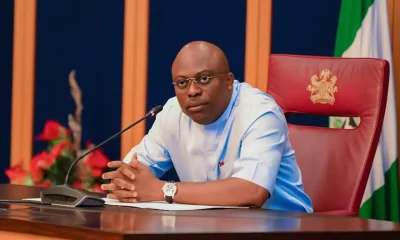


Rivers State Governor, Sir Siminalayi Fubara, has charged the newly appointed Secretary to the State Government (SSG) and Chief of Staff (CoS) to carry out their duties with discipline, loyalty and a firm commitment to the success of the administration and the wellbeing of the people of Rivers State.
The governor warned that any involvement in unauthorised nocturnal meetings or any conduct capable of embarrassing the government will attract immediate dismissal.
Fubara gave the warning yesterday shortly after the newly appointed Secretary to the State Government (SSG), Dr Dagogo S.A. Wokoma and the new Chief of Staff (CoS), Barrister Sunny Ewule, were sworn in at the Executive Council Chambers of Government House, Port Harcourt.
As part of the ceremony, the Chief Registrar of the State High Court, David Ihua-Maduenyi administered the Oath of Allegiance and Oath of Office on the duo before the governor gave his charge.
Addressing the appointees, Fubara reminded them that their elevation to the new positions was a call to service and not a platform for political grandstanding or the pursuit of personal ambition.
He stressed that their foremost responsibility should be to themselves and to the people of Rivers State, stressing that their conduct must always reflect integrity, restraint and dedication to public good.
Speaking directly to Dr. Wokoma, whom he described as an accomplished academic and mathematician, the governor expressed confidence in his intellectual depth and capacity to deliver on the new assignment.
The office of the Secretary to the State Government, Fubara stressed, demands thoroughness, discipline and a deep sense of responsibility. He charged the SSG to represent the State with honour at all times.
“Your duty includes representing the state government. You need to represent us in a way and manner that will bring honour to us.
“What is important to this administration is to see that the good works that we started and the ones that we met, are concluded in a way that will bring progress and development to our dear state,” he stated.
Turning to the new Chief of Staff, the governor explained that he is expected to ensure smooth administrative coordination, managing official engagements effectively and safeguarding the image of the Government House.
He underscored the sensitive and personal nature of the role and emphasised that the position operates strictly under the authority of the governor.
Fubara stressed that the role does not permit independent political engagements or private strategy meetings without his knowledge and consent.
“Let me sound it here very clearly. Your duty is to make sure that you handle the administrative duties and image making roles perfectly well, liaising with whoever is coming for any official assignment here.
“If you involve yourself in nocturnal meetings and all those things, I will sack you. I’m very serious. What is important to me today is peace, progress and prosperity of this state. I’m not going to compromise anything for it,” he said.
The governor cautioned that involvement of the new appointees in any action capable of bringing the government or his office to disrepute would attract appropriate sanctions.
While congratulating the new appointees, Fubara expressed optimism that they would justify the confidence reposed in them.
He called on all public officials to work together in unity, observing that collective success is stronger and more enduring than individual achievement.
The governor who also addressed the Permanent Secretaries present at the ceremony, directed those of them who have reached retirement age to start preparing their handover notes without delay.
The notice, he said, was not intended to scare anybody but to prepare their minds towards the inevitability of exiting the service one day and to pave way for an orderly transition.
He warned against any attempt to engage in financial misconduct or last-minute irregularities, stressing that he was closely monitoring the system to ensure strict enforcement of accountability rules.

Rivers State Governor, Sir Siminialayi Fubara, has dissolved the State Executive Council.
The governor announced the cabinet dissolution yesterday in a statement titled ‘Government Special Announcement’, signed by his new Chief Press Secretary, Onwuka Nzeshi.
Governor Fubara directed all Commissioners and Special Advisers to hand over to the Permanent Secretaries or the most Senior officers in their Ministries with immediate effect.
He thanked the outgoing members of the State Executive Council for their service and wished them the best in their future endeavours.
The three-paragraph special announcement read, “His Excellency, Sir Siminalayi Fubara, GSSRS, Governor of Rivers State, has dissolved the State Executive Council.
“His Excellency, the Governor, has therefore directed all Commissioners and Special Advisers to hand over to the Permanent Secretaries or the most Senior officers in their Ministries with immediate effect.
“His Excellency further expresses his deepest appreciation to the outgoing members of the Executive Council wishing them the best in their future endeavours.”
The Independent National Electoral Commission (INEC) yesterday told the National Assembly that it requires N873.78bn to conduct the 2027 general elections, even as it seeks N171bn to fund its operations in the 2026 fiscal year.
INEC Chairman, Prof Joash Amupitan, made the disclosure while presenting the commission’s 2026 budget proposal and the projected cost for the 2027 general elections before the National Assembly Joint Committee on Electoral Matters in Abuja.
According to Amupitan, the N873.78bn election budget covers the full conduct of national polls in 2027.
An additional N171bn is needed to support INEC’s routine activities in 2026, including bye-elections and off-season elections, the commission stated.
The INEC boss said the proposed election budget does not include a fresh request from the National Youth Service Corps seeking increased allowances for corps members engaged as ad-hoc staff during elections.
He explained that, although the details of specific line items were not exhaustively presented, the almost N1tn election budget is structured across five major components.
“N379.75bn is for operational costs, N92.32bn for administrative costs, N209.21bn for technological costs, N154.91bn for election capital costs and N42.61bn for miscellaneous expenses,” Amupitan said.
The INEC chief noted that the budget was prepared “in line with Section 3(3) of the Electoral Act 2022, which mandates the Commission to prepare its election budget at least one year before the general election.”
On the 2026 fiscal year, Amupitan disclosed that the Ministry of Finance provided an envelope of N140bn, stressing, however, that “INEC is proposing a total expenditure of N171bn.”
The breakdown includes N109bn for personnel costs, N18.7bn for overheads, N42.63bn for election-related activities and N1.4bn for capital expenditure.
He argued that the envelope budgeting system is not suitable for the Commission’s operations, noting that INEC’s activities often require urgent and flexible funding.
Amupitan also identified the lack of a dedicated communications network as a major operational challenge, adding that if the commission develops its own network infrastructure, Nigerians would be in a better position to hold it accountable for any technical glitches.
Speaking at the session, Senator Adams Oshiomhole (APC, Edo North) said external agencies should not dictate the budgeting framework for INEC, given the unique and sensitive nature of its mandate.
He advocated that the envelope budgeting model should be set aside.
He urged the National Assembly to work with INEC’s financial proposal to avoid future instances of possible underfunding.
In the same vein, a member of the House of Representatives from Edo State, Billy Osawaru, called for INEC’s budget to be placed on first-line charge as provided in the Constitution, with funds released in full and on time to enable the Commission to plan early enough for the 2027 general election.
The Joint Committee approved a motion recommending the one-time release of the Commission’s annual budget.
The committee also said it would consider the NYSC’s request for about N32bn to increase allowances for corps members to N125,000 each when engaged for election duties.
The Chairman of the Senate Committee on INEC, Senator Simon Along, assured that the National Assembly would work closely with the Commission to ensure it receives the necessary support for the successful conduct of the 2027 general elections.
Similarly, the Chairman of the House Committee on Electoral Matters, Bayo Balogun, also pledged legislative support, warning INEC to be careful about promises it might be unable to keep.
He recalled that during the 2023 general election, INEC made strong assurances about uploading results to the INEC Result Viewing portal, creating the impression that results could be monitored in real time.
“iREV was not even in the Electoral Act; it was only in INEC regulations. So, be careful how you make promises,” Balogun warned.
The N873.78bn proposed by INEC for next year’s general election is a significant increase from the N313.4bn released to the Commission by the Federal Government for the conduct of the 2023 general election.
-
Maritime4 days ago
Nigeria To Pilot Regional Fishing Vessels Register In Gulf Of Guinea —Oyetola
-

 Sports4 days ago
Gombe-Gara Rejects Chelle $130,000 monthly salary
-
Maritime4 days ago
Customs Declares War Against Narcotics Baron At Idiroko Border
-

 Sports4 days ago
TEAM RIVERS SET TO WIN 4×400 ” MORROW” …Wins Triple jump Silver
-
Maritime4 days ago
NIMASA,NAF Boost Unmanned Aerial Surveillance For Maritime Security
-

 Sports4 days ago
NPFL Drops To 91st In Global League Rankings
-

 Sports4 days ago
NIGER DELTA GAMES PANACEA TO YOUTH DEV”
-

 Sports4 days ago
NPFL Impose Fines On Kwara United Over Fans Misconduct