Connect with us

Sports

Basketball Excels Amidst Crisis

Published

on

Despite the leadership crisis that engulfed Nigeria Basketball Federation (NBBF) after the elections that held in June 2017, the country still excelled in the year under review.
The basketball family was fractionalized because of Tijani Umar’s refusal to acknowledge the result of the election that held in Abuja, a day after he organized an orchestrated election in Kano that returned him to power.
With the Sports Ministry and the Nigeria Olympic Committee recognizing the Abuja election, all the shenanigans at the instance of Umar faction fell flat when FIBA acknowledged in a letter affirming the Abuja election won by Musa Kida.
The letter affirmation letter became inevitable when the NOC electoral committee contented that none of the factions would be recognized at the NOC election that held last week in Yola.
FIBA in a letter dated December 18, 2018 and addressed to the Secretary General of the Nigeria Olympics Committee (NOC), Chief Tunde Popoola, who had written FIBA on the need to name the “eligible representative of the NBBF, who will be at the NOC elective Annual General Meeting (AGM) and to vote” in Yola, Adamawa State.
FIBA Secretary General, Andreas Zaglis, replied, “FIBA has communicated with the board of Kida concerning the affairs of the NBBF since July 2017 and has organized FIBA events with the same board’s assistance.
“Besides, FIBA notes that good progress is being made in regularizing fully the NBBF-FIBA relationship, which remains an internal matter of the basketball family, since the NBBF is not suspended and enjoy full rights as a member,” FIBA continued.
FIBA explained that having earlier received a letter from the NOC recognizing the board elected on the 13th of June 2017 in Abuja and the recent memo of the Federal Ministry of Youth Sports Development revalidating Kida and his board, the international body has deemed it fit to accord the board all the necessary recognition.
The latest letter, put paid to insinuations in different quarters over who is in charge of basketball administration in Nigeria expressly named Kida who recently bagged a Doctorate Degree in Credit Management as president.
The letter granting Kida (or a validly nominated delegate of his) therefore nullified the earlier erroneous pronouncement of the NOC electoral committee chaired by Alhaji Ibrahim Galadima that no board had been recognized by FIBA as the legitimate basketball federation.
With FIBA’s position clearly stated on who is in charge of basketball administration in Nigeria, Musa Kida called on all basketball stakeholders to join hands and contribute meaningfully to basketball growth.
He said despite the recent landmark achievements recorded by the board since its assumption of office, more ground could have been covered especially at the home front if not the incessant distractions.
The year began with the Commonwealth Basketball event in Australia. A home based team represented the country at the Commonwealth losing all games as expected. The team finished the competition with four straight losses. D’Tigers scored 248 points but conceded 355; with the team’s captain, Ikechukwu Diogu, posting 84 points. Nigeria however placed sixth at the end of the Games.
However, Kida desired to take the game to the next level ensured that the team got all the support needed in their bid to qualify for the 2019 FIBA World Cup in China.
D’Tigers became the first Africa team to qualify for the FIBA Men’s World Cup after winning their first two qualifying tournaments in style.
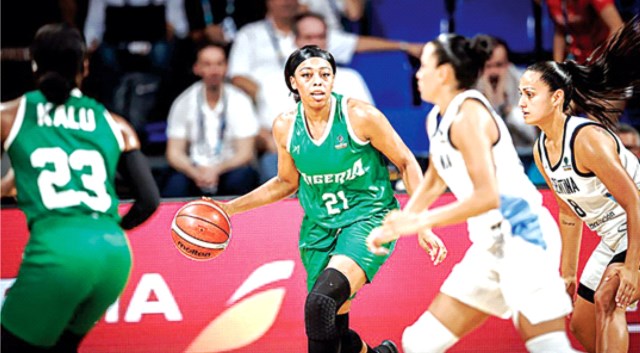
However, D’t igress participation at the FIBA Women’s Championship was the icing in the cake in a year the country recorded excellent successes internationally.
At the Women’s World Cup, Nigeria became the first African team reached the quarterfinal of any FIBA tournament and were also the first African team to win more than one game in a single World Cup tournament.
Before the tournament, D’Tigress ranked 34th now emerged as the 2nd best team in Africa, replacing Angola.
Head Coach, Hughley Otis Jr. guided the team to a record of 3-4; including straight wins over Turkey, Argentina and Greece.
D’Tigress progress did not go unnoticed by FIBA president, Horacio Muratore.
In an interview granted to the official FIBA blog, Muratore spoke among others, on the performance of Nigeria and Senegal, paying glowing tributes to the D’Tigress, especially.
“One of the best story lines of this Women’s World Cup without a doubt will be that Africa proved it has some very good teams in Nigeria and Senegal.
“These are teams that can play against anyone and I congratulate both of them for their campaigns.
“Senegal had a historic win (against Latvia) and a great game against Spain (in quarterfinal qualifications). They made the tournament hosts tremble a bit. It would have been amazing for both African teams to reach the quarterfinals.
“Nigeria outplayed the USA – the reigning world champions – in the first half of their quarterfinal and got wins over Turkey, Argentina and Greece.
“This is extremely positive for African basketball and for the sport in general.”
At the club level, Rivers Hoopers, Nigeria champions, described the year as the best ever in the history of the club.
Hoopers for the first time won the FIBA Africa Zone 3 Championship early in December in Cotonou finishing with a 5-0 record.
Looking back on 2018, Ifie Ozaka, General Manager of the club labelled it a bitter-sweet experience for the Zone 3 Champions who played only two games all year, before the competition in Cotonou.
“I will describe 2018 as turbulent for the team. We didn’t play any competitive basketball till November where we had only two competitive matches, which qualified us for the FIBA qualifiers in Zone 3. From the turbulence of 2018 we are ending the season on a high. A turbulent season turned out to be our best season and highest point ever in the history of the club.”
Ozaka continued, “Playing a long league where players have to play many matches, where players get more allowances, where the fans of the team come out and watch the team play week in, week out that’s what I would have loved to do this season.
“Not playing a long league and not just the Kwese league wasn’t too good for my team and also fans of basketball in Port Harcourt.”
“I was very impressed with my boys. At the beginning of 2018 when we went out to recruit the couple of players we wanted I think we made very good choices in the transfer market.
“The players we brought in filled the gaps properly. I told them it’s been a long time I had a bunch of talented young men together as a team. A team I believe that can hold their own against any team in Nigeria so I was very impressed with their play judging that they have not had a long time together.
“They played a lot of physical sides and I say kudos to them and if we can keep them together for another season I am sure they will go on to do great things.”


Tonye Orabere

Continue Reading

Sports

Tackling age falsification among athletes In Nigeria 

Published

on

The January 16, 2026, deadline handed to Nigeria by the World Athletics Integrity Unit (AIU) to explain the circumstances surrounding multiple dates of birth for 17 Nigerian athletes may have triggered another round of trouble for the Athletics Federation of Nigeria (AFN)

In countries where sport is seen as a serious business, both governments and individuals treat age falsification as a crime due to the significant danger it poses to society.

Age falsification is a practice where athletes, coaches, or individuals within the system alter their ages to gain an unfair advantage, and in the process prevent younger and qualified individuals from career progression and employment opportunities.

Apart from leading to frustration and high youth unemployment rates, competing in lower age brackets or extending eligibility undermines the fairness, credibility and integrity that sports are meant to embody.

The ripples of such dishonesty stretch far, impacting individual athletes, programmes, and the global reputation of competitive athletics.

From a moral standpoint, age falsification erodes trust within the sporting community; it kills the morale of junior athletes, who train tirelessly only to compete against older folks or those who are more developed physically and mentally. This level of deceit not only denies younger athletes the recognition that they deserve but also creates an uneven playing field that violates the spirit of competition.

Beyond emotional consequences, the long-term damage could hinder the development of talented athletes, who may decide to walk away due to unfair competition.

In well-organised sports societies like the United Kingdom and the United States, severe legal penalties await offenders, including imprisonment and fines, as well as career consequences (loss of job, medals, or permanent bans), among others.

Such serious-minded countries see age falsification as fostering a culture of dishonesty and fraud, as other corrupt acts often move in tandem with it, making the system less efficient and effective.

To them, age falsification undermines trust and accountability within institutions, as it signals a corrupt and unfair system. It tarnishes a nation’s international reputation, leading to global ridicule and sanctions from international bodies like FIFA, World Athletics (WA) and the International Olympic Committee (IOC).

Conversely, in Nigeria, age falsification seems to have become a practice among certain individuals and organisations, as they see every competition as a “must-win” event to impress their patrons. Yet, there are some Nigerians who view age falsification as a systemic issue, driven by economic and social pressure from “pay masters”, not minding the results, which include breakdown of integrity, fairness, and efficiency at all levels of society.

The Athletics Federation of Nigeria (AFN), for the second time in two years, has become a centre of global attention, following a December 2, 2025, letter from the World Athletics’ Integrity Unit (AIU) that raised concerns about multiple dates of birth for 17 Nigerian athletes, who competed at the 2025 African Combined U-18/U-20 Athletics Championships in Abeokuta, Ogun State.

In June 2024, the AIU queried the AFN following discrepancies in the ages of four Nigerian athletes, who were preparing for the World U-20 Championships in Lima, Peru.

The AIU said then that it “identified discrepancies regarding the date of birth (DOB) for at least four Nigerian athletes,” noting that “each of these athletes has at least two, and sometimes three or more, different DOBs, which have been used to enter competitions at different times.”

The AIU said: “It was not aware of any reason why these athletes appear to have completely different, multiple DOBs. It is also not clear whether the identification documents submitted by the athletes (such as passports) are true or whether they have been forged or falsified.”

The AIU letter on June 7, 2024, addressed to AFN President Tonobok Okowa and former Secretary Rita Moshindi, was signed by the Head of the Athletics Integrity Unit, Brett Clothier. It gave the AFN until Friday, June 21, 2024, to respond to the query.

Then, the AIU demanded that the AFN submit, among other things, the athletes’ current passport, all previous passports, birth certificates, national ID cards, documents submitted in support of passport applications, medical records, including hospitalisation records, dental records, vaccination records as well as education records, including matriculation records, school end-of-term/year reports and school examination results, among others.

In the current query, the AIU revealed shocking discrepancies, as Juliana Ademola Temitope, listed as born in 2005 in earlier competitions, had her date of birth suddenly changed to 2006 at the African Junior Championships.

Adeola Adenji Muideen appeared with a 2004 birthdate in Lagos, but astonishingly became 2009 elsewhere. Esther Aiffigbo competed in 2025 as a 2006-born athlete, yet her World Athletics profile lists 2002 as her year of birth.

Ibrahim Ajibare has no fewer than four different dates of birth, ranging from 2002 to 2009, while Emmanuel Blessing’s DOB was entered as 2007 at the Juniors, but 2002 at the Asaba Trials.

For the AIU, these definitely are not clerical errors, but deliberate manipulations designed to sneak overage athletes into junior competitions. The AIU has made it clear that such practices undermine the honesty standard of athletics and cast doubt on Nigeria’s integrity in global sport.

The demand by AIU is clear: the AFN must produce verifiable documents such as birth certificates, passports, school records, or medical files to prove the athletes’ true ages.

Anything less will trigger a formal investigation into age manipulation, a violation of the World Athletics Technical Rules and the Integrity Code of Conduct.

As it stands, unless the AFN produces credible, contemporaneous documents by the January 16 deadline, the country will face another round of investigations that may tarnish its athletes’ reputations and damage the country’s image.

Instead of answering the AIU’s direct questions on why athletes have conflicting dates of birth, the AFN elected to sit in judgment over itself by setting up a probe panel made up of some of its board members.

To some stakeholders, that is a conflict of interest.

A former President of the AFN, Olamide George, told The Guardian from his base in the United States of America that the issue of age falsification under the present AFN leadership has long been a troubling shadow over the federation’s integrity.

“The AIU’s introduction of stricter sanctions could represent a turning point in addressing this long-standing challenge,” George said. “For every cheat, there must be a penalty.”

The Ondo State-born sports administrator further said: “After thorough investigation by AIU, it could decide to suspend the affected athletes, ban officials implicated in the fraud, and penalise the federation, to deliver justice while signalling a commitment to reform.”

According to him, the AFN needs advanced biometric solutions or data verification systems to pre-empt tampering with documents like birth certificates.

“But the question is, ‘Is the leadership ready to lead? Is it equipped and prepared for leadership?’ What a shame. These measures put the spotlight not just on athletes, but also on the adults or institutions that enable such practices. After all, the root cause often lies in organised manipulation rather than individual decisions.”

George continued: “On the flip side, a key challenge is how to balance the punishment with fairness. Some athletes may find themselves penalised for actions they didn’t directly control, particularly minors whose documents were altered by parents, coaches, or administrators. This raises broader ethical debates.

“How do we ensure that sanctions deter dishonesty without unfairly punishing victims of a corrupt system? Governments and athletics’ governing bodies will need to walk a fine line between accountability and compassion.

Ultimately, these stringent measures are aimed at restoring confidence in the purity of athletic achievements.

Sanctions alone, however, may not be enough. I, therefore, call on the NSC to reform the AFN because the federation needs systemic reform, including better education, transparency, and more pathways for athletes to rise on merit. Only then can sports truly embody values like honesty, dedication, and perseverance; values worth preserving for future generations.”

“The AFN President, Tonobok Okowa, should be the first to stand accused. He failed to act when the issue first emerged, and his poor judgment in appointments has only deepened the rot.”

Even before setting up a probe panel to investigate the latest age falsification saga, the AFN boss, Okowa, had absolved the federation of blame, but fingered athletes and their coaches in the age-cheating scandal.
Speaking on a radio programme, Talk Sports, Okowa insisted that athletes and their coaches are responsible for the infractions. He described the behaviour of some athletes and their coaches as “worrisome.”

“This issue has nothing to do with the AFN. Athletes keep attending different competitions with their coaches, who register them with varying dates of birth. You can see somebody with a date of birth that is just about 13 days different. Is that a typographical error or whatever it is?” he asked.

Okowa explained that the federation, which had perfected its database, was shocked to find out that some athletes entered competitions using different dates of birth that differed from those in its database. “That is just what it is. What reason will a coach have to change the date of birth of an athlete? It is getting worrisome,” he said.

But the president of the Athletics Coaches Association of Nigeria, Solomon Aliu, disagrees with Okowa. He said that coaches should be absolved of the blame because they work with athletes given to them. Aliu, who is also AFN’s Head Coach, described the latest age falsification saga as more of a record-keeping problem.

“Anybody who is blaming age falsification by athletes on coaches’ doorsteps is being untruthful,” Aliu said.

“What I know about crime prevention is to make it difficult for the criminal to commit the crime by putting in place preventative measures. If the AFN Secretariat has a functional database with the relevant information about our athletes from their very first competition, i.e., Date of Birth and other relevant data, athletes or their coaches cannot wake up to change the athletes’ DOB without the Secretariat flagging such an athlete.

“Coaches are not the record keepers of the federation, and as such should not be blamed totally for this mess that we are faced with. I am happy that the NSC is taking the issue of age cheating in our sports seriously. I’m also certain that AFN will wake up to its responsibility to investigate properly and bring to book whoever is involved in this disturbing trend. Until that is done, I won’t accept anybody trying to tarnish the image of our hard-working coaches. We deserve to be patted on the back and not subjected to name-calling. Heads must roll, but let the head of the innocent remain on their necks. Let us all work together in cleaning up our sports, not just of age cheats, but also of dope,” Aliu stated.

To a former Secretary of the Delta State Athletics Association, Monday Akpoyibo, the age falsification scandal in the nation’s athletics became more rampant during the tenure of a former AFN president (names withheld).

“It was during his tenure as AFN president that the issue of age falsification became rampant because of his desire to win at all costs,” Akpoyibo told Tidesports source.

“In the days of Adeyemi Wilson and Dan Ngerem, they had zero tolerance for age cheats. If the AFN had a good database of its athletes, there would be no age falsification. As far back as the 1973 National Sports Festival, there were three categories of athletes. We had the U-13, Intermediate class and Men/Women class. This system enabled athletes to grow from one class to another as they mature into the Games. So, it was pretty difficult to cheat since the federations had your data,” Akpoyibo stated.

Continue Reading

Sports

Remo Stars set for Ikenne return

Published

on

Reigning Nigeria Premier Football League champions, Remo Stars, are set to return to their Remo Stars Stadium in Ikenne for the second stanza of the 2025/26 season following the completion of renovation works on the ground.

The Sky Blue Stars will make their long-awaited return on January 7, when they host Ikorodu City in their NPFL matchday 20 fixture, bringing to an end a five-month spell away from home in Abeokuta.

Chairman of the club, Kunle Soname, confirmed that the stadium was ready to welcome the team and its supporters again after major renovation works were carried out on the pitch.

“Renovation of the pitch has been completed and has been certified even by the FIFA inspection team. Our first game will be against Ikorodu City when the second stanza of the season resumes,” Soname told Tiesports source.

First opened in 2020 and hosting its maiden league fixture in 2021 following the club’s return from the second division, the stadium’s hybrid synthetic turf has now been replaced with a new surface after five years of use.

At the start of the season in August 2025, Remo Stars adopted the MKO Abiola Sports Arena in Abeokuta, the Ogun State capital, as their temporary home ground while renovation works were ongoing in Ikenne.

However, life in Abeokuta has proved challenging for the champions, who have struggled for consistency in their bid to defend the title. They opened the campaign with a 1-1 draw against Rivers United on August 22, 2025, before suffering home defeats to Rangers International on November 13 and Bendel Insurance, who edged them 3-2 on Sunday, December 21.

Remo Stars also played their CAF Champions League preliminary matches in Abeokuta but once again failed to reach the group stage. They cruised past Comoros champions Zilimadjou with a 5-0 aggregate victory in the first round, only to be outclassed by South African giants Mamelodi Sundowns, who sealed a dominant 7-1 aggregate win after a 5-1 victory in Nigeria in October and completing the rout in South Africa.

Currently languishing in 16th position on the NPFL table with 22 points from 19 matches, Remo Stars will hope their return to Ikenne provides the spark needed to revive their campaign in the second stanza of the season.

Head coach Daniel Ogunmodede, who is currently on national team duty with the Super Eagles at the 2025 AFCON, had earlier attributed the club’s slow start in the league to the temporary change in home ground.

“It is not an excuse, but things might have been different if we had played our home games in Ikenne,” Ogunmodede said in August 2025, following the draw against Rivers United.

Remo Stars enjoyed a remarkable run in the league last season, clinching their first-ever title with 71 points, seven clear of second-placed Rivers United.

While they may no longer be in contention for the crown this term, it remains to be seen how much they can salvage from the campaign upon their return home.


Continue Reading

Sports

Soname Calls For  NPFL referees  demotion

Published

on

Remo Stars owner Kunle Soname has launched a strong criticism of officiating in the Nigeria Premier Football League, calling for referees involved in what he described as clear and obvious errors this ongoing season to be held accountable and demoted, Tidesports source reports. .

Speaking to the media on Wednesday at the Remo Stars Sports Complex in Ikenne, Soname said the club’s concerns were driven by repeated decisions that have, in his view, tilted matches unfairly.

Remo Stars currently sit 16th on the NPFL table, one place and one point above Barau FC in the first relegation spot, a sharp contrast to last season when they lifted the league title.

Soname referenced several incidents this campaign, including a recent game against Ikorodu City, the matchday 18 fixture involving Remo Stars and Insurance, as well as video footage from the Barau and Shooting Stars encounter, all of which he said highlighted inconsistencies in refereeing decisions.

He insisted that the issue was not a blanket attack on referees but a demand for accountability and consistency.

“Referees can be good. They can get the job done. They just decide to apply the rules in a different way. Now, we have just brought this out now because they are clear and obvious errors. But we all know football, there are many instances where their bias will not result in goals,” Soname said.

He added that the problem often lies in repeated marginal decisions favouring one side.

Say 50-50 calls, they are just consistently giving it to one side, one side, one side. So if there is a body that will watch all the games and that will hold them accountable and say, ‘Listen my friend, why is this a foul in this match for this team in yellow, and the same thing has happened here against them and it’s not a foul?’ Then everybody will sit up and the game will be fair.”

He added, “The committee should reward referees who are doing great jobs and punish those with poor officiating by demoting them to the NNL. It is not the kind of demotion that after one or two weeks they are back, they should be demoted for the entire season.”

Soname stressed that fairness was fundamental to the growth of Nigerian football.

“The better teams will win and that is how football can develop and grow in this country,” he said.

He was also keen to distance his comments from what he described as a misdirected attack on the Nigeria Football Federation.

They will say, ‘He’s attacking NFF.’ It has got nothing to do with NFF. NFF did not appoint referees. It is the committee that appointed the referees. NFF did not hold the whistle to come and do stupid things on the pitch,” he said.

According to Soname, responsibility must be shared between match officials and those who appoint them.

“The referees will carry their cross and the appointment committee will carry their cross as well. Under whose purview is the referee appointment? NFF committee appointed them. That is exactly what I’m saying,” he stated.

He called on the federation to ensure the right people oversee officiating.

“The NFF needs to put proper people there, proper people, that will just ensure accountability and fairness. That is all we require. And trust me, if there is fairness on the pitch, this football will grow astronomically in this country.”

Soname also rejected suggestions that Remo Stars had benefited from refereeing favouritism in the past, particularly during their title-winning campaign.

“Anybody that says he collected one cent from Remo Stars last season, season before last, season before that one, should come out and say it and I will sack that official the same day. That is not what we stand for,” he said.

“I challenge anybody, anybody. If the person can prove it, the person that did that in this club is gone the same day. Gone,” Soname said, adding that Remo Stars’ operations were transparent and could not conceal such payments.

Beyond officiating, Soname highlighted the broader financial realities of Nigerian football, noting that most clubs operate at a loss. He explained that Remo Stars rely heavily on their academy model to sustain the club.

However, he argued that financial strength should be expressed through squad building rather than manipulation.

“If you have more money, go and recruit Ronaldo, pay him, he will score 30 goals and you will win the league. Resources need to be channeled towards competition, towards fairness. It cannot be the other way,” Soname said.

Continue Reading

Trending