
Sports
Sports: A Harvest Of Achievements

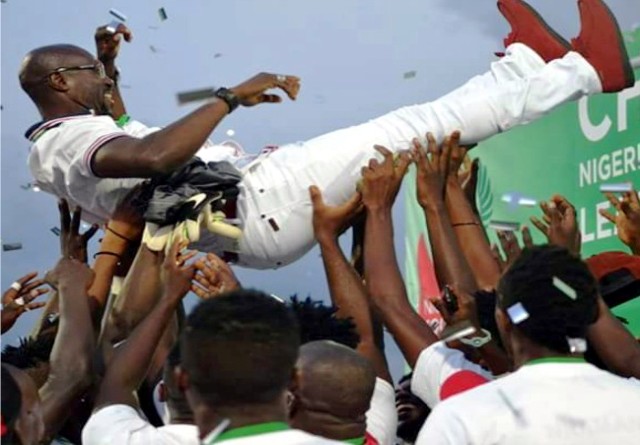
Since creation, about 50 years ago, the geographical expression called Rivers State has been one of the major players in the Sports industry in Nigeria. From the production of sportsmen and women, who grew to win laurels, national and international glory for the country, and the development of Sports infrastructure, the state has been central.
Therefore, at times like this, when scoresheets are collated, and past strides are analysed, counting the leaps and honour roll call of Rivers State in sports 50 years into its creation would not be out of place.
Looking back and, chronicling the giant strides of the state and her people would however not be a simple or an easy task.
Having been created on the 27th of May 1967, the State shaped its identity not only on the economic and social front but in sports as well. From the outset, the state played frontal roles in shaping the course of sports development and talent contribution to the country. From the provision of sports facilities that at different times were put at the disposal of the country, and thrusting forward athletes to fly the nation’s flag at international competitions, Rivers State has been among the top five. It is this vision, one of those of the founding fathers of the state that has kept the state in the front burner of players in the country’s sports industry. It has made Port Harcourt a destination of choice for national sports events.
From its creation to present day, the State can boast of facilities that have placed it at the top of proud owners of modern sports facilities that can be described as world class in Nigeria.
Since the days of the famous Recreation Stadium, to the impressive but uncompleted Liberation Stadium of Old, and the Civic Centre, later Christened the Alfred Diete-Spiff Sports Complex, Rivers State has improved infrastructurally.
Today, the State can celebrate the impressive and ultra modern Adokiye Amiesimaka Sports Complex which was started during the administration of the immediate past governor, Rotimi Amaechi and completed by the incumbent, Chief Nyesom Wike.
It is an imposing infrastructure that boasts of space and facilities for almost all kinds of sports, from athletics, ball games, racquet sports, aquatic sports, indoor halls, medical and administrative centres, a mainbowl and multiple training pitches to other facilities.
The complex has become an addition to the facilities put in place by the first Military Administrator of the state and now a respected elder statesman, King Alfred Diete-Spiff.
Due to the presence of these facilities and additional basketball, volleyball, handball and tennis facilities in the Town axis of Port Harcourt, the state capital has become a consummate centre for wearing and expression of talent and home for many national and international Sports events.
In fact, the state has at different times come to the rescue of Nigeria, particularly, as her teams tried to qualify for international competitions. The state under Sir Peter Odili played pivotal role in ensuring that the national football team, the Super Eagles qualified for the 2002 World Cup in Korea/Japan.
Governor Nyesom Wike also, barely months in office placed the Adokiye Amiesimaka Stadium at the disposal of the national team and the youth side, the Flying Eagles, as they laboured to relaunch themselves into international competitions.
The State’s ambience and hospitality played major roles in the teams’ progress at the time the Nigeria Football Federation, NFF, was in a difficult position and no other state wanted to shoulder the responsibilities of the national teams.
As hosts of the 1999 U-20 World Cup Sub seat of the Local Organizing Committee, LOC, Nigeria ’99, the State was among the subseats that received accolades for the way the teams were hosted, events organized and the spectators’ comportment throughout the first football World Cup played in Nigeria.
Apart from the football teams, Port Harcourt has also been a Mecca of sorts for intellectual discussions on ways of advancing the cause of the Sports sector in Nigeria. Many Sports federations would rather take their events, especially workshops, seminars and other events to the city rather that anywhere else.
It is on record that the state is among the list of few in the nation to have hosted the National Sports Festival, an event designed to be the discovery and launch pad for emerging and young talents into national assets, twice since inception, in 1988 with ‘Rivers 88’ and in 2011 when Garden City Games 2011 made headlines for the best reasons.
In fact, the Garden City Games was adjudged the most glamorous and best organized edition of the National Sports Festival. To date, a few have tried but no state has been able to match the standard set by that memorable festival.
It is to the credit of the state that one of the few Sports High Performance centres in Africa and the major one in West Africa is hosted in the State, with the centre at the University of Port Harcourt critical to the wearing and preparation of athletes for major competitions.
In addition to the infrastructural weight of the state as far as the Sports sector is concerned, there are also landmark achievements, stars and heroes of yore and present to celebrate.
Over the years, athletes discovered on the streets, creeks and coastal areas of the State have grown to win laurels and bring glory not only to Rivers, but Nigeria as a whole. From the time of the Old Rivers State to present day, athletes and teams from the State have made appreciable marks in the sands of time.
Therefore, as the drums are rolled out this day in celebration and reminiscences of the giant strides of Rivers and her people, some thoughts and recognition must be spared for those that have written the name of the state in gold though sports at one time or the other.
Multiple title winners, Rivers United Football Club of Port Harcourt in its days as Eagle Cement FC and Dolphins FC of Port Harcourt has severally won the National challenge Cup, now Federation Cup and the country’s top flight title to be regarded as one of the most successful football clubs in Nigeria. The Club is currently, under their new identity as Rivers United, the only survivor flying the country’s flag in a CAF’s continental football competition CAF Confederation Cup, this season. Rivers Angels FC, one of the pioneers of women football clubs in Nigeria has also become serial winner of all the national titles on offer, be it the League or the Federation Cup competition.
The state was also able to break the ice and wrote its name among the few that have won the National Sports Festival, when Rivers hosted and won remarkably the 17th edition in 2011.
At individual levels, athletes and sports administrators from the state have equally been able to hold their own and ensured that the state at different times was proud to have had worthy sons and daughters that represented her well.
“In the 1970s and ’80s, the state was so blessed with talents’ recalled one of the veteran athletics coach still around today, Tobias Igwe, fondly called ‘Toblow’ in a recent interview, ‘ that the state was a major supplier of athletes to the national camps, the state had a way of throwing up athletes as if they were on standby:
Interestingly, as the old generations fade, new ones emerge to take over the mantle.
Leading the old brigade was late Dr. George Ogan, an accomplished athlete and technocrat that was one of those Nigerians that were sent to study why the Germans were so successful in Sports in the 1950s and ’60s. He was also among those that wrote the letters of the National Sports festival in Nigeria. Dr. Ogan, who died recently was a pioneer long and triple jumper in the ’60s.
Another triple jumper, Chief Nemi Adoki bestrode the event at the Oluyole ’80 National Sports festival. He ruled the sport in his days before veering into sports administration. Adoki is among the pioneer members of the National Association of Athletics Technical Officials, NAATO.
Another old brigade athlete is Warisenibo Kalada Aminiokuma. The Bonny-born high Jumper of repute dominated and popularized the event in the State as he won several meets, especially in the then Eastern region of Nigeria.
There are several other athletes and stars of yester-years who deserve mention and recognition, particularly at this time of celebration. Mr. Joshua J. Kio, popularly known as J.J. Kio is one of such athletes. Kio took the baton for his Kinsman, Ogan and became synonymous with triple jump. He won several national and international laurels.
An astute technocrat, who has superintended over the Rivers State Sports Institute, Isaka and served as Director, Sports Development in the Ministry of Sports remains one of the state’s only two time Olympians. He was part of Nigeria’s contingent to the 1980 Moscow Olympies and the subsequent edition in Los Angeles in 1984.
Step out Chief Adokiye Amiesimaka, MON, JP, an erudite scholar, broadcaster, footballer and Sports administrator. Amiesimaka among other things remains one of the most celebrated members of the maiden title winning football team, Green Eagles when the country lifted the African Cup of Nations in Lagos in 1980. Amiesimaka, who played for the national team as an undergraduate also laced boots for the famous Rangers International of Enugu and Sharks FC of Port Harcourt, which he later managed as chairman.
Late Ombo G. Peters was one of the best sprinters to have come out of the state. He was a specialist in the sprints and long jump and was a member of the Nigerian team to Edinburgh 1986 Commonwealth games. There was also Ethel Jacks, a table tennis Amazon who ruled the circuit before the emergence of players from the South West as leading forces of the Sport.
Also part of the old guard were Tamunoemi Gibson, late Silas Ogwuama, Graywood Oruwari, Tari Tikili, Mbakabuari Fyneface and Godwin Banuna, who held sway in badminton and athletics.
Then enter the recent generation of athletes, who consistently put Rivers on the map by sustaining the character and performance of the state at national and international competitions.
Time was when the state was a colossus in weight-lifting. That time belonged to the likes of Ojadi Aduche, Oliver Toby and Benjamin Minimah were the leading lights.
Aduche blazed the trail in the 1990s, dominating almost every National Sports festival and flew the country’s flag at the All Africa games, Commonwealth Games and the Olympics. He won gold medals at Kenya and Cairo ’91 All Africa games Silver at the Commonwealth games in 1990 and represented Nigeria at the 1992 Olympic Games in Barcelona.
Following the trail of Aduche were Oliver Toby, a 64kg Category Weightlifter and Minimah, a heavyweight. Toby was a Junior Championship Champion at several World weight lifting Championships, winning gold in Florida in 1990 and in turkey in 1992. He also won three gold medals at the world junior Weightlifting Championships in 1994 in Canada and earlier secured two gold medals at the All Africa Games, Cairo 1991 and two gold and one Silver in Kenya. He is also an Olympic games in Barcelona.
Minimah on his part, rode the national scene, particularly the National Sports Festivals in the 1990s. he quit competitive weightlifting after Bauchi 2000 National Sports festival.
Gabriel Nwanetanya



The Nigerian, who arrived in China fresh from winning gold at the African Senior Athletics Championships in Ghana earlier on Wednesday, clocked a season’s best of 12.41s behind Olympic champion Masai Russell and Bahamian star Devynne Charlton.
Russell produced a dominant display to win the race in a meeting record and world-leading time of 12.25s, improving on her previous world lead of 12.40s.
Charlton, the reigning world indoor champion, finished second in 12.38s in one of her strongest outdoor performances to date.
Amusan, whose world record of 12.12s remains the fastest time ever run in the event, improved significantly from her previous season’s best of 12.84s set during her victorious outing at the African Championships in Accra.
The 29-year-old was competing in a stacked field that included reigning world champion Ditaji Kambundji of Switzerland, Jamaican pair Megan Simmonds and Ackera Nugent, China’s Wu Yanni and Americans Tonea Marshall and Danielle Williams.
Kambundji, who won the world title in Tokyo last year with a Swiss record 12.24s, finished fifth in 12.82s, while Jamaica’s Nugent placed sixth in 12.98s.
Marshall and Williams failed to finish the race.
Following Amusan’s victory in Accra, the three-time Diamond League final winner expressed gratitude to her supporters while insisting she remained determined to achieve more success this season.
“Beyond grateful to God, my team, supporters, and everyone who continues to believe in me through every season. Historic feeling. Still hungry for more. The mission continues,”

The 10-time African champions are scheduled to take on the Teranga Lionesses on June 5 and 8 at the Remo Stars Stadium in Ikenne, Ogun State, in what will form a key part of their build-up to July’s continental tournament.
The fixtures were confirmed on social media platform X by Super Falcons Show, which announced the details of the encounter and venue.
“Nigeria’s senior women’s national team, the Super Falcons, will take on Senegal Women’s National Team in a double-header international friendly scheduled for June 5 and 8,” the post read.
“Both matches will be played in Ikenne, Nigeria.”
The friendlies come after Nigeria’s proposed training tour of the United Kingdom, which included a planned match against Jamaica, was cancelled due to scheduling complications linked to FIFA’s official women’s international window. The timing meant clubs would not have been obliged to release players.
With that tour shelved, the Senegal fixtures now offer a timely opportunity for coach Justine Madugu and his technical team to assess squad options, test tactical systems and strengthen team cohesion ahead of the WAFCON campaign and longer-term qualification targets for the 2027 FIFA Women’s World Cup in Brazil.
Senegal are expected to provide a competitive regional test, with their physical style and disciplined organisation likely to offer Nigeria a different tactical challenge across both matches.
The Super Falcons, who have dominated African women’s football for decades, will be aiming to use the double-header to fine-tune preparations as they pursue another continental title in Morocco next year.

Dr Bojuwoye, a seasoned medical professional with extensive experience in road running events across Nigeria, is expected to bring added value to the race through his expertise.
As medical director, his responsibilities will include overseeing emergency medical response, coordinating first aid stations along the course, ensuring athlete safety, and supervising medical volunteers and paramedics.
His role is critical in safeguarding the health of both elite and recreational runners, as well as spectators.
In addition to unveiling its new medical director, the organisers also announced five corporate partners for the 2026 edition.
The Development Bank of Nigeria (DBN), Petralon Energy, Razzl Drink, Dan Oil, and Carloha Motors have joined as sponsors, reflecting the race’s growing appeal across diverse sectors of the Nigerian economy.
The Okpekpe race, organised by Pamodzi Sports Marketing Company, has steadily risen in prominence since becoming the first road race in Nigeria to earn World Athletics label status in 2015.
It has since advanced to Gold Label Race status, attracting elite athletes from around the world and cementing its reputation as one of Africa’s benchmark road-running competitions.
Edo State, under the leadership of Governor Monday Okpebolo, has reaffirmed its commitment to supporting the race, citing its role in promoting tourism, community pride, and international recognition for the region.
Race Director Zack Amodu noted that the new partnerships underscore the event’s stature and its impact beyond sport.
We are delighted to welcome DBN, Petralon, Razzl, and Carloha Motors as partners for the 11th edition. Their support, alongside the backing of Edo State, not only strengthens the race but also reinforces its role as a platform for promoting excellence, youth empowerment, and community development,’ Amodu said.
Beyond its sporting significance, the Okpekpe International 10km Road Race has become a catalyst for social, health, and economic benefits.
It encourages fitness and healthy lifestyles, fosters social cohesion by bringing communities together, and generates economic activity through tourism, hospitality, and local commerce.
The event also showcases Edo State’s cultural vibrancy while contributing to Nigeria’s growing reputation in global athletics.
The 11th edition is expected to draw elite athletes, local participants, and international attention, further consolidating Nigeria’s place on the global athletics calendar.