
Politics
OB Lulu-Briggs: Finding Rest For A Great Statesman

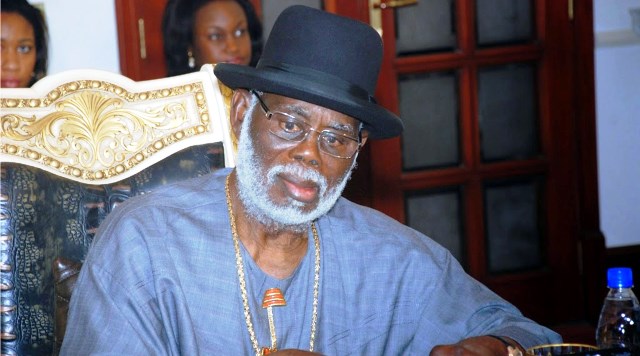
It is no longer news that the distinguished politician, statesman, corporate titan in the oil industry and philanthropist par excellence, the great and phenomenal High Chief Olu Benson Lulu-Briggs answered the glorious home call of his Maker in December 2018. What is news however is the controversy that has defined and surrounded his funeral rites and burial since he passed on over one year ago.
Though he was defined more by his philanthropy than by his other contributions to the nation, he was never the less, an ebullient and charismatic leader and a formidable political colossus in his days, who rose to become one of the revered leaders and outstanding statesmen of Nigeria’s political-cum democratic metamorphosis.
Indeed, the history of our national politics, especially the robust and exciting epoch of the Second Republic, will be grossly incomplete without critical chapters, dedicated to celebrate a man who gained unparalleled prominence and national recognition for his progressive role as the National Deputy Chairman of then ruling party, the National Party of Nigeria, NPN, which was the dominant political party in Nigeria from 1979 to 1983.
Already grounded and well celebrated in the politics of trade unionism in his civil service years as a civil servant at the Nigerian Ports Authority, where he rose through the ranks during his 23-year plus career at the NPA, High Chief Lulu Briggs served as Secretary of the Workers Union for seven years; Chairman of the Maritime Trade Union Federation of the Eastern Ports for three years (1968-1971) and was a founder and President (from 1970-1972) of the Rivers State Council of Labour. When he retired from NPA in 1978, he was its Principal Industrial Relations Officer and Head of Division, Eastern Ports, a position never attained by an indigene before now.
His desire to affect the cause of national politics for the better informed his purposeful venture into partisan politics at the onset of the Second Republic and he was one of the founding fathers of the then ruling National Party of Nigeria, NPN.
In September 1978, the military government, headed by General Olusegun Obasanjo, lifted the ban on political activities in Nigeria in preparation for the return to civilian rule. This led to the formation of new political parties – including the National Party of Nigeria (NPN). With its catchy motto, “One Nation, One Destiny,” and a strategy that included an alliance between Northern leaders and their southern minority counterparts, NPN was viewed as the party that best accommodated Nigeria’s diversity and stood a good chance of winning what would be a keenly contested election. High Chief Lulu-Briggs was active in politics in the Old Rivers State. As a vocal and influential businessman, he emerged as a leader at the Constituent Assembly of 1978
He became a founding member of the NPN in Rivers State, acting as its first Protem Secretary in 1979. He stunned political watchers during NPN’s first national convention, where he emerged as its National Vice Chairman (South) – defeating more experienced politicians. He was prominent in the NPN’s Presidential Campaign, travelling the length and breadth of the country with Alhaji Shehu Shagari, its presidential candidate and helping secure the votes from what is now known as the South-South.
As an NPN party leader, he was a major force for stability within the party, known for his discipline, honesty, fair mindedness and forthright manner. His was a respected voice, which he used to push for policies that promoted growth and human development, as well as recognition of issues of minorities and of what is today known as the ‘Niger Delta’, such as environmental challenges and inadequate funding for a region that provides most of the country’s revenue.
During his NPN years, High Chief Lulu-Briggs served as Chairman of the National Animal Feeds Company (the precursor to the National Fertilizer Company of Nigeria, NAFCON) from 1981-1983. He was also a director of the Rivers State Transport Corporation, RTC, 1979-1982, both of which became symbolic establishment success stories of which glowing tributes and nostalgic narratives are still referenced till date.
Even after the NPN government was overthrown by the military in 1983, High Chief O.B Lulu-Briggs remained a popular go-to politician, regularly consulted and brought into progressive national conversations, dialogues and initiatives. His political stature was such that he even ran for the office of President of Nigeria in the early 1990s under the defunct Social Democratic Party (and the Option A4 political experiment). He was the elected candidate in Rivers State, polling over 72% of the popular vote in a field comprising five other contestants and when that political process was eventually truncated, he continued to champion the need for political service which placed his beloved country Nigeria and the empowerment of its teeming populace – not personal, parochial and petty interests – at its centre.
It is noteworthy that High Chief O.B. Lulu-Briggs emerged from political office and public service without any smear on his integrity. And during his time as a politician, his businesses continued to function and provided him enough income to keep his personal affairs running.
High Chief Dr. O.B. Lulu-Briggs was a diligent Kalabari community leader, who lived up to and promoted the standards of his community and culture established by his renowned maternal and paternal forebearers.
He established the Lulu-Briggs chieftaincy stool in 1991 and was elevated to the Young Briggs Iniikeiroari V chieftaincy stool of the Kalabari Kingdom in 1993. He built the Chief Young Briggs Memorial Hall and Mausoleum, cementing his place in the history of the Oruwari Briggs War Canoe House as a worthy son. He also constructed the Oruwari Briggs Memorial Hall in Abonnema. It is therefore not surprising that the family and community fondly bestowed on the High Chief, the great Kalabari warrior’s sobriquet, ‘Opuda.’
In 2017, High Chief Lulu-Briggs was appointed Acting Chairman of Abonnema Council of Chiefs till the controversies raised by the suspension of the Chairman of the Council were resolved.
Indeed, it is against the backdrop of these outstanding, achievements, contributions and the peerless and legendary personality of his phenomenal reputation that the controvesy and acrimony which have overshadowed his final burial rites leave a sour taste in the mouth and a sad reflection of the absolute disrespect which his excellent legacy has been subjected to since his passing in 2018.
His son and Chief mourner, Chief Dumo Lulu-Briggs succinctly captured the unsavoury sequence of events that have bedeviled and truncated every effort to give the mercurial partrach a befitting burial, while addressing a meeting of the Oruwari War Canoe House in Abonnema, headquarters of Akuku-Toru Local Government Area of Rivers State on February 15, 2020 to give an update on the latest impediment standing in the way of choosing a date for the burial, following the recent dismissal of all cases and the order to hand over the mortal remains of the great man to his family for burial, by the Supreme Court of Ghana
Lulu-Briggs said: “Our father, the late Paramount Ruler of Oruwari War Canoe House died on December 27, 2018. Until this day, we have not been able to bury him and the simple reason is that we do not have his mortal remains.
“This matter has been subject of several litigations brought by his widow, Mrs. Sienye Lulu-Briggs, against his sons and myself, the Chief of the house that his mortal remains should not be given to us.
“There have been several interventions and the latest intervention we had was the one from no less a person than the Inspector-General of Police. That intervention was on February 4, 2020.
“The condition of the intervention is that all legal hurdles should be withdrawn. That Chief Dumo Lulu-Briggs is the Chief Mourner and Head of the Lulu-Briggs house and therefore, the mortal remains should be released to him by custom. So that we can come together to give the late Paramount Head of the Oruwari House a befitting burial.
“He was a great philanthropist; his works are known across the globe. The Nigerian government was very concerned and the Inspector-General of Police also expressed concerns that he has not been buried till this day. To pave way for this was to withdraw all the cases in Ghana.
“An inquest is ongoing; whatever be the outcome of the inquest, the Nigerian Police will be informed and they will make their opinion on the inquest. However, let the body be released so that he will be given a befitting burial and we all accepted, including Mrs. Sienye Lulu-Briggs, who was also present at the meeting with her legal team and some relatives.
“The inquest in Ghana would have nothing to do with the burial. Inquests continue long after deceased persons had been buried. So, it would have nothing to do with it. The IGP’s instruction was that we should withdraw all the suits that had been filed at the Courts”.
According to Dumo Lulu-Briggs, the family had thought that when all the petitions were dismissed by the Ghana Supreme Court, the matter would finally come to end, everybody would be happy and at least, the mortal remains of their father would be brought home for a befitting burial, especially with the release of the autopsy report, which the Supreme Court had also said should be filed at the High Court.
Alas that was not to be the case, as a fresh suit was filed by the widow on the very day of the Supreme Court judgement and against the express directive of the Inspector-General of Police, challenging the decision to release the mortal remains to the family
Dumo Lulu-Briggs said: “She went to the High Court in Ghana asking the funeral home not to release the body to us. Today, we don’t have the mortal remains of our father after the express decision of the Inspector-General of Police and after the express decision of the Supreme Court of Ghana.
On her part however, the widow of High Chief O.B Lulu-Briggs also insists that she is not responsible for the delay in the burial of her late husband. A statement from her publicist, Mr. Oraye St. Franklyn, while reacting to the post Ghana Supreme Court allegations reads in part: “What Mrs. Lulu-Briggs wants is the burial of her husband and thankfully, the Rivers State Governor has committed to it. But the moves to solely go to obtain the body of the deceased without a burial plan and without complying with the court-imposed preconditions can only be stopped by an injunction especially since he is also personally pursuing an inquest in Ghana.
“Meanwhile, he intends to pick up the body of his father on the 17th and 18th of February 2020 without fulfilling the preconditions imposed by a December 23, 2019 judgment of the High Court of Ghana, which has also been upheld by the Supreme Court of Ghana,” St. Franklyn said.
It could be recalled that in recognition of the huge national and global stature of High Chief O.B Lulu-Briggs and in appreciation of his massive contributions to the political and socio/economic growth of Rivers State, the Governor of the state, Chief Nyesom Wike has not only met with the family on no less than four occasions to find an amicable resolution to the conflicts delaying the burial of the Lulu-Briggs partriach, but has even pledged the commitment of Rivers State Government to give High Chief Olu Benson Lulu-Briggs a beffiting state burial.
Governor Wike even went further in his intervention efforts to solicit the cooperation of the Amanyanabo of Abonnema, King Disreal Bobmanuel to work with both parties to ensure the High Chief receives a State Burial. A committee of prominent Kalabari indigenes was set up to achieve this purpose and it was widely corroborated by both parties that they appeared before the committee and stated their positions clearly on the matter.
So, as the litigations continue in the courts, what has become obvious is that the burial of High Chief Olu Benson Lulu-Briggs will still be delayed a little bit more as the unfortunate saga surrounding his rites of passage drags on towards its eventual resolution.
By: Victor Tew



The Independent National Electoral Commission (INEC) has extended the deadline for political parties to submit the list of candidates for the 2027 governorship and state Houses of Assembly elections from Saturday, August 8, to Tuesday, August 11, 2026.
The commission announced the extension in a statement issued on Saturday and signed by the National Commissioner and Chairman of its Information and Voter Education Committee, Mohammed Haruna.
According to INEC, the decision followed appeals by political parties for additional time to complete the submission process through the dedicated online portal.
“The submission window, which according to the revised Timetable and Schedule of Activities for the General Election was originally scheduled to close on Saturday, 8th August, 2026, has been extended to Tuesday, 11th August, 2026,” the commission said.
In a a related development, INEC announced the suspension of PVC collection in Osun State ahead of the August 15 governorship election.
The commission said voters who applied for replacement of lost, damaged or defaced Permanent Voter Cards would have until midnight on Sunday, August 9, to print downloadable copies of their cards.
The electoral body explained that the deadline was necessary to enable it compile data on downloaded PVCs and produce final statistics on the total number of cards collected ahead of the election.
INEC said PVC collection in Osun commenced at the Registration Area level from July 22 to 28, 2026, but was extended to July 31 following complaints about large crowds and difficulties experienced by voters at collection centres.
The exercise subsequently moved to the local government level and ran from August 1 to 7.
The commission also disclosed that replacement downloadable PVCs had been made available to voters in Odo-Otin and Ife Central Local Government Areas following the theft of cards during attacks on the two collection centres.
It stressed that the stolen cards could not be used to vote.
INEC reassured Osun residents of its preparedness for the August 15 governorship election.
“The commission reiterates that the stolen cards cannot be used to vote.
“INEC reassures the people of Osun State of its readiness to conduct a free, fair, credible and inclusive governorship election on 15th August, 2026,” the statement said.
The commission said the deadline, initially set for Saturday, 8 August, has been extended to Tuesday, 11 August 2026, following appeals from political parties for more time.
INEC also announced that the window for voters who applied to replace lost, damaged or defaced PVCs to download their replacement cards will close at midnight on Sunday, 9 August.
The move is to enable the commission compile final PVC collection figures ahead of the 15 August Osun governorship election.
INEC said replacement downloadable PVCs have also been provided to affected voters in Odo-Otin and Ife Central Local Government Areas after hoodlums carted away cards from two collection centres, stressing that the stolen cards cannot be used to vote.
The commission reaffirmed its readiness to conduct a free, fair, credible and inclusive election in Osun State.
Gov. Kefas made the remarks over the weekend at the Federal Medical Centre (FMC), Jalingo, during the flag-off of the second phase of the Renewed Hope Medical Outreach in Taraba State, organised as part of activities marking Prof. Yilwatda’s 58th birthday.
The governor commended Prof. Yilwatda for choosing to mark his birthday by providing medical care to people in need.
“What Professor Nentawe did is a powerful demonstration of what leadership should be,” Gov. Kefas said.
He assured that his administration would continue to support initiatives that complement government efforts to improve healthcare delivery and the wellbeing of residents.
Speaking at the event, Prof. Yilwatda called on Nigerian leaders to embrace the culture of giving and use their positions to touch the lives of the less privileged.
He said his decision to celebrate his 58th birthday in Taraba State was deliberate and informed by the needs of underserved communities, particularly people who face difficulties accessing healthcare because of distance and financial constraints.
According to him, the intervention followed a needs assessment and was extended across the three senatorial districts of the state.
He said the exercise commenced on August 3 at Takum General Hospital and covered the Federal University Teaching Hospital, Wukari; First Referral Hospital, Sunkani, Ardo-Kola Local Government Area; General Hospital, Bali; General Hospital, Gembu; and FMC Jalingo.
Prof. Yilwatda said the intervention provided medical services to thousands of beneficiaries, including people who required surgical procedures.
He said sustainable national development could only be achieved when strong institutions placed Nigerians at the centre of development.
“Leadership is about service,” he said, urging political and public leaders to make giving back to society an important part of their responsibilities.
He reaffirmed his commitment to serving Nigeria and its people, saying his personal vision was to make every day of his life useful to humanity.
“Every day that I live, the vision is: let it be useful to humanity,” he said.
The Taraba State Commissioner for Health, Dr. Bordiya Buma, commended the initiative, saying it was consistent with the Renewed Hope agenda and efforts to strengthen healthcare delivery in the state.
Dr Buma said the second phase followed the successful completion of the first phase, which was conducted simultaneously in six local government areas, with two LGAs selected from each of the three senatorial districts.
According to him, more than 10,000 patients were attended to during the first phase, including people with medical and surgical conditions.
He disclosed that 327 general surgeries, 71 eye surgeries and 575 dental procedures were carried out during the exercise.
The commissioner expressed appreciation to President Bola Tinubu for the Renewed Hope Medical Outreach and thanked Prof. Yilwatda for supporting the initiative and choosing Taraba State as a beneficiary.
The Minister of Health and Social Welfare, Prof. Muhammad Ali Pate, also commended Prof. Yilwatda for choosing Taraba State to mark his 58th birthday through a medical outreach.
Prof. Pate said making healthcare the centrepiece of the birthday celebration was significant because health affects everyone.
-

 News2 days ago
RSG Targets Nine Million Residents in Mosquito Net Distribution Campaign
-

 Oil & Energy2 days ago
Aiyedatiwa Signs New Electricity Bill
-

 Maritime2 days ago
Marine Minister Commends President Tinubu On NPERA Bill Assent
-

 Oil & Energy2 days ago
NLNG Commissions Research And Innovation Centre In RSU
-

 News2 days ago
KenPoly Holds Eight Convocations, August 29
-

 News2 days ago
RSG Begins Another Phase of Projects Commissioning Today
-

 News2 days ago
RMAFC Completes Revenue Sharing Review, Proposes New Pay
-

 Maritime2 days ago
NAGAFF Petitions IGP Over Alleged Maritime Police Harassment