
Politics
Let The Votes Count

Never in the political history of Nigeria that certain parts of the country are put in suspense just to hear the announcement of who will be the governor of their state that is almost one month after the elections that were supposed to produce who will govern us at the state level as well as those to preside at the state Houses of Assembly.
Up till now, states like Rivers, Adamawa, Benue, Bauchi, Kano and Sokoto are yet to get governors-elect. From all indication, this quagmire is not just the fault of INEC alone, but the brigandage exhibited by some members of the APC-led Federal Government and at the state level.
The Independent Electoral Commission (INEC), I believe is in a dilemma as some of the major actors have now resorted to be shopping for courts that will give them favourable judgements to hold the democratic system to ransom. Already, there are injunctions on INEC not to collate any result in Bauchi state, that of Rivers State was not granted, and we won’t be suprised if this copy cat syndrome will not spread to other states.
To those who are familiar with the political terrain proper, all these injunctions are an abuse of the judicial process as they are post-election matters and not pre-election issues. It is only an election tribunal under the law that can handle issues like this. Well, but this is Nigeria where rules are bent and intimidation and harassment of those who don’t do the bidding of the powers that be can be accused of corruption at any given day.
According to the German philosopher, Frledrich Nietzsche, “The value of a thing sometimes lies not in what one attains with it, but in what one pays for it, what it costs us.” The behaviour being exhibited by those who lost out in the last governorship election has not shown exemplary conduct. And their actions are not just costing the states good governance but also creating uncertainty especially in investment opportunities.
One begins to wonder, for how long some individuals will continue to be allowed to truncate or slow down the democratic process of free choice and making our votes count. The handover date for new governors is just about two months from now and are we certain that with all these delays and now legal ambush being unleashed by desperate politicians, the May 29th handover date will be sacrosanct? No one envisaged that the 2019 general elections in some parts of the country will turn out to be very ugly with broad day light ballot box snatching in vogue and security personnel playing active role in the process.
The problem is not just in the conduct of the elections but how to present the outcome to the public. From various reports which emanated from those who monitored the elections, it seems that there are a lot of discrepancies in the results submitted by collation officers from that gotten from the voting units. Just recently the collation officer for Tafewa Balewa local government area was replaced following threats to her life. This indicates that most results announced so far are highly questionable. This could be the reason state governors from Bauchi, Kano and Adamawa who contested to return for a second term had to go to the conventional court to get injunctions instead of the mandatory election tribunals. To those with understanding of how things work in Nigeria, this is just a delay tactic to prevent those who probably have the highest votes cast from being declared winners of the election.
But the big question is, for how long will this continue? Despite the arm-twisting and other overt strategies that might be used to postpone the eventual outcome, one thing is clear, there is always a terminal date for every elected public officer. The office of governor is not the reserve or birthright of any individual but for those who have the mandate of the people through a legitimate, electoral process.
It seems that Nigerians love the theatre of the absurd more than what is real and can move the society forward. Since 1999, elections have been conducted and results were either accepted or challenged in the courts. But why is it that today things are suddenly different 20 years after. If some say that we are still learning about democracy, the answer is strongly no! We are not learning anything new rather, we are dismantling our democratic institutions one-by-one with the aim of destroying the society if we don’t achieve our selfish interest. And this attitude must change. How can someone still claim that after learning to cast his vote 20 years ago, he is still doing the same learning 20 years after?
For now everywhere there is suspense, people are talking, questions are being asked, even little children are worried and are apprehensive as to when all these charade and Nollywood movies will end so that we can get back to reality. What we need now are people of integrity, of strong will, who can withstand intimidation, bullying, seduction and do the right thing so that those who truly won the elections will be announced. Nigeria is by far greater than the whims and caprices of individuals with inflated ego who want to play tin gods of our politics.
If this situation is allowed to linger more than necessary, the spiral effect will not only affect the individual states but also the federal government as people including foreigners are sad that the 2019 election had set a bad example for democracy in Africa. Were the five sets of elections from 1999 to 2015 a wasteful exercise? Why is it that announcement of election results has become such a herculean task that it will take more than a month to make such?
If the task has become quite difficult maybe it is time to outsource the duties of our electoral umpire to that of Benin Republic to manage, which I believe will do a better job. Benin Republic has had elections which can be described as the pride of Africa. This is a country where a dictator turned democrat lost an election, came back years after and won. This is a country where an Independent Presidential candidate without a political party contested against established political parties including a candidate of the ruling party and won and at the end of his second tenure in office gracefully bowed out of the political scene.
Why can’t we learn from these little countries? Can we say that we have anything to teach the like of Sierra Leone, Liberia, Senegal, the Gambia, Malawi, Namibia Seychelles, Zambia or Cape Verde? Our political class seems not have changed as we make the same mistake year in, year out. Nigeria is a country where critics of government interprete what is the truth based on their economic need. When he is hungry and in the opposition nothing is good but when he gets into office it is the opposition that is bad.
The solution to this logjam of the present situation is for INEC to conclude the collation process and announce the results and if a political party and its candidates are not satisfied they know where to get justice, the election tribunals. The tribunals, right from 1999 have been handling such cases and we should stop every pretence that such courts do not exist. The APC chairman, Adam Oshiomohle, or Peter Obi, the Iroko of Ondo politics, Olusegun Mimiko and a few others are all products of the election petition tribunals. So it is not out of place for election losers to go that way.
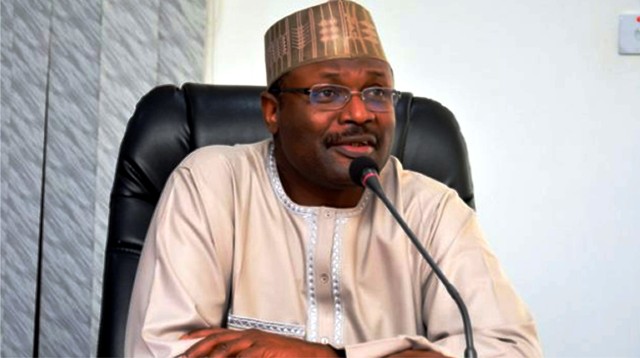
As a Nigerian, I don’t envy the INEC chairman Professor Mamoud Yakubu. First of all, he is truly under pressure and secondly his integrity is at stake. This is because the job is a thankless one. To midwife an election if we reflect back, has always been full of tension, accusations of being biased, inducement and outright partisanship against the incumbent chairman. From Eyo Esua in 1960, Michael Ani Ovier Whiskey, Eme Awa, Humphry Nwosu, Okon Ewa Sumner Dagogo Jack, Ephraim Akpata Abel Goubadia, Michael Iwu and Attahiru Jega, it has not been easy.
Let’s hope that by the time Mamood Yakubu concludes his assignment, he would put his experience in a book form so that future generations and scholars will learn a lot from him and understand why Nigeria is a strange country.
Tonye Ikiroma-Owiye



The commission announced the extension in a statement issued on Saturday and signed by the National Commissioner and Chairman of its Information and Voter Education Committee, Mohammed Haruna.
According to INEC, the decision followed appeals by political parties for additional time to complete the submission process through the dedicated online portal.
“The submission window, which according to the revised Timetable and Schedule of Activities for the General Election was originally scheduled to close on Saturday, 8th August, 2026, has been extended to Tuesday, 11th August, 2026,” the commission said.
In a a related development, INEC announced the suspension of PVC collection in Osun State ahead of the August 15 governorship election.
The commission said voters who applied for replacement of lost, damaged or defaced Permanent Voter Cards would have until midnight on Sunday, August 9, to print downloadable copies of their cards.
The electoral body explained that the deadline was necessary to enable it compile data on downloaded PVCs and produce final statistics on the total number of cards collected ahead of the election.
INEC said PVC collection in Osun commenced at the Registration Area level from July 22 to 28, 2026, but was extended to July 31 following complaints about large crowds and difficulties experienced by voters at collection centres.
The exercise subsequently moved to the local government level and ran from August 1 to 7.
The commission also disclosed that replacement downloadable PVCs had been made available to voters in Odo-Otin and Ife Central Local Government Areas following the theft of cards during attacks on the two collection centres.
It stressed that the stolen cards could not be used to vote.
INEC reassured Osun residents of its preparedness for the August 15 governorship election.
“The commission reiterates that the stolen cards cannot be used to vote.
“INEC reassures the people of Osun State of its readiness to conduct a free, fair, credible and inclusive governorship election on 15th August, 2026,” the statement said.
The commission said the deadline, initially set for Saturday, 8 August, has been extended to Tuesday, 11 August 2026, following appeals from political parties for more time.
INEC also announced that the window for voters who applied to replace lost, damaged or defaced PVCs to download their replacement cards will close at midnight on Sunday, 9 August.
The move is to enable the commission compile final PVC collection figures ahead of the 15 August Osun governorship election.
INEC said replacement downloadable PVCs have also been provided to affected voters in Odo-Otin and Ife Central Local Government Areas after hoodlums carted away cards from two collection centres, stressing that the stolen cards cannot be used to vote.
The commission reaffirmed its readiness to conduct a free, fair, credible and inclusive election in Osun State.
Gov. Kefas made the remarks over the weekend at the Federal Medical Centre (FMC), Jalingo, during the flag-off of the second phase of the Renewed Hope Medical Outreach in Taraba State, organised as part of activities marking Prof. Yilwatda’s 58th birthday.
The governor commended Prof. Yilwatda for choosing to mark his birthday by providing medical care to people in need.
“What Professor Nentawe did is a powerful demonstration of what leadership should be,” Gov. Kefas said.
He assured that his administration would continue to support initiatives that complement government efforts to improve healthcare delivery and the wellbeing of residents.
Speaking at the event, Prof. Yilwatda called on Nigerian leaders to embrace the culture of giving and use their positions to touch the lives of the less privileged.
He said his decision to celebrate his 58th birthday in Taraba State was deliberate and informed by the needs of underserved communities, particularly people who face difficulties accessing healthcare because of distance and financial constraints.
According to him, the intervention followed a needs assessment and was extended across the three senatorial districts of the state.
He said the exercise commenced on August 3 at Takum General Hospital and covered the Federal University Teaching Hospital, Wukari; First Referral Hospital, Sunkani, Ardo-Kola Local Government Area; General Hospital, Bali; General Hospital, Gembu; and FMC Jalingo.
Prof. Yilwatda said the intervention provided medical services to thousands of beneficiaries, including people who required surgical procedures.
He said sustainable national development could only be achieved when strong institutions placed Nigerians at the centre of development.
“Leadership is about service,” he said, urging political and public leaders to make giving back to society an important part of their responsibilities.
He reaffirmed his commitment to serving Nigeria and its people, saying his personal vision was to make every day of his life useful to humanity.
“Every day that I live, the vision is: let it be useful to humanity,” he said.
The Taraba State Commissioner for Health, Dr. Bordiya Buma, commended the initiative, saying it was consistent with the Renewed Hope agenda and efforts to strengthen healthcare delivery in the state.
Dr Buma said the second phase followed the successful completion of the first phase, which was conducted simultaneously in six local government areas, with two LGAs selected from each of the three senatorial districts.
According to him, more than 10,000 patients were attended to during the first phase, including people with medical and surgical conditions.
He disclosed that 327 general surgeries, 71 eye surgeries and 575 dental procedures were carried out during the exercise.
The commissioner expressed appreciation to President Bola Tinubu for the Renewed Hope Medical Outreach and thanked Prof. Yilwatda for supporting the initiative and choosing Taraba State as a beneficiary.
The Minister of Health and Social Welfare, Prof. Muhammad Ali Pate, also commended Prof. Yilwatda for choosing Taraba State to mark his 58th birthday through a medical outreach.
Prof. Pate said making healthcare the centrepiece of the birthday celebration was significant because health affects everyone.
-

 News5 days ago
RSG Targets Nine Million Residents in Mosquito Net Distribution Campaign
-

 Oil & Energy5 days ago
Aiyedatiwa Signs New Electricity Bill
-

 Maritime5 days ago
Marine Minister Commends President Tinubu On NPERA Bill Assent
-

 Oil & Energy5 days ago
NLNG Commissions Research And Innovation Centre In RSU
-

 News5 days ago
KenPoly Holds Eight Convocations, August 29
-

 News5 days ago
RSG Begins Another Phase of Projects Commissioning Today
-

 News5 days ago
RMAFC Completes Revenue Sharing Review, Proposes New Pay
-

 Maritime5 days ago
NAGAFF Petitions IGP Over Alleged Maritime Police Harassment