
News
Yobe Killings: Reps Declare Day Of Mourning …NASS Adjourns Plenary To Tuesday

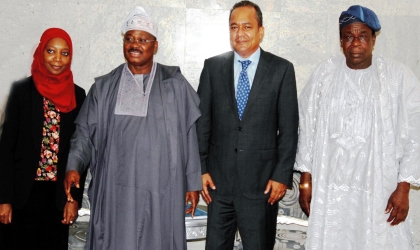
L-R: An economist with the World Bank, Miss Halima Zama, Governor Abiola Ajimobi of Oyo State, the head, Private Sector and Finanace, World Bank, Mr Michael Wong and Deputy Governor of Oyo State, Chief Moses Adeyemo, during the visit of the World Bank team to the governor in Ibadan, recently. Photo: NAN
The House of Representatives at its plenary sitting yesterday declared “a day of mourning” in honour of the 59 innocent students of the Federal Government College, Buni Yadi, Yobe State, who were murdered in their sleep.
The House is to observe the day in honour of other victims of violence in the country.
In his address at a special session of the House to remember the students and other victims of terrorism in Nigeria, Speaker, Aminu Waziri Tambuwal, who described the actions of the terrorists to target the innocent and defenceless as cowardice, declared that the agents of terror, who murdered sleep on Tuesday, February 25, would no longer sleep.
His words “When innocent, harmless and defenceless women and children become the targets of these heartless murderous bandits; when the lives of sleeping children are so callously snuffed out, it becomes clear that these agents of terror have murdered sleep, and they henceforth deserve none.
“Whatever grievances the terrorists harbour against the government of Nigeria, Nigeria’s innocent children have nothing to do with it. Nigeria’s children bear no responsibility for either policy making or policy implementation in Nigeria. It is, therefore, an act of cowardice worthy of ringing condemnation to target the children, to strike at those who are not only innocent, but are also unable to strike back or defend themselves.
“There can be no reason, no justification and no acceptable excuse for this act of mindless brutality. Whatever message the terrorists set out to send to the Nigerian government has been drowned out by the cries for justice by the blood of these innocent martyrs.
“It is to remember these innocent children and other victims of violence in this country that the House has declared today ‘a day of mourning’ to express our collective outrage on these killings that have gone on for far too long,” Tambuwal said.
The speaker roundly condemned the gruesome murder of the defenceless children, describing the terrorist attack as one which will live very long in the memory of families, as he recalled the attack on the Federal Government College, Buni Yadi, Yobe State on February 29 night where about 59 students were murdered in cold blood.
“Nigeria suffered a horrendous terrorist attack that struck a fatal blow at the heart and soul of the Nigerian nation, and desecrated values that decent peoples of all nations hold dear. On that night, about 59 students of Federal Government College, Buni Yadi, Yobe State, were killed in the most heinous manner. Some of our future national leaders were mowed down in gruesome circumstances in their sleep. Some were shot dead, while many were burnt beyond recognition. That day was a day that will live in infamy in the history of this nation,” Tambuwal lamented.
Citing Section 14 of the 1999 Constitution, which provides that the security and welfare of Nigerians is the primary purpose of government, the speaker charged the three arms of government to rise to the occasion.
His words, “In making this provision, the Constitution places a duty on all of us here and everyone else entrusted with the mandate of governance and representation to place a high premium on the security of lives and property of Nigerians.
By this parameter, the Nigerian government must rise to the occasion. And by government, I do not mean only the executive. We, in the legislature, are also part of government. And we cannot, therefore, merely join in the chorus of lamentations. Our duty is to act swiftly and decisively in the protection of the citizenry.”
According to the speaker, the House had passed over 20 resolutions on the issue of national security, amended the Anti-Terrorism Act 2011, to strengthen the security agencies and also ensured that huge sums are appropriated for the security agencies.
He also noted that, “only recently on January 30, 2014, the House, in making its recommendations for constitutional amendment, voted to include the National Security Agencies and the Nigerian Police on the first line charge for the purpose of ensuring their financial independence and timely release of funds when appropriated.”
Both chambers of the National Assembly on resumption, yesterday, again adjourned till next Tuesday to enable its committees finalize work on the 2014 budget defence and submit their reports to the committees on appropriation.
Meanwhile, the Senate yesterday deferred the consideration of the report on the Trafficking in Persons Prohibition Bill to March 18.
The consideration of the report was deferred to enable the Senate Sub-Committees on Appropriation complete work on the 2014 budget defence by Ministries, Departments and Agencies (MDAs).
The report was prepared by the Joint Committee on Judiciary, Human Rights and Legal Matters, Women Affairs and Youth Development.
The bill seeks to repeal the 2003 Act and enact a new Act to provide for more comprehensive legal and institutional measures aimed at eradicating trafficking in persons.
The Chairman of the Joint Committee, Sen. Umaru Dahiru (PDP-Sokoto), said the bill was designed to respond to the challenges encountered in the last 10 years in the fight against trafficking in Nigeria.
Earlier, the senators were divided over a clause in the draft law which seeks to regulate the actions of law enforcement agents with respect to civility in the discharge of their functions.
Clause 6 (b) empowers law enforcement agents to “enter into any premises or property without warrant for the purpose of conducting searches in furtherance of their functions under this Act or under any law’’.
Some senators faulted the clause, saying it gives too much power to the law enforcement agencies which could lead to breach on the privacy and rights of the people.
Others argued that such provisions had been in existence to enhance prompt and effective action on the part of the law enforcement agencies.
The Senate Leader, Sen. Victor Ndoma-Egba, said the clause was ‘critical’ to enable law enforcement agencies take quick action on cases of human trafficking.
He noted that the provision had been in existence for a long time, adding that it was intended to give special attention to the victims who were mostly children and women.
Sen. James Manager (PDP-Delta) observed that the absence of such a provision would impede law enforcement agencies from doing their work.
But, Sen. Kabiru Marafa (APC-Zamfara), said that the clause should be expunged from the proposed law, saying it would give law enforcement agencies overbearing powers.
The Senate President, Sen. David Mark, put the question to a voice vote and those in support for retention of the clause carried the day.
Nneka Amaechi-Nnadi, Abuja



The Rivers State chapter of the All Progressives Congress Christian Leaders Forum has expressed strong confidence in the capacity of All Progressives Congress (All Progressives Congress) candidates in the state to deliver effective governance if elected into office in the coming elections.
The State Coordinator of the forum, Archbishop Lucky Aroh, made this known during a breakfast and thanksgiving meeting held in Port Harcourt, where leaders gathered to pray for the stability of the party and the safety of its candidates ahead of the 2027 general elections.According to him, the meeting was convened to seek divine intervention for peace, unity, and security among APC candidates across Rivers State.
“Today we are praying for APC stability in Rivers State and the security of our candidates that have been elected to contest the 2027 elections. It is a breakfast meeting,” Aroh said.
He further expressed optimism that the party’s candidates would not disappoint the people if entrusted with leadership responsibilities.
“They will not fail when elected into office. We are here as fathers of the land to let them know, and I must tell you the truth that these are the authentic people that will do well in Rivers State,” he added.
Speaking earlier, the National Chairman of the forum, Professor Olanrewaju Abraham, commended the Rivers State chapter for organizing the programme, noting that the national body of the forum believes strongly in the power of prayer.
He stated that political leadership provides an opportunity to influence society positively, including advancing moral and spiritual values, while expressing confidence that APC candidates at all levels would emerge victorious in the upcoming elections.
Also speaking, the Rivers State Women Leader of the APC, Hon. Darling Amadi, praised the forum for its commitment to prayers for peace, stability, and the protection of party candidates.
Represented by the Deputy Women Leader of the party in the state, she described the initiative as commendable and urged other political and support groups within the party to emulate the gesture in promoting unity and stability.
By: John Bibor, Menebe Emmanuel & Fortune Paibi
Prominent businessman and philanthropist, Elder Anthony Osagwe-Ogo, was celebrated in grand style as he marked his 70th birthday anniversary, with distinguished Nigerians, business leaders, and golf enthusiasts gathering to honour his remarkable contributions to society.
The colourful celebration took place at the Port Harcourt Golf Club, where friends, associates, and well-wishers converged to pay tribute to the revered elder statesman.
Chairman of the occasion, High Chief (Dr.) Ikenna Okafor, described the celebrant as a detribalised Nigerian whose generosity, humility, and commitment to humanity have earned him admiration across different communities and backgrounds.
According to Dr. Okafor, Pa Osagwe-Ogo’s impact on society and the development of his community remains unparalleled. He noted that members of the golfing community are proud to be associated with a father figure who consistently promotes the welfare and well-being of those around him.
He further stated that the history and growth of the Port Harcourt Golf Club cannot be told without acknowledging the significant role played by the celebrant, whose wisdom, encouragement, and leadership have helped sustain the club over the years.
“We are here to celebrate a man who has impacted humanity positively, a peace-loving individual and an epitome of hope for the younger generation. We pray to emulate his virtues. Today, we celebrate a bridge-builder, a trailblazer, and an iconic leader whose life continues to inspire many,” Dr. Okafor said.
He expressed delight at the large turnout of guests from various walks of life, describing it as a testament to the respect and affection Pa Osagwe-Ogo commands within and beyond Rivers State.
In his response, the celebrant, Pa Anthony Osagwe-Ogo, expressed profound gratitude to God for preserving his life and granting him the privilege of attaining the milestone age of 70.
He also thanked members of the Port Harcourt Golf Club, family members, friends, and associates for identifying with him during the celebration and for their unwavering support over the years.
The event featured the cutting of the birthday cake, presentation of awards to deserving members of the club, goodwill messages, and moments of celebration among guests.
The ceremony was attended by notable personalities from the business community, the golfing fraternity, and other sectors, all of whom joined in celebrating the life and legacy of the respected elder statesman.
Rivers State Governor, Sir Siminalayi Fubara, and the Permanent Secretary of the Rivers State Ministry of Information and Communications, Dr. Honour Kuru Sirawoo, have been honoured with awards of recognition in connection with the 2026 Democracy Day celebrations held in Port Harcourt.
The awards, which formed part of activities marking Nigeria’s Democracy Day on June 12, were formally presented on Tuesday at the Ministry of Information and Communications in Port Harcourt.
Presenting the awards was Hon. Abdul Hameed Oladipupo Alli, popularly known as “Mr. Nigeria,” Publisher of Asiwaju Trumpet Magazine and Achievers World International Magazine.
Governor Fubara was recognised for his efforts in sustaining peace, stability, and a conducive political atmospherJohn Bibor / Menebe Emmanuel / Fortune Paibie in Rivers State. The organisers noted that his administration has fostered harmony and strengthened civic participation across the state.
Dr. Sirawoo, on the other hand, was honoured for his exemplary administrative leadership and significant contributions to effective information management within the Ministry of Information and Communications.
Representing Dr. Sirawoo at the presentation ceremony, Dr. Christian Davies received the award on his behalf and expressed gratitude for the recognition. He described the honour as a reflection of Dr. Sirawoo’s unwavering commitment to professionalism, excellence, and dedicated public service.
Dr. Davies assured the organisers that the award would be formally conveyed to the Permanent Secretary.
The event also featured the presentation of commemorative publications highlighting major governance and civic milestones in Rivers State, including Easter celebrations, Workers’ Day activities, the Governor’s third anniversary in office, and Democracy Day programmes.
Organisers of the awards commended the Rivers State administration for what they described as sustained peace, political stability, and improved civic engagement, noting that these achievements have contributed significantly to the state’s continued development.
By: Jessica Sambol