
Politics
“High Cost Of Governance, Recipe For Under Dev”

Rivers State was created on May 27, 1967 by a military Decree and by 1996, Bayelsa State was carved out of it. However, agitation for the creation of Rivers State predated Nigeria’s independence from Britain in 1960. During the Colonial period. Britain signed many treaties of protection with the chiefs of many coastal communities.
Some of these chiefs had hoped that with Nigeria’s independence, the treaties of protection they signed with Britain would also lapse and thus, they would become independent states. The 1958 constitutional conference which affirmed Nigerian nationhood dashed that hope, but agreed on some measures to allay the fears of the ethnic minorities in this area.
Between 1941 and 1952, an organization known as the izo Rivers People’s League had agitted for the creation of a distinct Rivers Province in 1953, another body called the Council of Rivers Chief People Conference in 1956. The leaders of this organization cooperated with the Calabar Ogaja Rivers (COR) State Movement formed in Uyo in December 1953, but later broke away to press their own case before the Willink commission.
To allay the fears of the minorities under the dominant ethnic groups within the Nigerian nationhood, the British made one import and concession by setting up a Commission headed by Sir Henry Willink to look into the misgivings of the ethnic minorities. The Willink Commission recommended the establishment of the Niger Delta Development Board (NDDB) to address the problem of underdevelopment of the area.
Surprisingly that board did not meet the aspirations of the people and thus, some people attempted to take the extra-legal means to achieve their goal. In February 1966, Isaac Boro, Sam Owonaro and Nottingham Dick with their supporters proclaimed a “Delta Peoples Republic.” Federal and Eastern Nigeria Governments brought this rebellion to an abrupt end. On May 27, 1967, Rivers State was among the twelve States created by the Gen Yakubu Gowon Regime.
The cries of political marginalization, environmental degradation and economic pauperization continued among the Ijaws, such that the Old Ijaw province was carved out of Rivers State as a distinct Bayelsa State in 1996 by the Abacha led military government of Nigeria.
The cries of political marginalization, environmental degradation and economic pauperization continued among the Ijaws, such that the Old Ijaw province was carved out of Rivers State as a distinct Bayelsa State in 1996 by the Abacha led military government of Nigeria.
But after the civilians took power in 1999, through a democratic process, Rivers State has not been able to meet those aspirations it suppose to have met after many years of civilian rules in the state.
Baring his mind on Nigeria’s Democracy, the leader of the Movement for the survival of Ogoni people, (MOSOP), Mr. Ledum Mitee, said in some aspect the country may have done as much as it would have done, in terms of freedom of speech, people can express themselves, press relatively free and delections were done and not military exerting force against everybody, even in terms of human rights, we have gone a step ahead but, still believed that in terms of translating the devidends and benefits that democracy offers the ordinary people, I’m not sure that we have gotten there yet. There were times that people living in the Diobu area use to turn the tap and water runs in their various yards, but today that is not the case, people now use pure water or sink a borehole, that is not good enough for a country like Nigeria. The public schools were not in good shapes until few years. The schools then looked like museum that have been abandoned for ages, thanks for the efforts of this government in Rivers State with the edifice that could be point to that there is still public schools.
Apart from the social amenities which has been absent even before the democratic process in the country, Mitee said, the government have not looked at the Agriculture and way of empowering the young ones. They have not explored enough Agriculture. The country have not reach where it supposed to reach in terms of farming, but unfortunately, the nation was still depending on the people who are toiling on their own pace, and we are getting nothing for it, and that adds to the poverty. In the past Rivers State Government use to have produce board, this board guarantee price. We also use to have palm plantations, rubber plantations but I think, since oil came, we completely dealt deathblow to all those things, our children who are growing up do not know what palm plantations are and why they even exited.
In terms of industry, the country, lendership open floodgatefor all sort of goods from every where, and so industries are completely dead, come and think of what had happened to Michelin some years ago, the company used to offer jobs to people and this was because they could produce tires and people could buy, and the company offered jobs for some thousands of people because they could do tyres and prople would buy them and it offered employments to a lots of people. Trans Amadi use to bubble of activities and several people were employed in various companies at Trans Amadi now the economy has sunk to the level, the factories have all gone and churches have taken over as a means of employment, he said.
He noted that one of the causes of the do or die politics in Nigeria is the lucrative nature and the high stake of the political offices, explaining that society have no longer value for professionals and role modes.
According to him, “you see somebody whom have no qualifications but as soon as he becomes a councilor, he earns more than a professor and Medical Doctor who have spent years of learning. “So, we have averted the value of society. If I may ask who are the people who are as role modes now in society, would you think of a medical doctor who have spent about 8 years in the university, trying to do the little that can save lives, or would you think of a university professor, who have gone through all the years learning, no one thinks of them as role models any longer, we are thinking of how to be councilors or politicians. Some even apply to be a political thugs, because that is what is obtainable.
He also said the cause of running governance in Nigeria is also expensive, stressing that it has also contributed to the underdevelopment of the nation. “If you take a look at the amount the legislators are taking, you would be surprise at the cost of governance. If there is a reduction in those areas, there would be sufficient money to handle social security, government can pay every person N10,000 monthly, if even the person has no job. This would make them not to engage in criminal activities. It happens in other countries, I believe that if all these combinations are put in place, we can now say we are geting the real benefits of democracy.
Stressing further, Mitee said government can as well buy jobs for its youth, adding that some countries do it.
He noted that the idea was to secure future for the coming generations but regretted that Nigeria is not thinking towards that direction and does not give attentions to its youths a situation he said was not a welcome development.
He said as Governor Chibuike Amaechi is about to commence the second phase of his administration, he should consolidate on what he has done in the past four years and try to connect the people with what had happened instead, “He has built schools, he should get teachers, not only getting teachers but also putting the system on check through supervision.” This, he said would help create a system that would work and punish the bad eggs.
According to him, “You can put such edifices’ and then have some class of people who would ruin the good job that he has started.
He advised, Amaechi to be thinking more of a legacy, “By now he should have settled those he owed last section. This is his last lap and the time that he owes himself a legacy. It is something that they would remember him of long after people have forgotten who built roads.
On the conduct of the last general elections by the Independent National Electoral Commission (INEC), the MOSOP leader noted he was not sure we are there yet but said, “you do not expect a leap from zero to hero just one night,” He noted that the problem does not lie on the INEC, but the mentality and attitude of the people to what is being done. In this respect, we could look at the self imposed urgency we gave ourselves, after the 2007 elections. Late Musa Yar’Adua acknowledged that the 2007 elections was not good enough and proposed for an electoral reforms, but regretted that nothing started until few months to the elections, so I think to build on what had happened 2011 election we should start now to amend any area that needs amendment in the electoral law and not to wait till the next election before thinking of having a law. “We give ourselves imposed urgency and I think it is not too good.”



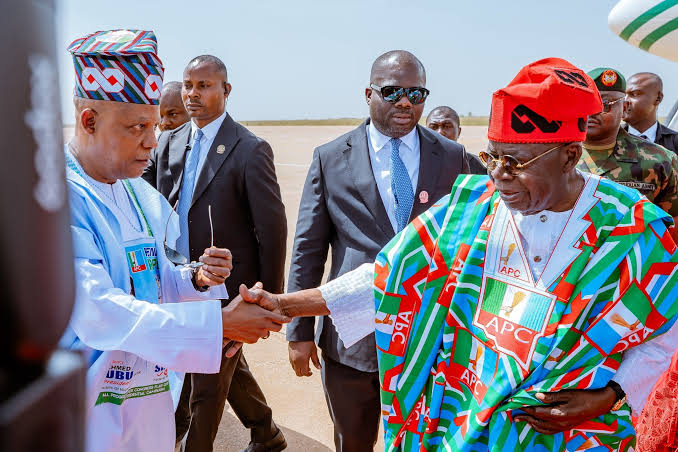
The campaign rally, held at the Kaduna Township Stadium, attracted Vice-President Kashim Shettima, APC governors, party leaders, federal and state lawmakers, political stakeholders and supporters from across the country.
The flag-off marks the beginning of the APC’s drive to secure a second presidential term for President Tinubu, with the party expected to promote its achievements, defend its economic reforms and outline its policy priorities under the proposed Renewed Hope 2.0 agenda.
Kaduna’s selection for the campaign launch underscores the strategic importance of the North-West, a region with a substantial voting population and considerable influence on presidential election outcomes.
The APC faces a significant challenge in Kaduna, where the Peoples Democratic Party’s presidential candidate, Alhaji Atiku Abubakar, defeated President Tinubu in the 2023 election. The rally therefore provides the ruling party an opportunity to strengthen its grassroots structures and regain electoral support in the state.
Addressing supporters, Vice-President Shettima appealed to Northern voters, highlighting President Tinubu’s political relationships with prominent Northern leaders, including Alhaji Abubakar, Mallam Nuhu Ribadu and the late President Muhammadu Buhari.
The Vice-President’s appeal reflects the APC’s determination to consolidate its support in the North as the party intensifies preparations for the presidential contest.
The Renewed Hope 2.0 agenda is expected to feature prominently in the campaign, providing a platform for President Tinubu to explain his administration’s economic policies and outline plans for another term.
However, the President’s record on economic reforms, rising living costs, petrol prices, employment, infrastructure and insecurity is expected to attract considerable scrutiny during the electioneering period.
-

 Education1 day ago
FCE Yola Graduates 3,555 Teachers , Seeks Upgrade to University
-

 Sports1 day ago
Nigerian Trio Target Titles At PFL Africa Finals
-

 Niger Delta1 day ago
Diri Restates Stance On Lagos-Calabar Coastal Highway
-

 Niger Delta1 day ago
C’River, NUJ Pay Tribute To Late Guardian Editor
-

 News1 day ago
NDLEA Recovers Tons Of Illicit Drug Consignments In Nine States
-

 Opinion1 day ago
Checking Voter Apathy In Nigeria’s Electoral Process
-

 Politics1 day ago
2027: DICKSON’S EX-ALLY VOWS TO WORK AGAINST NDC INTEREST IN BAYELSA
-

 Politics1 day ago
2027: GROUP PLEDGES 40,000 SUPPORTERS FOR COALITION CANDIDATES IN RIVERS