
Featured
Despite Inadequacies, INEC Conducted 2023 Election With Reduced Violence, Deaths -Wike …Swears-In Members Of RSIEC, Primary Healthcare Management Board

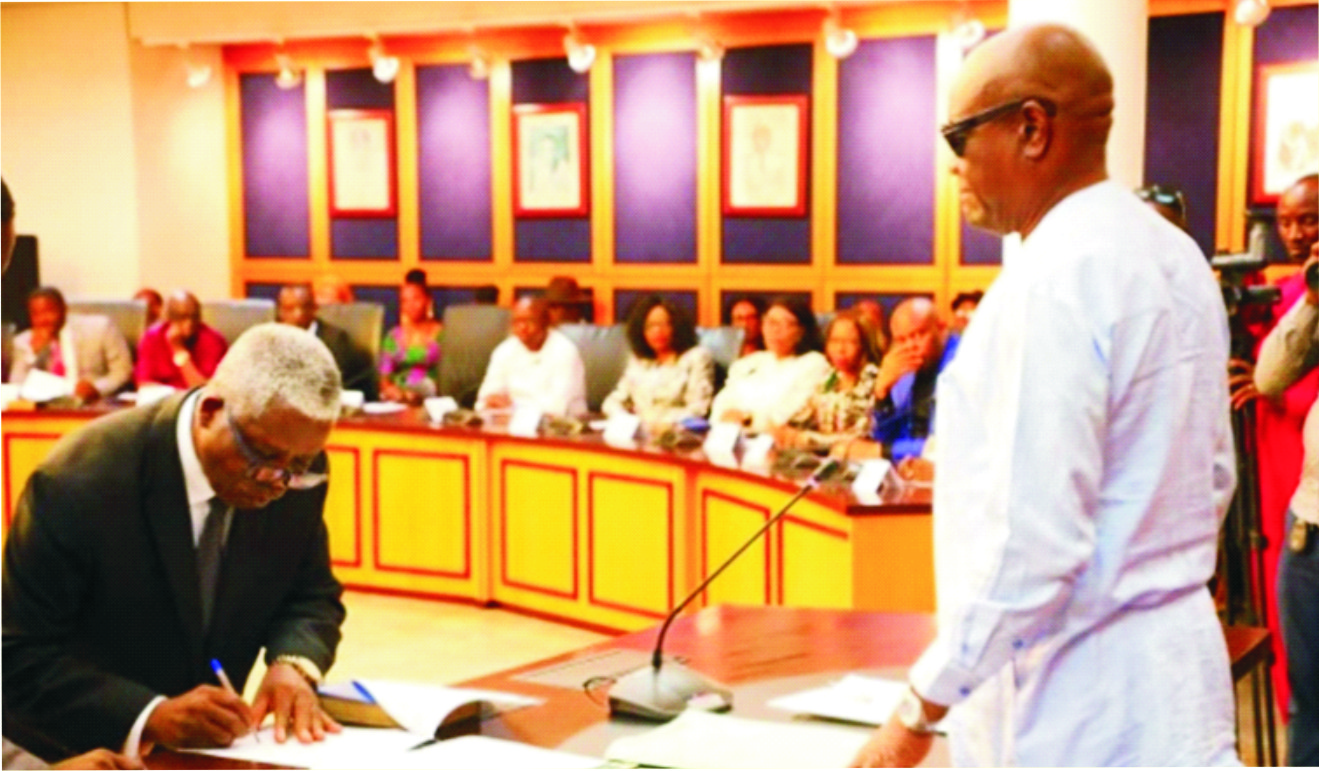
Rivers State Governor, Nyesom Ezenwo Wike says Nigerians should commend the Independent National Electoral Commission (INEC) for conducting the 2023 general election with reduced violence and deaths experienced across the country.
Governor Wike recalled how previous elections under INEC had been characterised by violence, with avoidable deaths amidst desperation of politicians to have their way, made possible because of the mode of voting that was previously adopted.
Governor Wike made the observation at the swearing-in ceremony of chairmen and members of Rivers State Primary Healthcare Management Board, and Rivers State Independent Electoral Commission (RSIEC) at Government House in Port Harcourt, yesterday.
The governor noted that even if the Bi-Modal Voters Accreditation Machine System (BIVAS) used by INEC in the 2023 general election did not perform optimally, so much success was achieved, because its use alone frustrated antics of security agencies who induced violence.
The Rivers State Independent Electoral Commission, RSIEC, has Hon. Justice Adolphus Enebeli, (rtd) as the chairman, with Prof Emenike Weli, Barr Adolphus. A. Brown, Dr Lasbury Nnah, Pastor Tamunotonye Tobins, Barr (Mrs) Chinwe Ihua-Maduenyi and Mrs Nuka Kponi as members.
The Rivers State Primary Healthcare Management Board has Prof. Blessing Jaja as the chairman, Dr Kinikanwo Green as the Executive Director and Dr Clarabell Abam, Dr (Mrs) Gladys Horsefall-Okafor, Madam Gladys Ihunda and Dr Famba O. Famba as members.
Governor Wike said no election is perfect, but it is always better that the subsequent ones are seen to be an improvement on the previous one, to make people believe in the process.
”That is why I tell people that if for nothing, Nigerians should commend INEC that they reduced the level of violence, the level of death because without this BIVAS, before we were fighting with security agencies, they were carrying electoral materials, hijack electoral officials, but now it is difficult.
”So, no matter the inadequacies, you’ll see that there was an improvement in terms of reduction of violence which is key, because in our electoral process it has always been killing, hijacking of materials, and using of security wrongly.”
Governor Wike stressed that Nigerians have accepted the outcome of the election and what INEC was able to deliver, and have moved on.
The governor said the disturbing trend with Nigerian system is that when people are apprehended and are guilty of the electoral offence, they appeared not to be sanctioned, or punished in order to serve as a deterrent to others.
He however, expressed the hope that the federal government will increase the capacity of INEC to do better in the next election.
To RSIEC, Governor Wike charged the chairman and his members to use their wealth of experience to ensure a successful transition when the local government election date is fixed next year.
He urged them to work as a team to achieve their given mandate, given the ample time that they have to prepare for the election.
To the members of the Rivers State Primary Healthcare Management Board, governor Wike, who noted that the previous board did very well, charged them to build on that success record.
Governor Wike urged them to bring their professional expertise to bear by improving on the system, serve the best interest of the State with greater commitment.
The governor said having been appointed to serve a four year tenure, so much is expected of them and they can only achieve more if they do not focus on making money alone, but work as a team in improving the healthcare delivery mechanism in the State.
In his response, the Chairman of RSIEC, Justice Adolphus Enebeli (rtd) said they are exceedingly grateful to be found fit and proper persons to serve in such capacity in the interest of the State.
Justice Enebeli gave the assurance that they will observe the fidelity to the sanctity of electoral processes and procedures in the conduct of local government elections within the extant laws to the end that there shall be credible, fair and free conduct of local government election in Rivers State.
On his part, the chairman of the Rivers State Primary Healthcare Management Board, Prof. Blessing Jaja thanked the governor for giving them the opportunity to serve and assured that they will not disappoint the expectation on them as they work assiduously to move the board’s activities forward.

Featured
JUNE 12: Democracy Remains Nigeria’s Strongest Path To Unity, Progress, Says Fubara ….Extols Abiola, Wife


Governor of Rivers State, Sir Siminalayi Fubara, has reaffirmed that democracy remains the most effective system of government for Nigeria, given the country’s rich diversity of ethnic, religious, and cultural identities.
In a goodwill message to Nigerians on the occasion of the 2026 Democracy Day celebration, Governor Fubara said June 12 represents far more than a historic date; as it embodies the enduring struggle, sacrifice, and collective aspiration of Nigerians for freedom, justice, and representative governance.
The Governor extended warm felicitations to Nigerians at home and in the Diaspora, paying tribute to the heroes and heroines of the democratic struggle, particularly Chief MKO Abiola, his wife, Kudirat Abiola, and countless others whose courage and sacrifices helped secure the democratic freedoms Nigerians enjoy today.
According to him, “June 12 is a reminder of the price paid for the democracy we enjoy today. The sacrifices made by Chief MKO Abiola, Kudirat Abiola, and many other patriots who laid the foundation for the democratic journey we continue to enjoy today. Their commitment to the principle that power must ultimately reside with the people remains a source of inspiration for every generation of Nigerians.”
Governor Fubara noted that thirty-three years after the historic June 12, 1993 election, Nigeria’s democratic experiment has continued to evolve despite challenges and setbacks.
“Our democratic journey has not been without difficulties, but the resilience of our institutions and the determination of our people have kept the nation moving forward. The ability to express differing opinions, engage in constructive debate, and peacefully choose leaders through the ballot remains one of the greatest achievements of our nation,” he said.
Governor Fubara stressed that democracy provides the best framework for managing Nigeria’s diversity and transforming it into a source of national strength.
“Nigeria’s diversity should never be seen as a weakness. Properly harnessed, it is our greatest asset. Democracy offers us the opportunity to build consensus, promote inclusion, strengthen national unity, and create the conditions for sustainable development and shared prosperity,” he said.
Governor Fubara commended President Bola Ahmed Tinubu, for his commitment to the Renewed Hope Agenda and ongoing efforts aimed at economic revitalization, strengthening security, and deepening democratic institutions across the country.
He reiterated the readiness of Rivers State to continue partnering with the Federal Government in advancing policies and programmes that improve the lives of citizens through infrastructure development, job creation, enhanced security, quality education, healthcare delivery, and good governance.
The Governor further called on Nigerians, regardless of political affiliation, ethnic background, or religious belief, to use the occasion of Democracy Day to renew their commitment to the Nigerian project and the ideals that underpin democratic governance.
“Democracy must not be viewed merely as a periodic electoral exercise. It must be reflected in our daily commitment to accountability, transparency, tolerance, justice, respect for the rule of law, and responsible leadership. As citizens and leaders, we all share a collective responsibility to strengthen our democracy and build a nation that future generations will be proud to inherit,” he said.
Governor Fubara expressed optimism about Nigeria’s future, urging citizens to remain united, hopeful, and committed to the values of peace, dialogue, and national development.
“Together, we can build a stronger, more inclusive, and more prosperous Nigeria where every citizen has the opportunity to thrive and contribute meaningfully to national progress,” he said.

Governor of Rivers State, Sir Siminalayi Fubara, has reaffirmed the unwavering commitment of his administration to peace, unity, security, and inclusive development as Rivers State marked its 59th anniversary, last Wednesday.
In a goodwill message issued on Wednesday to commemorate the anniversary, Governor Fubara stated that despite the challenges faced over the years, the people of Rivers State have continued to demonstrate resilience, strength, and an enduring spirit of unity that has sustained the state since its creation.
The Governor noted that the strong bond of brotherhood among the various ethnic nationalities of the state, including the Ijaw, Ikwerre, Ogoni, Etche, Ekpeye, Andoni, Kalabari, and others, remains one of Rivers State’s greatest strengths and a critical foundation for peace, stability, and progress.
He further observed that Rivers State has remained a major driver of Nigeria’s economy for decades, not only because of its abundant oil and gas resources, but also because of the exceptional contributions of its people across diverse sectors including academia, jurisprudence, business, entertainment, public service, and sports.
Governor Fubara assured the people that his administration will continue to prioritize policies and programmes that promote peace, protect lives and property, and expand development across all parts of the state. He emphasized that governance must be people centered and impactful, with equal attention given to every Local Government Area of the state.
The Governor also paid tribute to the elders and founding leaders of the state for preserving the spirit of unity and coexistence over the years, while urging the youths to remain hopeful, responsible, and actively committed to building a greater Rivers State through innovation, hard work, and patriotism.
He equally acknowledged the invaluable role of women in strengthening families, communities, and society, describing them as indispensable partners in the continued growth and stability of the state.
Governor Fubara called on all Rivers people to use the occasion of the anniversary as a moment of reflection and renewed commitment to peaceful coexistence, mutual respect, dialogue, and collective progress, stressing that the unity and future of Rivers State must always rise above personal interests and political differences.
Rivers State was created on May 27, 1967, by General Yakubu Gowon.

-

 Niger Delta3 days ago
Warri Airport Manager Disputes Air Peace Bird Strike Claim
-

 News3 days ago
Nigeria Won’t Surrender Any Territory To Criminals -Tinubu
-

 News3 days ago
FG Begins Trial Of Over 600 Terrorism Suspects
-

 Politics3 days ago
Parties’ Deregistration: How Justice Lifu Overruled Appeal Court Justices
-

 Rivers3 days ago
79th IAUE Inaugural Lecture: Prof Anero Advoctes Tuition-Free Education For Children
-

 Politics3 days ago
ADC: Okonkwo Rejects Amaechi As Presidential Running Mate, Withdraws Support
-

 Politics3 days ago
2027: Tinubu’s Projects Give APC Edge In South East – Yilwatda
-

 News3 days ago
Rivers Judges Commence Annual Vacation, July 20