
Lifestyle
Gowon At 85: My Recollections

The Ogina Bereton
In 1971, Nigerian Head of State and Commander-in-Chief of the Armed Forces, General Yakubu Gowon, visited Rivers State. Commander Alfred Diete-Spiff, pioneer military governor of Rivers who made me his first Commissioner for Finance, 1968-1973, made me Chairman of the Reception Committee. During this visit, General Gowon said he wanted to inspect the riverine.
At the Marine Base, we boarded the Niger Delta Enterprise. The itinerary was to reach the Degema Division before heading for the Brass Division with Twon Brass as our final destination. But on leaving Degema our boat ran aground in low tide, leaving us stranded in the middle of nowhere. We were in a panic. What would the world say if anything happened to General Gowon while he was our guest? His predecessor, General JTU Aguiyi-Ironsi, was abducted and killed while being hosted by Col. Francis Fajuyi, the Western Region governor. It was a cruel fate that our August visitor should pass the night in the creek exposed to every conceivable hazard.
But to our surprise, it was General Gowon himself who was cheering us to be of good spirit. As a good fella he made light-hearted jokes to relax us. An exemplary leader in the grand old tradition, he could have called for a helicopter to rescue him but chose to pass the night in the boat with us. The tide finally returned in the morning and we fired up for Nembe where we lunched in Commander Diete-Spiff’s house before heading for Twon Brass.
We reached Twon Brass at night only to run into a bigger problem. The two speed boats conveying our provision from Port Harcourt were yet to arrive due to engine problems. So what was the Commander-in-Chief going to eat and drink? We would be tempting fate giving him the brown well-water.
Once more, it was General Gowon who told us not to worry. How could anyone fail to smile back when he flashed those disarming smiles? His bonhomie, witty jokes and easy manners were simply infectious and we soon put a great setback behind us. We returned to Port Harcourt in the morning by sea. Till date, General Gowon is the only Nigerian Head of State or President who bothered to tour the creeks and see, for himself, what poverty looks like.
The boat incident was an eye opener for Commander Diete-Spiff who announced he was building a new boat for Rivers. His envisaged craft should be stately enough for any visiting Head of State. He was designing it himself and, for one year, he seriously toiled away. We soon got used to greeting him with the question, “How’s your boat, now?” His usual response, “I have cancelled it but I’m starting a new one.” But behind his back we had a good laugh.
A day came when he surprised his critics. He said his boat was ready and curiosity was the better of us. It was the scratching of the head as he lectured us on the highly complex and mathematical sketches. Our respect for him soared. Commander Diete-Spiff built his boat in Holland christening her Ogina Bereton; meaning God has decided.
When we were overthrown in 1975 the Ogina Bereton was seized and taken to Lagos. The Federal Government refused to return it, even when it was established as state property, rather than Commander Diete-Spiff’s personal boat as alleged. It was given to the Nigerian Navy that refurbished it abroad at a cost far higher than what it took to build it. Rivers people were never compensated. Eventually, the boat that Commander Diete-Spiff built was taken out to the sea and sunk.
How Minorities Dominated Military
Deductive calculation, inference and an open mind are the watchwords when analysing General Gowon’s legacy as Head of State, 1966-1975. A northern Christian from the minority Angas tribe, he had little chance of advancing in the First Republic.
The Macpherson Constitution of 1951 could have created more regions instead three. Unfortunately, the three major tribes engaged the regions as their private properties. In the Eastern Region the majority Igbo tribe under Dr. Nnamdi Azikiwe and his National Council of Nigerian Citizen (NCNC) excluded their regional minorities. In the Western Region the Yoruba, under Chief Obafemi Awolowo and his Action Group (AG) committed the same sin. And in the Northern Region the Hausa/Fulani group, under Sir Ahmadu Bello and his Northern People’s Congress (NPC) also excluded their minorities.
Political exclusion forced the minorities to demand for their own alternate states only for the majorities to also oppose that. The Igbo supported state creation for Northern and Western minorities while resisting same for their Eastern minorities. The Yoruba favoured state creation for Eastern and Northern minorities but never for their Western minorities. And the Hausa/Fulani wanted states for Eastern and Western Regions, but not for their Northern minorities. This created a “negative consensus” among the majorities who knew what to do to liberate their minorities but refused to do it.
The minorities responded to the highly circumscribed political space permitted them in two ways. One, they established their own political parties. And two, they massively enlisted into the military, one of few government institutions that was open to them, but which was of little interest to the majorities. It was an accident of history that Gowon and his fellow northern minorities dominated the non-commissioned ranks of the unattractive military that turned out the proverbial rejected stone.
Following the two coups of 1966, it was Gowon, a Lieutenant Colonel, who was made Head of State as the most senior northern officer. His emergence brought the live-and-let-die rule of the majorities to a dramatic end. On May 27 1967, he created twelve states out of the existing four regions. By so doing, he saved Nigeria from total disintegration as the Tiv Riots of 1964 and the Isaac Boro rebellion of 1966 left none in doubt.
General Gowon prosecuted the Nigerian Civil War (1967-1970) to stop Nigeria from disintegrating. But he aptly realised Nigeria could still disintegrate under an unworkable peace. Europe imploded into the Second World War when an unworkable peace was imposed on a defeated Germany at the end of the First World War. If post-war Nigeria disintegrated, the majorities capable of surviving independently would bring their weak minorities under their suzerainties.
These lessons were on General Gowon’s mind influencing him not to treat the Igbo as conquered people. He favoured a policy of “No Victor and No Vanquished” at the end of the war to make national reconciliation possible. I end my tribute to this great general, on his 85th birthday, by recalling an incident that confirmed his anxiety for reconciliation.
General Gowon’s Anger
As Commander Diete-Spiff’s joint Commissioner for Economic Development and Reconstruction, and Information, 1973-1975, I initially conceived the East-West Road as state road. But paucity of funds forced me to convert it to a Trunk A road by bringing on board the other littoral states of South Eastern, Mid-Western and Lagos. Trunk A status meant the Federal Government would fund it.
We then submitted a joint project application to the Federal Government. But on the day the Supreme Military Council (SMC) was to take a decision on it disaster struck. Somebody jokingly asked my governor, “Commander, everyone in Port Harcourt is talking about this East-West Road; what do you need it for?” He joked back…
General Gowon cancelled the East-West Road to make national reconciliation possible. But when presented with a higher patriotic argument on (1) What the road meant not just to the Niger Delta minorities but for the country as a whole. (2) Making it easier for quick deployment of troops to protect critical oil facilities in the event of foreign invasion, and (3) Opening up the region for mechanised farming as the 1959 World Bank report projected the region could feed West Africa with swamp rice; he was flexible enough to reinstate and approve it a year later.
General Gowon could only be sarcastic when he recently said that his only mistake while in power was not allocating land to himself. But I stand to say that by not allocating land to himself, he set a rare example. Unfortunately, his successors used their official positions to allocate resources to themselves. Secondly, General Gowon also set a positive example for the African youth. I was a visiting scholar in the University of East Africa at Makerere and saw how Africa celebrated this handsome and dedicated hero who, at a very young age, held his country together.
His only mistake was in not handing over power to civilians in 1975. Under pressures from entrenched interests, General Gowon delayed, leading to his overthrow. But this does not deplete the fact that he courageously created the twelve states thereby liberating the minorities from the monolithic regions. Call that the first restructuring. What is now left is to carry out a massive devolution of power and resources through constitutional means so that the 36 states can prevail in areas they have comparative advantage and remit tax to the center.
Prof. Ekpebu is a pioneer member of the Rivers State Executive Council.
By: Lawrence Ekpebu


The Federal Government has begun a scheme to battle malnutrition in children.
Tagged, “Nutrition 774 Initiative”, the programme was unveiled by Vice President Kashim Shettima as it falls within a framework for the Federal Government’s comprehensive vision for a nationwide nutrition programme to address malnutrition and food insecurity in Nigeria.
The proposed programme, “Nutrition 774 Initiative,” aims to improve nutritional outcomes across all 774 local government areas (LGAs) in the country.
Speaking yesterday during a roundtable with development partners at the Presidential Villa, Abuja, VP Shettima said the initiative aligns with President Bola Ahmed Tinubu’s broader focus on food security and availability across Nigeria.”The priority with which His Excellency, President Bola Ahmed Tinubu, has pursued food availability has gone hand-in-hand with our commitment to eradicating malnutrition.
“Our aspiration as a nation goes beyond the mere abundance of food in our barns and warehouses. We cannot claim victory unless there is certainty that each household across Nigeria has access to the preferred and prescribed diets essential for a healthy life,” the vice president stated.
It would be recalled that the 144th meeting of the National Economic Council (NEC) had in September endorsed the Nutrition 774 programme as a primary platform for combating malnutrition within Nigerian communities.
The council encouraged development partners to provide financial and technical assistance to support this initiative.
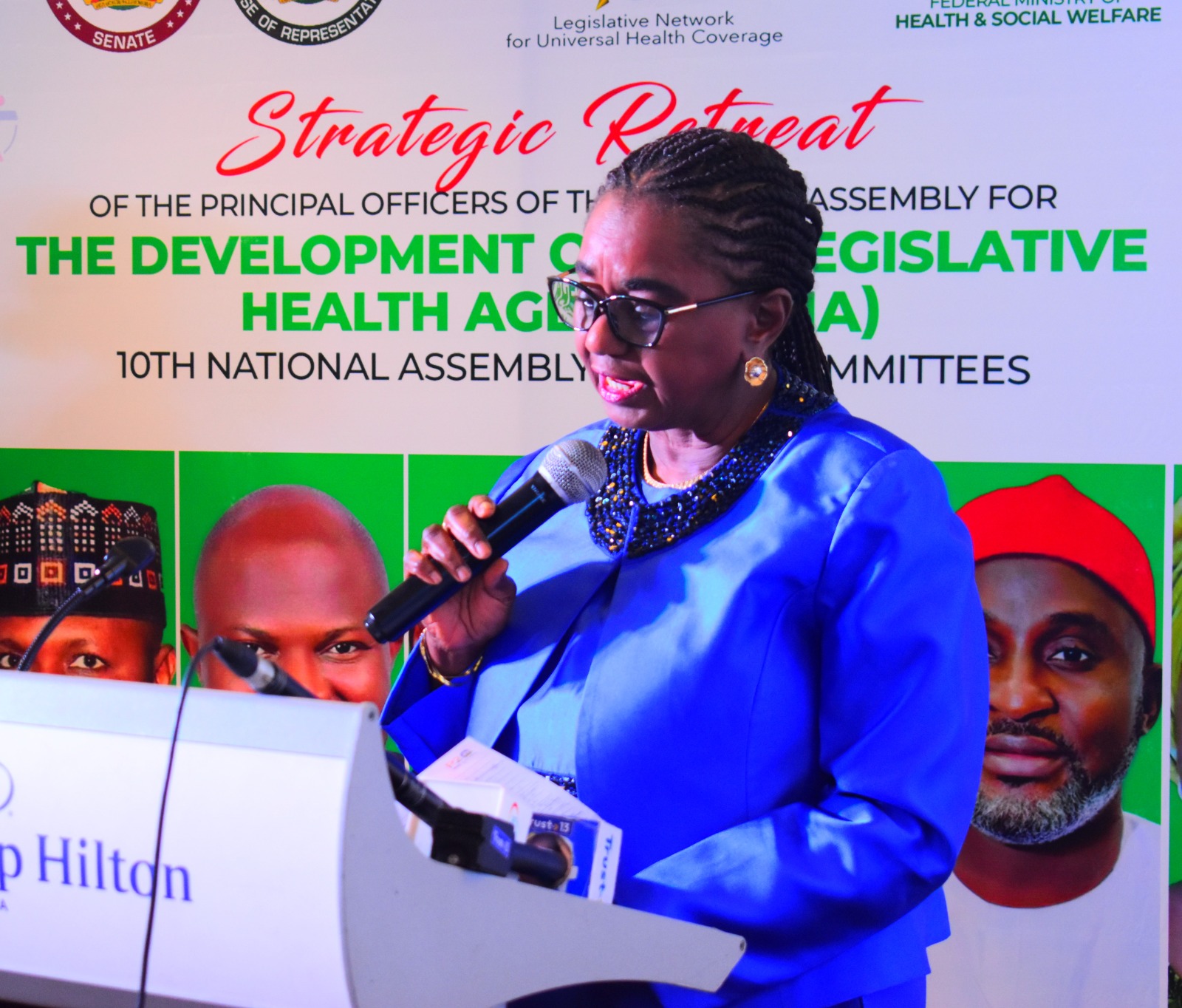
The importance of e-Health devices and digital health solutions in improving Nigeria’s healthcare system has been emphasised by Senator Ipalibo Harry Banigo, Chairman of the Senate Committee on Health, Secondary and Tertiary.
She also stressed that health is a multilayered activity and a multisectoral collaboration that requires legislators to work together to provide legislation, implement policies, and track funds effectively.
Banigo, who represents Rivers West Senatorial District in the National Assembly, made these remarks at the 5th Annual Legislative Summit on Health in Abuja, themed “Improving Legislative Stewardship and Accountability for Universal Health Coverage.”
She highlighted the potential of eHealth devices, especially given Nigeria’s large population and limited healthcare professionals.
“We can develop platforms that can be accessed through simple phones, even in remote villages, to provide health education and interventions,” she said.
“We are not talking about highfalutin things; we are talking about what will impact communities at the grassroots level, particularly pro-poor initiatives that will benefit vulnerable populations.”
Banigo also emphasized the importance of accountability and effective care, encouraging legislators to share knowledge, engage in peer reviews, and exchange information to achieve better health outcomes.
She recalled the cholera outbreak, where basic health education and interventions could have been delivered via mobile phones, preventing preventable deaths.
The 5th Annual Legislative Summit on Health brought together federal and state legislators, the Coordinating Minister of Health and Social Welfare, Prof. Muhammad Pate, the World Health Organisation’s representative in Nigeria, Dr. Walter Mulombo, and other dignitaries.
-

 Niger Delta1 day ago
Warri Airport Manager Disputes Air Peace Bird Strike Claim
-

 News2 days ago
Nigeria Won’t Surrender Any Territory To Criminals -Tinubu
-

 News2 days ago
FG Begins Trial Of Over 600 Terrorism Suspects
-

 Rivers1 day ago
79th IAUE Inaugural Lecture: Prof Anero Advoctes Tuition-Free Education For Children
-

 Politics1 day ago
Parties’ Deregistration: How Justice Lifu Overruled Appeal Court Justices
-

 Politics1 day ago
ADC: Okonkwo Rejects Amaechi As Presidential Running Mate, Withdraws Support
-

 Politics1 day ago
2027: Tinubu’s Projects Give APC Edge In South East – Yilwatda
-
Politics1 day ago
2027: Rivers PFN To Mobilise 600,000 Votes