
Lifestyle
Divorce In Nigeria| All You Need To Know In 2019

Divorce in Nigeria
In Nigeria, getting a divorce is seen as a taboo and most people find it exceedingly uncommon. This is because of the highly respected norms and traditions of the people which forbid the practices of divorcing a married couple. Nigerians are very religious people and they do not believe that getting a divorce can break the sacred vows that were made at an altar.
As stated by , about 1% of Nigerian couples admit to being divorced while 0.2% of men and 0.3% of women are legally married. Most wedding ceremonies done in Nigeria are traditional marriages which are not governed by the law. However, there are so many situations that would make a couple undergo divorce in Nigeria. This article will briefly give you all that you need to know about getting a divorce in Nigeria.
What are those grounds for divorce in Nigeria?
Generally, there are four types of marriages practiced in Nigeria. They are the Religious, Customary, Traditional, and Statutory marriages. However, just two of these four marriages are mainly recognized by the law of the country and these are the Customary and Statutory wedding. Getting a divorce in Nigeria depends on the type of marriage conducted. Under the Matrimonial Causes Act which governs the divorce process in Nigeria, there are certain stated grounds that can be used to dissolve a marriage and they include;
- No Consummation Of The Marriage
Before you can divorce your partner, you must make it known to the court that there has been no sexual intercourse between you and your spouse. What this means is that you must prove to the court that your spouse had failed to have sexual intercourse but in a situation where it is proved that sex occurred even once, the marriage will be deemed consummated and therefore, you can not rely on this ground for divorce.
- There Is A Case Of Adultery
You must prove to the court that since your marriage, your spouse had committed adultery and you find him or her intolerable to live with. By this, it means that you must prove to the court that your spouse has not been faithful and you find him or her unbearable to live with such infidelity.
- Presence Of An Unreasonable Conduct
Before you can rely on this ground, you must satisfy the court by showing proof that your spouse had acted in such a way that you cannot reasonably be expected to live with him or her again. What this really means is that you must prove to the court that there has been a presence of unreasonable conduct such as rape, habitual drinking, murder, brutality, made an attempt to murder spouse, inability to take care of the spouse, had the intention to or actually abused the spouse by inflicting serious bodily injuries.
- Abandonment Of Spouse For a Long Period Of Time
On this ground, you must prove to the court that your spouse had deserted you for at least, a period of one year prior to the filing of the divorce petition. By desertion, this means that your spouse must have abandoned you for a long period of time without any justification.
- Both Parties lived Separately
What this means is that you and your spouse have been living apart for a continuous period of at least 2 years or even 3 years preceding the presentation of the divorce petition and there is no objection by the person you want to divorce. Before you can rely on this ground, you must prove to the court that you and your spouse have not been staying together for a period of 2-3 years.
- Failure of Either of The Party To Comply With Court Order
You must prove to the court that your spouse had failed to comply with a court order regarding the marriage or a decree of restitution of conjugal right made under the Marriage Causes Act.
- Absence Of The Other Party
On this ground, before filing for divorce, you must prove to the court that your spouse has been absent or you have no idea of where he or she could be. In such circumstances, you will have to provide reasonable grounds that your spouse is dead or in cases of disappearance.
However, it is stated by the law that a marriage under 2 years cannot be dissolved; this is called the two-year rule. In most exceptional cases, a marriage under 2 years can be dissolved if the petitioner can prove to the court that there has been an exceptional hardship or that the case is one that involves exceptional depravity.
How To File For Divorce In Nigeria?
Filing for divorce in Nigeria isn’t that easy. There are so many steps to follow and it would be better for you to fully understand how to apply for divorce in Nigeria before filing for a divorce petition. However, if you are planning to file for a divorce, there are so many necessary things for you to consider and the very first thing for you to do is to consult a lawyer. After that, you can learn those basic grounds for divorce in Nigeria which we have already looked at. In this section, we are going to focus more on the process of getting a divorce.
– The Divorce Process
a) A Petition –
The first thing to do is filing a divorce petition which is written by either of the spouses. The petitioner will institute divorce proceedings by filing a petition and the content of the Divorce Petition should include the following:
- Identification of the spouses by name and address
- Date and place of the marriage
- An acknowledgement that you or your spouse had lived in a state or community for a specific period of time prior to the filling of for a divorce.
- Grounds for divorce
- A declaration or request as to how the petitioner would like to settle finances, sharing property, child custody, visitation and other issues relating to the divorce.
- Which spouse will psychically take custody of the child
- Child visitation schedule for the non-custodial spouse
- Payment of child support
- Payment of spousal support
- Which child will live in the couple’s house or primary residence?
- Payment of bills or other financial needs
b) Serving the divorce petition –
The divorce documents must be served on the other spouse. Once you have filed the divorce petition in the court, your petition will be given a file number in the court system and then the contents of your petition will be delivered to your spouse. A specific number of days will be given to your spouse to reply back or respond to your petition. However, in a situation where your spouse refuses to respond or difficult to locate, you can look for professional assistance to help deliver your paperwork.
c) Divorce Petition Response –
Once your spouse has replied to your petition, then the court will hear the case in the open. You can also bring witnesses that will provide evidence in the court but it is very necessary for your spouse to respond to your petition before any judgement is held.
d) The Final Steps Of Divorce –
This is when the judges make the final judgement on the case and once the judges have decided, no further step would be taken. Both spouses will be required to disclose information concerning their assets, liabilities, income and expenses. If you and your spouse agree on the terms and conditions of the divorce then there will be less paperwork to file. Once the judges are satisfied with the divorce, then a Decree Nisi would be granted. A Decree Nisi is a court order that basically dissolves a marriage. However, the Decree Nisi does not just end the marriage quickly but you will have to wait for an extra 3 months and then the Decree Nisi will become a ‘Decree Absolute’. The court also has the power to grant child custody to either of the spouses and can make an order for the payment of maintenance and settlement of any property of the marriage.
Who Gets The Child Custody After Divorce in Nigeria?
We will start with a brief definition of what child custody may be. Child custody can be defined as the protective care or guardianship of a child which is determined by the court when both parents of the child are divorced or separated. The issue of child custody mostly arises in divorce proceedings. However, child custody primarily rests on the best interest of the child. Discussing the issue of child custody can be considered into stages and that is custody of an illegitimate child and custody of a Legitimate child.
At common law, neither of the parents are strictly entitled to an illegitimate child because that child is seen as a FILIUS NULLIUS. The term also means a ‘son of nobody’, therefore this child has few legal rights under the common law and he or she is not entitled to either of the parents. However, in most cases, the mother is granted the child’s custody.
But for the custody of a legitimate child, under the common law, the father is given the absolute right to the custody of his children under maturity. Even when the father dies, the mother still cannot claim custody over the child. So generally, if the child is legitimate then the father will be given the child custody after the divorce. But once the father is dead, the right of child custody is given to the male head of the father’s family although the mother is responsible for the daily care of the child.
What is the cost of getting a divorce in Nigeria?
There are no fixed costs of getting a divorce in Nigeria. The process of getting a divorce could be personal or procedural. As such, it differs from one circumstance to another and from one person to another. However, filing for divorce in Nigeria isn’t quite expensive.
In conclusion, getting a divorce in Nigeria isn’t that easy not forgetting to mention that most people in the Nigerian society wouldn’t even respect your decision on divorcing your spouse. However, getting a divorce depends on the type of marriage conducted.




Tagged, “Nutrition 774 Initiative”, the programme was unveiled by Vice President Kashim Shettima as it falls within a framework for the Federal Government’s comprehensive vision for a nationwide nutrition programme to address malnutrition and food insecurity in Nigeria.
The proposed programme, “Nutrition 774 Initiative,” aims to improve nutritional outcomes across all 774 local government areas (LGAs) in the country.
Speaking yesterday during a roundtable with development partners at the Presidential Villa, Abuja, VP Shettima said the initiative aligns with President Bola Ahmed Tinubu’s broader focus on food security and availability across Nigeria.”The priority with which His Excellency, President Bola Ahmed Tinubu, has pursued food availability has gone hand-in-hand with our commitment to eradicating malnutrition.
“Our aspiration as a nation goes beyond the mere abundance of food in our barns and warehouses. We cannot claim victory unless there is certainty that each household across Nigeria has access to the preferred and prescribed diets essential for a healthy life,” the vice president stated.
It would be recalled that the 144th meeting of the National Economic Council (NEC) had in September endorsed the Nutrition 774 programme as a primary platform for combating malnutrition within Nigerian communities.
The council encouraged development partners to provide financial and technical assistance to support this initiative.
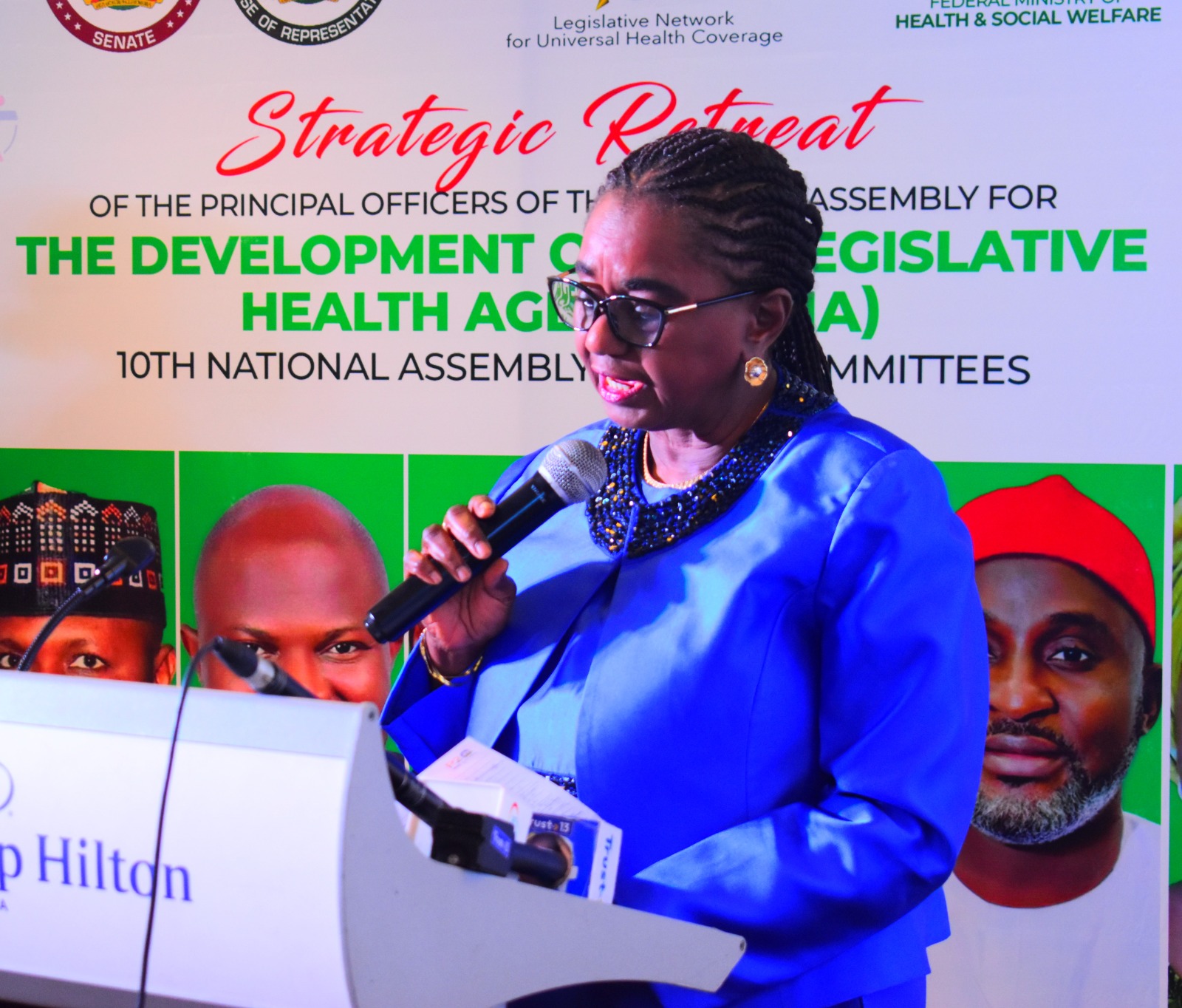
She also stressed that health is a multilayered activity and a multisectoral collaboration that requires legislators to work together to provide legislation, implement policies, and track funds effectively.
Banigo, who represents Rivers West Senatorial District in the National Assembly, made these remarks at the 5th Annual Legislative Summit on Health in Abuja, themed “Improving Legislative Stewardship and Accountability for Universal Health Coverage.”
She highlighted the potential of eHealth devices, especially given Nigeria’s large population and limited healthcare professionals.
“We can develop platforms that can be accessed through simple phones, even in remote villages, to provide health education and interventions,” she said.
“We are not talking about highfalutin things; we are talking about what will impact communities at the grassroots level, particularly pro-poor initiatives that will benefit vulnerable populations.”
Banigo also emphasized the importance of accountability and effective care, encouraging legislators to share knowledge, engage in peer reviews, and exchange information to achieve better health outcomes.
She recalled the cholera outbreak, where basic health education and interventions could have been delivered via mobile phones, preventing preventable deaths.
The 5th Annual Legislative Summit on Health brought together federal and state legislators, the Coordinating Minister of Health and Social Welfare, Prof. Muhammad Pate, the World Health Organisation’s representative in Nigeria, Dr. Walter Mulombo, and other dignitaries.
-

 News2 days ago
RSG Targets Nine Million Residents in Mosquito Net Distribution Campaign
-

 Oil & Energy2 days ago
Aiyedatiwa Signs New Electricity Bill
-

 Oil & Energy2 days ago
NLNG Commissions Research And Innovation Centre In RSU
-

 Maritime2 days ago
Marine Minister Commends President Tinubu On NPERA Bill Assent
-

 News2 days ago
KenPoly Holds Eight Convocations, August 29
-

 News2 days ago
RSG Begins Another Phase of Projects Commissioning Today
-

 News2 days ago
RMAFC Completes Revenue Sharing Review, Proposes New Pay
-

 Maritime2 days ago
NAGAFF Petitions IGP Over Alleged Maritime Police Harassment