
Metro
From Himalayan Ice to Niger Delta Floods: How Melting Glaciers Will Reshape Nigeria’s Coastline

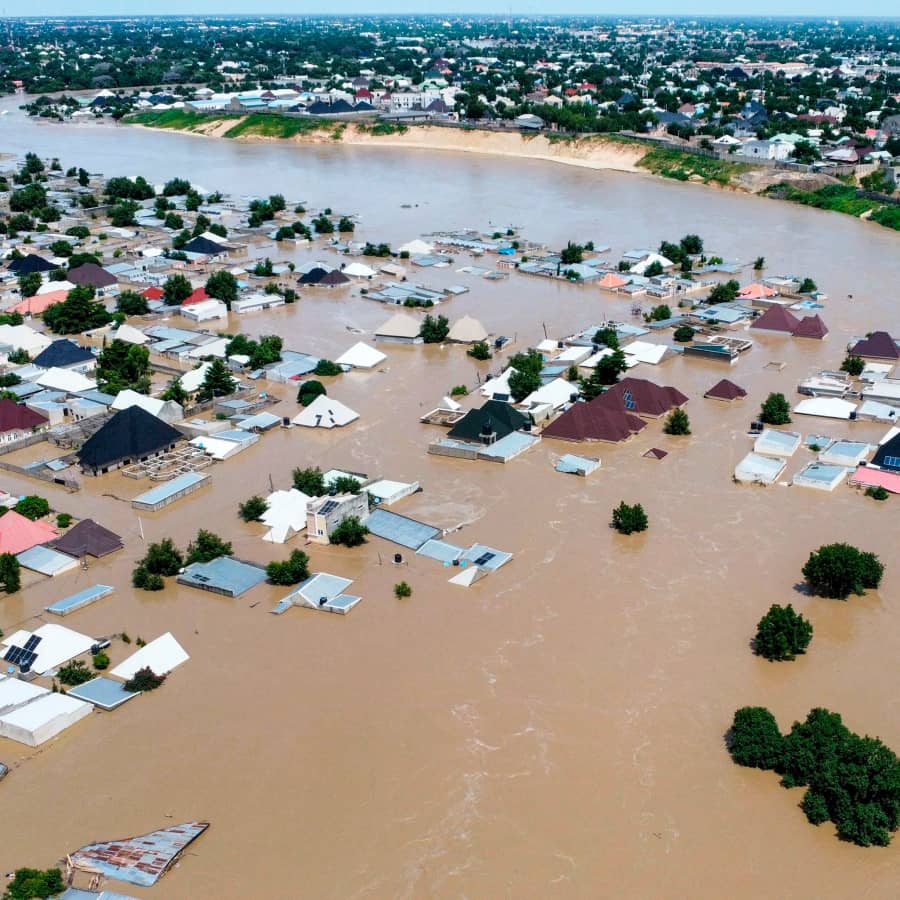
On Wednesday August, 26, 2026, the world watched Nepal as glacial collapse sent a wall of water tearing through the Nepal-China border mountain villages, swallowing homes, schools, roads, bridges and hydropower plants and causing significant loss of lives. All these were gone in minutes.
According to reports, the first indication that something was amiss came at 8.37 am local time,when the earth started shaking along the Nepal-China border, north of Kathmandu.
Scientists later established the fact that an enormous chunk of glacier sheared off from high on a mountain.This plunged into the river below. The section of the glacier that fell was approximately 2,000 feet wide.
A Professor of Hydrology at the Imperial College, London, Wouter Buytaert said, “this is the type of event that is triggered by climate change. Global warming strinks glaciers making it more likely for them to break apart.”
So far, more than 1000 people are found dead, 4,267 individuals rescued. As at Tuesday, 1st September, 2026, more than 4,400 people still reported missing and and more than 65,000 people affected in Nepal and Tibet. There are fears that the numbers of dead may still rise exponentially.
That disaster in the Himalayas feels far from the Niger Delta. But climate science tells us it is connected. The ice that melts in the Antarctica, Arctic, Andes, Himalayas,Alaska,Alps,Mt. Kilimanjaro and Mt. Kenya does not stay there. It flows into our oceans, and our oceans decide what happens to the Niger Delta.
For a proper understanding, we need to put this in perspective. What are glaciers?Glaciers and ice sheets are large masses of ice that form when fallen snow is compressed and recrystallised over the course of thousands of years. The two types of glaciers are the continental glaciers and the alpine (mountain)glaciers. The glaciers exist on all the world’s continent except Australia.These glaciers hold about 68-70% of the world’s freshwater. Together, they cover approximately 10 percent of the Earth’s total land mass.
For 10,000 years they were relatively stable. That changed in the 1900s. Since 1990, glaciers have lost over 9 trillion tonnes of ice. The World Meteorological Organization (WMO) and the World Glacier Monitoring Service confirms that global glacier mass loss has accelerated, and 2022-2024 were the 3 largest loss years on record.
All 19 of the world’s major glacier regions reported a net annual loss of ice mass, though, year 2023 set an individual annual record for single-year water loss with glaciers shedding approximately 600 gigatons of water.
In October of 2023, during a visit to the Everest region in Nepal, the United Nations Secretary-General, Antonio Guterres called on the world to “stop the madness” of climate change, warning that the disappearance of glaciers altogether looms even larger.
However, researchers in recent projections show that mountain glaciers will lose one quarter to one half of their mass by 2100 for global temperature change scenarios. A third of glaciers in the World Heritage sites are set to disappear by 2050.
Also, many mountain regions have already witnessed radical glacier loss with many low elevation and small glaciers around the world, including all of Africa’s remaining glaciers at risk of disappearing within this century.
The ice is melting because global temperatures have risen to almost 1.4°C since pre-industrial times. The extra heat turns ice to water. As a result, the gradual disappearance of glaciers contributes to rising sea levels, increased risk of drought in densely populated plains and atmospheric pollution,where ancient greenhouse gases like methane trapped deep beneath the ice are released.
Glaciers in Greenland, Antarctica, Alaska and the Himalayas melt into rivers into the Atlantic, Arctic and Pacific Oceans.
The meltwater adds volume to the ocean. Thermal expansion of warmer seawater adds more water. Global mean sea level has risen from 21-24cm since 1900, and the rate has doubled since 2006. All this add up to the pressure in Nigeria’s Niger Delta, which over the years has witnessed severe flooding.
The Niger Delta Coast of Nigeria has 853km of coastline facing the Atlantic Ocean along the Gulf of Guinea.It stretches to a total of nine states including Rivers,Bayelsa, Akwa Ibom, Cross River, Delta, Edo, Lagos, Ogun and Ondo. The coastline comprises inshore waters, coastal lagoons, estuaries and mangroves especially in the Niger Delta. The Niger Delta is a low-lying, sediment-based delta. Bonny, Brass, Okrika, Warri and Lagos Island generally sit across low-lying coastal terrain. .
So the meltwater from thousands of kilometers away ends up pushing against the shorelines of the Niger Delta, raising tides, and pushing saltwater into our creeks and groundwater.
The impact of the melting glaciers are enormous on the Niger Delta.The glacier melt may not cause a Himalayan-style flood, but may cause slow, compounding damage.
This is mainly due to the fact that higher sea levels mean king tides which now reach further inland. Communities in Okrika, Nembe, and Lagos Bar Beach already lose land yearly. With 0.5m rise by 2050, 30-50% of the Delta could face annual inundation.
Furthermore, as sea level rises, salt pushes into coastal aquifers and surface water. This is critical for the Niger Delta where people depend on shallow hand-dug wells and boreholes 10-20m deep for drinking water. Salinity ruins drinking water and kills agricultural crops.
Also, it will lead to worsened flooding and extreme rainfall. Climate change makes rains heavier. When high tides meet heavy rain with poor drainage in most Niger Delta communities and urban cities, floodwater has nowhere to go.
The critical impact will be the loss of livelihoods in the area. Fishing and farming in the Niger Delta area depend on brackish water balance. More salt from floods results to fish migration, and also crop failure.
The massive inflow of water may lead to Infrastructural damage: roads, refineries, industries and businesses at the coastal line are affected, while repeated flooding corrodes and disrupts production.
With the continuous melting of the glaciers, the next five years and beyond for people of the Niger Delta region is ominous.
By 2031, scientists evisage more “nuisance flooding” during high tide with 10-15cm additional sea level rise globally. And by 2050, according to the Intergovernmental Panel on Climate Change (IPCC) projects 0.28-0.55m sea level rise even if countries cut down on emissions. This will translate to more flooding and moderate coastal flooding will happen 10 times more often than it does today.
High tide will routinely flood coastal streets, damaging local infrastructure and threatens fresh water supplies. For the Niger Delta, that means displacement of communities and billions in damage.
What is worse? By 2100, if emissions continue, 1-2m sea rise is possible and this will make parts of the Niger Delta to become uninhabitable, if there are no massive defenses put in place.
While the rest of the world are preparing to abate disasters, the Niger Delta and Nigeria as a whole seem to be asleep to the reality that is beckoning.
The rest of the world are developing early warning systems for disasters, community evacuation drills and placements.
The UN 2025 report shows that 119 countries are now covered by a multi- Hazard Early Warning System. Launched in 2022 by United Nations Secretary-General, Antonio Guterres, Early Warning for All is a ground breaking initiative to ensure that every one on Earth is protected from hazardous weather, water or climate events through life saving early warning systems by the end of 2027.
In the Netherlands the government used a technique known as Delta Works. They have built a country below sea level. The Delta Works is a massive network of dams, slluices, locks and storm surge barriers built to protect the Southern part of the Netherlands from catastrophic flooding after the 1953 floods.
The Dutch also use a system to strategically open and close dams that redirect massive volumes of river water to flush salt water back into the North Sea.
The United Nations (UN) and IPCC have begun the Global Stocktake-monitoring and inventory of climate issues of countries. There is the Loss and Damage Fund under the UN Framework Convention on Climate Change agreed at the 28th annual United Nations Climate Change Conference in Dubai 2023 to help vulnerable developing countries facing climate-induced impacts.
It is important to commend the African Union for the Climate Change and Resilient Development Strategy which it is delivering on African goal for inclusive and sustainable development. Aslo, the Great Green Wall project to combat land degradation, desertification and climate change across the Sahel region. They must find a way to bridge the funding gap for the projects, which is huge.
Nigeria has to wake up from its deep slumber on these issues. What Is The solution?
If we cannot build Dutch sea walls tomorrow, we can do “smart adaptation”.
Research is key in this direction. Research institutes and the Nigerian Meteorological Agency (NIMET) must monitor sea levels, salinity in boreholes, and map vulnerable communities.You cannot adapt what you do not measure.
We must return to nature-based solutions, such as restoration of mangroves in the Niger Delta. Thick mangrove forests act as natural wall against storms, hurricanes and rising sea levels One hectare of mangrove absorbs waves better than concrete and costs less. It also stores carbon.
Another solution is Water Safety,thereby investing in rainwater harvesting, deeper boreholes >40m above saltwater intrusion, and household water treatment for communities. This tackles Sustainable Development Goal 6.
We must adopt early warning. SMS flood alerts for communities like what Nepal is doing. Recently, the Federal Government of Nigeria issued alerts that over 2000 communities would face flood risk across 30 states. Seven states were identified as critical hot-spots.
In a statement, the Director of the Erosion, Flood and Coastal Zone Management Department, Mr. Usman Bokani said Akwa Ibom, Delta, Kogi, Benue, Rivers, Bayelsa and Ebonyi states could be critical areas during the forecast period. Also, Adamawa, Kwara,Taraba and Kebbi states had been categorised as high risk locations. Some communities in Borno, the FCT, Plateau, Nasarawa and Yobe states are expected to experience moderate flooding during this period. This is a good start.
Nigerian government must do all it takes to access funds in the area of foreign policy and finance and use it appropriately. Government should access the United Nations Loss and Damage Fund. Also, integrate climate into the Niger Delta Development Commission(NDDC) Masterplan and push for “polluter pays” from oil companies to fund adaptation.
Communities ought to be involved in this through information and education. Let them be enlightened about the consequences of their actions that lead to climate change. Government must mobilze communities in this regard. Climate adaptation works when people own it.
In conclusion, it is important to stress that
the ice in Greenland and the water in the Niger Delta are linked by one ocean. Nepal’s glacier burst was a warning. Our warning may be slower, salt in our wells, water in our streets, people moving from their ancestral homes, and more.
But we still have time. If Nigeria invests now in monitoring, growing mangroves, and community resilience, we can reduce the damage. Climate change is global. The response must be local.
By: Dr. Ibinabo Ogolo
Dr. Ibinabo Ogolo is a Research Fellow at the Institute of Geosciences and Environmental Management, Rivers State University, Port Harcourt, Nigeria.



Traditional rulers in Rivers State say they are mobilising their subjects to ensure Governor Siminialayi Fubara’s administration succeeds.
The Chairman of Rivers State Council of Traditional Rulers(RSCTR), Eze Oha Apara IV of Apara Kingdom, Eze Chike Amadi Worlu – Wodo gave the assurance at the 117th and 118th quarterly general meeting of the council held in Port Harcourt.
He commended the state governor for maintaining peace in the State despite the unwarranted political crisis orchestrated by selfish and overzealous politicians.
He stated that Governor Fubara should not retaliate by toeing the violent path, adding that Rivers people know those who are over-heating the polity.
The chairman further appealed to people of the State on all sides of the political divide to remember that they have nowhere else to call home apart from Rivers State, saying that they must not allow their personal interests to destabilise and stifle growth of the State.
“As traditional rulers, we owe our State the duty of making it peaceful by cautioning our children against violent act. We, therefore, cannot caution anybody if we allow ourselves become overly partisan.
“ We will then lose the moral authority to reprimand those causing trouble when we take sides.So I say let us all work assiduously to maintain peace in Rivers State,” he said.
He used the medium to advise the supporters of the governor to avoid persons or events that will cause violence, as detractors want to make the State ungovernable so as to call for the declaration of state of emergency.
“ Let me use this opportunity to thank Your Excellency for maintaining peace in the State in the face of the unwarranted political crisis orchestrated by selfish and overzealous politicians.
“ You must not, Your Excellency, fall into their traps by going the violent way. All of us know that those who are over-heating the polity have one aim of making this state ungovernable so as to make it fit for a declaration of state of emergency”, Eze Worlu- Wodo said.
He thanked the state governor for appointing him as the chairman of traditional rulers, council adding that he will contribute his own little quota to the development of the traditional rulers council and by extension, our dear State, Rivers State.
“ Council records have shown that this is the second time since you became Governor of the State on May 29, 2023 that you have approved and released funds for two sets of combined quarterly meetings of the council.
“ This means that your administration is not indebted to us in terms of payment of our meeting sitting allowances.
“ It takes only someone who is both law-abiding and generous to be able to do this.
“On behalf of the traditional rulers, I thank you our Governor”, he said.
Stories by Kevin Nengia
As the Rivers State Ministry of Transport announces an ultimatum to commercial drivers to paint their vehicles with the approved state colour latest on August 1, some commercial drivers have pleaded for more time.
The directive was announced on Monday by the State Commissioner for Transport, Prince Collins Onunwo as it insisted that after the deadline, defaulters will not be allowed to operate.
He said in a statement signed by him that the new order is for uniformity and to ensure subsidised rates. “The Rivers State Ministry of Transport and the National Union of Road Transport Workers (NURTW) have reached an agreement with some designated automobile painting workshops, interested persons can contact the following persons.”, he said.
Meanwhile, responding to the directive, some commercial drivers who spoke to The Tide Metro sought for more time so that they can source money to paint their vehicles.
Kennedy Amahu, who plies between Choba and Mile One said , “ the time is too short. August 1 is just less than two weeks from now and I don’t think many of us can meet the deadline.”
Besides, he explained that many commercial vehicle owners do not paint their vehicles as this allows them to take charter and drops into restricted facilities.
He argued that if their vehicles are painted with state colour, many of them will lose customers and will be restricted to enter some places.
On his part, Hope Nwankwo decried the time given by the government, “ I can’t meet up, but if they extend it to October”, many of us can try.
So far, according to Nwankwo, who ferries passengers from Iwofe to Mile One, Diobu, many of his fellow drivers are not aware of the new policy.
He begged that government should do more extensive publicity on the new directive.
Another commercial driver, Anele Nwobi said what should be done is to register the vehicles to monitor car theft than painting vehicles.
“As far as I’m concerned, “ Nwobi said, “ this new government directive will empower Agberos and the police to harass commercial drivers.”
He recalled that previous administrations had given such directive but that after a while, it failed because of poor implementation.
Nwobi argued that with the poor economy, it would be difficult for many drivers to meet the deadline since most of them are on hire purchase. “The price of fuel is too high now for most of us to cover our daily returns, he said.”
Jaja Stephens, a keke bus driver told The Tide Metro that painting vehicles is quite expensive and hence, many of them will be put out of the road.
Apart from pleading for time extension, Stephens further stated that there is need for the drivers unions to sensitise their members, stressing that many of them are not aware of the new government directive.
It was supposed to be a book launch but fate turned it into a day of reminiscence for natives of Rebisi in Port Harcourt City Local Government Area of Rivers State.
For over 113 years when their great grandfathers ceded some parts of their land to colonial masters and named it after Sir Harcourt then Secretary of Colonies in 1913, natives of Port Harcourt became part of the new metropolis now called Port Harcourt.
According to Eze Apara Rebisi, HRM Isaiah Elekwu, about 25 square miles of their land were ceded to develop the new city which included a new port and railway at the time.
Fortunately, the book launch turned to a historical forum as speaker after speaker spoke of the past and the rich heritage bequeathed by their fathers.
It was this backdrop that made the paramount ruler of Port Harcourt, HRM Elekwu to charge historians to begin earnest documentation of Rebisi people as a way to preserve their heritage.
The royal father gave the charge during the launch and public presentation of the book, ‘Rebisi Natives of Port Harcourt: History and Developments’ written by Arthur Kalagbor held on Wednesday in Port Harcourt.
The monarch said intellectuals in the Kingdom should engage more in written than oral history, as he commended Kalagbor for leading the light in documenting his people.
He described the book as the beginning of a new era in Rebisi Kingdom and quest to ensure that there is cohesive and united front among the people.
Calling on elites in Rebisi to rise to the challenge of leadership, Eze Elekwu said time has come to save the future of the Kingdom.
Part of the charge by the Rebisi monarch was to make sure that the struggles of their great grand fathers were captured.
For instance, he recalled that while the 1913 agreement made both by Okrika and some Rebisi chiefs were rejected, the colonial authorities were forced into accepting it.
Earlier, Chairman of the occasion, Prof. Sunny Amadi said he was elated that a new awakening has started in Rebisi Kingdom with the book.
The university teacher however, advocated for a new economy for Rebisi as he called for use of estate development to drive future growth of the people.
“In his words, Today most parts of Rebisi have been overtaken by development and that is why I urge our people to see opportunities from the estate , and built environment to preserve the future of children.”
Reviewing the book, Dr Chris Akani described the work as historical legacy, that seeks to throw light on the ontology of the people.
He stated that the seven-chapter book with 106 pages is fluid and easy to read, with special focus on the origins of Rebisi people.
Akani added that, “it’s an exciting book that has come at the right time and I think the author should be given a resounding ovation”.
The book reviewer noted that the book is a response to the desire of indigenes to know their roots.
Following the expansion and migration by Rebisi children which included, Okuta. Abali; Ola Ekenigbo and others.
Said he, “Rebisi had four wives, and he was a young man aching for success. And so the children did not relent to expand like Orubom and Abali who were adventurous.”
The expansion according to the university don was as a result of wars and skirmishes and this took place between 1700- 1734. And this led to the conquer of Elekahia.
While launching the book, former House of Representatives member representing Port Harcourt Constituency, Hon. Ken Chikere described history as key to the future.
He said, “if we know our history, then, we will be fully guided.”
Hon. Chikere, a former Commissioner for Justice and Attorney General added,” “What is important is to know where you come from. We need to learn our history, so that no one writes our story for us.”
In his remarks, the book author, Arthur Kalagbor disclosed that the book is an outcome of a study group set up by Rebisi Monarch in 2014.
In the view of Kalagbor, the book is not a folklore, but rather a collation of oral history compiled and confirmed by various sources.
He said,” Even with the lack of reading culture, we still need to write with information that are verifiable and evidence-based.”
With the completion of the assignment to collate history of the Kingdom, he noted that he was compelled to expand the frontiers to cover other areas of culture and origins to educate the young generation.
Kalagbor reiterated that the book is dedicated to the future generations who have little knowledge of their history, and thanked royal fathers, and local sources for support, including former President of Ogbakor Ikwerre Organisation Worldwide, Prof. Otonti Nduka for writing the forward of the book.
Kevin Nengia
-

 News2 days ago
Police Rescue Two Foreign Women Held Captive In Lagos
-
 Business11 hours ago
Bayelsa Denies Delays In Infrastructure Project Execution… Task Journalists On Factual Reportage
-

 News2 days ago
Collaboration With NAF Key To Securing Rivers, Nigeria’s Economy -Fubara
-
 Politics2 days ago
NDC Ekiti Confirms State Chairman’s Resignation
-

 Politics2 days ago
Alleged Attacks On Family, El-Rufai Vows Not To Forgive APC
-

 Sports2 days ago
Football Set For Comprehensive Reform In Nigeria
-

 News2 days ago
Fubara Reaffirms Commitment To Education, Awards Scholarship To Team Rivers
-
 Business2 days ago
Manufacturers Pay N74.5bn Tax As Reforms Offer Relief