
News
Nigeria Gets Database Of Deaths, Births,Soon -NPC


The National Population Commission says that a comprehensive database for births and deaths registration in the country from 2004-2019 will be ready by the end of the year.
The Chairman of the commission’s Civil Registration and Vital Statistics (CRVS), Dr Tayo Olatunji disclosed this yesterday in Lokoja.
Olatunji, who spoke at the opening of a two-day workshop for 2014 and 2015 scanned vital registration forms, said that the registrations, which were done in the analogue form, were being scanned and transferred electronically to a database.
Olatunji, a former Director-General of the NPC, said that vital registrations for 2004, 2005, 2006, 2007 and 2008 had already been scanned and transferred electronically into the database.
He said that the scanning and transmission of vital statistics outstanding from 2009 to 2013 would commence as soon as money was released by the Federal Government.
According to him, the exercise is strenuous and challenging, but it has to be done for the country to be on par with other developed nations.
The NPC boss said that the statistics being worked upon now were mainly birth and death registrations from the 774 local governments in the country. “Since we have been writing them in analogue forms, they are not useful until they are put together in electronics form,” he said.
Olatunji said that the organisation had since stopped the collection of vital statistics in analogue form, adding that the decision to go fully digital would help to change the direction of civil registration in Nigeria.
He charged participants, who were mostly ICT staff of the Commission, to take the workshop seriously by taking advantage of the training to improve their knowledge.
The Commissioner, representing Kogi State on the board of the Commission, Prof. JimohIsah, said that researchers, planners and manufacturers were among those who would benefit from the database when finally released at the end of the year.
Governor Yahaya Bello, while declaring the workshop open, emphasised the importance of vital statistics to planning and policy formulations.
Bello, represented by his Special Adviser on SDGs, MrAbdulmuminiOkara, said that vital statistics was very key to the realisation of meeting SDG targets by countries.
According to him, the state has established befitting centres and create awareness across the state to ensure prompt and adequate registration of births and deaths.



Soberekon, in a statement, urged Nigerians to join him in appreciating President Tinubu for his efforts to address some of the country’s longstanding challenges, noting that the President should not be blamed for all the problems confronting Nigeria but rather encouraged to continue his development initiatives.
Reflecting on Nigeria’s history, he recalled the famous song, “Which Way Nigeria,” by popular highlife maestro, Sonny Okosun, as well as “Nigeria Jagajaga” by Idris Abdulkareem, which highlighted the country’s challenges during different administrations.
According to him, despite the difficulties facing the country, the Tinubu administration has demonstrated a commitment to national development, particularly through major road infrastructure projects, including the Lagos-Calabar Coastal Highway.
He, however, appealed to President Tinubu not to abandon the challenges facing Nigeria’s existing road network while pursuing new infrastructure projects outside the country. He specifically urged the President to give priority attention to the East-West Road, calling for its comprehensive rehabilitation and reconstruction to a standard comparable to the Coastal Highway.
Soberekon also appealed to President Tinubu and patriotic Nigerians involved in the oil industry to explore ways of reducing fuel prices to ease the economic burden on citizens and improve their standard of living.
Recounting his history of activism, the Octogenarian disclosed that he once protested against an increase in petrol prices during the administration of former President Shehu Shagari, when the price reportedly rose from 9.5 kobo to 15 kobo per litre.
He said his intervention led to the President reconsidering the increase and reducing the price in oil-producing areas.
He also recalled his advocacy for the interests of oil-producing communities, particularly the demand for a fairer share of the nation’s oil resources, which he linked to the eventual approval of the 13 per cent oil derivation principle.
On the issue of political succession, Soberekon acknowledged that several Nigerians, both Christians and Muslims, possess the capacity and qualifications to aspire to the presidency. However, he appealed to them to allow President Tinubu to complete his first and second terms before seeking to succeed him.
He described the desire of a departing leader to have a worthy successor as a natural aspiration, stressing that political ambition should not override the need for continuity, stability and national development.
Quoting Proverbs 24:23, he underscored the importance of wisdom in leadership and succession.
He further called for religious harmony, describing Christians and Muslims as inseparable components of Nigeria’s national identity, just like the teeth and tongue, which coexist in one mouth.
According to him, both religious groups should continue to live together in peace, mutual respect and understanding, irrespective of their differences.
The human rights advocate also recalled his previous advocacy for the restructuring of Nigeria into six geopolitical zones, but expressed the view that the extensive road infrastructure initiative of the Tinubu administration, particularly the Coastal Highway, represents a significant step towards national integration and connectivity.
The Defence Headquarters has denied any ceasefire agreement with Boko Haram, the Islamic State West Africa Province and other criminal groups.
The military high command noted that operations against terrorists and kidnappers will continue across the country.
The denial comes amid a report that the Federal Government had entered into a secret ceasefire agreement with the Boko Haram faction led by Bakura Doro, which reportedly contributed to relative calm in parts of the North-East for about three months.
The report, citing three people with contacts among senior Boko Haram members, said the truce had been in effect since June and was expected to be extended.
However, speaking at the joint security briefing in Abuja, the Director of Defence Information, Maj. Gen. Samaila Uba, said the military was sustaining pressure on the armed groups, citing the number of terrorists neutralised, suspects arrested and kidnapped victims rescued during recent operations as evidence that troops were not relenting.
“On the issue of whether there is a ceasefire with Boko Haram, I want to make it clear that there is nothing like a ceasefire.
“Considering the terrorists neutralised, suspects arrested, victims rescued and other successes recorded across our operations, it is clear that we are not relenting.
“We will continue to sustain pressure on these criminal elements,” he added.
The defence spokesman said the military’s operations were not restricted to Boko Haram and ISWAP but also targeted kidnappers and other armed criminal groups threatening the lives and security of Nigerians.
“Our operations are not limited to Boko Haram or ISWAP. They also target kidnappers and other criminal elements who take up arms against innocent citizens,” Uba said.
He warned that individuals involved in criminal activities would either be neutralised through lawful military operations or brought to justice.
“Anyone involved in criminal activities that threaten the lives and security of Nigerians will either be eliminated through lawful military operations or brought to justice,” he said.
On reports of insurgents moving into parts of the country where they were previously less active, Uba described the development as evidence of the impact of ongoing military operations but said the Armed Forces were not taking the situation lightly.
He said the military was identifying locations where the insurgents might have relocated to prevent them from establishing new bases.
“The fact that some of them are leaving their former locations is a testimony to the successes of our operations. However, I assure you that we are not taking the situation lightly,” he said.
Uba cited the recent neutralisation of a high-level terrorist in a forest area as evidence that insurgents would not find safe havens anywhere in the country.
“What we are doing is mapping out all the locations where we believe they may have relocated and taking proactive measures to prevent them from establishing footholds in those areas,” he added.
The DDI also disclosed that recent adjustments to the Armed Forces’ order of battle, including the establishment of new formations, battalions and units, were aimed at closing security gaps and strengthening military presence in vulnerable areas.
He said the military would sustain its operations to prevent terrorists from expanding their activities to other parts of the country.
Releasing the military’s achievement said troops executed 588 distinct security operations in September and October.
He said troops neutralised 435 terrorists and bandits, including high-profile commanders such as Ali Mandara, Abba Gajiri, Habu Ikkima, Nakif Yana Faruk, Commander Gogore and Abdussamad Ohida.
Uba said troops arrested 809 suspects, secured the voluntary surrender of 198 insurgents and successfully liberated 717 kidnapped victims and captives.
He listed rescued victims to include 20 prospective NYSC members in Owerri, Imo State and 11 individuals in Danko-Wasagu, Kebbi State.
According to him, troops recorded major tactical breakthroughs in Buniyadi, Baga, Kukawa, Bittai and the Owo forest, which severely fractured enemy networks.
Uba said that to dismantle their war-making capacity, troops recovered 5,666 arms, ammunition, explosives and Improvised Explosive Devices, alongside vital logistical assets.
Soberekon, who described himself as a long-standing advocate of Niger Delta development, urged the Federal Government to prioritise coastal protection and strengthen water defence systems to address the challenges associated with water pressure, erosion and the vulnerability of riverine communities.
He proposed that the water defence infrastructure should cover Brass in Bayelsa State and extend through coastal communities in Rivers State, including EleKalabari, Bonny and Opobo, before reaching AkwaIbom and Cross River States.
According to him, the proposed intervention should incorporate appropriate engineering measures to strengthen coastal barriers and manage the movement of water from the River Niger and River Benue systems towards the Atlantic Ocean.
Soberekon also advocated the extension of Brass Airport towards the sea, explaining that improved aviation and coastal infrastructure could enhance connectivity, attract investment and create employment opportunities for residents of the surrounding communities.
He further proposed the construction of an Oceanic Hotel in Brass, modelled after major hospitality establishments on Victoria Island, Lagos, saying , such a project could help promote tourism, create jobs and position the coastal area as an emerging destination for business and leisure.
The elder statesman emphasised that development initiatives in the region should reflect the needs and aspirations of local communities, particularly those whose livelihoods depend on fishing, maritime activities and other coastal economic ventures.
On employment opportunities associated with the proposed Brass Airport and other federal projects, Soberekon urged the authorities to ensure that qualified people from neighbouring towns and villages are given opportunities to participate in the projects.
He stressed that public infrastructure should provide benefits for the host communities rather than concentrate opportunities in the hands of a few individuals.
According to him, the principle of inclusive development must guide the implementation of federal projects in the Niger Delta, ensuring that local people are not excluded from employment, contracts and other economic opportunities.
Soberekon also made proposals concerning the naming of buildings associated with the Niger Delta Development Commission (NDDC), recalling his involvement in the supervision of the construction of the commission’s building.
He suggested that the NDDC building in Port Harcourt, should be named the A K Horsfall Building, in honour of an individual he identified as Chief A.K. Horsfall, whom he said worked with him during the supervision of the project.
He further proposed that the procurement building within the compound should be named the SokariSoberekon 13 Per Cent Development Block, to reflect the importance of the Niger Delta’s resource-derived development allocation and the struggle for the region’s economic advancement.
The proposed names, he said, would serve as a lasting recognition of the contributions of individuals associated with the region’s development efforts.
The elder statesman also called for the revival of abandoned or underutilised development funds, particularly the old petroleum-related development fund, which he believes could be deployed to address longstanding infrastructure deficits in oil-producing communities.
He specifically called for the development of Oloibiri, the historic oil-producing community in present-day Bayelsa State, lamenting what he described as the lack of adequate development in the area despite its significance in Nigeria’s petroleum history.
Soberekon recalled that former President MuhammaduBuhari had promised to establish a museum in Oloibiri. He said he had advised that the proposed intervention should also include the establishment of a university of petroleum to promote education, research, technical skills and the development of Nigeria’s oil and gas industry.
He maintained that Oloibiri and its surrounding communities deserve greater attention from the Federal Government, considering their contributions to the nation’s petroleum wealth.
He also called for the empowerment of the people of Ogbia, stressing that residents of oil-producing communities should benefit directly from development initiatives through employment, education, enterprise support and other sustainable economic opportunities.
Soberekon’s proposals reflect his broader appeal for a development approach that combines environmental protection, infrastructure expansion, education, tourism and community empowerment across the Niger Delta.
Reflecting on his personal history and public recognition, the Octogenarian said his people called him Olotu, a title he explained meant a champion, adding that younger admirers had also called him Super the Black Power, a nickname he said was associated with his public image and activities.
He further recalled that members of the press had described him as an ordinary man doing extraordinary things, pointing out that the late publisher of The Daily Mirror, Mr Isikima Harry had specifically referred to him as an extraordinary man doing extraordinary things.
Soberekon described himself as the Senior Advocate of the Niger Delta, a self-styled title reflecting his longstanding identification with the region’s development concerns and his determination to draw attention to the challenges facing its people.
He called on President Tinubu and relevant federal agencies to give serious consideration to the proposals, particularly those relating to coastal defence, aviation infrastructure, the development of Oloibiri and the empowerment of oil-producing communities.
-
Rivers4 days ago
Don Seeks Repositioning Of Tech Education For Dev
-

 Education4 days ago
PAMO MEDICAL UNIVERSITY -Nullifies Arrest warrant on VC
-
Niger Delta4 days ago
PANDEF Seeks 50% Oil Derivation Allocation Increase
-

 Education4 days ago
IAUE MOVES TO END GHOST WORKERS SYNDROME AS 400 NEW NON-TEACHING STAFF UNDERGO MANDATORY ETHICS TRAINING
-

 News4 days ago
Fresh Ebola Scare As NCDC Records Two Cases
-
News4 days ago
Customs Partners EFCC, NDLEA, Others To Tackle Money Laundering, Terrorism Financing
-

 Politics4 days ago
2027: RIVERS GUBER CANDIDATES SIGN CHARTER TO PRIORITIZE CITIZENS’ DEMANDS
-
 Politics4 days ago
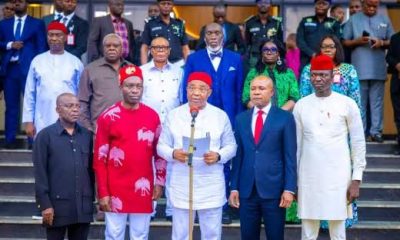
2027: South-East Govs Insist On Tinubu’s Re-election