
Opinion
Let’s Discover Our Potentialities


Every man, except the pampered child of fortune, ought to have a vocation in order to earn a living. In ancient Jewish society, acquisition of vocational skills was required. Apostle Paul of the Bible added tent-making to his location, while Jesus Christ earned carpentry skills from Joseph, his foster father.
Vocational education demands the training of specialists in various fields. There are institutions for imparting various types of specialised training to help people qualify for this. Our society demands specialists in every facet, be it office, factory and even educational institutions. Acquisition of special skills can lead to self-reliance.
Self-reliance is the great asset everyone ought to possess. By being self-reliant, a man gains glorious independence. He depends on his own powers and abilities and may not need to be helped by others. He has a heroic attitude to life and he is host to himself.
Life to him is a great adventure, full of interest and great excitement. He never feels dull or dispirited. Cicero, an ancient Greek, once said: “Most happy is he who is entirely self-reliant and who centres all his requirements on himself.”
Thrown upon his resources, the self-dependent accepts the challenges of life and develops new ventures, new qualities. He is full of devices and is ready to take the initiative. He is always confident of finding a way out of difficulties – economic, political or social.
At this period of radical economic difficulties, the lesson of self-reliance is needed because the average Nigerian is by nature fatalistic in his attitude. He tends to depend too much on fate or chance. Fate is the scapegoat on which he places the heavy responsibilities of his failures, which he always calls misfortunes.
This mindset destroys the springs of action. But if one has courage, initiative or is daring, one may become the master of one’s destiny. There are many who make their fortune by their own effort and then call it fate. They think it is an act of piety and humility towards God. But even this attitude is improper.
If it is God who has given us strength of body and power of mind, he surely expects us to help ourselves with them and not to be whining for divine help always. It is our duty to develop the gifts he has given us. Self-reliance is the parent of many virtues.
The self-reliant man is patient and persevering. He does not change or complain. He does not shirk his responsibilities. He is satisfied with what he can achieve by himself and is always striving after success. He does not envy others; nor does he think of begging favours from others.
The self-reliant person faces misfortune with a quiet courage. Emerson calls it “the essence of heroism, the first secret of success”. One who is self-reliant feels neither fear nor shame to labour with the hands because he understands that there is dignity in labour.
He is always learning new lessons, gathering valuable experience. His example is an inspiration to others, while his achievement is a model. Failure cannot shake his well-grounded self-confidence. Rather it spurs him to renewed enterprise. Confidence in himself wins him the confidence of others.
The great Italian artist, Michelangelo says: “The promises of the world are for the most part vain phantoms”. If we trust in them we delude ourselves. At the proper time, they invariably betray us, help to underline our weaknesses and breed in us a feeling of inferiority, a ruinous distrust in ourselves and a pathetic dependence on others.
As Bernard Shaw pointed out: “it is easy – terribly easy – to shake a man’s faith in himself”. And nothing does this more effectively than the habit of relying on others, of expecting the world or government to help us in the face of every difficulty.
Therefore, as we howl or bay through the biting economic hardship which manifests in loss of jobs, rising inflationary trend, capital flight, etc, emanating from the economic reforms and state of insecurity in the country, every Nigerian must imbibe the spirit of self-reliance. There is no way out of it. This country is undergoing a strange phase of her economic life, and it is only the self-reliant that can brace the trend.
Our dependence on government largesse has to wane and those in paid employment must begin to develop their capability for self-reliance, as uncertainty trails every employment. However, government has to create the enabling environment for the realisation of individual and corporate economic potentialities.
Human achievement is indeed a record of man’s reliance upon himself. Great heroes, great scientists, great merchants were all self-made men. For instance, Benjamin Franklin was born of poor parents who could give him little education, yet by relying on his own God-given powers, he made his name memorable in science and statesmanship. Michael Faraday was a builder, but rose to be one of the greatest scientists of the world, among others.
If we fail to think properly of our own abilities, if we look to others for guidance at every step, we shall continue to faint at the mention of retrenchment or joblessness. We shall lose our confidence. Paupers shall we be perpetually, and be buried in unmarked grave of poverty.
Arnold Alalibo



The Federal Government’s approval of a N70,000 monthly transport intervention for public service workers for six months, beginning in November 2026, offers hope to employees struggling with the rising cost of living. The agreement with the Nigeria Labour Congress (NLC), reached at a conciliation meeting in Abuja on October 27, is intended to cushion transport costs and ease pressure on workers’ incomes. But for public servants in Rivers State, it raises a familiar question: will the State Government key into the intervention and ensure that its workers benefit? The agreement provides for N70,000 monthly across all levels, for six months. The Federal Government also approved peculiar allowance arrears effective from May 1, 2026, to be paid in three equal instalments beginning in November.
The parties agreed to reconvene after one month to assess implementation. Ultimately, the value of these resolutions will be measured not by announcements but by whether eligible workers receive the money. Transport costs consume a substantial share of many civil servants’ earnings before they can meet household needs. Support for commuting is therefore not a luxury or political favour; it is temporary assistance to help workers remain at their jobs without sinking further into hardship. For lower-paid employees, transport costs can turn modest salaries into a daily exercise in difficult choices and sacrifice.
The agreement also urges State and Local Governments to participate and unions to press for implementation. The federal agreement does not automatically guarantee that every State and Local Government employee will receive the support. State authorities must clarify how it will apply to their workforce, make the necessary arrangements and publish a payment timetable. Rivers State must approach the arrangement with urgency and transparency. The Government should State whether it will implement the intervention and when payments will begin. Any administrative or financial question should be addressed promptly with organised labour, not allowed to become excuses for delay.
The concern is sharpened by the earlier N35,000 monthly wage award introduced by the Federal Government in 2023 after petrol subsidy removal. It was intended as temporary relief pending a new national minimum wage. While several States negotiated and paid wage awards or related sums, implementation nationwide was uneven. Reports in 2024 indicated that many States had failed to pay the federal award, while others provided different amounts. In Rivers, labour and media reports raised concerns about implementation of the N35,000 award for State workers, amid separate announcements and arrangements concerning Local Government employees.
The wage award was meant to ease the immediate effects of subsidy removal, yet workers faced uncertainty over whether the promised relief would reach them. In February 2024, the Rivers State Government announced approval of the N35,000 award for local government workers, but subsequent reports showed that implementation across worker categories remained a concern. The lesson is clear: approval and implementation are not the same. A declaration at a meeting offers little comfort to a worker whose account does not reflect the promised payment. For workers who travel to their offices daily, the implications of delayed support are significant. Transportation expenses compete with food, rent, school fees, healthcare and other essential household needs.
As fares rise, employees may be forced to reduce spending on necessities or borrow to sustain their families. A timely transport intervention would therefore provide practical relief and demonstrate that government understands the economic pressures confronting its workforce. Its temporary nature makes prompt implementation even more important. It is fair to acknowledge that this transport intervention is a new agreement and that its administrative details may require clarification. Rivers State should not be condemned in advance for a failure that has not occurred. Nevertheless, the earlier experience gives workers legitimate grounds to seek assurances before the November commencement date. The State should avoid allowing uncertainty to persist until workers begin asking why the promised assistance has not arrived.
The NLC and unions in Rivers State should engage the State Government immediately and seek a written commitment, an implementation plan and a process for reporting missed payments. If clarification from the Federal Government is needed, the State should seek it without abandoning the goal of providing relief. Labour leaders must also keep members informed about progress and insist that any agreed arrangements are applied fairly and transparently. The Rivers State Government should treat this intervention as an opportunity to rebuild confidence. Timely support would show that workers’ welfare is more than a talking point and that the State recognises the economic realities confronting its employees.
Silence, delay or selective implementation, by contrast, would revive frustration over earlier relief measures and weaken trust between government and labour. Every month lost to administrative delay leaves workers facing the same transport burden without the intended assistance. The State should consult labour, publish arrangements and pay eligible workers on time. Rivers workers should not have to wonder whether federal relief will reach them. The Federal Government has announced the support; now the State must make its position clear. We hope the N70,000 monthly transport intervention will not follow the troubling path of the earlier wage award. Rivers State should learn from that experience and ensure that this time, relief is not merely promised but delivered.
Sylvia ThankGod-Amadi
Everyday, Christians call on Abraham, Isaac and Jacob as they pray to God in the privacy of their homes across our multicultural, multiracial and multiethnic world. On Sundays and almost everyday of the week in the new-found full freaking fanaticism in Pentecostalism, they gather in the more than four million churches or congregations in the world to worship God, invoking the spirits of the ancestors of Jews. Meanwhile, in the scaremongering antics of institutional religion, the African has allowed himself to be hoodwinked into believing that invoking the spirit of his ancestors in prayers is idolatry and patently evil. He is mind-controlled into believing that indulgence in what the Christian clergy calls ”Satanic Act” is a sure ticket to Hell, where the individual is tormented, burnt and charred till eternity on the orders of a loving Father; what a laughable irony.
Come with me on my experience of what the Christian clergy contemptuously calls ancestorial worship. One Monday in September 1988, I drove from Port Harcourt to Owerri, accompanied by Chief AM Abasi who was the general manager of Delta Holdings Ltd, a company owned by Chief Ranami Abah, (Abadifeni III). Our mission was a meeting with Mr. Nwaorgu, the marketing manager of 33 Breweries Ltd for a dealership for Mrs. Alice Abah, whose husband, Chief Ranami Abah, had substantial equity shareholding in 33 Breweries Ltd. At the end of the meeting, we agreed to return on Wednesday with Mrs Alice to sign a contract for the dealership. When Chief Abasi and I stepped out to the parking lot, it hit me that I could not recollect how I drove from Port Harcourt through Igwuruta, Isiokpo and Elele to Owerri.
First, I waved the feeling off, ascribing it to the aerodynamic and slippery nature of the super slick German machine, a Mercedes-Benz 280 SLC convertible owned by Chief Ranami Abah. But on a second thought, I sensed a premonition; an ominous feeling. Then a sense of foreboding hit me, leaving me with the chilly feeling that something wrong was in the air. For a person who does not know fear as a result of having had out-of-body experience (OBE) in 1975 and considering the threshold of death the most beautiful experience in my life, it was a very worrisome feeling, to say the least. I quickly shook those thoughts out of my head, engaged the gear of the ever-ready German machine and zapped through Owerri traffic, attracting the same attention that trailed us all the way from Port Harcourt.
At Control Post, an inner voice instructed me not to return to Port Harcourt through the route we came. In reflexive obedience to the mysterious inaudible voice, I turned right (northwards) and stepped heavily on the gas. The straight six-cylinder engine roared in dutiful obedience; the automatic transmission immediately dropped into a lower gear, thereby giving the engine a very powerful pull that enabled the small-bodied car to dust every other vehicle on the road. Through the rear view mirror, I saw the vehicles we overtook recede speedily and virtually disappear behind us. In almost a whisper, Chief Abasi asked if I wanted to visit the 33 Brewery factory at Awo Omamma; I said ”no” without explaining the movement in the opposite direction of our journey.
Strangely, Chief Abasi did not pry further. We raced on, northwards; in thunderous silence. At Ogbaku junction, I turned left, drove westwards past Ejemekwuru and Izombe, turned left at Oguta and headed southwards on the Oguta Lake–Egbema–Omoku–Ahoada Federal Road. Carefully navigating the potholes that generously punctuated the road vis-a-vis the very low clearing of the car, I entered Egbema territory at Opuoma, drove through Mmahu, Abacheke, Okwuzi and turned eastwards to Mgbede, my home town. There, I quickly introduced Chief Abasi to my parents, left him with them and briskly walked a few metre to the grave of Osai, my grandfather. At the graveside, I solemnly told Osai that I sense something wrong in the air.
Then, in furious rage, I threatened him and my uncle, Lazarus, who lay beside him, that if they remained sleepy-eyed in that dimension and I am forced out of this world, that I will scatter their ribcage with penknife. My cousin and age mate, Luke Ofere, came out of his house and asked what was wrong and why I was in tears. With hot tears running down my cheeks, I turned around and left the graveside without a word to him; shock, surprise and confusion were boldly written on his face. On my way back to my father’s house, Nze Romanus Ogboh caught up with my brisk strides and, viciously pulling his right ear, he warned me to be careful on the road; that he dreamt that I died in a motor accident but that he administered a potion on me and I came back alive.
He was completely confused when I replied ”I know” and continued walking in tears towards my father’s house without a further word. Still in the holy rage, I called out Chief Abasi to join me in the car. Back to Port Harcourt through Omoku, Ahoada, Elele Alimini and Emohua, I told my spouse that something wrong is certainly around the corner. As we planned, Chief Abasi travelled to Calabar on Tuesday to inform Auntie Alice of the development and request her to come to Port Harcourt on Wednesday for onward journey to Owerri to effect the dealership contract. On Wednesday, I waited for them but they did not show up. I called Chief Abah and complained about the development. Thursday morning, they pulled up in front of my apartment in a blue Peugeot 504.
To be continued in our next edition.
Jason Osai
Osai lectures in Rivers State University.
-
Opinion3 days ago
Ancestorial Worship: My Take (1)
-

 News3 days ago
FG Must Address Nigerians’ Concerns On Reforms -Shettima …Warns Against Misuse of AI, Social Media
-

 Featured3 days ago
Tinubu Jets To S’Arabia For Lesser Hajj …Unveils Free Healthcare For Pensioners
-
Niger Delta3 days ago
Police Rescue Woman, 24, From Online Dating Kidnappers … Arrest Five Suspects
-
 Featured3 days ago
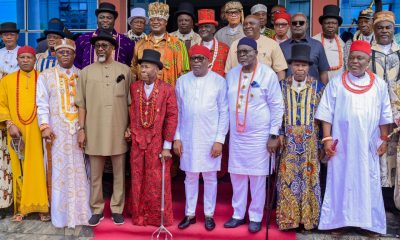
2027: Be Politically Neutral, Fubara Tasks Traditional Rulers
-
News3 days ago
FG Approves King Amachree Airport In Rivers, Sets Conditions For Construction
-
News3 days ago
Lawmaker Sets Sights On Assembly Return …As Mammoth Crowd Grace Flag Handover Rally
-
News3 days ago
RSG, Peter Odili Cardiovascular Hospital Move To Promote Early Breast Cancer Detection