
Entertainment
Reminiscence Of Nigerian Highlife Kings .The Crave For Their Songs


Koredo
These are songs that bring
back that longing sense of nostalgia that makes you crave for a Nigeria before the Civil War. Thanks to these kings of highlife music even the young generation can listen to it and are on the music playlists of a lot of Nigerian weddings home and abroad.
Highlife is life! Meet our African Kings of highlife music. Enjoy!
10. Celestine Ukwu
Celestine Obiakor was born in 1940, Efik, Onitisha, Nigeria. Celestine was a hit back then and was on the verge of a national breakthrough when the Nigerian Civil War brought touring and recording to a grinding halt. He re-emerged in 1970 with Philosopher’s stone.
He released his biggest hit money palaver in 1976. He died later the same year.
9. Sunny Okosun
Sunny Okosun born in January 1, 1947 in Enugu, Sunny who was from Edo State was one of the leading Nigeiran musicians from the late 1970s to mid 1980s.
He formed his first band. The postmen, in Enugu in 1965 and joined Melody Maestros, a band led by Victor Uwaifo in 1965. From 1972 to 1974 he led a group known as Paperback Limited and then formed a newband, Ozziddi.
Some of his popular songs are Fire in Soweto, High life and Which Way Nigeria. Okosun continued his career in music as a gospel musician in the early 90s.
He died aged 61 of Colon Cancer on 24 May 2008.
8. Tunji Oyelana
A former lecturer, Tunji Oyelana was born in October 4, 1939 and is credited with having sold the most albums by a Nigerian High Life musician.
He composed the song, I love my country with Nobel laureate Wole Soyinka. Both were charged with treason in 1996, and forced into exile by Sani Abacha, while touring internationally with Soyinka’s play the beatification of Area Boy.
7. Orlando Owoh
Originally born as Stephen Oladipupo Owomoyela in February 1932, in Osogbo, Orlando was a notable highlife musician and band leader. He was shifted from the carpentry trade in 1958, when he was hired by Kola Ogunmola Theatre Group to play drums and sing.
He went on to form Dr Orlando Owoh and his Omimah Band in 1960 and Dr Orlando Owoh and his Young Kenneries Band in 1975; and over a musical career of forty years became one of the leading proponents of highlife music. He had over 45 albums to his credit.
Some of his well known song include, Yellowe Sisi, Ajokodun bi ile, Ololufe gba temi, Omo Pupa and No friend/Aiye Lokun.
6. Prince Nico Mbarga
Prince Nico Mbarga was born to a Nigerian mother and a Cameroonian father in Abakaliki on January 1, 1950. He is renowned for his hit song Sweet Mother, recorded with his band Rocafil Jazz, as well as Aki Speical.
Prince Nico Mbarga’s style of Highlife is a mixture of Soukuos of the two Congos, Makossa of Cameroon, and of course the Guitar Highlife of Nigeria.
5. Jim Rex Lawson a.k.a Cardinal Rex
Cardinal Rex was born to parents of Igbo and Kalabari descent in 1935.
He played with Sammy Obot, Bobby Benson, Victor Olaiya Chris Ajilo, and other Ghanaian and Nigerian musicians and bands. With the majors band, they recorded the hits: So alateme, Yellow sisi, Gowon Special and Jolly Papa.
He’s renowned for hit songs like; Yellow Sisi, Love Mu Adure and Sawale. Sawale was remixed by Flavor to make the popular hit song, Nwa Baby (Ashawo).
4. Victor Olaiya
Victor Olaiya was born to a wealthy family on the 31st of December 1930, in Calabar, Cross River State, and is the 20th child of a family of 24. He hails from Ijesha-Ishu in Ekiti State.
In 1954 Olaiya formed his own band, the Cool Cats (later the All Star Band), playing popular highlife music. His band was chosen to play at the state ball when Queen Elizabeth II of the United Kingdom visited Nigeira in 1956 and later to play at the state balls when Nigeria got independence in 1960 and when Nigeria became a republic in 1963. On the latter occasion, Olaiya shared the stage with the American jazz musician, Louis Armstrong. During the Nigerian Civil War of 1967-70, Olaiya was given the rank of a lieutenant colonel (honorary) in the Nigerian army and his band played for the troops at various locations. The cool cats later travelled to the Congo to perform for United Nations troops.
3. Dr Sir Warrior
Christogonus Ezebuiro Obinnaa was born in 1947 in Imo State, the ultimate Dr Sir Warrior, was the leader of the Oriental Brothers International Band which was famous in the Nigerian Igbo highlife music scene for several decades.
He began performing at the age of 11, when he joined men’s choral group specialising in a music form known as Ese. By 16 he had achieved fame for his voice and performance of Ese music.
He introduced the Oyorima concept, which is an Igbo word that means a refined feeling of rhythmic movement and balance.
It is said that the Oriental Brothers played a very important spiritual role in keeping many Igbo sane as they were severely traumatised by the civil war.
2. Oliver De Coque
Popularly known as Oliver De Coque, Chief Dr Oliver Sunday Akanite was born on April 14, 1947 and hails from Ezi nifite in Anambra State. He recorded more than 73 albums to his credit making him the most popular High life king of Africa.
His music band group Ogene Sound Super of Africa, blended modern high life and traditional Igbo music. He started playing music at the age of 17 with Ekpili.
1.Chief Stephen Osita Osadebe
Born in March 1936, in Atani, a city in Anambra State, he came from a line of singers and dancers. His career spanned over 40 years and he has written over 500 songs, half of which were commercially released. His popular hits include: Osondi Owendi (meaning “one man’s meat is another man’s posion”. Nwannem Ebezina, Kedu America and Onuigbo.
Osita later died in St. Mary’s Hospital Waterbury, Connecticut on 11 May 2007.



Nigerian singer and half of the defunct P-Square duo, Paul Okoye, aka Rudeboy, has claimed that social media has reduced the prestige and value fans attached to musicians due to the mystique that artistes had before the era of social media.
Speaking in a recent interview with Lun Lifestyle TV, Rudeboy argued that social media, despite all its benefits, has shattered the illusion of artistes being mysterious and godlike.
This he said has reduced the buzz artistes previously enjoyed whenever their fans got the opportunity to see them whether physically or visually.
The ‘Reason With Me’ crooner explained that because artistes are no longer mysterious, fans are no longer eager to watch them in music videos.
He claimed that shooting music videos is now a waste of money.
Rudeboy said, “Music videos somehow now, because of this generation, is a waste of money. I am sorry to say this. But do you remember us [P-Square] before? You don’t see us anywhere. You just watch music videos, you see us and that’s it, or we come to your country, you see us.
“The reason you don’t see people faint for artistes anymore is because they see them on TikTok every day dancing and promoting your music. If Michael Jackson was alive now and doing promotional content on social media, nobody would see him and faint.
“Unfortunately, it’s too late for us to bring back the era of artistes being mystiques. How can you advise an artiste to post every day? How? Post what? You don’t need to.
“Social media brought positive change to the industry but it also led to ‘see-finish.’ Artistes are now too exposed. Fans see how they eat, cry. Before when artistes go to club, they stay in restricted VIP areas, but now when they are clubbing, everyone is filming.”
Afrobeats superstar, Davido’s aide, Damilare Aladegbola, popularly known as Dre, has offered a cash reward to whoever returns his phone, which he claims went missing during rapper Zlatan Ibile’s wedding ceremony.
Dre made the appeal in a post on his Instagram page on Monday, pleading with the person who allegedly took the device to return it in exchange for money.
“If na u carry my phone for Zlatan wedding, abeg return am, I go give you money please,” he wrote.
The aide also expressed frustration over what he suggested was a method being used to take phones at social gatherings.
He said he would no longer tolerate waiters asking whether guests had finished eating so they could clear their plates, alleging that the practice could provide an opportunity for phones left on tables to be taken.
“From now on, if I go any party or dey any party and any stupid waitress tell me say are you done eating so I can pack your plate, na swear I go swear for you cause na pattern wey una dey use pack phone for table be that now,” he added.
However, Dre did not identify anyone suspected of taking his phone or provide further details about how the device went missing.
Zlatan Ibile tied the knot with his longtime partner, Davita Lamai, during a traditional wedding ceremony on Saturday, October 24, 2026.
The ceremony, held in Lagos, attracted several celebrities, fans and well-wishers, with Davido among the prominent guests and leading the groomsmen.
Popular singer, Chidinma Ekile has revealed that before transitioning from secular music to the gospel genre, she “ran away” from Nigeria.
Speaking at a recent Eezee Conceptz event, Chidinma explained that she travelled abroad and wanted to secure permanent residency because she didn’t want to return to Nigeria, but failed.
She revealed that while she was abroad, the CEO of Eezee Conceptz was the only person calling her from Nigeria, so she decided to work with him upon her return.
“I travelled. I ran away from Nigeria. I was processing my papers not to come back to Nigeria, but for some reason, it didn’t work.
“While I was abroad, the CEO of Eezee Conceptz was the only one who was calling me from Nigeria. He kept encouraging me, and I found the strength to come back to Nigeria. When I came back, I asked him to give me a gospel music contract because I want to spend time with God. And he gave me a contract that even my lawyer said seemed like a charity,” Chidinma stated.
The music star added that she did not transition into gospel music because she wanted to make gospel, but because she wanted a serious relationship with God.
-
 Politics3 days ago
LG CITY BOY COORDINATOR HAILS WIKE’S SUPPORT FOR ONYESOH, TINUBU
-
Politics3 days ago
DIRI INAUGURATES APC CAMPAIGN COUNCIL, SETS MILLION VOTES TARGET FOR TINUBU
-
 Politics3 days ago
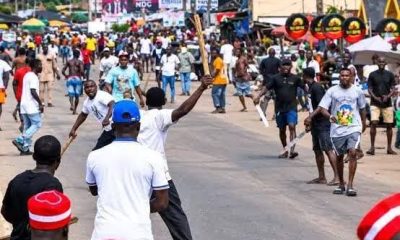
NDC Candidate Urges Oborevwori To Probe Asaba Political Violence
-
 News3 days ago
Army Recovers X Account After Hack Attempt
-
 Business3 days ago
Nigeria Loses N17tr Yearly To Abandoned Projects
-
Politics3 days ago
2027: Oborevwori Tasks Media On Fair, Accurate Reporting
-
Politics3 days ago
2027: AKPABIO ENVISAGES TINUBU’S VICTORY IN SOUTH SOUTH REGION
-
Politics3 days ago
Asaba Political Violence: Police Confirm One Dead, Delta Govt Urges Probe