
News
ACCI Advocates Private Sector Inclusivity To Revitalise Enterprises

The Abuja Chamber of Commerce and Industry (ACCI) has advocated stronger private-sector participation through Public-Private Partnerships (PPPs), to revive viable moribund state-owned enterprises.
Director-General of the Chamber, Mr Agabaidu Jideani, made the suggestion in an interview with newsmen in Abuja, recently.
Jideani said that collaboration between government and private investors was critical to restoring viable state-owned enterprises, while calling for comprehensive reforms and professional management to revive the sector.
According to him, stronger private-sector participation through PPPs will strongly support the reviving of the viable enterprises.
“The revival required treating the enterprises as economic assets that must be commercially viable, professionally managed and accountable for results,” he said.
The director-general also recommended comprehensive audits to determine the enterprises’ financial positions, assets, liabilities, infrastructure conditions, market potential and reasons for their decline.
He said that the government should classify enterprises based on their strategic importance, commercial viability and the need for restructuring or repurposing.
He suggested that viable enterprises should undergo recapitalisation, debt restructuring, technology upgrades and rehabilitation of critical infrastructure to restore their productive capacity.
He emphasised the need for strong corporate governance and professional management, with boards appointed based on competence, integrity and relevant industry experience.
Jideani, however, called for clear and measurable performance targets, adding that management should enjoy operational autonomy while remaining accountable for productivity and service delivery.
“Operating challenges, including unreliable power, inadequate infrastructure, regulatory bottlenecks and limited access to finance, must be addressed.
“The reviving of the enterprise should go beyond government funding to include corporate restructuring, technology, innovation, access to finance, competitive markets and accountability.
The ACCI D-G described PPPs as an important instrument for reviving viable enterprises where government lacked sufficient capital, technology or managerial expertise.
He noted that the PPPs arrangement should involve clearly defined responsibilities, risks, rewards and performance obligations for both government and private investors.
He said various PPPs models could be considered, including management contracts, leases, concessions, joint ventures and strategic equity partnerships.
He added that the appropriate model should depend on the nature, strategic importance and commercial potential of each enterprise.


The Revenue Mobilisation, Allocation and Fiscal Commission (RMAFC) has pledged to deepen collaboration with Nigerian Extractive Industries Transparency Initiative (NEITI), to strengthen transparency, accountability and revenue mobilisation in extractive sector.
The RMAFC Chairman, Dr Mohammed Shehu, said this when NEITI Executive Secretary, Mr Musa Adar, paid him a courtesy visit in Abuja recently.
Shehu said that the partnership would improve revenue monitoring, transparency and accountability in Nigeria’s extractive industries.
He described the longstanding partnership between RMAFC and NEITI as strategic and mutually beneficial to both institutions and the country.
He commended NEITI for providing credible information on operations and financial flows in the extractive industries, adding that its efforts had strengthened accountability.
According to him, NEITI’s work had also improved public understanding of Nigeria’s extractive sector and promoted openness in managing the country’s natural resources.
Shehu said NEITI had earned a strong reputation through efforts to uncover facts, reconcile information and promote transparency in the extractive industries.
He expressed hope that NEITI’s international partners would continue to support its capacity in information gathering, data verification, revenue transparency and accountability.
The RMAFC chairman assured NEITI of the commission’s continued support and openness to collaboration in data sharing, research, revenue monitoring and policy engagement.
He congratulated Adar on his appointment as NEITI executive secretary, describing it as well deserved and expressing confidence in his leadership.
“Your experience, competence and diligence will contribute to greater achievements in promoting transparency and accountability in Nigeria’s extractive sector,” he said.
In his remarks, Adar described the relationship between NEITI and RMAFC as a longstanding partnership built on transparency, accountability and improved revenue mobilisation.
The NEITI executive secretary said both institutions needed to strengthen the partnership to achieve greater impact in revenue monitoring, resource governance and accountability.
He highlighted RMAFC’s role in monitoring revenues accruing to the Federation Account and measures to improve revenue collection and accountability.
Adar said reliable information on revenues from oil, gas and mining activities was essential for fiscal management, public accountability and informed decision-making.
According to him, NEITI’s independent reconciliation of financial production, exports and company activities.
And physical flows provides useful data on revenues, payments, production, exports and company activities.
“NEITI’s reports can support RMAFC’s work in revenue monitoring, verification, policy analysis and developing measures to improve revenue mobilisation,” he said.
President Bola Ahmed Tinubu, GCFR has received the Director-General of the Nigerian Maritime Administration and Safety Agency (NIMASA), Dr. Dayo Mobereola, at the State House, Abuja, to discuss issues bordering on the development of Nigeria’s maritime sector.
During the meeting, Dr. Mobereola briefed the President on developments within NIMASA over the past two years, highlighting the progress recorded by the Agency as well as some of the challenges confronting the industry.
Following the briefing, President Tinubu reaffirmed his administration’s commitment to the continuous development of Nigeria’s maritime industry.
He noted that the creation of NIMASA was a deliberate step towards ensuring that the maritime sector contributes more significantly to the nation’s Gross Domestic Product (GDP).
While commending NIMASA for the progress recorded so far, the Presidentd charged Dr. Mobereola and his team at NIMASA not to rest on their oars.
Metro
From Himalayan Ice to Niger Delta Floods: How Melting Glaciers Will Reshape Nigeria’s Coastline
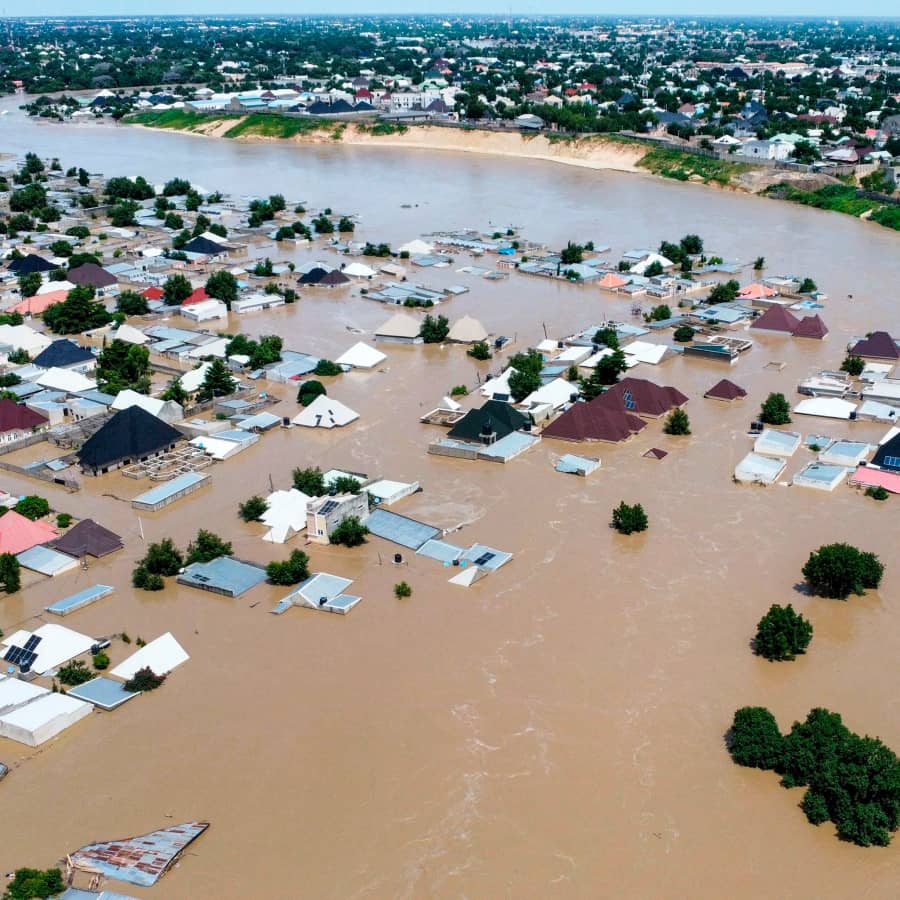
On Wednesday August, 26, 2026, the world watched Nepal as glacial collapse sent a wall of water tearing through the Nepal-China border mountain villages, swallowing homes, schools, roads, bridges and hydropower plants and causing significant loss of lives. All these were gone in minutes.
According to reports, the first indication that something was amiss came at 8.37 am local time,when the earth started shaking along the Nepal-China border, north of Kathmandu.
Scientists later established the fact that an enormous chunk of glacier sheared off from high on a mountain.This plunged into the river below. The section of the glacier that fell was approximately 2,000 feet wide.
A Professor of Hydrology at the Imperial College, London, Wouter Buytaert said, “this is the type of event that is triggered by climate change. Global warming strinks glaciers making it more likely for them to break apart.”
So far, more than 1000 people are found dead, 4,267 individuals rescued. As at Tuesday, 1st September, 2026, more than 4,400 people still reported missing and and more than 65,000 people affected in Nepal and Tibet. There are fears that the numbers of dead may still rise exponentially.
That disaster in the Himalayas feels far from the Niger Delta. But climate science tells us it is connected. The ice that melts in the Antarctica, Arctic, Andes, Himalayas,Alaska,Alps,Mt. Kilimanjaro and Mt. Kenya does not stay there. It flows into our oceans, and our oceans decide what happens to the Niger Delta.
For a proper understanding, we need to put this in perspective. What are glaciers?Glaciers and ice sheets are large masses of ice that form when fallen snow is compressed and recrystallised over the course of thousands of years. The two types of glaciers are the continental glaciers and the alpine (mountain)glaciers. The glaciers exist on all the world’s continent except Australia.These glaciers hold about 68-70% of the world’s freshwater. Together, they cover approximately 10 percent of the Earth’s total land mass.
For 10,000 years they were relatively stable. That changed in the 1900s. Since 1990, glaciers have lost over 9 trillion tonnes of ice. The World Meteorological Organization (WMO) and the World Glacier Monitoring Service confirms that global glacier mass loss has accelerated, and 2022-2024 were the 3 largest loss years on record.
All 19 of the world’s major glacier regions reported a net annual loss of ice mass, though, year 2023 set an individual annual record for single-year water loss with glaciers shedding approximately 600 gigatons of water.
In October of 2023, during a visit to the Everest region in Nepal, the United Nations Secretary-General, Antonio Guterres called on the world to “stop the madness” of climate change, warning that the disappearance of glaciers altogether looms even larger.
However, researchers in recent projections show that mountain glaciers will lose one quarter to one half of their mass by 2100 for global temperature change scenarios. A third of glaciers in the World Heritage sites are set to disappear by 2050.
Also, many mountain regions have already witnessed radical glacier loss with many low elevation and small glaciers around the world, including all of Africa’s remaining glaciers at risk of disappearing within this century.
The ice is melting because global temperatures have risen to almost 1.4°C since pre-industrial times. The extra heat turns ice to water. As a result, the gradual disappearance of glaciers contributes to rising sea levels, increased risk of drought in densely populated plains and atmospheric pollution,where ancient greenhouse gases like methane trapped deep beneath the ice are released.
Glaciers in Greenland, Antarctica, Alaska and the Himalayas melt into rivers into the Atlantic, Arctic and Pacific Oceans.
The meltwater adds volume to the ocean. Thermal expansion of warmer seawater adds more water. Global mean sea level has risen from 21-24cm since 1900, and the rate has doubled since 2006. All this add up to the pressure in Nigeria’s Niger Delta, which over the years has witnessed severe flooding.
The Niger Delta Coast of Nigeria has 853km of coastline facing the Atlantic Ocean along the Gulf of Guinea.It stretches to a total of nine states including Rivers,Bayelsa, Akwa Ibom, Cross River, Delta, Edo, Lagos, Ogun and Ondo. The coastline comprises inshore waters, coastal lagoons, estuaries and mangroves especially in the Niger Delta. The Niger Delta is a low-lying, sediment-based delta. Bonny, Brass, Okrika, Warri and Lagos Island generally sit across low-lying coastal terrain. .
So the meltwater from thousands of kilometers away ends up pushing against the shorelines of the Niger Delta, raising tides, and pushing saltwater into our creeks and groundwater.
The impact of the melting glaciers are enormous on the Niger Delta.The glacier melt may not cause a Himalayan-style flood, but may cause slow, compounding damage.
This is mainly due to the fact that higher sea levels mean king tides which now reach further inland. Communities in Okrika, Nembe, and Lagos Bar Beach already lose land yearly. With 0.5m rise by 2050, 30-50% of the Delta could face annual inundation.
Furthermore, as sea level rises, salt pushes into coastal aquifers and surface water. This is critical for the Niger Delta where people depend on shallow hand-dug wells and boreholes 10-20m deep for drinking water. Salinity ruins drinking water and kills agricultural crops.
Also, it will lead to worsened flooding and extreme rainfall. Climate change makes rains heavier. When high tides meet heavy rain with poor drainage in most Niger Delta communities and urban cities, floodwater has nowhere to go.
The critical impact will be the loss of livelihoods in the area. Fishing and farming in the Niger Delta area depend on brackish water balance. More salt from floods results to fish migration, and also crop failure.
The massive inflow of water may lead to Infrastructural damage: roads, refineries, industries and businesses at the coastal line are affected, while repeated flooding corrodes and disrupts production.
With the continuous melting of the glaciers, the next five years and beyond for people of the Niger Delta region is ominous.
By 2031, scientists evisage more “nuisance flooding” during high tide with 10-15cm additional sea level rise globally. And by 2050, according to the Intergovernmental Panel on Climate Change (IPCC) projects 0.28-0.55m sea level rise even if countries cut down on emissions. This will translate to more flooding and moderate coastal flooding will happen 10 times more often than it does today.
High tide will routinely flood coastal streets, damaging local infrastructure and threatens fresh water supplies. For the Niger Delta, that means displacement of communities and billions in damage.
What is worse? By 2100, if emissions continue, 1-2m sea rise is possible and this will make parts of the Niger Delta to become uninhabitable, if there are no massive defenses put in place.
While the rest of the world are preparing to abate disasters, the Niger Delta and Nigeria as a whole seem to be asleep to the reality that is beckoning.
The rest of the world are developing early warning systems for disasters, community evacuation drills and placements.
The UN 2025 report shows that 119 countries are now covered by a multi- Hazard Early Warning System. Launched in 2022 by United Nations Secretary-General, Antonio Guterres, Early Warning for All is a ground breaking initiative to ensure that every one on Earth is protected from hazardous weather, water or climate events through life saving early warning systems by the end of 2027.
In the Netherlands the government used a technique known as Delta Works. They have built a country below sea level. The Delta Works is a massive network of dams, slluices, locks and storm surge barriers built to protect the Southern part of the Netherlands from catastrophic flooding after the 1953 floods.
The Dutch also use a system to strategically open and close dams that redirect massive volumes of river water to flush salt water back into the North Sea.
The United Nations (UN) and IPCC have begun the Global Stocktake-monitoring and inventory of climate issues of countries. There is the Loss and Damage Fund under the UN Framework Convention on Climate Change agreed at the 28th annual United Nations Climate Change Conference in Dubai 2023 to help vulnerable developing countries facing climate-induced impacts.
It is important to commend the African Union for the Climate Change and Resilient Development Strategy which it is delivering on African goal for inclusive and sustainable development. Aslo, the Great Green Wall project to combat land degradation, desertification and climate change across the Sahel region. They must find a way to bridge the funding gap for the projects, which is huge.
Nigeria has to wake up from its deep slumber on these issues. What Is The solution?
If we cannot build Dutch sea walls tomorrow, we can do “smart adaptation”.
Research is key in this direction. Research institutes and the Nigerian Meteorological Agency (NIMET) must monitor sea levels, salinity in boreholes, and map vulnerable communities.You cannot adapt what you do not measure.
We must return to nature-based solutions, such as restoration of mangroves in the Niger Delta. Thick mangrove forests act as natural wall against storms, hurricanes and rising sea levels One hectare of mangrove absorbs waves better than concrete and costs less. It also stores carbon.
Another solution is Water Safety,thereby investing in rainwater harvesting, deeper boreholes >40m above saltwater intrusion, and household water treatment for communities. This tackles Sustainable Development Goal 6.
We must adopt early warning. SMS flood alerts for communities like what Nepal is doing. Recently, the Federal Government of Nigeria issued alerts that over 2000 communities would face flood risk across 30 states. Seven states were identified as critical hot-spots.
In a statement, the Director of the Erosion, Flood and Coastal Zone Management Department, Mr. Usman Bokani said Akwa Ibom, Delta, Kogi, Benue, Rivers, Bayelsa and Ebonyi states could be critical areas during the forecast period. Also, Adamawa, Kwara,Taraba and Kebbi states had been categorised as high risk locations. Some communities in Borno, the FCT, Plateau, Nasarawa and Yobe states are expected to experience moderate flooding during this period. This is a good start.
Nigerian government must do all it takes to access funds in the area of foreign policy and finance and use it appropriately. Government should access the United Nations Loss and Damage Fund. Also, integrate climate into the Niger Delta Development Commission(NDDC) Masterplan and push for “polluter pays” from oil companies to fund adaptation.
Communities ought to be involved in this through information and education. Let them be enlightened about the consequences of their actions that lead to climate change. Government must mobilze communities in this regard. Climate adaptation works when people own it.
In conclusion, it is important to stress that
the ice in Greenland and the water in the Niger Delta are linked by one ocean. Nepal’s glacier burst was a warning. Our warning may be slower, salt in our wells, water in our streets, people moving from their ancestral homes, and more.
But we still have time. If Nigeria invests now in monitoring, growing mangroves, and community resilience, we can reduce the damage. Climate change is global. The response must be local.
By: Dr. Ibinabo Ogolo
Dr. Ibinabo Ogolo is a Research Fellow at the Institute of Geosciences and Environmental Management, Rivers State University, Port Harcourt, Nigeria.
-
 Metro5 days ago
From Himalayan Ice to Niger Delta Floods: How Melting Glaciers Will Reshape Nigeria’s Coastline
-
Sports53 minutes ago
Edo Queens Emerge WAFU B Champions, Qualify For CAF WCL
-
Sports53 minutes ago
African V’Ball: Amaka Paul Emerges 4th Best Scorer
-
Business35 minutes ago
FG Recommits To Boost Fish Production
-
Opinion53 minutes ago
Parental Honour: Recipe for Longevity
-
Business29 minutes ago
NIMASA Moves To Save Over $40,000, Bans Foreign Vessels
-
 Featured3 days ago
FUBARA SIGNS 2026 APPROPRIATION BILL INTO LAW
-
Sports53 minutes ago
Npbl: Sky Hawks Dent Hoopers’ Bid For Clean Sweep At Playoffs