
Editorial
Rivers: Let The Projects Go On

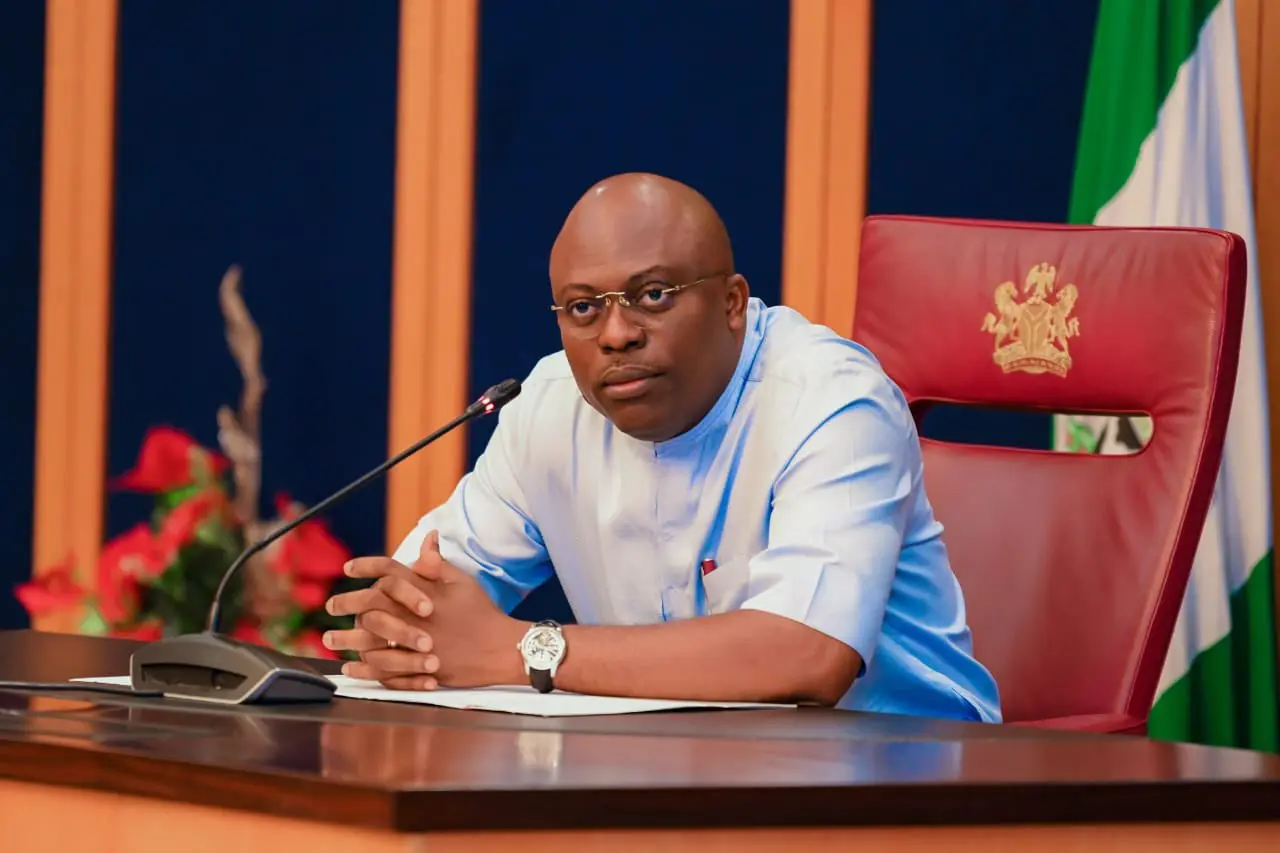
Governor Siminalayi Fubara has exemplified a proactive and resolute approach in steadfastly advancing the agenda of his administration, even in the wake of the Supreme Court’s ruling, which officially recognised Martins Amaewhule as the legitimate Speaker of the Rivers State House of Assembly. This unwavering commitment to governance and developmental progress underscores the Governor’s dedication to fulfilling his responsibilities to the people of Rivers State, regardless of the prevailing political and legal circumstances.
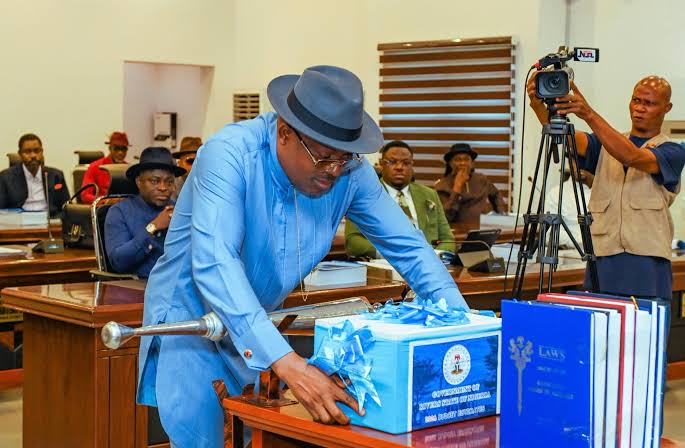
In meticulously orchestrating and initiating a broad spectrum of project inaugurations in multiple locations within Rivers State, Fubara articulates his resolute determination to honour the assurances given to Rivers people. His strategic focus on delivering tangible developmental projects not only highlights his determination to ensure the continued advancement of the state but also reinforces his vision of sustaining infrastructural growth, social welfare improvements, and economic empowerment.
This proactive stance can be viewed as a strategic move to showcase his administration’s competence and dedication to the public. Through the continuation of infrastructure endeavours and social initiatives, Governor Fubara aspires to reinforce public endorsement and effectively handle the complicated political situation resulting from the Supreme Court’s decision. The commissioning events serve as concrete evidence of the government’s initiatives and achievements, highlighting its commitment to progress.
The announcement of the projects generated widespread excitement throughout the state, with residents eagerly anticipating the institution of major infrastructure developments. The completion of these projects signifies an important milestone for the administration, demonstrating its dedication to fulfilling promises and investing in the state’s future. The Governor’s emphasis on the projects’ potential to drive economic growth, improve public services, and enhance overall quality of life, reflects his administration’s focus on delivering tangible benefits to the people.
The commissioning ceremonies are highly publicised events that attract considerable public attention and participation. This underscores the importance of the projects in enhancing the well-being and infrastructure of key areas in Rivers and Bayelsa States. The projects cover a wide range of sectors including housing, firefighting and emergency response, security, healthcare, education, and judiciary welfare, reflecting a comprehensive development approach essential for community progress.
The allocation of resources across various sectors demonstrates a deliberate strategy to address urgent needs and improve residents’ quality of life. In its efforts to foster safer communities, the government focuses on enhancing security and emergency response measures. Additionally, investments in healthcare and education underline a long-term commitment to human capital growth and well-being.
Among the projects scheduled for commissioning by the state government are the Government House Staff Quarters, the State Fire Service Headquarters with firefighting vehicles, the handover of a helicopter to the Nigerian Air Force, the Borikiri Fire Service Station, and the construction and furnishing of the palace and residence of the Akpor monarch. These projects address critical infrastructure needs and highlight the government’s dedication to enhancing public services and community welfare.
Other projects include the judges’ quarters, Bori General Hospital, Okrika Grammar School, as well as the furnishing, equipping, and electrification of the Nigerian Law School, Yenagoa Campus, and the Rumuodomaya Fire Service Station along with firefighting vehicles. Each of these projects plays a crucial role in improving the quality of life for residents and fostering development across key sectors in the region.
Governor Fubara’s actions speak volumes about his commitment to propelling Rivers State forward. The inauguration of diverse infrastructure projects is a tangible demonstration of his administration’s focus on progress and effective service delivery. This ardent approach extends beyond mere construction; it is a strategic investment in the future. Recall that in December last year, the Governor embarked on a schedule of projects commissioning and flag-offs to advance infrastructure and security across the state.
Through the prioritisation of key industries and allocating resources to essential sectors, the government is laying the groundwork for a more robust and prosperous Rivers State, offering its citizens enhanced opportunities and a higher quality of life. Through these initiatives, Governor Fubara is not just building roads and facilities; he is building trust, fulfilling his promises, and solidifying his leadership as a driver of sustainable development in the state.
The government is clearly committed to improving Rivers State. To say that Governor Fubara is rapidly transforming the state’s landscape with bold development initiatives is simply stating the obvious. In a short period, the Governor has turned the entire state into a vast construction site, with significant projects either underway or already completed — all in spite of the ongoing political challenges.
We join the good people of Rivers State, Nigerians, businesses, and individuals in commending and celebrating the Governor during this remarkable season of project commissioning and inauguration. The projects delivered so far reflect an extraordinary transformation, positioning the state as an attractive destination for investors. This progress stands as a testament to His Excellency’s commitment to leaving Rivers State far better than he found it.



There are moments in the life of a legislature when plain speaking becomes a public service. Senator Adams Oshiomhole provided such a moment on the floor of the Senate when he accused the Minister of Works, Senator David Umahi, of manifestly neglecting critical federal arteries in Edo and Delta States, and implored his colleagues to prevail on the Minister to adopt a more equitable and genuinely national approach to road infrastructure delivery. It was blunt, it was uncomfortable, and it was necessary.
The specifics of his complaint deserve restating. Drawing attention to the recent approval of some 20 new road projects despite the parlous state of existing ones, the former Edo State governor lamented that Nigerians cannot travel from Benin to Warri, Benin to Asaba, Benin to Auchi, or Auchi to Okene without encountering severe distress. He alleged a deliberate omission of these corridors from the national budget in the last three years, save for palliative interventions directed by President Bola Tinubu through tax credit arrangements. His question — “What have we done wrong?” — resonates far beyond the chambers of the National Assembly.
We lend our full and unequivocal support to that call. The Auchi-Benin Road, for instance, has been in a deplorable and near-impassable condition for several years, turning what should be a two-hour journey into an all-day ordeal of broken axles, extortionate fares, and despondent commuters. The media have, on multiple occasions, chronicled the suffering of motorists, traders, and students who ply that route. To describe it as a federal road today is to stretch the meaning of the term beyond recognition.
This pattern of sidelining is not confined to Edo or Delta. Even here in Rivers State, the disposition of the Federal Ministry of Works has left much to be desired, particularly along the Eleme axis of the East-West Road. That road, which ought to be a flagship of federal presence in the Niger Delta, has remained in a wretched state for long. Those who use it daily — workers at the Eleme Petrochemical Complex, the two refineries, Onne Port, and the countless ancillary industries — can attest to its deterioration. Work has proceeded in fits and starts without the sustained urgency such a strategic road demands.
The Eleme stretch is not a mere intra-state byway. It is the gateway to the nation’s economic jugular. According to the Federal Ministry of Works and Housing’s 2023 Highway Condition Survey, only about 35 per cent of the country’s 36,000 kilometres of federal roads are rated as being in good or fair condition, with the remainder classified as poor or very poor. The East-West Road, conceived in the 1970s to bind the entire Niger Delta, remains unfinished in critical sections more than four decades after. If it had been treated as a priority, the perennial gridlock, carnage, and economic loss on the Eleme-Refinery junction would have long been consigned to history.
The irony is as painful as it is glaring. The Niger Delta remains the goose that lays the golden eggs. Data from the Nigeria Extractive Industries Transparency Initiative [NEITI 2023 Oil and Gas Audit] show that the region still accounts for over 78 per cent of Nigeria’s federally collected export earnings and about 65 per cent of total government revenue. The National Bureau of Statistics [NBS Foreign Trade Report Q4 2024] similarly confirms that crude oil continues to dominate export receipts. By every metric of equity and economic logic, a region that sustains the national purse deserves first-rate consideration in the allocation of infrastructure, not afterthoughts and tokenism.
Road infrastructure is not largesse to be dispensed by favour; it is the skeleton upon which commerce, cohesion, and citizenship hang. When contracts are concentrated in one geopolitical zone while other zones are left to contend with craters, it erodes trust in the federation itself. The World Bank’s Nigeria Development Update [June 2023] estimated that poor transport connectivity inflates the cost of moving goods by up to 40 per cent and costs the Nigerian economy an estimated $1.5 billion annually in lost man-hours and vehicle maintenance. If we profess to be one country, then equity must be the compass that guides key institutions before any project is executed. Development must spread round, not pool in one place as though other regions do not matter.
There is also a grave security dimension that can no longer be ignored. The deplorable condition of federal roads has become a veritable enabler of criminality. The NBS Crime Experience and Security Perception Survey reported over 2.5 million incidents of kidnapping-related occurrences nationally, with transport workers identifying bad road spots as prime ambush points. When vehicles are forced to crawl at 10 kilometres per hour through failed sections at Auchi, Sapele Road, or Eleme, they become sitting ducks for armed gangs. Fixing bad roads, therefore, is not merely about convenience; it is about safeguarding lives.
By his intervention, Senator Oshiomhole has hit the nail on the head and reminded Minister Umahi of a fundamental constitutional truth: public office is held in trust. The Ministry of Works is not a personal estate where contracts are awarded according to whim or political convenience. It is a national institution funded by the collective resources of Nigerians, including the oil and gas rents from the very communities whose roads are now neglected. The Minister must demonstrate balance, transparency, and a pan-Nigerian outlook in the distribution of projects that impact the daily existence of citizens. Selective neglect breeds suspicion, and suspicion is corrosive at a time when the nation is preaching unity, oneness, equity, and justice.
Consequently, the National Assembly must go beyond rhetoric and assert its oversight powers with vigour. Sections 88 and 89 of the 1999 Constitution [as amended] empower the legislature to investigate and expose any maladministration in the execution of federal projects. If an office holder is not acting rightly, it is the duty of the Senate and the House of Representatives to call him to order. Oversight must not be reduced to budget approval ceremonies; it must translate to field verification, public hearings, and insistence that the Federal Character principle, as enshrined in Section 14(3) of the Constitution, reflects in road awards.
Let the Auchi-Okene, Benin-Warri, Benin-Asaba, and Eleme East-West gangways be restored to motorable dignity. Let priority be given to completing existing, economically vital roads before embarking on new ones. If those who, through their resources, sustain the federation are sidelined in the distribution of tangible dividends, it tells poorly of our nationhood. Bad roads must be fixed, and they must be fixed now, with fairness as the guiding standard.
-

 News2 days ago
RSG Targets Nine Million Residents in Mosquito Net Distribution Campaign
-

 Oil & Energy2 days ago
Aiyedatiwa Signs New Electricity Bill
-

 Oil & Energy2 days ago
NLNG Commissions Research And Innovation Centre In RSU
-

 Maritime2 days ago
Marine Minister Commends President Tinubu On NPERA Bill Assent
-

 News2 days ago
KenPoly Holds Eight Convocations, August 29
-

 News2 days ago
RSG Begins Another Phase of Projects Commissioning Today
-

 News2 days ago
RMAFC Completes Revenue Sharing Review, Proposes New Pay
-

 Maritime2 days ago
NAGAFF Petitions IGP Over Alleged Maritime Police Harassment