
Oil & Energy
How Much Lower Could Oil Prices Fall?

On Friday, April 7th, Brent crude closed at over $85 per barrel. That was a few days after OPEC+ had announced it would reduce its production by an additional 1.16 million barrels daily.
Fast forward a month, and Brent is almost $10 cheaper. Despite the promised supply cut, despite a production suspension in Kurdistan, and despite China’s demand growth, prices have fallen. And they may have further to fall. For a while, at least.
The big reason for the price drop we witnessed over the past four weeks was economic sentiment, especially economic sentiment in the United States.
Analysts loyal to the Federal Government are beginning to run out of euphemisms for “recession.” The media are getting bolder with their use of the word. No wonder oil prices are down.
There are plenty of causes for concern. Diesel demand is down after months of worry that the U.S. is facing a diesel shortage because demand is exceeding supply.
Well, that’s one thing people need not worry about anymore. Because diesel demand is down by a lot, and that spells bigger trouble: call it a slowdown, call it a correction, but what it comes down to is what one analyst called a recession.
“If you were looking at it in the closet, and not knowing what the wider economy was doing, you would say we’re seeing some sort of an industrial recession”, Tom Kloza from the Oil Price Information Service told the FT in comments on the diesel demand situation.
Inflation, meanwhile, is in decline but still a lot higher than the Fed’s comfort level at 5% for April, prompting yet another rate hike last week that did nothing for oil bulls.
That was because of the traditionally inverse relationship between interest rates and oil demand as the former boost the dollar, making oil more expensive in absolute terms.
At the same time, the manufacturing sector has been shrinking for six consecutive months, according to the Institute for Supply Management.
It shrank yet again in April, although S&P Global estimated an expansion in the sector for last month. It begins to become clear why it is so hard to call a recession in the U.S. for now.
Based on the latest oil price trends, there is definitely a recession, whatever the actual data says. The good thing is that this recession seems to be, at least partly, in the minds of oil traders rather than in the actual U.S. economy, where the service sector is growing despite manufacturing’s shrinking. Not all is lost until another bank collapses with a bang.
The banking sector tremors of recent weeks have also had a lot to do with oil prices: fears of a banking meltdown have rippled into fears of a broader meltdown, and that has translated into a fear of oil demand destruction and, consequently, a selloff. But here’s the thing. The supply situation may be about to change.
China’s oil demand topped 15 million barrels daily in March, breaking a record. U.S. crude oil inventories are now below the five-year average for this time of the year after a long streak of weekly declines.
And, according to Reuters’ John Kemp and historical patterns, U.S. oil and gas production growth may slow down significantly over the next months.
In a column earlier this month, Kemp noted the several months’ lag between price movements and drilling activity in the U.S., which means that it takes several months for drilling to expand in any noticeable way after a sustained rally in prices.
By the same token, Kemp noted, it takes several months between a sustained price decline and the consequent decline in drilling activity.
The thing is that U.S. production was already in decline in February, according to the latest official data. The total was nearly 1.2 million bpd higher than the average for February 2022, but it was also more than 80,000 bpd lower than the average for January 2023.
That’s not a whole lot when you’ve got a total of 12.5 million barrels daily, but it is a very different development from what the Energy Information Administration had predicted for February: another output rise to a record high. The EIA is now predicting that the record high will be hit in March.
If the EIA guesses right, prices could go further down, especially if demand for fuels remains subdued now that driving season is beginning. If it guesses wrong, however, oil will likely gather steam again unless another flare-up in recession worry occurs, of course.
“The selloff was far greater than what market balances are showing — namely lower inventories with the prospect of inventory draws as the northern hemisphere’s summer unfolds,” Citi’s commodity chief Edward Morse said, as quoted by Bloomberg, earlier this month.
In other words, price movements in oil are not in sync with oil’s fundamentals, and a correction may be only a matter of time.
However, as clearly shown by the price decline from the past month, expectations about fundamentals are at least as important, if not more important, than the fundamentals themselves. All it could take is one more bank domino piece falling.
Slav reports for Oilprice.com



By Felicity Bradstock for Oilprice.com 16
The State Commissioner for Works (Rural Roads) and Public Information, Charles Aniagwu, disclosed this at a press conference in Asaba, weekend, noting that the initiative was part of wider reforms aimed at opening up the power sector to private investors.
Aniagwu, who was accompanied by the Executive Assistant to the Governor on New Media, Felix Ofou, said the state was exploring alternative sources of electricity to support businesses, households and communities while reducing pressure on the national grid.
He said the government was particularly interested in exploiting Delta’s abundant natural gas resources for power generation, pointing to the Kwale Free Trade Zone, which is part of the state’s special economic zone, as a major opportunity for investors.
According to him, prospective investors were taken to the zone during the state’s recent economic summit to enable them to assess the availability of gas as a key raw material for electricity generation. ComparePower Rates
The commissioner explained that generating more electricity locally would not only increase supply in Delta but also free up power on the national grid for use by other consumers.
Aniagwu cited the 8.5MW Independent Power Plant located behind the state secretariat in Asaba as an example of what could be achieved through alternative power sources.
He said the facility had enabled the secretariat complex to operate independently of the national grid, thereby making the electricity that would otherwise have been consumed there available to other users.
He added that the planned 120MW partnership with Supply Power would further strengthen the state’s electricity supply capacity and provide a more reliable power base for small and medium-sized enterprises.
Aniagwu said the state government was also intervening in areas traditionally regarded as the responsibility of electricity distribution companies because inadequate power supply could no longer be allowed to constrain economic development. LearnQuantum Physics
He identified the extension of the electricity grid from Abraka towards the Ndokwa axis as one of the interventions being undertaken to connect more communities to electricity.
The commissioner, however, raised concerns over the burden placed on communities that are often required to provide transformers and other electricity infrastructure, only for distribution companies to take over the facilities and subsequently collect electricity bills without adequately accounting for the investments made by the communities.
He said the state would continue to support efforts aimed at energising communities, noting that improved electricity supply would stimulate businesses, create jobs and help tackle social problems associated with unemployment and idleness.
On regulation, Aniagwu said the government was working with the Ministry of Energy and a committee set up to develop an appropriate regulatory framework for the state’s emerging power sector. SwitchEnergy Plans
He said the proposed energy commission would be responsible for regulating new electricity producers, determining appropriate tariffs and overseeing distribution networks.
The commissioner stressed that liberalising the sector required effective regulation to protect consumers and investors, adding that decisions on power distribution infrastructure, including the use of overhead or underground lines, must take into account the peculiarities and safety requirements of each location.
He warned that power expansion without adequate regulation could expose residents to electrocution and other hazards, stressing the need to protect electricity infrastructure while ensuring consumers were not subjected to unfair pricing.
Aniagwu said the state government’s broader objective was to build an efficient and sustainable electricity market driven by private investment and capable of powering businesses, households and communities across Delta State.
-
Rivers2 days ago
Don Seeks Repositioning Of Tech Education For Dev
-

 Education2 days ago
PAMO MEDICAL UNIVERSITY -Nullifies Arrest warrant on VC
-
Niger Delta2 days ago
PANDEF Seeks 50% Oil Derivation Allocation Increase
-

 Education2 days ago
IAUE MOVES TO END GHOST WORKERS SYNDROME AS 400 NEW NON-TEACHING STAFF UNDERGO MANDATORY ETHICS TRAINING
-

 News2 days ago
Fresh Ebola Scare As NCDC Records Two Cases
-
News2 days ago
Customs Partners EFCC, NDLEA, Others To Tackle Money Laundering, Terrorism Financing
-
 Politics2 days ago
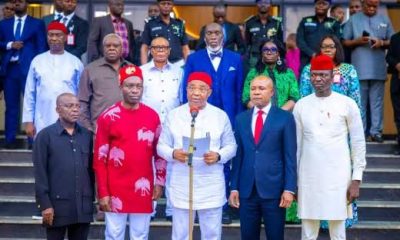
2027: South-East Govs Insist On Tinubu’s Re-election
-

 Politics2 days ago
2027: RIVERS GUBER CANDIDATES SIGN CHARTER TO PRIORITIZE CITIZENS’ DEMANDS