
Featured
NBA, Others Oppose Proposal For Six More Law Schools …PH Campus Duly Approved, Senate Affirms

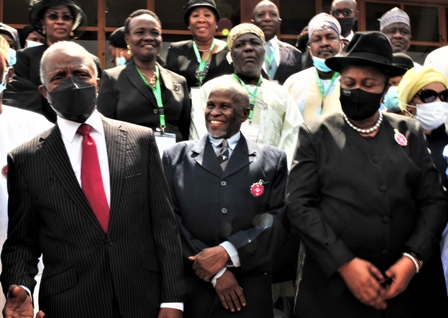
A move for the establishment of six more law schools in the six geopolitical zone in the country met with stiff opposition from senators and major stakeholders in Nigeria judicial system who warned against politicization of legal education.
The lawmakers, Nigeria Bar Association (NBA); Council of Legal Education, amongst the stakeholders, in a public hearing, yesterday, at the National Assembly, warned against politicisation of legal education as this would only lead to deteriorated system but urged states governments who wants one to take a cue from Rivers State.
Specifically, they noted that the function of establishing law schools was vested in the Council of Legal Education, adding that such power should not be usurped by the National Assembly.
These came from a two-day public hearing on a bill seeking for its establishment of six more law schools sponsored by Senator Smart Adeyemi and two others by the Senate Committee on Judiciary, Human Rights and Legal Matters.
The Senate committee, chaired by Senator Opeyemi Bamidele, had at the public hearing, sought for inputs from critical stakeholders on the legislative proposal titled: “Legal Education (Consolidated etc, Amendment) Bill 2021” but got unfavourable submissions from them.
First to pick holes in the bill were Senators Ike Ekweremadu and Seriake Dickson who called on their colleagues to be cautious on the proposal.
Ekweremadu, in particular, warned against politicising legal education, saying “establishment of new campuses or law schools should be left at the discretion of Council for Legal Education as empowered by the Act that set it up in 1962.”
Also opposing the proposed piece of legislation, the National President of NBA, Olumide Akpata, said the move was unnecessary as the existing six Law schools are grossly underfunded before the intervention of Rivers State Government with a well-equipped campus in Port Harcourt.
“With required infrastructure, the existing law schools across the country are enough to accommodate thousands of law students graduating from the various universities.
“The Council for Legal Education is the institution empowered by law to set up a new campus on the basis of need assessment and not political considerations driving the move for establishment of additional six across the six geo-political zones.
“Besides, resources of the Federal Government which are wearing out cannot help in putting in place such campuses let alone, sustaining them.
“What is required from the Senate and by extension the National Assembly is to by way of appropriation, team up with the executive for adequate finding of the existing law schools,” he said.
Speaking in the same vein, Chairman of the Council for Legal Education, Emeka Ngige, SAN, said the council is 100% opposed to it.
The position of the council, he lamented, arose from deplorable condition of most of the existing ones now due to gross underfunding.
“For instance, the deplorable condition in which students at the Yenagoa law campus are studying, is worse than what prisoners in Ikoyi Prison are experiencing,” he said.
He pointedly told the lawmakers that they will shed tears if they visit some of the existing campuses and see the deplorable conditions in which students and lecturers are living.
“The move by the Senate through this bill is more or less subtle usurpation of the functions of the Council for Legal Education.
“Any need for establishment of a new law school campus are by law, be routed through the Council for Legal Education as exemplified by the Rivers model,” he stressed.
However, the sponsor of the bill, Senator Smart Adeyemi, Senator Abiodun Olujimi, Kashim Shettima, Femi Falana, John Bayeshes, both Senior Advocates of Nigeria, SAN, argued for establishment of the proposed law schools for accessibility of legal education by concerned knowledge seekers.
Earlier, chairman of the committee explained that the bill seeks to amend the extant Act in order to make provision for increase in the number of the Nigerian Law School campuses from the current six to 12 with one additional campus in each of the geo-political zone.
According to Bamidele, many students struggle to secure admission into the law school for them to qualify as legal practitioners in the country, adding that the bill seeks to provide more opportunities for the applicants.
Earlier on Monday, the Senate had acknowledged the approval by the Council of Legal Education for the establishment of the Nabo Graham-Douglas Campus of the Nigerian Law School in Port Harcourt.
The Chairman, Senate Committee on Judiciary, Human Rights and Legal Matters, Senator Opeyemi Bamidele said they would visit the Port Harcourt Campus of the Nigerian Law School to assess ongoing construction work.
Bamidele stated this in his opening remark at a public hearing on Legal Education (Consolidation, etc.) Act L.10, LFN 2004 (Amendment) Bill 2021 (SB 820) at the Senate, last Monday.
He said the intent and purpose of the bill was to enhance the justice sector was in time with trends and practice as obtainable in other jurisdictions.
“It is instructive to note that during debate on the general principles of the bill at various sittings of the Senate, divergent views were canvassed by distinguished senators, thereafter, myriad of reaction was stimulated from relevant stakeholders and member of the public on the rationale of enacting the bills as act of the National Assembly.
“Consequently the committee resolved to adopt the legislative mechanism of conducting this public hearing in order to gauge and aggregate the view point and opinion of relevant stakeholders in our bid to further strengthen and enrich the legislative process.”
Senator Smart Adeyemi, who sponsored the Bill that is intended to create, at least, two campuses of the Nigerian Law School in each geopolitical zone, said Port Harcourt campus would not be affected by the amendment.
“There is already approval for a law school in Port Harcourt, and that will be accommodated.”
The Rivers State Attorney General and Commissioner of Justice, Prof. Zacchaeus Adangor, SAN, in a memorandum submitted to the committee, urged the National Assembly to reject the Bill 2021 as presently constituted, because it is oppressive and discriminatory against the government and people of the state.
He recalled that during the flag-off ceremony for the construction of modern facilities at the Yenagoa Campus of the Nigerian Law School by Rivers State Government, Governor Nyesom Wike, had offered to build, furnish and handover a brand new campus of the Nigerian Law School in Port Harcourt, if given the approval.
According to him, President Muhammadu Buhari, through the Attorney General and Minister of Justice of the Federation, Abubakar Malami, SAN, had consented to the request and work has reached advance stage.
“In any event, a law is not required to establish new campuses of the Nigerian Law School as that exercise is purely administrative and the Council of Legal Education has already exercised that power with respect to the establishment of the Port Harcourt Campus of the Nigerian Law School.”
Speaking on the proposed establishment the bill, Senator Kashim Shettima said Wike has further demonstrated that he believes in the Nigerian project by investing in the construction of a brand new campus of Nigerian Law School in Port Harcourt.
“If someone can singularly build a law school, he who comes to equity as you lawyers say, must come with not only clean hands, but the ability to add value and he (Wike) has added value by giving a law school, and justice and equity demand Law School should be established in Port Harcourt.”
The Chairman of Council of Legal Education, Chief Emeka Ngige, SAN, observed that there was an erroneous conception that by creating Port Harcourt Campus, the council had created a new law school.
He explained that Wike during a visit to the Yenagoa Campus with the Director General of the Law School, had been appalled by the decrepit infrastructure on the campus, and offered to build two hostels and one auditorium, valued at N5billion.
Ngige said during the flag-off of the two hostels and auditorium at the Yenagoa campus, Wike had offered to build a brand new campus in Port Harcourt, if the Council of Legal Education gives approval.
“We didn’t agree there. We had to follow due process. We went back to the supervising ministry, the Ministry of Justice to table the offer by His Excellency, the governor. The minister in turn took it to Mr. President (Muhammadu Buhari) and Mr. President gave his approval. That was how Port Harcourt campus came.”
He declared that the establishment of the Port Harcourt campus was devoid of sentiment or politics.
According to him, the Rivers State Government was presently constructing two hotels that would accommodate 1,500 people, an administrative block, medical centre, and lecturers’ quarters, among others.
Impressed by the infrastructure being provided by the Rivers State Government, he said the Council now has a guideline, tagged the ‘Rivers’ model’, that will be used as a yardstick to accept or reject any proposal for the establishment of any additional campus.
Former Nigerian Bar Association President, Onueze C.J. Okocha, said extant law empowers only the Council of Legal Education to establish campuses of the law school.
According to him, approval for the Port Harcourt followed through all the mechanism set for such approval.
By: Nneka Amaechi-Nnadi, Abuja

Featured
JUNE 12: Democracy Remains Nigeria’s Strongest Path To Unity, Progress, Says Fubara ….Extols Abiola, Wife


Governor of Rivers State, Sir Siminalayi Fubara, has reaffirmed that democracy remains the most effective system of government for Nigeria, given the country’s rich diversity of ethnic, religious, and cultural identities.
In a goodwill message to Nigerians on the occasion of the 2026 Democracy Day celebration, Governor Fubara said June 12 represents far more than a historic date; as it embodies the enduring struggle, sacrifice, and collective aspiration of Nigerians for freedom, justice, and representative governance.
The Governor extended warm felicitations to Nigerians at home and in the Diaspora, paying tribute to the heroes and heroines of the democratic struggle, particularly Chief MKO Abiola, his wife, Kudirat Abiola, and countless others whose courage and sacrifices helped secure the democratic freedoms Nigerians enjoy today.
According to him, “June 12 is a reminder of the price paid for the democracy we enjoy today. The sacrifices made by Chief MKO Abiola, Kudirat Abiola, and many other patriots who laid the foundation for the democratic journey we continue to enjoy today. Their commitment to the principle that power must ultimately reside with the people remains a source of inspiration for every generation of Nigerians.”
Governor Fubara noted that thirty-three years after the historic June 12, 1993 election, Nigeria’s democratic experiment has continued to evolve despite challenges and setbacks.
“Our democratic journey has not been without difficulties, but the resilience of our institutions and the determination of our people have kept the nation moving forward. The ability to express differing opinions, engage in constructive debate, and peacefully choose leaders through the ballot remains one of the greatest achievements of our nation,” he said.
Governor Fubara stressed that democracy provides the best framework for managing Nigeria’s diversity and transforming it into a source of national strength.
“Nigeria’s diversity should never be seen as a weakness. Properly harnessed, it is our greatest asset. Democracy offers us the opportunity to build consensus, promote inclusion, strengthen national unity, and create the conditions for sustainable development and shared prosperity,” he said.
Governor Fubara commended President Bola Ahmed Tinubu, for his commitment to the Renewed Hope Agenda and ongoing efforts aimed at economic revitalization, strengthening security, and deepening democratic institutions across the country.
He reiterated the readiness of Rivers State to continue partnering with the Federal Government in advancing policies and programmes that improve the lives of citizens through infrastructure development, job creation, enhanced security, quality education, healthcare delivery, and good governance.
The Governor further called on Nigerians, regardless of political affiliation, ethnic background, or religious belief, to use the occasion of Democracy Day to renew their commitment to the Nigerian project and the ideals that underpin democratic governance.
“Democracy must not be viewed merely as a periodic electoral exercise. It must be reflected in our daily commitment to accountability, transparency, tolerance, justice, respect for the rule of law, and responsible leadership. As citizens and leaders, we all share a collective responsibility to strengthen our democracy and build a nation that future generations will be proud to inherit,” he said.
Governor Fubara expressed optimism about Nigeria’s future, urging citizens to remain united, hopeful, and committed to the values of peace, dialogue, and national development.
“Together, we can build a stronger, more inclusive, and more prosperous Nigeria where every citizen has the opportunity to thrive and contribute meaningfully to national progress,” he said.

Governor of Rivers State, Sir Siminalayi Fubara, has reaffirmed the unwavering commitment of his administration to peace, unity, security, and inclusive development as Rivers State marked its 59th anniversary, last Wednesday.
In a goodwill message issued on Wednesday to commemorate the anniversary, Governor Fubara stated that despite the challenges faced over the years, the people of Rivers State have continued to demonstrate resilience, strength, and an enduring spirit of unity that has sustained the state since its creation.
The Governor noted that the strong bond of brotherhood among the various ethnic nationalities of the state, including the Ijaw, Ikwerre, Ogoni, Etche, Ekpeye, Andoni, Kalabari, and others, remains one of Rivers State’s greatest strengths and a critical foundation for peace, stability, and progress.
He further observed that Rivers State has remained a major driver of Nigeria’s economy for decades, not only because of its abundant oil and gas resources, but also because of the exceptional contributions of its people across diverse sectors including academia, jurisprudence, business, entertainment, public service, and sports.
Governor Fubara assured the people that his administration will continue to prioritize policies and programmes that promote peace, protect lives and property, and expand development across all parts of the state. He emphasized that governance must be people centered and impactful, with equal attention given to every Local Government Area of the state.
The Governor also paid tribute to the elders and founding leaders of the state for preserving the spirit of unity and coexistence over the years, while urging the youths to remain hopeful, responsible, and actively committed to building a greater Rivers State through innovation, hard work, and patriotism.
He equally acknowledged the invaluable role of women in strengthening families, communities, and society, describing them as indispensable partners in the continued growth and stability of the state.
Governor Fubara called on all Rivers people to use the occasion of the anniversary as a moment of reflection and renewed commitment to peaceful coexistence, mutual respect, dialogue, and collective progress, stressing that the unity and future of Rivers State must always rise above personal interests and political differences.
Rivers State was created on May 27, 1967, by General Yakubu Gowon.

-

 Niger Delta4 days ago
Warri Airport Manager Disputes Air Peace Bird Strike Claim
-

 News4 days ago
Nigeria Won’t Surrender Any Territory To Criminals -Tinubu
-

 News4 days ago
FG Begins Trial Of Over 600 Terrorism Suspects
-

 Politics4 days ago
Parties’ Deregistration: How Justice Lifu Overruled Appeal Court Justices
-

 Rivers4 days ago
79th IAUE Inaugural Lecture: Prof Anero Advoctes Tuition-Free Education For Children
-

 Politics4 days ago
ADC: Okonkwo Rejects Amaechi As Presidential Running Mate, Withdraws Support
-

 Politics4 days ago
2027: Tinubu’s Projects Give APC Edge In South East – Yilwatda
-
News4 days ago
Forum Expresses Confidence In APC Candidates’ Performance In Rivers