Connect with us

Politics

LG Chairmen And Re-Election Fever

Published

on

With the inauguration of a new Rivers State Electoral Commission forthnight ago, it is now clear that local government election will hold next year.
Among the Peoples Democratic Party(PDP) led states, Rivers State seems to be in the lead in constitution of local councils. This posture exemplifies the posture of the state governor, Chief Nyesom Wike, who has given attention to grassroot governance and ensuring that democracy  flourishes at all levels of government.
He told the eight member RSIEC- led by Justice   George Omereji, to ensure that the LG election was done in compliance with the Local Government Law as amended.
The law provides that LG elections will be conducted every three years.
By June next year, the current local government chairmen and councillors will complete their first tenure. And with the pursuit of the elections there might be  caretaker committee in the various councils for the transition period.
It’s against this backdrop that the governor counselled the new RSIEC to ensure there were no loopholes, as he reminded them that , “ some people will be looking for loopholes but do your work first.”
Mindful of antics and possible distraction by the opposition , especially the All Progressives Congress(APC), the governor urged the State Electoral body to be transparent and firm.
His charge is to ensure that all logistics and shortcomings of previous LG elections are curbed and at the same time make sure , the election is credible.
Against this backdrop, Chief Wike challenged them to be committed and focused to deliver on their mandate.
But while primaries are yet to be conducted by the parties, the major challenge now from The Tide investigations is the area of controversies surrounding the de- registration of some political parties.
Recall that shortly after 2019 elections some parties were de-registered.
Before now there used to be over 90 political parties. But the parties were trimmed down to 18. About 22 political parties affected by the axe of  the  Independent  National Electoral Commission(INEC) went to court.
The parties lost at the High Court but got judgement at the  Court of Appeal which called for status quo.
According to the Rivers State Chairman of the Young Democratic Party(YDP), Ronarth Dappa, that is a big challenge.
“Currently only 18 parties are recognised, but the controversy is, will INEC accept the Court  of  Appeal’s ruling? ”Dappa querried.
Already, it was learnt that INEC has appealed the matter at the Supreme Court, “ and we are expecting a favourable outcome,” said the YDP chairman.
“Since RSIEC most times works with INEC template, it’s likely that it’s the 18 recognised political parties that will be in the ballot next year”,  Dappa added.
Dappa’s YDP was de-registered, including 21 others who had participated in the last LG elections.
 Another area of concern for stakeholders is in the selection of candidates and other internal party matters.
With this in view, the ruling PDP has announced its template for candidates who will qualify for primaries.
Though the primaries are yet to commenced the state chairman of the PDP, Ambassador Desmond Akawor, said that only performing LG chairmen might have the chance to  contest  for second term.
Though he said that would be determined by the people, he told a delegation led by Ikwerre LG Chairman, Engr Samuel Nwanosike  during a courtesy call in his office in Port Harcourt, in September,  that performance in the first tenure was key.
Akawor reiterated the same view when the leadership of a pro- PDP group, “Wike for Positive Change” visited him earlier this month.
He stressed that  only local government chairmen with proven records of performance would be given a second chance and urged members of the party to await the decision of the party leadership before deciding on who to support during the governorship election.
According to him, the control of the third tier of government is being driven at the grassroots,  hence all Local Government chairmen must ensure good governance touches their people.
The state PDP chairman opined that managing humans was a Herculean task, as he urged the Ikwerre LG Chairman to ensure all persons were carried along to ensure peace, order and development in the area.
The PDP chairman revealed that leadership of the respective local government areas would decide, and not the party, but that performance would be used as a factor to adjudge those fit for second term.
He blamed the opposition for the crisis in Ikwerre LGA, as he urged the council chairman to display tact and wisdom to ensure that the party remained united and free from crisis.
Consequently, many local government chairmen have begun frantic lobbying and networking on how to beat the hurdle, but the reality remains that happenings in the next few months will be key on who will fly the party’s flags in the primaries.
Though RSIEC is yet to unveil its election timetable, serious underground campaigns have begun by chairmen and other candidates to get endorsement from the party leadership before the primaries.
Continue Reading

Politics

2027: Attack Electoral Officials, Face Full Weight Of Law, INEC Warns

Published

on

The Chairman of the Independent National Electoral Commission (INEC), Prof. Joash Amupitan, has warned that anyone who threatens, intimidates or attacks the Commission’s ad-hoc staff, National Youth Service Corps (NYSC) members or permanent personnel during the 2027 General Election will face the full weight of the law.

Prof. Amupitan gave the warning on Saturday, in Port Harcourt, Rivers State, during the South-South Zonal Readiness Assessment and Interactive Staff Engagement organised ahead of the 2027 general elections.

He said insecurity remained a potential challenge to the electoral process but stressed that the Commission would not allow threats against its personnel to undermine its constitutional responsibilities.

“Insecurity may pose a challenge, but our collective constitutional resolve is far stronger. Let me again send a clear message from Port Harcourt: anyone who attempts to threaten, intimidate, or harm our ad-hoc staff, NYSC members, or permanent personnel will be brought to justice under the full weight of the law,” he said.

The INEC Chairman, who was accompanied by National Commissioners, directors and technical aides, disclosed that the South-South engagement was the fifth in a series of zonal assessments, following similar exercises in the South-West, North-West, South-East and North-East.

He explained that his physical presence across the geopolitical zones reflected the Commission’s field-first approach, emphasising that electoral integrity must be established through effective operations at the grassroots.

According to him, the assessment would cover operational preparedness across the 123 Local Government Areas in the six South-South states.

On election security, Prof. Amupitan said INEC had moved away from reactive security arrangements traditionally activated around election day to a proactive, intelligence-driven framework known as the “ICCES Tentacle”.

He explained that the framework was designed to extend inter-agency security coordination from national and state headquarters to local government areas and Registration Area Centres, including remote communities.

He identified three critical pillars of the framework as mapping and mitigating security threats, protecting electoral personnel and infrastructure, and guaranteeing safe access to polling units.

The INEC boss said the security arrangement would provide comprehensive protection for electoral personnel, technological infrastructure, including Bimodal Voter Accreditation System (BVAS) devices and server infrastructure, as well as voters.

He added that the framework was intended to ensure that every polling unit, irrespective of its geographical location or history of security challenges, remained safe and accessible for the exercise of democratic rights.

Prof. Amupitan disclosed that the South-South security architecture comprised approximately 60 major operational formations, headquarters and state commands operating under the Inter-Agency Consultative Committee on Election Security (ICCES).

The network, he said, brings together military, naval, air, police and other security and intelligence agencies across the six states.

“Together, this integrated multi-agency network represents the operational backbone that guarantees intelligence-led protection across every riverine creek, coastal axis, and land-based polling unit in the Niger Delta,” he stated.

Providing an overview of the region’s electoral significance, the INEC Chairman said the South-South had the fourth-largest voting bloc in the country, with 15,823,550 registered voters, representing 15.30 per cent of the national register.

Rivers State alone, he said, accounts for 3,736,434 registered voters spread across the 23 local government areas.

Continue Reading

Politics

2027: RIVERS GUBER CANDIDATES SIGN CHARTER TO PRIORITIZE CITIZENS’ DEMANDS

Published

on

Five governorship candidates in Rivers State have signed the Rivers 2027 Citizens’ Charter of Demands, indicating their willingness to prioritise the people’s expectations if elected in 2027.
The candidates signed the document at the seventh edition of The Rivers We Want Town Hall Series, held under the theme, “Rivers 2027: The People’s Agenda”, in Port Harcourt, recently.
The candidates that signed the charter included Dr Gabriel Pidomson of the African Democratic Congress (ADC), Barr Ivy West of the African Action Congress (AAC), Rev. Minaibim Harry of the National Rescue Movement (NRM), Prof. Ben John of the Social Democratic Party (SDP) and Chief Nature Kieghe of the People’s Redemption Party (PRP).
The charter, which was presented by Dr. Frank Nelson and the Rivers State Chairman of the Trade Union Congress (TUC), Comrade Samuel Ogan, outlines citizens’ demands in employment generation, education, healthcare, security, infrastructure, economic growth and environmental protection.
The candidates also presented their respective programmes for the state, highlighting job creation, improved education, accessible healthcare, security and infrastructure development as key areas of attention.
The organisers disclosed that governorship candidates who could not attend the event would also be given the opportunity to review and sign the charter.
About 170 participants attended the dialogue organised by the Rivers Peace Initiative in partnership with Super 93.3 FM, in collaboration with the Centre for Peace and Security Studies, University of Port Harcourt, and the Trade Union Congress, Rivers State Council.
The organisers said the initiative was aimed at keeping the demands of Rivers people at the centre of the 2027 electoral process, adding that elected leaders would be expected to account for the commitments they made to the electorate.
Meanwhile, the Chairman of the Civil Liberties Organisation (CLO) in Rivers State, Mr Sunny Dada, has called for improved governance, accountability and effective leadership in the state ahead of the 2027 governorship election.
Mr Dada made the call while speaking at the seventh edition of The Rivers We Want Town hall Series, held under the theme, “Rivers 2027: The People’s Agenda”, in Port Harcourt.
He identified some of the major challenges confronting Rivers State, particularly in governance, economic development and security, and stressed the need for political leaders to address issues affecting the welfare of the people.
Also speaking, the Convener of the Rivers Peace Initiative, Mr Obinna Ebogidi, said the 2027 governorship election should go beyond political competition and focus on the needs and expectations of Rivers people.
Mr Ebogidi maintained that the electorate deserved a governance process that would place their interests above partisan considerations and ensure that political promises translated into tangible development.
By: King Onunwor
Continue Reading

Politics

Atiku Demands INEC Officials’ Probe Over Alleged Voters’ Register Manipulation 

Published

on

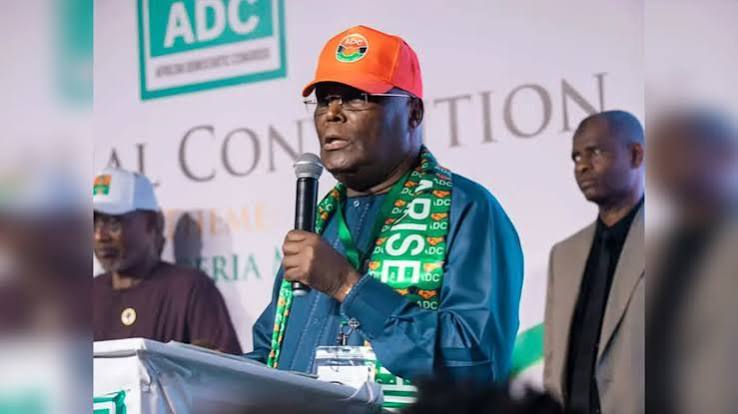
The presidential candidate of the African Democratic Congress (ADC) in next year’s election, Alhaji Atiku Abubakar, has called on the Independent National Electoral Commission (INEC) to investigate and prosecute officials allegedly involved in manipulating the preliminary voters’ register through the introduction of artificial intelligence-generated photographs and other questionable entries ahead of the 2027 general elections.

Alhaji Abubakar made the demand following revelations that some INEC registration officers allegedly abused their access to the voter registration system to introduce irregular records into the database.

In a statement issued by his Director of Strategic Communications, Mr Phrank Shaibu, the former vice-president described the development as a serious breach of the Commission’s internal safeguards and raised concerns about the integrity of the electoral process.

He urged INEC to identify the officials implicated in the alleged misconduct and explain what disciplinary or legal measures had been taken against them.

Alhaji Abubakar also called for an independent forensic audit of the preliminary voters’ register to establish the scale of the alleged manipulation, identify affected records and determine how the questionable entries were introduced into the system.

He further insisted that INEC preserve all relevant voter records, image files, system access logs and electronic audit trails to prevent the destruction or alteration of evidence before an independent examination could be conducted.

The former vice-president also demanded that the Commission disclose the identities of companies contracted to produce sensitive election materials ahead of the 2027 polls, arguing that transparency was essential to building public confidence in the electoral process.

INEC’s Director of Information and Communication Technology, Dr Lawrence Bayode, had earlier disclosed during a television interview that some registration officers across the country allegedly used their official login credentials to introduce irregularities into the voters’ database.

Dr Bayode explained that the Commission’s Automated Biometric Identification System helped identify questionable records and establish how some irregularities entered the system.

He, however, clarified that not all suspicious photographs were AI-generated, as some resulted from poor registration procedures.

The development followed public concerns over suspected AI-generated photographs, alleged duplicate entries and other inconsistencies discovered in the preliminary voters’ register published online on October 26, 2026.

INEC has maintained that the published document is a preliminary register and that it is reviewing questionable records ahead of the certification of the final Register of Voters.

The controversy has intensified calls for greater transparency and accountability in the management of the voters’ register as preparations gather momentum for the 2027 general elections.

Continue Reading

Trending