
Featured
Governor Wike Inaugurates State Community Policing Advisory Committee

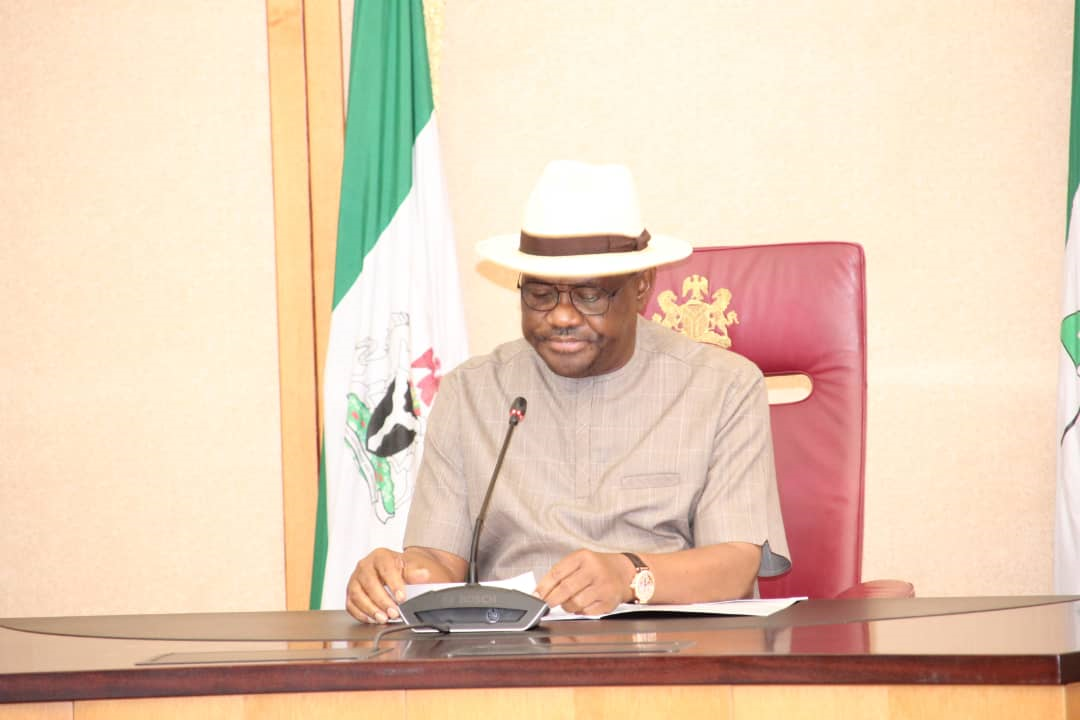
Rivers State Governor, Nyesom Ezenwo Wike has inaugurated the State Community Policing Advisory Committee(SCPAC) and State Community Policing Committee (SCPC) with a charge to members to sustain the peace in the state.
The State Community Policing Advisory Committee has 17 members while the State Community Policing Committee has 9 members with the State Chairman of Traditional Rulers Council, King Dandeson Douglas JAJA as Chairman.
Speaking during the inauguration at the Banquet Hall, Government House, Port Harcourt, Governor Wike who was represented by the State Deputy Governor, Dr. Ipalibo Harry Banigo charged members of the committees to discharge their duties according to their constitutional mandate.
Governor Wike also enjoined members of the committees to ensure that the peace already attained in the state is maintained in order to attract investors .
“On behalf of His Excellency, the Governor of Rivers State, I hereby inaugurate the Rivers State Community Policing Advisory Committee and I wish to charge you to follow closely the tenets of the purpose for which you are set up by promoting justice, judgement and fairness to all.
“Rivers State is a peaceful and hospitable state and we will like to see that these committees add value to what the Governor has been doing to keep the peace in the state.
“We will like to assure the committees that the state government is committed to support security agencies in the fight against crime and criminality with the provision of adequate logistics,” he stated.
In his speech, the Inspector General of Police, Mohammed Adamu represented by the Supervisory Deputy Inspector General of Police, South-South Zone, Anthony Ogbizi Michael said the inauguration marked the commencement of community policing in the state.
While noting that community policing had existed right from the time of the colonial masters, the Inspector General of Police said the inauguration of the committees would be replicated at different levels in the state by the State Commissioner of Police create community ownership.
“We are reenacting this process so that we can take back the policing project to the communities. So the communities will now own community policing and we believe that this will promote transparency between the communities, police and by extension other security agencies.
” Partnering together, solving security problems together, definitely will foster peace, and we will all know were there is peace and social harmony, there will be development,” he added.
Also speaking, the State Commissioner of Police, Joseph Mukan said the inauguration of the State Community Policing Advisory Committee, SCPAC and State Community Policing Committee is a deliberate move by the Police to bring policing closer to the people.
“The power of Community Policing is derived from the Police Order 291 which deals on Community Policing and empowers the police at all levels to engage in active partnership with law abiding citizens and government agencies to collectively and collaboratively solve problems of crime, he added.
In his response, the Chairman of the State Community Policing Committee, King Dandeson Douglas Jaja lauded the State Governor and the Commissioner of Police for the confidence reposed on members of the committees and assured of their commitment to serve the State.




Featured
JUNE 12: Democracy Remains Nigeria’s Strongest Path To Unity, Progress, Says Fubara ….Extols Abiola, Wife


Governor of Rivers State, Sir Siminalayi Fubara, has reaffirmed that democracy remains the most effective system of government for Nigeria, given the country’s rich diversity of ethnic, religious, and cultural identities.
In a goodwill message to Nigerians on the occasion of the 2026 Democracy Day celebration, Governor Fubara said June 12 represents far more than a historic date; as it embodies the enduring struggle, sacrifice, and collective aspiration of Nigerians for freedom, justice, and representative governance.
The Governor extended warm felicitations to Nigerians at home and in the Diaspora, paying tribute to the heroes and heroines of the democratic struggle, particularly Chief MKO Abiola, his wife, Kudirat Abiola, and countless others whose courage and sacrifices helped secure the democratic freedoms Nigerians enjoy today.
According to him, “June 12 is a reminder of the price paid for the democracy we enjoy today. The sacrifices made by Chief MKO Abiola, Kudirat Abiola, and many other patriots who laid the foundation for the democratic journey we continue to enjoy today. Their commitment to the principle that power must ultimately reside with the people remains a source of inspiration for every generation of Nigerians.”
Governor Fubara noted that thirty-three years after the historic June 12, 1993 election, Nigeria’s democratic experiment has continued to evolve despite challenges and setbacks.
“Our democratic journey has not been without difficulties, but the resilience of our institutions and the determination of our people have kept the nation moving forward. The ability to express differing opinions, engage in constructive debate, and peacefully choose leaders through the ballot remains one of the greatest achievements of our nation,” he said.
Governor Fubara stressed that democracy provides the best framework for managing Nigeria’s diversity and transforming it into a source of national strength.
“Nigeria’s diversity should never be seen as a weakness. Properly harnessed, it is our greatest asset. Democracy offers us the opportunity to build consensus, promote inclusion, strengthen national unity, and create the conditions for sustainable development and shared prosperity,” he said.
Governor Fubara commended President Bola Ahmed Tinubu, for his commitment to the Renewed Hope Agenda and ongoing efforts aimed at economic revitalization, strengthening security, and deepening democratic institutions across the country.
He reiterated the readiness of Rivers State to continue partnering with the Federal Government in advancing policies and programmes that improve the lives of citizens through infrastructure development, job creation, enhanced security, quality education, healthcare delivery, and good governance.
The Governor further called on Nigerians, regardless of political affiliation, ethnic background, or religious belief, to use the occasion of Democracy Day to renew their commitment to the Nigerian project and the ideals that underpin democratic governance.
“Democracy must not be viewed merely as a periodic electoral exercise. It must be reflected in our daily commitment to accountability, transparency, tolerance, justice, respect for the rule of law, and responsible leadership. As citizens and leaders, we all share a collective responsibility to strengthen our democracy and build a nation that future generations will be proud to inherit,” he said.
Governor Fubara expressed optimism about Nigeria’s future, urging citizens to remain united, hopeful, and committed to the values of peace, dialogue, and national development.
“Together, we can build a stronger, more inclusive, and more prosperous Nigeria where every citizen has the opportunity to thrive and contribute meaningfully to national progress,” he said.

Governor of Rivers State, Sir Siminalayi Fubara, has reaffirmed the unwavering commitment of his administration to peace, unity, security, and inclusive development as Rivers State marked its 59th anniversary, last Wednesday.
In a goodwill message issued on Wednesday to commemorate the anniversary, Governor Fubara stated that despite the challenges faced over the years, the people of Rivers State have continued to demonstrate resilience, strength, and an enduring spirit of unity that has sustained the state since its creation.
The Governor noted that the strong bond of brotherhood among the various ethnic nationalities of the state, including the Ijaw, Ikwerre, Ogoni, Etche, Ekpeye, Andoni, Kalabari, and others, remains one of Rivers State’s greatest strengths and a critical foundation for peace, stability, and progress.
He further observed that Rivers State has remained a major driver of Nigeria’s economy for decades, not only because of its abundant oil and gas resources, but also because of the exceptional contributions of its people across diverse sectors including academia, jurisprudence, business, entertainment, public service, and sports.
Governor Fubara assured the people that his administration will continue to prioritize policies and programmes that promote peace, protect lives and property, and expand development across all parts of the state. He emphasized that governance must be people centered and impactful, with equal attention given to every Local Government Area of the state.
The Governor also paid tribute to the elders and founding leaders of the state for preserving the spirit of unity and coexistence over the years, while urging the youths to remain hopeful, responsible, and actively committed to building a greater Rivers State through innovation, hard work, and patriotism.
He equally acknowledged the invaluable role of women in strengthening families, communities, and society, describing them as indispensable partners in the continued growth and stability of the state.
Governor Fubara called on all Rivers people to use the occasion of the anniversary as a moment of reflection and renewed commitment to peaceful coexistence, mutual respect, dialogue, and collective progress, stressing that the unity and future of Rivers State must always rise above personal interests and political differences.
Rivers State was created on May 27, 1967, by General Yakubu Gowon.
