
Business
FOREX: Reps Direct NPA, NIMASA To Clarify Charges

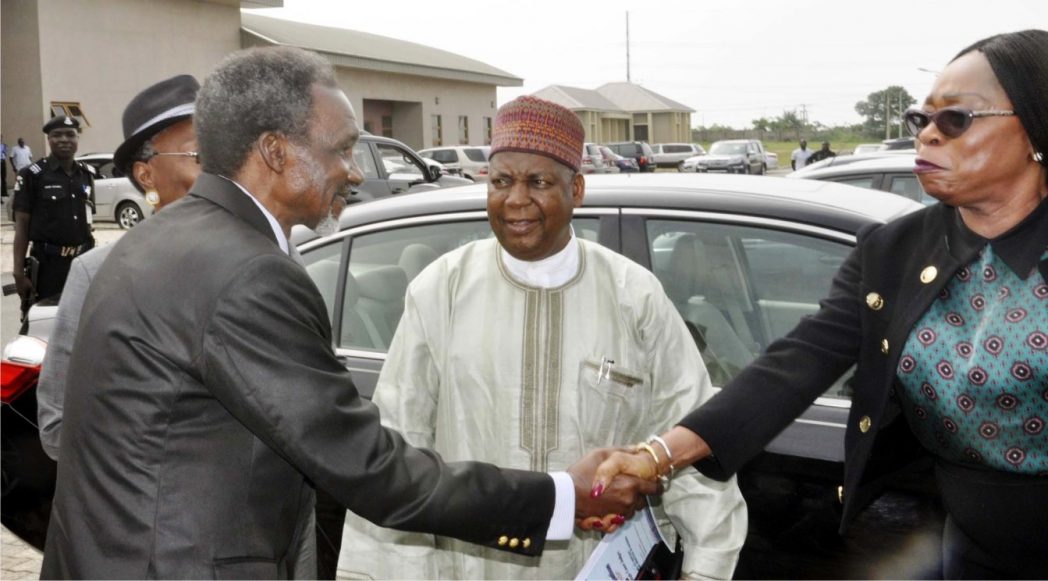
The House of Representatives Adhoc Committee on Review of Pump Price of Petrol last Friday directed the Nigerian Ports Authority (NPA) and the Nigerian Maritime Administration and Safety Agency (NIMASA) to clarify their charges in foreign currency.
The Chairman of the Committee, Mr Raphael Igbokwe, gave the directive during the committee’s visit to NPA and the Nigerian Maritime Administration and Safety Agency (NIMASA) headquarters in Lagos, Friday.
Igbokwe said representatives of both organisations should be present at the Executive briefing in Abuja for clarification.
He said that operators of wet cargo had complained that inability to access dollars led to deals with had multiple effects on petroleum products.
According to him, there is need to justify why NPA and NIMASA charged most of their levies in dollars.
The Tide source reports that NPA charges are: Lease and Vessel Fees; payment for Cargo and Shipping Dues; payment for Provisional Bill and Concession Fees; and payment for Pilotage and Royalties.
Reports says that NIMASA charges 3 per cent freight bench mark.
Igbokwe said that among the challenges faced by the shipping companies was that Nigerian waters were not deep enough to accommodate bigger vessels which had room outside the country
He said that inability of NPA to create room for mother vessels to berth petroleum products had lead to midstream discharge, illegal bunkering and malpractices which gave room for some operators to be short-changing the government.
“There was need for NIMASA to improve on security of Nigerian waterways to enable more vessels and bigger ones to berth at the port,’’ Igbokwe said.
He said if bigger vessels containing petroleum products berth at the ports, this would stop operators of ship- to-ship discharge; and not discharging accurate quantity to the supplier or marketers in the supply chain.
“We are looking at NIMASA and NPA to reconcile some charges they made in dollars; to stop the increase in price of dollars as well as offshore discharge.
“From our findings, petroleum products operators disclosed that 80 per cent of vessels bringing petrol engaged in offshore discharge before bringing the products it into our water with smaller vessels.
“The operators also said that the processing had created double charges for them which had cost effect on the consumers.
“The mandate bestowed on the committee is for us to brief Nigerians time to time on how their resources are being managed, ‘’ Igbokwe said.
The Managing Director of NPA, Ms Hadiza Usman, said that the authority was working hard to tackle finance and technical charges affecting the operations of petroleum products.
The Executive Director, Marine and Operations of NPA, Dr Sekonte Davis said there was a directive by the Federal Government through the Minister of Transportation to grant 50 per cent rebate since 2009.
Davis said that the rebate was revived in 2016 when the Federal Government removed subsidy from petroleum products.
He said that NPA subsidised N3.5 billion between 2009 to 2016.
According to him the rebate had affected operations of NPA during those periods under review.
Sekonte said that dredging took almost 70 per cent of the authority’s expenditure which was done by International companies to enable constant dredging of the ports.
“NPA is partnering with international companies such as the Lagos Channel Management, Bonny Channel Company and Calabar Channel Management.
“The dredging company provides technology while NPA provides money to carry out the dredging operations on Nigerian Ports.
“There is a limitation on dredging the Nigerian Ports which could only accommodate 13 metres to avoid environmental hazards.
“The establishment of deep seaports would enable mother vessels to berth into Nigerian ports.
He said that the present management of the authority had deemed it fit to engage in continuous collaboration with all stakeholders to enable more vessels to visit Nigerian ports.
The executive director said NPA gives 30 per cent rebate to Ship To Ship operation adding that both their dollars and naira charges goes into Single Treasury’s Account (TSA) of the Federal Government.
He said that NPA would collaborate with other agencies to arrive at an appropriate calculation to determine NPA charges to make Nigerian ports a preferred destination and accessible for wet cargos.
Sekonte said that “shipping is an international business and brought into the country a lot of dollars.
“The authority pays all dues to international organisations on regulation control in dollars,’’ the executive director said..
He urged the Chief Economic Adviser to President to assist the authority to inform the Central Bank of Nigeria (CBN) to grant the shipping companies access to their dollars on Treasury Single Account (TSA) to reduce time of doing business.
In his response, the Director, Legal Services of NIMASA, Mr Suleiman Abdulsalam, representing the Director-General, Dr Dakuku Peterside, said the agency was saddled with the responsibility of ensuring safe and secured shipping.
Peterside said that NIMASA engaged in some international obligations on Port State Control for safety of maritime environment.
He said that recently the agency apprehended a petroleum product vessel which was trying to divert from its initial destination from Nigeria to Durban and Philadelphia due to the surveillance system of the agency.




The daughter of late Nigerian banking executive, Herbert Wigwe has sold her father’s luxury yacht for $6.5 million which is the equivalent of N8.74 Billion following legal proceedings involving her, Otutochi Wigwe, and the company holding the vessel, Grosvenor Marine Ventures Limited.
This was contained in an online report obtained by The Tide Source in Port Harcourt recently.
The Source further clarified that $6. 5 Million dollars or N8.74 Billion was the asking price as at March this year but was unable to prove, if the said amount was exactly what the vessel went for.
The yacht, known as Chitochi, is a 2016 Custom Line 108 superyacht measuring approximately 33 metres (108 feet) in length. The transaction was handled by international yacht brokerage firm IYC, with its sales and charter consultant, Mark Elliott, overseeing the sale.
The disposal of the high-value vessel followed legal steps taken to address the corporate status of Grosvenor Marine Ventures Ltd., the company through which the yacht was held.
Otutochi Wigwe reportedly approached a court in the British Virgin Islands (BVI) to secure the restoration of the company to the corporate register, a move that enabled the necessary legal steps towards the sale of the vessel.
The proceedings were central to resolving the corporate issues affecting the company and facilitating the transaction, underscoring the legal complexities that may arise when valuable assets are held through corporate entities in foreign jurisdictions.
The sale is also significant in the context of estate administration, as luxury yachts require substantial financial commitments to maintain, even when they are no longer actively used by their owners or beneficiaries.
Such vessels typically attract considerable expenses, including crew salaries, insurance premiums, berthing charges, routine servicing and other maintenance costs, making their continued ownership a major financial responsibility.
Beyond the recurring expenses, luxury yachts are depreciating assets that may lose value over time. Their disposal can therefore form part of a strategy to preserve estate value, reduce liabilities and convert an expensive asset into liquid funds.
Wigwe, who was the former Group Chief Executive Officer of Access Holdings, died on February 9, 2024, in a helicopter crash in California, United States, alongside his wife, Chizoba; their son, Chizi; and former Nigerian Exchange Group chairman, Abimbola Ogunbanjo.
His death was widely mourned across Nigeria’s banking and business communities, where he was recognised for his contributions to the financial services industry, entrepreneurship and philanthropy.
Wigwe’s passing left behind an estate whose administration involves the management of assets and other financial interests, a process that can require legal and financial decisions to protect the interests of the estate and its beneficiaries.
The sale of Chitochi highlights the challenges associated with managing high-value assets held through corporate structures, particularly where the relevant companies and legal proceedings fall under different jurisdictions.
The $6.5 million transaction brings the yacht’s ownership chapter to a close while illustrating how legal procedures, financial considerations and estate management can intersect in the administration of the assets of a prominent business figure.
‘’We determined to get all our equipments and machinery functioning as we progress. For now we’ve about 105 workers, comprising daily paid harvesters and regular staffs. But aside these 105 staffs we also employ daily slashers who for now are about 100.
“During peak periods, hopefully on or before January 2026 we hope to increase our work force for maximum production”, the firm’s management Stated.
King Onunwor
Ariwera Ibibo-Howells, Yenagoa
Some traders at the Rumuwoji Market popularly known as Mile 1 Market have decried the continuous increase in the prices of food stuffs and other items in the ember season.
This was made known by the traders when The Tide visited the market recently.
The traders revealed varying changes in the prices of foodstuffs, with some commodities recording higher increase than others .
A trader Mrs Charity Obinna, at the market, said the price of yam remained the same last week and this week compared to the prices from last month to this month, adding that only a difference of about N100 to N200 was seen.
Another trader, Chukwuebuka Livinus who deals on garri, reported that the prices of some food commodities had been changing frequently.
According to him, the price of a bag of garri increased from N45,000 last week to N58,000 this week, representing an increase of N13,000.
Livinus described the increase as scary and called on the government to do something about it, especially as we get closer to the festive period.
A trader that deals on vegetables, Mrs Joy reported that a significant increase in the prices of pepper rose from N20,000 last week to N40,000 this week.
Similarly, the price of a bag of melon (egusi) increased from N420,000 toN490,000 this week.
In a separate report, Mrs Charity Obinna said that foodstuffs were generally cheaper last month than this month, with price differences ranging from N150 to N200 for some items.
Meanwhile, Giff Okoro reported a decrease in the price of tomatoes. According to her, a quantity of tomatoes that cost N45,000 last month now sells for N25,000, indicating a reduction of N20,000.
Another trader, Usman Ibrahim said the cost of transporting goods from the communities to urban areas where they are sold is one of the major reasons for high cost of goods.
He said transport cost has doubled due to the cost of petroleum products in Nigeria, adding the whole cost is part of the goods because “entrepreneurs must cover their cost and make their gains .
Ibrahim called on the government to help farmers and traders even with little capitals to expand and sustain their business.
Another trader, Mrs Choice Promise a fish retailer said a cartoon which sold at #35,000 last week now sells at #50,000 .
Promise complained that there is no gain or profit because the price has drastically increase and most people cannot afford to buy fish again.
“Mr. President’s Renewed Hope Agenda recognizes that economic ambition requires dependable infrastructure,” Tegbe said.
He added that investments in electricity infrastructure would strengthen the foundations for business expansion, employment and economic growth.
The Kankia substations comprise two 60 MVA, 132/33 kilovolt (kV) facilities designed to strengthen the transmission network serving Katsina State and neighbouring areas.
Tegbe said the infrastructure would improve the network’s ability to distribute available electricity, supporting commercial activities and household welfare.
He also urged residents to protect the facilities against vandalism and other activities that could disrupt electricity infrastructure, asking them to report suspicious activities to TCN or security agencies.
Katsina State Governor, Dikko Umaru Radda, described the project as a significant investment in the state’s electricity infrastructure.
Radda stated that improved electricity supply could support industrial development, economic growth and public service delivery.
He further commended the President, the Federal Ministry of Power and TCN for completing the project.
It would be noted that the latest projects come amid a broader government’s drive to address bottlenecks in Nigeria’s electricity transmission network, which has constrained the amount of electricity that can be delivered to distribution companies and end users.
Wali Chioma, Obasi Chidinma & Amarachi Uche
-
Opinion4 days ago
Ancestorial Worship: My Take (1)
-

 News13 hours ago
Fresh Ebola Scare As NCDC Records Two Cases
-
Niger Delta12 hours ago
PANDEF Seeks 50% Oil Derivation Allocation Increase
-
Rivers11 hours ago
Don Seeks Repositioning Of Tech Education For Dev
-

 Education12 hours ago
PAMO MEDICAL UNIVERSITY -Nullifies Arrest warrant on VC
-

 Education12 hours ago
IAUE MOVES TO END GHOST WORKERS SYNDROME AS 400 NEW NON-TEACHING STAFF UNDERGO MANDATORY ETHICS TRAINING
-
News13 hours ago
Customs Partners EFCC, NDLEA, Others To Tackle Money Laundering, Terrorism Financing
-
 News3 days ago
FG Must Address Nigerians’ Concerns On Reforms -Shettima …Warns Against Misuse of AI, Social Media