
News
ECOWAS Plans War On Cybercrimes

Economic Community of West African States (ECOWAS) says it is working with member states to enhance strategies in cyber security for economic development in the region.
ECOWAS Commissioner for Telecommunications and Information Technologies, Dr Isaias Barreto da Rosa said this in an interview with newsmen in Abuja on Tuesday.
The commissioner said that the development of the ECOWAS cyber security agenda was aimed at helping member states put in place the right legislation to develop necessary cyber security strategies.
According to him, the agenda is also aimed at training judges, prosecutors, and law enforcement agents on investigation and prosecution of cyber crimes.
He also noted that West African countries were losing financially to the scourge of cybercrimes.
“We have a serious problem in the region when it comes to cyber security because many of our countries are listed in prominent positions in international cyber crimes ranking.
“That is why we are working on the ECOWAS cyber security agenda to also help member states that do not have Computer Emergency Response Teams (CERTS) put such teams in place,” he said.
He explained that these CERTS were critical to monitoring the cyber security environment within a country, make recommendations and assist in ensuring a safer cyber environment within a country.
Bareto da Rosa further reiterated that the harmonisation of national regulatory framework and policies would facilitate and promote cooperation among ICT stakeholders across member states.
Cybercrime, or computer crime is crime that involves a computer and network.
Computer crime encompasses a broad range of activities such as fraud and financial crimes, cyber terrorism, computer viruses and malware that primarily target computer networks or devices, among others.
According to the United Nations, cybercrime covers any illegal behaviour directed by means of electronic operations that targets the security of computer systems and the data processed by them.
SciDev.Net, a website on science and technology information, noted that a widely accepted estimate puts cybercrime costs on the world economy at 500 billion dollars.
It also noted that according to estimates, cybercrime costs the Nigerian economy the sum of 500 million dollars per annum.
Check Point Software Technologies Ltd, in its quarterly global Threat Index report, revealed that in May 2016, Nigeria ranked 16th in cyber attacks vulnerability index in Africa.
Check Point is the largest global pure-play network cyber security vendor, and its Threat Index provides a data-based breakdown of new and prevalent threats; as well as the relative rankings of countries’ risk profiles globally.
Its report further revealed that Nigeria also ranked 19th out of the 112 countries on the overall global index.
According to the report, there are four African countries in the top 10 of the index which are Malawi, Djibouti, Namibia and Angola.
It also showed disparities in the threat environments in Africa, and the potential for increased attacks as cybercriminals target mobile devices.
Experts have also emphasised that cyber crime may be the greatest threat to every organisation in the world.





Nobel Laureate, Professor Wole Soyinka, has called on Nigerians to reject silence in the face of extrajudicial killings and other abuses of human rights.
Soyinka stressed that accountability and civic courage remain essential to rebuilding public confidence in the nation’s institutions.
He made the call during the 28th Wole Soyinka Lecture held in Port Harcourt, last Friday as part of activities marking his 92nd birthday.
The lecture, themed “Reclaiming the Nigerian State through Accountability, Justice and Civic Courage,” drew participants from different sectors of society.
The renowned playwright and human rights advocate said the country’s greatest tragedy was not only the unlawful killings carried out by state and non-state actors, but also the silence that often follows such incidents, allowing perpetrators to evade justice.
According to him, indifference by citizens to abuses of power and violations of fundamental human rights has contributed to the persistence of extrajudicial killings and other forms of injustice across the country.
Soyinka said he dedicated this year’s lecture to victims of unlawful killings, noting that the event was intended to honour individuals who had lost their lives as a result of failures within the justice system and society’s inability to protect the sanctity of human life.
He stressed that the lecture was dedicated to what he described as the basic unit of every society – the human being, and urged Nigerians to place greater value on human dignity irrespective of ethnicity, religion or social status.
The Nobel Laureate recalled several incidents of violence, including the fatal shooting and killing of a young man in Ugheli in Delta State by a police officer, and the mob killing of Deborah Yakubu in Sokoto State sometime ago, lamenting that many of those responsible are yet to face justice.
He expressed concern that some perpetrators of violent crimes had openly admitted their actions without fear of prosecution, describing such situations as evidence of serious failures within the nation’s justice system.
Soyinka maintained that when justice is delayed or denied, public confidence in state institutions continues to erode, thereby encouraging further violations of human rights.
Responding to critics who accuse him of promoting religious or ethnic divisions whenever he spoke on such issues, Soyinka dismissed the allegations and pointed out that his advocacy has always centred on the protection of human life and the rule of law.
He urged Nigerians to remain vigilant and continue demanding justice in cases of alleged extrajudicial killings, including the recent shooting of a young man by a police officer, stressing that every life deserves equal protection under the law.
The literary icon also recalled an earlier pledge by a past incoming president to make public the files relating to unresolved assassinations and extrajudicial killings, questioning the status of the promised investigations.
He challenged citizens to continue asking questions about unresolved cases, insisting that justice, accountability and respect for human dignity are indispensable to building a peaceful, democratic and inclusive Nigerian society.
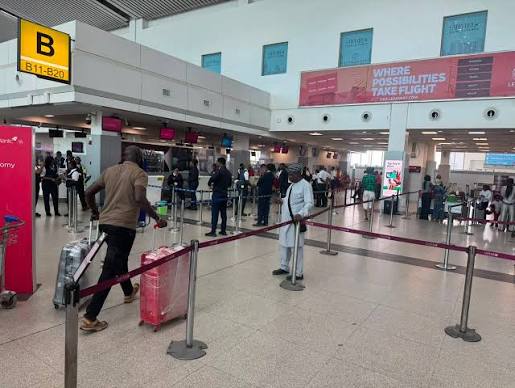
The Federal Airports Authority of Nigeria (FAAN) has clarified that there was no fire at Terminal 2 of the Murtala Muhammed International Airport, Lagos, contrary to its earlier advisory.
Earlier yesterday, FAAN had announced that a fire incident had occurred at Terminal 2 of the nation’s busiest airport, and assured that its Aerodrome Rescue and Firefighting Service had been deployed to contain the situation.
There were also reports that activities were briefly disrupted at the airport yesterday after smoke was seen inside parts of the terminal.
Videos circulating online showed passengers kept standing outside the terminal while firefighters responded to the incident.
However, in an update issued less than two hours later by the Director of Public Affairs and Consumer Protection, Henry Agbebire, and posted on FAAN’s official X handle, the authority said preliminary findings showed that the smoke seen at the terminal was caused by the discharge of the facility’s FM-200 fire suppression system.
“Further to our earlier advisory regarding the incident at Terminal 2 of the Murtala Muhammed International Airport, Lagos, the Federal Airports Authority of Nigeria (FAAN) wishes to provide the following update,” the statement read.
“Preliminary findings indicate that there was no fire at the terminal. The smoke observed within the affected area resulted from the discharge of the terminal’s FM-200 fire suppression system. The reason for the activation of the fire suppression system is currently being investigated,” FAAN stated.
The authority said normal operations had resumed at the terminal while investigations were ongoing to determine the cause of the incident.
“Normal operations have since resumed at the terminal, while detailed investigations are ongoing to determine the exact cause of the incident,” the statement added.
The authority thanked passengers, airlines, airport users and other stakeholders for their understanding and cooperation.
FAAN appreciated the understanding and cooperation of passengers, airlines, airport users and all stakeholders, and reiterated its commitment to the safety and security of all airport operations.