
Business
NNPC Restates Commitment To End Petrol Scarcity

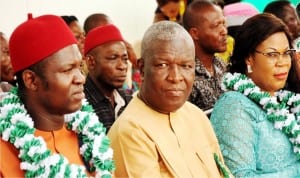
L-R: Speaker, Ebonyi State House of Assembly, Chief Ogbonna Nwifuru, President, Enugu Chamber of Commerce, Industries, Mines and Agriculture (ECCIMA), Rev. Ugochukwu Chime and Ebonyi State Commissioner for Commerce, Mrs Elizabeth Ogbaga, during Ebonyi State Day at the on-going 27th Enugu International Trade Fair in Enugu on Monday.
The Nigerian National Petroleum Corporation (NNPC) has reassured Nigerians of its commitment to end the persistent fuel scarcity in the country.
This is contained in a statement signed by Mr Garba Deen Muhammed , Group General Manager, Group Public Affairs Division, on Monday in Abuja.
“We wish to re-assure Nigerians that we are on top of the petroleum products supply and distribution situation and we remain committed to eliminating this endemic issue once and for all within the next few days.
“We genuinely empathize with the attendant sufferings and wish to reassure that we are focused and committed to bring an end to this situation within the next few days.
“We kindly call on all Nigerians to partner with us on this journey to allowing the whole process of change come into fruition,” it said.
It said the current administration inherited a huge catalog of issues and problems in the downstream sector not limited to arrears of subsidy payments to oil marketers.
Other issues, it said, included corruption and inefficiencies in the supply and distribution chain, incessant vandalism of pipelines and poor performance of refineries, among others.
It noted that a combination of these issues resulted in most oil majors completely pulling out from the importation business .
This, it said, led to NNPC assuming a near 100 per cent importation obligation without the necessary logistics put in place.
It said the NNPC management had initiated and made progress on various key solutions to providing a lasting end to these issues.
It added that with the firm support of President Muhammadu Buhari and the National Assembly, the debt burden had been reduced since January 1.
“We have been able to eliminate subsidy payments by managing prices at current levels through price modulation.
This has resulted to savings of over N100 billion monthly for the nation.
“Nationwide petroleum supply and distribution have been ramped up to all states to ensure product availability in the country,” it said.
According to the statement, the current supply to states is in excess of the normal consumption especially in the five major consuming cities.
It added that monitoring had been intensified to ensure full compliance with approved prices adding that violations of approved prices and hoarding of petroleum products attracted penalties.
The penalties include giving out of petroleum products free to the public and sealing off fuel stations found to be hoarding petroleum products and payment of a fine.
Others were withdrawal of Marketer’s Licence and penalising any NNPC, DPR, PPPRA or government agent found conniving and wanting in line with public-service guidelines and procedures.
It encouraged the general public to report product hoarders and saboteurs of the change efforts .
“We encourage everyone to shun panic buying and undue return trips as this attitude emboldens marketers to hoard products.
“Supply constraints due to foreign exchange challenges are being resolved through collaboration with the Central Bank of Nigeria on innovative ways of closing the gaps in accessing foreign exchange,” it said.
The statement noted that the major international upstream oil companies had indicated their willingness to support major oil marketing companies with some of the required foreign exchange.
It added that corporation was pursuing an improved model for ‘crude oil for refined product’ exchange (the Direct Sale – Direct Purchase arrangement).
Chris Oluoh



Business
Jonathan, Diri, Others Laud Firm’s Milestone in Bayelsa …Says Project Will Drive Industrialisation, Create Jobs



-

 News3 days ago
RSG Targets Nine Million Residents in Mosquito Net Distribution Campaign
-

 Oil & Energy3 days ago
Aiyedatiwa Signs New Electricity Bill
-

 Maritime3 days ago
Marine Minister Commends President Tinubu On NPERA Bill Assent
-

 Oil & Energy3 days ago
NLNG Commissions Research And Innovation Centre In RSU
-

 News3 days ago
KenPoly Holds Eight Convocations, August 29
-

 News3 days ago
RSG Begins Another Phase of Projects Commissioning Today
-

 News3 days ago
RMAFC Completes Revenue Sharing Review, Proposes New Pay
-

 Maritime3 days ago
NAGAFF Petitions IGP Over Alleged Maritime Police Harassment