
Featured
Rivers: Private Schools To Apply For Fresh Approval …As Wike Issues Two Weeks Ultimatum …Charges New UBE Board On Education

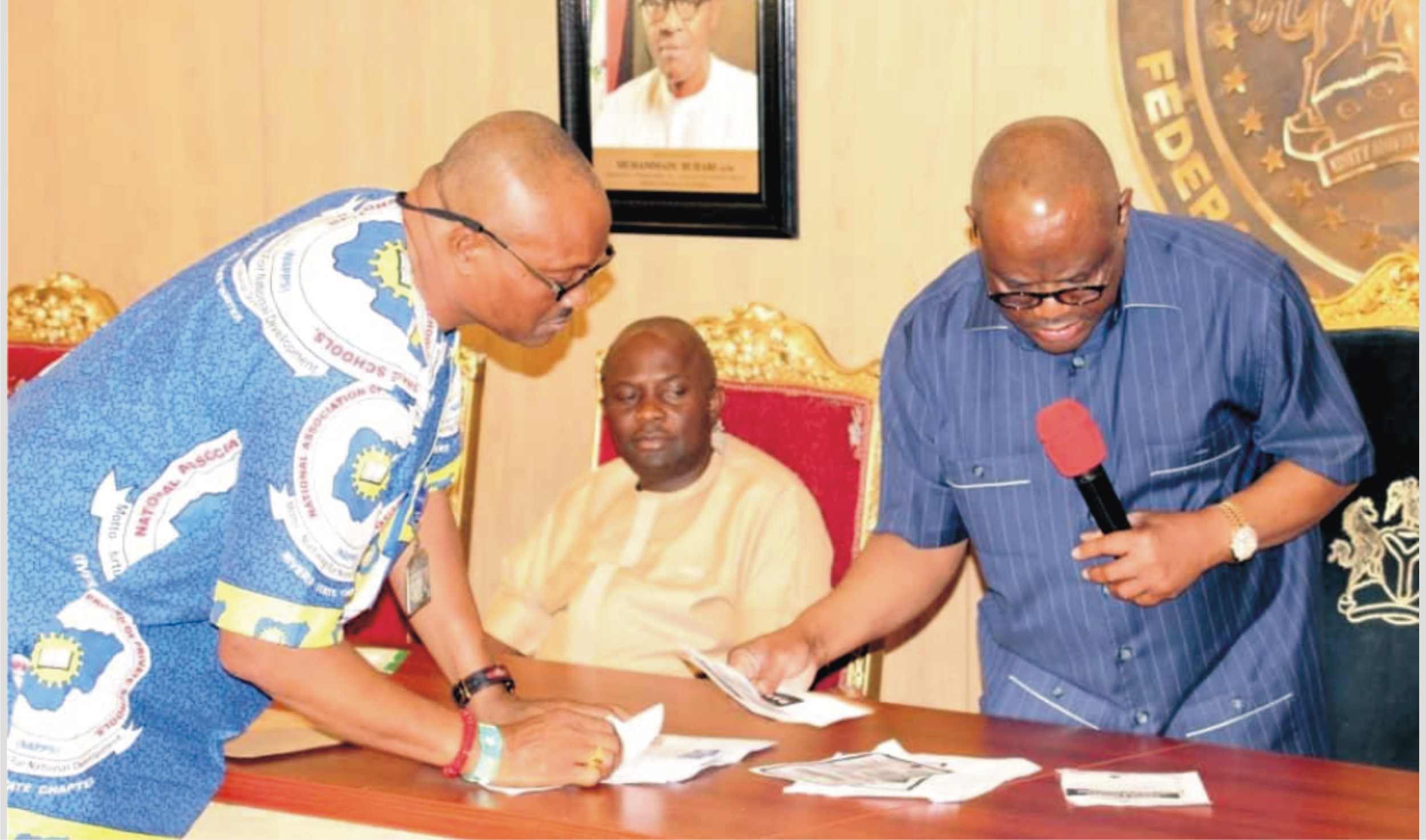
In a move to ensure that only standard schools operate in the state, the Rivers State Governor, Chief Nyesom Wike has directed all private schools to apply for fresh 2019 operational approval.
Wike also directed that the application for operational approval must be done by all schools within the next two weeks.
The governor gave the directive in a meeting with all private school proprietors in Rivers State at the Government House, Port Harcourt, last Friday.
He said: “All the schools must apply for operational approval within the next two weeks. We will set up committees that will recommend the approval of schools. All the schools in the state must be the required standard”.
The governor said that his second term is committed to improving the right standards in the education sector for the good of Rivers people.
“The governor’s office will review all the approval of schools. All the existing approvals by the Ministry of Education have been cancelled. For this process, there will be no room for bribery and corruption”, he said.
On the issue of revenue paid by schools, the Rivers State governor directed that all levies must be paid through approved designated bank accounts, insisting that anyone who demands for cash payment should be reported to security agencies via designated phone lines.
He said that the Office of the Secretary to the Rivers State Government would publish the telephone lines that school proprietors should contact in case they are pressured to pay illegal levies.
The 23 local government chairmen and permanent secretaries attended the meeting.
Meanwhile, the Rivers State Governor, Chief Nyesom Wike has sworn-in the reconstituted Rivers State Universal Basic Education Board (RSUBEB) with a charge to members of the board to work towards the development of the basic education sub-sector.
Wike also charged the reconstituted board to ensure that head teachers and principals of basic schools don’t collect any forms of levies from pupils and students.
Addressing the board members after their oath of office, the governor said that the board must work towards making meaningful contributions to grow the state.
He said: “You must key into what we are doing in the state. This is your time to contribute to the development of the state.
“This is a privilege to work for the good of Rivers State. This is not the time to seek making money from the system”.
The governor urged the reconstituted board to work towards improving the school enrolment figures in the basic education sub-sector.
He advised the board members to cooperate with the board chairman to deliver on their responsibilities to Rivers people.
“If there are things you need, channel it to the appropriate authorities. As board members, leave the comfort of your offices and monitor the events on the field to know the true position of things”, he directed.
In his response, the Chairman of the Rivers State Universal Basic Education Board, Ven Fyneface Akah thanked the governor for the second opportunity to serve the state.
He said they are prepared to work with the Rivers State governor to develop a functional institution for the growth of the state.
Chris Oluoh

Featured
JUNE 12: Democracy Remains Nigeria’s Strongest Path To Unity, Progress, Says Fubara ….Extols Abiola, Wife


Governor of Rivers State, Sir Siminalayi Fubara, has reaffirmed that democracy remains the most effective system of government for Nigeria, given the country’s rich diversity of ethnic, religious, and cultural identities.
In a goodwill message to Nigerians on the occasion of the 2026 Democracy Day celebration, Governor Fubara said June 12 represents far more than a historic date; as it embodies the enduring struggle, sacrifice, and collective aspiration of Nigerians for freedom, justice, and representative governance.
The Governor extended warm felicitations to Nigerians at home and in the Diaspora, paying tribute to the heroes and heroines of the democratic struggle, particularly Chief MKO Abiola, his wife, Kudirat Abiola, and countless others whose courage and sacrifices helped secure the democratic freedoms Nigerians enjoy today.
According to him, “June 12 is a reminder of the price paid for the democracy we enjoy today. The sacrifices made by Chief MKO Abiola, Kudirat Abiola, and many other patriots who laid the foundation for the democratic journey we continue to enjoy today. Their commitment to the principle that power must ultimately reside with the people remains a source of inspiration for every generation of Nigerians.”
Governor Fubara noted that thirty-three years after the historic June 12, 1993 election, Nigeria’s democratic experiment has continued to evolve despite challenges and setbacks.
“Our democratic journey has not been without difficulties, but the resilience of our institutions and the determination of our people have kept the nation moving forward. The ability to express differing opinions, engage in constructive debate, and peacefully choose leaders through the ballot remains one of the greatest achievements of our nation,” he said.
Governor Fubara stressed that democracy provides the best framework for managing Nigeria’s diversity and transforming it into a source of national strength.
“Nigeria’s diversity should never be seen as a weakness. Properly harnessed, it is our greatest asset. Democracy offers us the opportunity to build consensus, promote inclusion, strengthen national unity, and create the conditions for sustainable development and shared prosperity,” he said.
Governor Fubara commended President Bola Ahmed Tinubu, for his commitment to the Renewed Hope Agenda and ongoing efforts aimed at economic revitalization, strengthening security, and deepening democratic institutions across the country.
He reiterated the readiness of Rivers State to continue partnering with the Federal Government in advancing policies and programmes that improve the lives of citizens through infrastructure development, job creation, enhanced security, quality education, healthcare delivery, and good governance.
The Governor further called on Nigerians, regardless of political affiliation, ethnic background, or religious belief, to use the occasion of Democracy Day to renew their commitment to the Nigerian project and the ideals that underpin democratic governance.
“Democracy must not be viewed merely as a periodic electoral exercise. It must be reflected in our daily commitment to accountability, transparency, tolerance, justice, respect for the rule of law, and responsible leadership. As citizens and leaders, we all share a collective responsibility to strengthen our democracy and build a nation that future generations will be proud to inherit,” he said.
Governor Fubara expressed optimism about Nigeria’s future, urging citizens to remain united, hopeful, and committed to the values of peace, dialogue, and national development.
“Together, we can build a stronger, more inclusive, and more prosperous Nigeria where every citizen has the opportunity to thrive and contribute meaningfully to national progress,” he said.

Governor of Rivers State, Sir Siminalayi Fubara, has reaffirmed the unwavering commitment of his administration to peace, unity, security, and inclusive development as Rivers State marked its 59th anniversary, last Wednesday.
In a goodwill message issued on Wednesday to commemorate the anniversary, Governor Fubara stated that despite the challenges faced over the years, the people of Rivers State have continued to demonstrate resilience, strength, and an enduring spirit of unity that has sustained the state since its creation.
The Governor noted that the strong bond of brotherhood among the various ethnic nationalities of the state, including the Ijaw, Ikwerre, Ogoni, Etche, Ekpeye, Andoni, Kalabari, and others, remains one of Rivers State’s greatest strengths and a critical foundation for peace, stability, and progress.
He further observed that Rivers State has remained a major driver of Nigeria’s economy for decades, not only because of its abundant oil and gas resources, but also because of the exceptional contributions of its people across diverse sectors including academia, jurisprudence, business, entertainment, public service, and sports.
Governor Fubara assured the people that his administration will continue to prioritize policies and programmes that promote peace, protect lives and property, and expand development across all parts of the state. He emphasized that governance must be people centered and impactful, with equal attention given to every Local Government Area of the state.
The Governor also paid tribute to the elders and founding leaders of the state for preserving the spirit of unity and coexistence over the years, while urging the youths to remain hopeful, responsible, and actively committed to building a greater Rivers State through innovation, hard work, and patriotism.
He equally acknowledged the invaluable role of women in strengthening families, communities, and society, describing them as indispensable partners in the continued growth and stability of the state.
Governor Fubara called on all Rivers people to use the occasion of the anniversary as a moment of reflection and renewed commitment to peaceful coexistence, mutual respect, dialogue, and collective progress, stressing that the unity and future of Rivers State must always rise above personal interests and political differences.
Rivers State was created on May 27, 1967, by General Yakubu Gowon.

-

 News12 hours ago
Nigeria Won’t Surrender Any Territory To Criminals -Tinubu
-

 News12 hours ago
FG Begins Trial Of Over 600 Terrorism Suspects
-

 Niger Delta9 hours ago
Warri Airport Manager Disputes Air Peace Bird Strike Claim
-

 Rivers9 hours ago
79th IAUE Inaugural Lecture: Prof Anero Advoctes Tuition-Free Education For Children
-

 News12 hours ago
Rivers Judges Commence Annual Vacation, July 20
-

 Politics9 hours ago
Parties’ Deregistration: How Justice Lifu Overruled Appeal Court Justices
-
Politics10 hours ago
2027: Rivers PFN To Mobilise 600,000 Votes
-

 News12 hours ago
RSG Reaffirms Commitment To Women’s Empowerment