
Business
Creating Jobs Via Resuscitation Of Moribund Industries

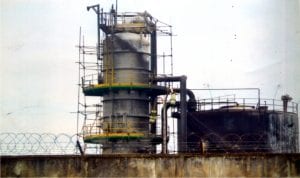
The production tank belonging to Nigeria Agip Oil Company (NAOC) in Ebocha Community, Ogba/Egbema/Ndoni Local Government Area of Rivers State.
Unarguably, unemploy
ment has reached alarming proportions in the country, especially among graduates of tertiary institutions.
This is partly because the Nigerian economy cannot absorb the growing number of graduates produced annually by the nation’s tertiary institutions.
Compounding the problem, tertiary institutions produce more graduates in the humanities and social sciences as a result their failure to adhere to the national admission policy, which prescribes 60:40 ratio in favour of the sciences.
The areas of specialisation of the graduates notwithstanding, experts insist that sustainable employment can be created via the manufacturing sector.
They are of the view that if state governments can revitalise the moribund industries in their states, this will reduce the unemployment rate, while boosting their internally generated revenue as well.
Several moribund industries, which were unfortunately blue-chip industries of yesteryears, now dot many parts of the country.
Concerned stakeholders, therefore, acclaim the recent pronouncement of Gov. Okezie Ikpeazu of Abia to resuscitate the Golden Guinea Breweries in Umuahia.
Mr Bonnie Iwuoha, the Commissioner for Information and Strategy, broke the cheery news about the state government’s plans to reopen the brewery when he addressed journalists recently in Umuahia.
In addition to Golden Guinea, the commissioner said that the International Glass Industry in Aba would also bounce back to life.
Golden Guinea was established in 1960 by the administration of Dr Michael Okpara, the then Premier of the defunct Eastern Region, and incorporated two years later.
It became an economic epicentre and financial livewire, not only for the people of the then Eastern Region, but also for natives of Umuahia who enjoyed the socio-economic benevolence it offered through its social responsibility programmes.
In fact, the products of Golden Guinea Breweries like Golden Guinea lager, Eagle Stout and Bergdorf lager received appreciable patronage from 1960 to 2005 when it was eventually shut.
Concerned stakeholders, nonetheless, urge Ikpeazu to refrain from making empty promises like his predecessor, Chief T.A. Orji, who promised to revive the company.
Indeed, Orji in 2012 inaugurated a committee to look into ways of reviving the 54-year-old company.
He vowed to revive the brewery before leaving office, a pledge he failed to fulfil.
On the other hand, the International Glass Industry (IGI), Aba, also owned by the Abia Government, was leased to the Churchgate Group and it is showing signs of improvement.
IGI’s General Manager, Mr Kelechi Onuiri, said recently in Aba that the company had resumed the production of glass products.
He said that the factory, which started production late in March, produced and supplied more than 740,278 pharmaceutical bottles within two weeks of its resumption.
He said that the factory was currently servicing the needs of pharmaceutical industries outside the state.
Onuiri said that the company had employed more than 500 workers since its resumption to ensure full circle production.
“Right now, we have many people working here; we have employed more than 500 workers. Of course, we will take more people if need be,” he said.
However, the story is somewhat different with regard to the Modern Ceramic Industries in Umuahia.
After years of inactivity, the company was handed over to UCL Consortium, promoted by the Catholic Diocese of Umuahia.
Regrettably, the company’s handover could not bring it back to life.
Mr Uwakwe Nwachukwu, an economist, recalled that the Golden Guinness Breweries was one of the most successful breweries in Nigeria until it became moribund, adding: “Its collapse was mainly due to bad or inefficient management.’’
He said that board and management appointments were not based on knowledge and expertise, but purely on political considerations.
“More often than not, round pegs were put in square holes. Consequently, the brewery, which hitherto employed many hands and created considerable wealth, died,’’ he said.
Nwachukwu, who once worked in Golden Guinea as a casual employee for a fleeting period, said that the idea of revitalising or re-building the factory was, indeed, a welcome development.
According to him, a lot of benefits will accrue to the state and the people if the factory is revived.
“Other ancillary jobs or businesses will spring up within the factory environment and this will also reduce the number of unemployed persons in our society.
“In a time like this when unemployment in Nigeria has become a key challenge, the factory will add a lot value to the economy of Abia and the Nigerian economy as a whole.
“Furthermore, it will be quite plausible if the government could give consideration to the revitalisation of the Modern Ceramics Company, Umuahia.
“The ceramics company has good prospects for jobs as well as wealth creation for the government and the people,’’ he added.
Nwachukwu urged Ikpeazu not to relent in his efforts to bring back the “dead factories’’ back to life.
He urged him to borrow a leaf from the Rivers Government which successfully resuscitated Pabod Breweries.
“Rivers is one example; the once moribund Pabod Breweries was rebuilt by the last administration in the state.
“Today, Pabod Breweries engages many hands and it is the proud producer of Grand Beer and the now fancied or popular malt drink, Grand Malt.
“This can be replicated by the Abia Government, using the Golden Guinea Breweries and the Modern Ceramics Company in Umuahia as the platform,’’ he said.
In the same vein, Prof Aloysius Okolie of the Department of Political Science, University of Nigeria, Nsukka, urged state governors in the South East geopolitical zone to revive the collapsed industries in their states in order to create more jobs.
He said that the revival of the industries would create more employment opportunities for millions of jobless youths, while generating additional revenue for the states.
“Revitalising of these industries will be a means of diversifying the economy of the states, especially now when the country is experiencing economic melt-down,’’ he added.
There has been a drastic decline in allocations from the Federation Account to states and local governments as result of a sharp decline in crude oil prices in the international market.
“Some states and local governments in the country now find it difficult to pay their workers’ monthly salaries because of this drop in federal allocations,’’ Okolie said.
He, therefore, commended Gov. Ikpeazu’s move to revive Golden Guinea Breweries in Umuahia, describing it as a welcome development.
He, however, suggested that the state government should not own 100 per cent equity shares in the brewery.
“Government should have at most 30 per cent equity shares so as to allow the management of the brewery to be in the hands of private people who are expert in managing such companies.
“Government should also carry along the host community in order to protect equipment and facilities in that brewery,’’ he added.
Okolie said that pragmatic efforts should be made to revive industries like the cashew industry in Enugu, the ceramics industry in Umuahia, among others, which had become moribund.
“The industrial sector is a critical sector of any economy; it helps a country not to depend completely on foreign products.
“Nigeria is a dumping ground for foreign goods today because of the years of neglect which led to the collapse of many industries.
“Other governors in South East should emulate the Abia governor’s good example of reviving the popular Golden Guinea Brewery Umuahia, in efforts to improve the economy of their states and reducing unemployment,’’ he said.
Analysts underscore the need for the federal, state and local governments to resuscitate all the moribund industries in their domains.
“This because industries provide employment opportunities for the youth, particularly graduates of engineering and physical sciences,’’ some of the analysts say.
Obike Ukoh is of the News Agency of Nigeria (NAN)
Obike Ukoh


-

 Niger Delta2 days ago
Warri Airport Manager Disputes Air Peace Bird Strike Claim
-

 News2 days ago
Nigeria Won’t Surrender Any Territory To Criminals -Tinubu
-

 News2 days ago
FG Begins Trial Of Over 600 Terrorism Suspects
-

 Rivers2 days ago
79th IAUE Inaugural Lecture: Prof Anero Advoctes Tuition-Free Education For Children
-

 Politics2 days ago
Parties’ Deregistration: How Justice Lifu Overruled Appeal Court Justices
-

 Politics2 days ago
ADC: Okonkwo Rejects Amaechi As Presidential Running Mate, Withdraws Support
-

 Politics2 days ago
2027: Tinubu’s Projects Give APC Edge In South East – Yilwatda
-

 News2 days ago
Rivers Judges Commence Annual Vacation, July 20