
Niger Delta
PANDEF Seeks 50% Oil Derivation Allocation Increase

The Pan Niger Delta Forum (PANDEF) has called for an increase in the derivation allocation to oil-producing states from the current minimum of 13 per cent to 50 per cent.
The group also called for acceleration of completion of the Lagos–Calabar Coastal Highway and urgent environmental remediation across the Niger Delta states.
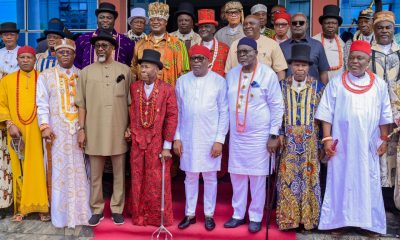
The demands were contained in a communiqué issued on Tuesday at the end of a joint meeting of the Forum’s Board of Trustees and National Executive Committee, held in Abuja to mark its 10th anniversary.
The communique, read by the Chairman, National Executive Committee of PANDEF, Ambassador Godknows Igali, noted that the meeting brings together political leaders, traditional rulers, former governors, former ministers and other stakeholders from Akwa Ibom, Bayelsa, Cross River, Delta, Edo and Rivers States to discuss issues affecting the oil producing region.
It called for the increase in derivation allocation to enable oil-producing communities to address years of environmental degradation, health challenges and developmental deficits associated with oil and gas exploration.
The Forum also called on the Federal Government, the Revenue Mobilisation, Allocation and Fiscal Commission (RMAFC) and the National Assembly to urgently abolish the onshore/offshore e allocation, stating that offshore petroleum operations also affect the marine ecosystems and fishing grounds on which coastal communities depend. dichotomy in revenue allocation, stating that offshore petroleum operations also affect the marine ecosystems and fishing grounds on which coastal communities depend.
As part of its anniversary reflections, the Forum expressed concern over the environmental consequences of more than six decades of oil and gas exploration in the Niger Delta.
It specifically identified Nembe Creek in Bayelsa State, Odidi in Delta State and Kula in Rivers State as areas requiring urgent environmental attention.
PANDEF called for adequate, sustained and transparent funding of the Ogoni clean-up programme, urging the Federal Government to develop a comprehensive framework for extending environmental remediation to other affected communities across the region.
The organisation also challenged presidential candidates in the 2027 general elections to demonstrate their commitment to environmental justice by presenting practical, measurable and time-bound plans for cleaning up polluted communities and restoring damaged ecosystems.
It stated that environmental protection must remain central to the development agenda of governments at all levels, given the impact of pollution on the livelihoods and economic well-being of the people.
On infrastructure, PANDEF described the accelerated completion of the 750-kilometre Lagos–Calabar Coastal Highway as non-negotiable, noting that the project has a long history in discussions about the connectivity and economic integration of Nigeria’s coastal communities.
It also welcomed approvals for proposed deep-sea port projects, including the Ibom Deep Sea Port in Akwa Ibom, Bonny Deep Sea Port in Rivers and Agge Deep Sea Port in Bayelsa.
PANDEF said the strategic location of the region’s ports could strengthen trade links with East, Central and Southern Africa, improve access to international maritime routes and enable Nigeria to benefit more from the African Continental Free Trade Area.
However, it urged the Federal Government to establish a sustainable financing framework for the port projects comparable to arrangements adopted for major port infrastructure around the Lagos corridor.
The organisation argued that modern ports, supported by effective transport infrastructure, would expand commercial activities and create opportunities for economic growth across the Niger Delta.
PANDEF also called for increased investment in natural gas development, gas-based industries and power generation, noting that the Niger Delta holds more than 209 trillion standard cubic feet of natural gas reserves.
It urged federal and state governments to accelerate investment in gas infrastructure, mini-liquefied natural gas facilities, liquefied petroleum gas and compressed natural gas hubs, petrochemicals and other value-added industries.
The Forum said developing the sector would promote industrialisation, improve electricity supply, generate employment and enhance economic prosperity in the region and the country at large.
On petroleum refining, PANDEF called for renewed priority for modular refineries, including the establishment of an appropriate framework for financing, licensing, technical support and environmental compliance.
It said modular refineries could complement large-scale facilities, including the Dangote Refinery and government-owned refineries, while reducing dependence on imported petroleum products, and supporting local enterprises in creating jobs.
The Forum recalled that a dedicated Modular Refinery Development Fund had previously been envisaged as a means of mobilising financing for viable facilities and expanding economic opportunities in the downstream petroleum sector.
Beyond oil and gas, PANDEF urged the Federal Government and the six South-South state governments to make agriculture a central pillar of the region’s economic diversification strategy.
It identified palm oil, rice, cassava, vegetables, horticultural products and other crops suited to the region’s ecological conditions as priority areas for investment and value addition.
The organisation called for coordinated agricultural programmes that would provide improved seedlings, mechanisation, irrigation and water management, rural roads, storage facilities, agro-processing industries, affordable financing and better market access for farmers.
It said the Niger Delta’s rainfall, water resources and ecological diversity offered significant opportunities to expand agricultural production, strengthen food security and reduce dependence on petroleum revenues.
PANDEF also announced plans to explore the establishment of a South-South Investment Fund to mobilise resources from individuals, businesses, institutions and other stakeholders for investments in critical sectors of the regional economy.
The proposed market-based fund, according to the communiqué, would support enterprise development, job creation, regional connectivity and sustainable economic growth.
The Forum said it would continue consultations with relevant stakeholders, particularly those in the private sector, to develop a workable framework for the initiative.
Reflecting on its first decade, PANDEF said it had recorded progress in advancing the interests of the South-South through public advocacy, civic engagement and constructive dialogue with the Federal Government.
It recalled that its 16-point agenda was presented to former President MuhammaduBuhari on November 1, 2016, as a framework for addressing the region’s developmental concerns.
Among the achievements highlighted were the establishment of the South-South Development Commission, the commencement of activities at the Nigerian Maritime University, Okerenkoko, Delta State, and the upgrading of the Maritime Academy of Nigeria in Oron, AkwaIbom State.
The Forum also cited its sustained advocacy for greater participation of South-South people in the oil and gas industry, improved infrastructure, the development and operation of regional ports, and greater local participation in securing oil and gas assets.
It commended its leadership for efforts towards restoring peace in Rivers State and acknowledged ongoing engagements aimed at resolving the oil-well dispute between AkwaIbom and Cross River states.
PANDEF also highlighted its efforts to promote improved inter-ethnic relations in Warri, Delta State, and peaceful coexistence among communities across the region.
The organisation reaffirmed its commitment to working with state governors, members of the National Assembly, traditional rulers, political leaders, business interests and other stakeholders to advance the collective interests of the South-South.
The anniversary meeting paid tribute to the founding fathers of PANDEF, who brought together various regional organisations under a common platform a decade ago.
By: Enoch Epelle


Akwa Ibom State Governor, Umo Eno, has promised to increase the annual bursary for students in public tertiary institutions from N50,000 to N200,000 beginning from 2027.
The Governor announced this recently during a fireside chat on the second day of the Ibom Ignite 2026 Conference at Ibom Hall, Uyo.
He said the new rates would take effect from February 2027 after governorship election and as he will be sworn-in for another term to continue the government.
Eno said the increase was intended to help students from less privileged backgrounds meet their educational expenses.
“We started by paying a bursary, we moved it, it’s now 50,000 for every student. But again, to show you that we’re engaging, and that we’re thinking about young people, from February 2027 we want to make sure that our young people who come from the kind of background I came from can at least pay their tuition, bursary will move to 200,000″, he said.
He also pledged to sustain free and compulsory education at the primary and secondary school levels.
The Governor urged beneficiaries of the N50 million Ibom Ignite business grant to invest the money in their businesses rather than spend it on personal pleasure or unproductive ventures.
Describing the grant as seed capital for business development, he said beneficiaries needed to use the funds judiciously to improve their livelihoods.
“A seed not properly planted and tended was as good as dead”, Eno said.
Speaking of support for vulnerable residents, the Governor said his administration had built more than 500 Compassionate Homes for less privileged people across the state’s 31 Local Government Areas.
He added that each beneficiary received a N500,000 business grant to support their livelihood.
Eno promised to build an additional 1,000 Compassionate Homes and provide the accompanying business grants across the state’s wards if re-elected.
The Bayelsa State Government says it has upgraded 62 primary and secondary health facilities across the state in the last two years as part of efforts to expand access to healthcare delivery.
The State’s Commissioner for Health, Prof. Seiyefa Brisibe, disclosed this during the 201st session of the state’s executive council meeting in Government House, Yenagoa.
Prof. Brisibe stated that government also equipped and rehabilitated 49 primary and 13 secondary health facilities within Yenagoa metropolis and in far-flung communities of the state.
He praised the State Governor, Douye Diri-led administration for its investment in human capacity development initiatives, noting that it had improved welfare of health workers by directing that every health facility had residential accommodation with at least two sources of power supply.
Acording to him, another success achieved in the sector was the provision of ambulance services and the approval of various welfare packages for health workers aimed at enhancing productivity and effective service delivery.
“I stand here today, Your Excellency, to extol and celebrate your phenomenal development effort in creating access to quality and robust healthcare for all Bayelsans.
“Between 2024 and today, we’ve upgraded, renovated and equipped 49 primary healthcare facilities across the state.
“Also within this period, you’ve about creating access to those very difficult-to-reach areas. upgraded, renovated and equipped 13 secondary care facilities across the state. One of the most intriguing part of this investment is that it is not just about facilities in Yenagoa, but also about creating access to those very difficult-to-reach areas.
“You’ve also invested in all of the health sector value chain to improve access by providing ambulance services and also invested in human capital development.
“You directed that any health facility we renovate or upgrade or build must have residential quarters for the workers. You also directed that the health facility must have a minimum of two sources of power supply. That is, either it is solarised with a generator, or with the national grid”, the Commissioner said.
While presenting a delegation from the National Association of Government General Medical and Dental Practitioners (NAGGMDP) led by the President, Dr. AnnasIdris, Prof. Brisibe explained that the association had about 20,000 membership across the country under the employ of various state governments in secondary healthcare facilities in rural areas.
The NAGGMDP President, who presented an Award of Exemplary Leadership to Diri in recognition of his administration’s investment in the health sector, commended the state’s use of drone technology to deliver essential medical supplies such as blood and vaccines to hard-to-reach communities, as well as the renovation of primary and secondary health facilities.
DrIdris equally lauded the approval of improved welfare packages for medical and dental practitioners, including accomplishment allowances, specialist allowances and the reviewed professional allowances table, saying it will boost productivity and curb brain drain.
He recalled the association’s 2025 outreach through the Nigerian Doctors Foundation in Southern Ijaw, Sagbama, Ogbia and Yenagoa, during which medical services and assistive devices were provided at the state’s School for Children with Special Needs.
The Association boss canvassed support for the 2026 International Day of Persons with Disability scheduled for December 3, 2026 to cover the remaining four local government areas.
Responding, Diri expressed delight for the honour and dedicated the award to the Health Commissioner and the State Exexutive Council for their excellent work.
The Bayelsa Governor expressed his administration’s determination to prioritise investment in the health sector, stressing that Bayelsa was among the few states in the country with a specialised medical university.
“You can imagine the level of investment in certain institutions, and I am sure that your colleagues from Bayelsa would have taken you round the Bayelsa Medical University here in Yenagoa, and the other campus in Sampou.
“I believe you have seen what we have done, as you rightly mentioned, with Zipline in delivering health services to far-flung communities, which hitherto would have taken us a longer time to reach. But through the Zipline drone system, it takes only minutes for the requirements and consignment to be delivered to those communities. As a government, we will continue to prioritise healthcare”, the Governor said.
He restated his call on politicians and their supporters to engage in issue-based campaigns during this political season rather than resorting to abusive language, and advised them to guard against utterances that could cause disaffection and destabilise the state, noting that “beyond politics Bayelsans remain brothers and sisters.”
By: AriweraIbibo-Howells, Yenagoa
The Akwa Ibom State Government says it has earmarked a total of N33billion to farmers and Small and Medium Enterprises (SMEs) in the State.
Expressing the State Government’s commitment to boosting small scale businesses, the State Government disclosed that so far, N2 billion had been disbursed to 3,496 traders across 31 local government areas to encourage commercial activities in rural communities.
The State Commissioner for Trade and Investment, Capt. Iniobong Ekong, disclosed that N31 billion was earmarked in 2026 as empowerment for traders, youths, women, farmers, transport operators as well as owners of the Micro, Small and Medium Scale Enterprises (MSMEs) under the Arise Agenda blueprint of the Pastor Umo Eno-led administration.
Speaking during the recent Ministerial Briefing at Akpan Isemin Hall, Government House, Uyo, the state capital, Ekong listed some of the achievements of the ministry to include business support, market infrastructure, investment promotion and industrial development.
The Commissioner explained that the ministry aims at positioning the state as a leading destination for investment, trade, industrialisation and development of micro businesses.
“The Ministry of Trade and Investment has the mandate to reposition the state as a leading investment destination and centre for trade, industrialisation, and growth of small businesses in line with the developmental framework of the ARISE Agenda”, he stated.
He stated that the business grants disbursed were meant to support beneficiaries’ working capital, help them expand their businesses, restock their shops and meet customer demand.
He announced market infrastructure progress at Ikot Ekpene modern International market project designed to accommodate 1,200 shops across 30 market blocks.
Ekong added that facilities at the International market include wholesale and distribution warehouses, administrative building, dedicated power station, borehole water supply, cooling facility, modern slaughterhouse, two restaurants and internal roads.
He said the project’s perimeter fence was 95 per cent complete, with installation of gates to be completed.
“The ministry is also planning industrial complexes for agricultural processing as part of efforts to attract investors and create more opportunities for local businesses”, he said.
According to him, the ministry was working with the Nigerian Export Promotion Council to promote non-oil exports and develop a framework to help local producers reach wider markets.
“The ministry is also monitoring locally produced commodities, including cocoa, palm oil, palm kernel, rubber and ginger, to check their quality and classification and track their movement.
“The exercise is expected to help check smuggling and reduce revenue losses”, he explained.
He added that the State Action on Business Enabling Reforms (SABER) programme, supported by the World Bank, was reviewing regulations, permits, fees and administrative procedures that affect businesses, with the aim of making it easier for them to operate and improve transparency.
“The ministry is providing technical, administrative and financial training, as well as consultancy services, to micro, small and medium-size enterprises.
“It is also researching locally available raw materials and working with the Standards Organisation of Nigeria, the National Agency for Food and Drug Administration and Control and Corporate Affairs Commission to help businesses meet required standards”, Ekong added.
By: Enoch Epelle
-
Opinion3 days ago
Ancestorial Worship: My Take (1)
-

 News3 days ago
FG Must Address Nigerians’ Concerns On Reforms -Shettima …Warns Against Misuse of AI, Social Media
-
News7 hours ago
Customs Partners EFCC, NDLEA, Others To Tackle Money Laundering, Terrorism Financing
-

 News7 hours ago
Fresh Ebola Scare As NCDC Records Two Cases
-

 Featured3 days ago
Tinubu Jets To S’Arabia For Lesser Hajj …Unveils Free Healthcare For Pensioners
-
Niger Delta3 days ago
Police Rescue Woman, 24, From Online Dating Kidnappers … Arrest Five Suspects
-
Rivers4 hours ago
Don Seeks Repositioning Of Tech Education For Dev
-
 Featured3 days ago
2027: Be Politically Neutral, Fubara Tasks Traditional Rulers