
Opinion
The Baduhu Factor In Politics

The term ‘baduhu’ is borrowed from late Cyprian Ekwensi’s novel, The Burning Grass. Known in Igbo parlance as ‘Otumokpo’, baduhu is Hausa word for fetish charm, ‘the giver of darkness’ which is supposed to possess the power to put an opponent in a state of confusion and amnesia. To be able to determine the level of crudeness and depravity or mass enlightenment and maturity of any society, it is usually instructive to scrutinise the conduct of its political and economic affairs. Obviously, Nigerian politicians, at least a majority of them, can be described as patrons of fetishism and cultism.
An ex-gallant General and former head of state, Olusegun Obasanjo, once advised ANC leaders in the fight to end apartheid in South Africa, to use ‘Black Power’ as a part of their accoutrements. If the use of such stuff is not common in Pretoria, surely it is common in Nigeria, and moreso in the arena of politics. Fetish and cult activities are quite prevalent in Nigeria, cutting across all social classes, including the Ivory Towers, as portrayed by late Professor Chukwuemeka Ike, in his novel, Naked Gods.
Nigerians who are deeply perceptive would know that widespread practice of fetishism and cultism account for much of the downward slope of the country. Perhaps it may not be known to those involved in such rituals that the Nigerian environment is being engulfed deeper and deeper by very deleterious radiations. Consequently, not only those who stir up such currents are exposed to the havoc which they unleash, but the effect also spreads wider and places the entire nation in jeopardy. Thus, what we experience as a nation arise largely from the activities and volition of individuals and groups.
Ritual murders and other dark deeds undertaken for political and economic purposes are not fairy tales but realities whose details are unfathomable but gory. Predominance of such propensities and deeds in a society, arising largely from ignorance and extreme grossness, lead to the formation of sources of energy which infect the minds of several people as corrupting influences. Thus patrons of fetish and diabolical practices are not only strengthened and energised by the creations of their volition, but also become means of corrupting the wider society. Realms of such perverted energies can only dissolve gradually when more and more people of goodwill generate positive radiations to counter-balance what predominates at the moment.
Unfortunately, practitioners and patrons of diabolical use of ‘black power’ constantly dig and grope about in the realms of errors and darkness thereby keeping themselves and others in an environment of bondage. They rarely know about their pitiable position, neither can they detach themselves easily from the clutches of the dark forces which they unleash and patronise. Justice demands that those who deliberately stir up the beehive must experience the stings of the bees.
Right approach to the challenges and demands of life does not require the use of short-cuts and smart methods of avoiding costs, by resort to fetish sacrifices and rituals. To steal away and destroy without giving back anything of equivalent value, is to create a vacuum or imbalance which must be atoned for, with tears and agonies, much later. Those are true facts of life which everyone can talk about glibly but whose operational mechanism become lost to the patrons of fetish and diabolical rituals. To dig and grope about in the realm of perverted energies is to miss out the bounties available to those who strive diligently to know the laws of creation.
The Nigerian society has degenerated so deeply into the realm of dark and perverted energies, hence the growing predominance of fetish practices, secret cults, ritual murders, acts of terrorism, insecurity etc. Neither would resort to the use of fetish charms and gory sacrifices for the purpose of political and economic successes help matters. Greed, lust for material goals, and degeneration in value orientation are some of the factors responsible for the search for short-cuts to successes. But there is hardly any substitute to a diligent devotion to searching out the true purposes and meanings of life on Earth.
But where individuals miss out in the principal task of finding purposes and meanings in life, the resort to materialism and the use of sordid rituals for the purpose becomes the means of compensating for the loss of the vital issues of life. A part of the striving in the wrong direction takes the form of sharpening the resources of the brain in frantic efforts to cut corners, cheat, amass wealth and make ritual sacrifices rather than obey the laws of life. Many of those who fall into such traps are often those who long for political power, not to serve the masses and solve human problems, but to amass wealth.
The sad situation is that the temptations have become so overwhelming that even self-proclaimed servants and men of God, have joined the bandwagon of materialists, seeking first the kingdom of stomach infrastructure. Apart from politics and economic affairs, the virus of materialism has also infected marital relationship whereby the administration of sordid concoction to foster greater love has become common experiences. Love, in this case, translates into docility, malleability, and perhaps, inability to be rational in thinking. Thus, commercialism and materialism rule the world.
Irrational beliefs in the efficacy of and resort to ‘black power’ have become so widespread that even highly educated people sometimes get lured into patronising such means as solution to challenges. In most cases, it is the strong and convinced state of the mind of patrons of cult rituals, rather than the rituals themselves, which accounts for the efficacy and wonders attributed to fetish practices. The power of human volition is such that miracles arising from it have often been attributed to something else. What is known as ‘placebo-effect’ relates to what a strong faith and state of the mind can achieve.
Expectedly, religious organisations are in the forefront in the current scramble for miracles and wonders, whose efficacy derive more from faith rather than exorcism and rituals that accompany proceedings. We can also not deny the fact that there are votaries of various centres of energy or thought forms which can be contacted through certain rituals and whose effects can be quite efficacious. The snag is that the diabolical ones are easier to access than benevolent ones, largely because of the predominant frame of mind of the populace.
The ‘baduhu’ cult in Nigeria points towards an increasing vacuum between what man truly is, and what he has negligently made himself to become. Not even cults, rituals, fetish practices or sacrifices can bridge the vacuum. It will require utmost diligence, self-exertion and pains-taking devotion to details, to be able to regain what had been missed out. When politics becomes a cult affair, rituals follow.
By: By: Bright Amirize
Dr Amirize is a retired lecturer from the Rivers State University, Port Harcourt.




Quote “Professor Kamene Okonjo
Some women leave behind more t
Yet, to remember Professor Kam
Professor Okonjo was the belov
one of the most dramatic chapt
On December 14, 2012, the then
She leaves behind children, gr
Professor Kamene Okonjo deserv
By: Sylvia ThankGod-Amadi

Quote: An African who invokes
This is the concluding part
… Given the fact that I was
At the end of the visit by the
Back to my apartment, at abo
Under normal circumstances, yo
That all she asks is that Chie
For some reason that I do not
I believe that everyone in hu
Our ancestors have not gone fa
By: Jason Osai
The Federal Government’s approval of a N70,000 monthly transport intervention for public service workers for six months, beginning in November 2026, offers hope to employees struggling with the rising cost of living. The agreement with the Nigeria Labour Congress (NLC), reached at a conciliation meeting in Abuja on October 27, is intended to cushion transport costs and ease pressure on workers’ incomes. But for public servants in Rivers State, it raises a familiar question: will the State Government key into the intervention and ensure that its workers benefit? The agreement provides for N70,000 monthly across all levels, for six months. The Federal Government also approved peculiar allowance arrears effective from May 1, 2026, to be paid in three equal instalments beginning in November.
The parties agreed to reconvene after one month to assess implementation. Ultimately, the value of these resolutions will be measured not by announcements but by whether eligible workers receive the money. Transport costs consume a substantial share of many civil servants’ earnings before they can meet household needs. Support for commuting is therefore not a luxury or political favour; it is temporary assistance to help workers remain at their jobs without sinking further into hardship. For lower-paid employees, transport costs can turn modest salaries into a daily exercise in difficult choices and sacrifice.
The agreement also urges State and Local Governments to participate and unions to press for implementation. The federal agreement does not automatically guarantee that every State and Local Government employee will receive the support. State authorities must clarify how it will apply to their workforce, make the necessary arrangements and publish a payment timetable. Rivers State must approach the arrangement with urgency and transparency. The Government should State whether it will implement the intervention and when payments will begin. Any administrative or financial question should be addressed promptly with organised labour, not allowed to become excuses for delay.
The concern is sharpened by the earlier N35,000 monthly wage award introduced by the Federal Government in 2023 after petrol subsidy removal. It was intended as temporary relief pending a new national minimum wage. While several States negotiated and paid wage awards or related sums, implementation nationwide was uneven. Reports in 2024 indicated that many States had failed to pay the federal award, while others provided different amounts. In Rivers, labour and media reports raised concerns about implementation of the N35,000 award for State workers, amid separate announcements and arrangements concerning Local Government employees.
The wage award was meant to ease the immediate effects of subsidy removal, yet workers faced uncertainty over whether the promised relief would reach them. In February 2024, the Rivers State Government announced approval of the N35,000 award for local government workers, but subsequent reports showed that implementation across worker categories remained a concern. The lesson is clear: approval and implementation are not the same. A declaration at a meeting offers little comfort to a worker whose account does not reflect the promised payment. For workers who travel to their offices daily, the implications of delayed support are significant. Transportation expenses compete with food, rent, school fees, healthcare and other essential household needs.
As fares rise, employees may be forced to reduce spending on necessities or borrow to sustain their families. A timely transport intervention would therefore provide practical relief and demonstrate that government understands the economic pressures confronting its workforce. Its temporary nature makes prompt implementation even more important. It is fair to acknowledge that this transport intervention is a new agreement and that its administrative details may require clarification. Rivers State should not be condemned in advance for a failure that has not occurred. Nevertheless, the earlier experience gives workers legitimate grounds to seek assurances before the November commencement date. The State should avoid allowing uncertainty to persist until workers begin asking why the promised assistance has not arrived.
The NLC and unions in Rivers State should engage the State Government immediately and seek a written commitment, an implementation plan and a process for reporting missed payments. If clarification from the Federal Government is needed, the State should seek it without abandoning the goal of providing relief. Labour leaders must also keep members informed about progress and insist that any agreed arrangements are applied fairly and transparently. The Rivers State Government should treat this intervention as an opportunity to rebuild confidence. Timely support would show that workers’ welfare is more than a talking point and that the State recognises the economic realities confronting its employees.
Silence, delay or selective implementation, by contrast, would revive frustration over earlier relief measures and weaken trust between government and labour. Every month lost to administrative delay leaves workers facing the same transport burden without the intended assistance. The State should consult labour, publish arrangements and pay eligible workers on time. Rivers workers should not have to wonder whether federal relief will reach them. The Federal Government has announced the support; now the State must make its position clear. We hope the N70,000 monthly transport intervention will not follow the troubling path of the earlier wage award. Rivers State should learn from that experience and ensure that this time, relief is not merely promised but delivered.
Sylvia ThankGod-Amadi
-
Rivers2 days ago
NUJ Set To Attend UNIPORT’s 217th Inaugural Lecture
-

 News2 days ago
NJC Suspends Three Judges, Sanctions Eight Others
-
Politics2 days ago
Atiku Kicks-Off 2027 Campaign, Promises To Tackle Nigeria’s Challenges
-
 Featured2 days ago
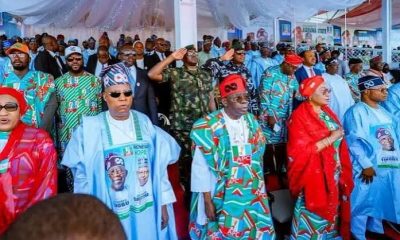
APC Presidential Campaign Storms PH, ‘Morrow
-
News2 days ago
FG Explains Supply Disruption As Power Generation Drops To 3,659MW
-
Metro2 days ago
Port Harcourt Prepares For 10,000 Runners As International Marathon Returns
-

 News2 days ago
Bille Gas Leak: Coalition Tasks FG On Proactive Measures
-

 News2 days ago
IGP Orders Arrest, Prosecution Of Campaign Billboard Vandals