Connect with us

Opinion

The Minimum Wage Debate

Published

on

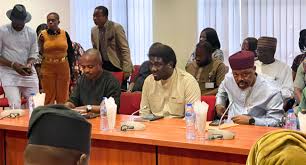
The new minimum wage negotiation which began peacefully last February, appears to have turned into a bitter disagreement that is generating debates among Nigerians, and especially between employers in Nigeria and the labour unions who represent groups of employees.The recent development in the entire discourse, concerning a proposal from Southern Governors Forum that the organised labour should allow state governments negotiate separate minimum wages for their respective states, appears not to have gone down well with the unions, which already are perceiving orchestrated delays in the implementation of a nationwide living wage for Nigerian workers. However, the mere proposal by state governors to enter into seperate negotiations with state workers puts to jeopardy the very essence of assuring a nationwide minimum wage, aside from the fact that the proposal runs contrary to the National Minimum Wage Act.
In a nation where all political office holders across the States and the federal government cadres receive remunerations as nationally categorized by the National Salaries, Incomes and Wages Commission, irrespective of the resource capacities of their respective governments, should there then be a separate measure for the rank and file of the workforce?All over the world, a national minimum wage is set to guard against inhumane exploitation of workers, who whether in government or private employments, face same economic situations. Besides, nations that value social equality and fairness set standards in education, healthcare, wages and other necessities of life, to ensure equal sustainability opportunities for all. The minimum wage should be a nationally assured lowest wage from which any employer may wish to negotiate to pay higher, and it should be aimed at ensuring subsistence for the least worker in a way that is reasonably fair, moral and affordable, to enable him/her meet basic living conditions.
History has shown that such protections have proved to ensure wider social justice, industrial harmony, while boosting workers’ productivity, and therefore sustaining a general economic growth.There’s no doubt that in the present economic situation in Nigeria, where the cost of a basic meal has risen above N1,000, the current N30,000 minimum wage can’t sustain the feeding, clothing, housing, transportation and healthcare needs of a single adult, let alone those with dependants. In the current devaluated currency and inflationary economy, and in the face of the affluence flaunted by politicians, workers may have a justification to feel short-changed in the lopsided distribution of wealth and see themselves left in cold, dark corners to languish in penury. It’s therefore unimagineable that some states still pay N18,000 as minimum wage, and stagnate workers’ promotions, while others have refused to pay wage awards intended to temporarily cushion hardships.
On January 30, 2024, Nigeria’s President, His Excellency, Bola Ahmed Tinubu, through the Vice President, Kashim Shettima, inaugurated a 37-man panel of Tripartite Committee on NationalMinimum Wage, headed by Bukar Aji, to review the current minimum wage of N30,000, and recommend a new minimum wage for the country. Members of the committee comprised representatves from Nigeria’s diverse employer groups, the six geo-political zones each represented by a state governor, as well as representatives of employee groups.Apart from the need to address the pressing economic challenges faced by salary earners in the country following the harsh impact of petroleum subsidy removal, Mr President’s action was also in line with the Minimum Wage Act of 2019 which rests upon a House of Representatives Resolution of May, 2017 that the National Minimum Wage Act be compulsorily reviewed every 5 years. The current N30,000 minimum wage had been agreed upon in 2019 based on which the National Minimum Wage Act was enacted, and expired in March 31, 2024.
The report of the committee’s review and recommendations were envisaged to be  ready before Workers’ Day when workers usually expect announcements of new labour policy directions. In the face of biting economic hardships, and as Mr President had promised that a new minimum wage regime would take effect from May 1, 2024, it was by no little expectations that workers awaited the outcome of the tripartite committee’s deliberations, and government pronouncement for May 1, 2024. The committee in its negotiations and consultations, conducted public hearings on minimum wage expectations across the six geo-political zones of Nigeria, where zonal stakeholders in high hopes reached some rather fabulous wage demands – the South-South zone had proposed N850,000 as an ideal minimum wage; South-West zone, N794,000; the North-Central zone, N709,000; the North-East zone, N560,000; the South-East zone, N540,000; while the North-West zone asked for N485,000, from which the organized labour finally settled on an initial demand of N615,000.
In presenting its demands, the united congress of the Nigerian Labour Congress (NLC) and the Trade Union Congress (TUC) claimed, “The figure was a product of a painstaking effort through which we captured the cost of living of Nigerian workers and masses in all parts of the country. It was essentially an outcome of an independent research conducted by the NLC and TUC on the cost of meeting the primary needs of an average family around the country. Our research was based on a family with both parents alive and four children without the burden of having other dependents with them”.However, which ever how labour tries to justify its initial demand, N650,000 is nothing but outrageous given Nigeria’s financial challenges, and considering that the minimum wage is envisaged for the lowest-level worker who most likely is without dependents.
By its unaffordable demand, labour may have shot itself on the foot by making itself be perceived  as unrealistic, which may have tempted the employers’ side to engage it in a hide and seek game, with the opening offer of N48,000. As labour downed to N497,000, the employer groups racheted the offer knob to N48,000, N54,000 and N60,000. In the final tally following a brief strike, labour pins to N250,000 demand, while the offer micro-ed to N62,000. In the stalemate and air of suspense, the Tripartite committee sent its report to the presidency following which all eyes are now on Mr President’s action and the likely reaction from labour. The new push from some governors to decentralize negotiatons won’t help diffuse the obvious tension hanging over Nigeria’s industrial relations, but may inflame it.The onus therefore lies on Mr President to come to the rescue, by bringng all contending stakeholders to a cordial agreement. A more pragmatic government should stir away from the unrealism of both the labour unions and employer groups, and rather see the survival of both sides as vital to the resuscitation of a struggling economy. But given that some employers who enjoy the affluence of office in a harsh economy, yet feel no empathy for stranded workers to the point of refusing to implement even the old N30,000 minimum wage, Mr President has got a lot of policy frameworks to tidy up.

By: Joseph Nwankwo

Continue Reading

Opinion

Tradition or idolatry? The Debate Over Nhe-Ajoku 

Published

on

Quote:“But when it becomes cloaked in mystery and secrecy, it risks breeding fear and abuse. 
In the heart of Ikwerre land, nestled among the green stretches of Rivers State, lies Omerelu  a community steeped in heritage and rhythm. Here, the people gather every two years for the Nhe-Ajoku, the bi-annual New Yam Festival that marks the harvest season, the renewal of gratitude, and the reaffirmation of kinship with the land. Debate It is a time when the yam, known as “the king of crops,” takes centre stage. The festival begins in joy and ends in solemnity, as the community offers thanks to the Almighty for sustenance and peace. At the climax of the celebration comes Nkwa-Nhe-Ajoku, a sacred dirge performed only by the initiated. By long-held custom, it forbids the Igbo people  from witnessing it irrespective of how long they have lived among them (Omerelu people) . The dirge, performed in secrecy and deep reverence, closes both the spiritual and physical chapters of the festival.
Yet, as the years pass, questions are rising within Omerelu: what still lies at the heart of this ceremony? Has the spirit of thanksgiving been overshadowed by practices that no longer serve the wellbeing of our people? The call to abandon idle worship that is, the worship of lifeless objects or empty rituals  grows louder. For many, the time has come to separate what uplifts the community from what diminishes it. Tradition, when rightly kept, preserves identity. But when it becomes cloaked in mystery and secrecy, it risks breeding fear and abuse. The dirge that once bound the people in reverence now occasionally divides them by secrecy. To the devout Christian, the festival’s spiritual dimension raises moral questions. Can thanksgiving to God be mixed with homage to carved symbols or ancestral forces? Must reverence be expressed through objects rather than through the heart?
Within Omerelu Community , elders recall that the first purpose of Nhe-Ajoku was gratitude  not idol worship. It was to honour hard work, the soil, and divine providence, not to erect shrines to shadows. But today, the week that should bring peace and brotherhood sometimes ends in conflict, theft, and fear. Livestock disappear. Goats and fowls vanish in the night. Some justify it as ritual entitlement; others call it ‘fast finger’. This is where the red flag must rise. A festival of peace cannot thrive in the smoke of wrongdoing. If Nhe-Ajoku becomes an excuse for moral decay, it loses its sacredness. Let the people of Omerelu remember: a tradition that harms its own people ceases to be culture it becomes bondage. It is not the festival itself that is at fault, but the way it is practised. When men hide behind masquerades to seize property, when youths interpret freedom as license, when the dirge becomes a cover for intimidation, the festival must be re-examined.
This conversation must happen without fear or sentiment. The Ikwerre person is proud, industrious, and deeply spiritual. We need not abandon our heritage to embrace truth. Rather, we must purify it, as gold is refined by fire. To understand where we stand, it helps to look back at FESTAC ’77  the Second World Black and African Festival of Arts and Culture, held in Lagos in 1977. It was a grand showcase of African identity, heritage, and pride. For a moment, the black world united under one banner of culture and art. Yet, in hindsight, some critics raised warnings. They argued that Nigeria, in trying to celebrate culture, unconsciously revived old spiritual practices that blurred the line between art and idolatry. A respected cleric once said FESTAC ’77 “handed Nigeria over to idols,” claiming it marked the beginning of the country’s moral confusion.
 Whether one agrees or not, it stands as a cautionary tale: culture without conscience can lead to chaos. So too in Omerelu, Nhe-Ajoku must not become a miniature FESTAC grand in display but hollow in purpose. The harvest must be about life, not lifeless worship. If a festival meant for peace turns into a spree of theft and intimidation, then the red flag flutters over the village square. Our elders must rise to correct this trend. Chiefs, youths, and women leaders must come together to reclaim the true essence of Nhe-Ajoku: thanksgiving, unity, and renewal. The dirge, Nkwa-Nhe-Ajoku, should retain its dignity and secrecy for those qualified, but its purpose must be explained clearly to the younger generation. Secrecy without explanation breeds suspicion and rebellion. Instead of exclusion, let there be understanding. Festivals should strengthen bonds, not stretch divisions.
Omerelu must show that tradition and modern faith can coexist, that the people can celebrate harvest without bowing to idols, can sing ancestral songs without losing moral clarity, can dance without looting. We must also redefine the meaning of worship. Worship is not about objects but obedience; not about rituals but righteousness; not about noise but truth. The younger generation watches keenly. If we hand them confusion, they will discard our culture. But if we hand them purpose, they will preserve it proudly. Let every yam harvested remind us that blessings come through toil, not through spirits or symbols. Let the sound of the drum call us to unity, not to indulgence. The red flag has been raised  not to condemn Omerelu, but to caution it. The line between reverence and ruin is thin; we must tread it carefully. If we reform Nhe-Ajoku today, we will hand to our children a festival worthy of pride.
 If we ignore the signs, we risk turning celebration into regret. Let’s celebrate hard work again by ensuring that our yams are from our yams, not Hausa yams. Our chickens and goats should also come from our farms. I , being a bonafide offspring of Nhe-ajoku adherence, know too well that agric (poultry fowl) and Hausa goats were never anywhere near the ‘Ajoku Shrine’, but now, the reverse is the case. The implication? People are no longer interested.However, let this year, and every year henceforth, mark a new beginning: a Nhe-Ajoku of peace, honesty, and gratitude   that honours our Creator. The yam is life, but life must be pure. Let the dirge speak truth again. Let the red flag remind us  when culture forgets conscience, it ceases to be culture. And when the drums of Nkwa-Nhe-Ajoku sound again in Omerelu, may they beat not for idols, but for renewal, justice, and peace.
By: King Onunwor
Continue Reading

Opinion

Fubara’s Strategic Masterstroke

Published

on

Quote:”What sets this administration apart is not just the volume of projects but their strategic coherence. Each road, bridge, and seaport initiative forms part of an integrated economic master plan that places Rivers State at the heart of Nigeria’s maritime future”
In the evolving narrative of Rivers State’s infrastructural transformation, Governor Siminalayi Fubara is quietly but decisively carving out a new economic roadmap—one anchored on strategic connectivity, blue economy exploration, and sustainable development. His recent inspection of the 13.5-kilometre Oyorokoto Road in Andoni and the visionary Trans-Kalabari Road project underline a bold ambition: to reposition Rivers State as the economic gateway of the Niger Delta and a key player in Nigeria’s emerging maritime economy. The Oyorokoto Road, slated for completion and commissioning in March 2026, is not just a transport corridor. It is the spine of what promises to be a thriving coastal economy. Stretching from Andoni’s popular Oyorokoto Beach to the newly discovered Atlantic beachfront, the project embodies the governor’s vision of turning Rivers State’s natural endowments into engines of growth. The road’s design is strategic—it connects land to sea, trade to tourism, and communities to opportunity.
Governor Fubara’s decision to extend the road beyond the initial Oyorokoto Beach destination speaks volumes about his forward-thinking approach. Upon discovering an expansive Atlantic beachfront with immense tourism and marine potential, the governor ordered the extension of the project—transforming it into what he aptly called “the pathway to the blue economy.” This statement encapsulates a shift in governance philosophy: from mere infrastructure delivery to economic diversification and sustainability. The blue economy, which encompasses maritime transport, fisheries, coastal tourism, and renewable energy, offers Rivers State a new frontier for wealth creation. With Oyorokoto’s proximity to the Atlantic Ocean, deep-sea exploration, aquaculture, and ocean-based tourism can thrive. Governor Fubara’s plan to develop activities around the seafront—hospitality, logistics, and marine services—will not only attract investors but also create jobs for local communities long isolated by geography and neglect.
The significance of the Oyorokoto project also lies in its symbolism. It signals a shift from oil-dependent infrastructure to climate-conscious development. The governor’s insistence on conquering difficult terrains to connect Andoni’s coastal communities underscores his administration’s commitment to inclusion and balanced growth. For decades, these communities have watched from the margins as the mainland prospered. Now, they are being woven into the state’s economic fabric. But the true genius of Fubara’s strategy emerges when viewed alongside the Trans-Kalabari Road project, a monumental undertaking designed to link several island communities in the Kalabari axis to the mainland. The first phase, which terminates at Bakana, is already being celebrated as a historic project with transformative economic implications. Beyond mere connectivity, Bakana’s deep-sea potential positions it as a future hub for maritime trade, shipbuilding, and logistics—key pillars of the blue economy.
By aligning the Trans-Kalabari and Oyorokoto projects, Governor Fubara is weaving a coastal development network that will fundamentally alter the geography of commerce in Rivers State. Once completed, these roads will not only ease movement but open up access to virgin coastlines, attract tourism, and stimulate private investment. In essence, Fubara is building corridors of prosperity across the state’s most difficult terrains. The governor’s unannounced stop at the Kalaibiama-Epellema Road in Opobo/Nkoro Local Government Area further underscores his personal commitment to follow-through. His inspection of the piling work at the Epellema bridge site reveals a hands-on leader determined to ensure that no project lingers on paper. In a region where infrastructure is often hindered by terrain and politics, Fubara’s approach reflects courage and vision in equal measure.
What sets this administration apart is not just the volume of projects but their strategic coherence. Each road, bridge, and seaport initiative forms part of an integrated economic master plan that places Rivers State at the heart of Nigeria’s maritime future. The synergy between the Trans-Kalabari and Oyorokoto corridors will create a seamless coastal belt that can support tourism, fisheries, and inter-island commerce—stimulating both rural and urban economies. Governor Fubara’s economic strategy is also deeply political in the most constructive sense. By investing heavily in long-neglected coastal communities, he is rebuilding trust in government and expanding the social contract. He understands that prosperity must be inclusive, and that true development is not measured merely in kilometers of asphalt but in livelihoods transformed. Critics may view these projects as ambitious, but ambition is the currency of progress.
Fubara’s determination to beat the terrain and deliver projects on schedule is a lesson in leadership under constraint. In the face of financial and environmental challenges, he is proving that development can be both visionary and pragmatic. The broader implication of these infrastructural moves is clear: Rivers State is transitioning from an oil-dependent economy to a diversified, ocean-driven one. The integration of deep-sea potential at Bakana, tourism assets at Oyorokoto, and bridge connectivity at Epellema points toward a strategic blueprint that could redefine the Niger Delta’s development model. As March 2026 draws closer, the Oyorokoto Road will stand not merely as a physical link between Andoni’s communities and the Atlantic but as a symbol of a government that sees beyond the present. It will represent a bridge to new possibilities—economic, social, and environmental.
In the final analysis, Governor Siminalayi Fubara’s economic masterstroke lies in his ability to turn geography into destiny. By connecting land to sea and people to prosperity, he is charting a course that could make Rivers State not just the treasure base of the nation, but the anchor of Nigeria’s blue economy in the 21st century.
 Ibim is a seasoned Journalist, political analyst and public affairs commentator.
By: Amieye-ofori Ibim
Continue Reading

Opinion

Should The Internet Go Bust

Published

on

Quote:”. Whereas it sounds apocalyptic, yet experts have long warned that a total internet collapse, whether from cyberwarfare, global technical failure, or coordinated attacks on undersea cables, could paralyze the world far beyond imagination”
We now live in a world that so much relies on technology, especially on digital communication networks and data services. Virtually every aspect of our life depends on the efficient functioning of machines. In view of this reliance, imagine waking up to a world where the internet simply goes dark. For advanced countries where the functionality, monitoring and data storage of surveillance, security and nuclear installations, all rely on electronics and networks, the disruption could be catastrophic. On the other hand, for developing nations like Nigeria where government’s  response is usually slow, the implications would be socially and economically disastrous. It would imply the sudden evaporation of all the modern conveniences we have taken for granted. No online banking. No emails. No mobile transfers. No WhatsApp messages, Twitter feeds or digital government portals.
The collapse would expose a dangerous dependency, the centralization of personal data. In Nigeria’s multi-biometric systems, the Bank Verification Number (BVN), the National Identification Number (NIN), and SIM registration for mobile networks, are all cloud-based. With no internet, access to these databases would be lost. Banks could not verify customers; telecom operators could not authenticate SIMs; and government agencies would be unable to issue new IDs or validate old ones.In Nigeria, over 80% of financial transactions now occur digitally, thanks to the rapid adoption of fintech platforms such as Opay, PalmPay, Paga, and the Central Bank Nigeria’s eNaira initiative. Assets of companies worth trillions of naira are also stored digitally and transacted on the Nigerians Stock Exchange. Like other transactions, these have no certified paper backings other than electronic storages.
It means that the wealth and wellbeing of millions now lie at the mercy of machines. According to the Nigeria Inter-Bank Settlement System (NIBSS), in 2024 alone, the value of electronic payments in Nigeria reached ?600 trillion. Whereas it sounds apocalyptic, yet experts have long warned that a total internet collapse, whether from cyberwarfare, global technical failure, or coordinated attacks on undersea cables, could paralyze the world far beyond imagination. A total internet blackout would instantly freeze the banking system as banks lose interconnectivity, making transfers, withdrawals, and payments impossible. Fintech companies would go offline, cutting off millions from access to their digital wallets, while Point-of-Sale (PoS) operators, who depend on network connections for every transaction, would be stranded.The economy would revert overnight to cash dependence.
But cash, already scarce due to the CBN’s currency redesign and digital push, would not circulate fast enough to meet demands. Markets would collapse into panic, and trust in banks could erode within hours. Modern governance in Nigeria has increasingly depended on digital infrastructure, using e-government portals to handle licensing, pension records, procurements, revenue collection and budget management. An internet collapse would send governance back to the analogue age. Ministries would lose coordination, digital files would be inaccessible and online recordkeeping systems would fail.For ordinary Nigerians, the consequences would be deeply personal. Salaries paid through electronic transfers would go into limbo. Traders on Jumia, Konga, and social media marketplaces would lose their livelihoods overnight. Health and other insurance policies that currently dependent on cloud records and telemedicine would be truncated.
Even more troubling, a prolonged blackout could corrupt or erase data stored in unsecured local servers. Without connectivity to global backups, entire records, financial histories, health data, and school records, could be lost. For millions around the globe, digital amnesia would mean loss of identity, wealth and social status. Without communication, rumours would fill the void, potentially triggering civil unrests, misinformation, or even national security crises that may lead to uprisings in many countries.In a world where WhatsApp has replaced the post office and Zoom serves as boardrooms, digital communication collapse would feel like the death of modern society. Businesses would halt meetings, journalists would lose sources, students would be cut off from online learning, and diaspora remittances and family ties would suffer. Even voice calls that depend on internet routing would be impossible.
 The silence would be deafening, not just socially but economically, because communication fuels productivity. Without it, markets stall.The collapse of the internet would expose how deeply our daily survival has come to depend on invisible digital threads. If the web were to go dark tomorrow, it would not just dim our screens, it would extinguish commerce, governance, and connection itself. Already, fallouts from increasing cyber-attacks on undersea cables or satellite networks show the fragility of the situation.To preempt these eventualities, developing countries must therefore,  plan to build digital resilience. Critical data should have offline backups within national borders. Banks and fintechs must maintain local intranets or satellite-based alternatives to the public web. Radios, SMS-based, and offline mesh communication networks should be installed as alternative fallback channels.
Proactive protection of key infrastructure must become a national priority, and not reactive fire-fighting. As the internet becomes the nerve centre of modern civilization, developing economies like Nigeria, which strives for inclusion and growth, should avoid being ensnared into a blind spot by rapidly digitalizing into over-dependence. And the question is not whether the internet could collapse, but whether we can survive it when it does. A society that entrusts everything to the cloud must first learn how to breathe without it.
By; Joseph Nwankwor


Continue Reading

Trending