Nation
NDLEA Intercepts Three Trailer Loads Of Opioids, Others, Arrests Suspects
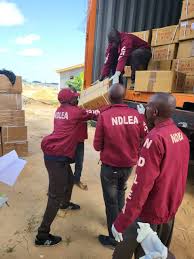
Operatives of the National Drug Law Enforcement Agency (NDLEA) have intercepted three trailer loads of opioids, comprising 3,450,000 pills and 344,000 bottles of codeine syrup.
The agency said the illegal drugs at Abule Ado in Amuwo Odofin Local Government Area of Lagos State, last Thursday.
The NDLEA Director, Media and Advocacy, Femi Babafemi, disclosed this in a statement, yesterday, adding that three suspects were also arrested in connection with the seizure.
The statement partly read, “The multi-billion naira consignments were loaded into two 40-ft container trucks and another 20-ft truck at the AML bonded terminal, Abule-Osun, near the International Trade Fair complex before heading to a large warehouse at Abule-Ado, where NDLEA officers eventually arrested the suspects and recovered the opioid consignments on Thursday, May 9, 2024.
“Those arrested include the warehouse agent, Cosmas Obiajulu, 51; Ridwan Balogun, 25, and Banjo Tayo, 30, both drivers of two of the trucks, while the third driver jumped off to escape arrest.”
The statement also revealed that in Ekiti State, a 75-year-old grandpa, Jibril Audu, was arrested on Friday with 7.5 kilogrammes of cannabis at Oke-asa village, Ijero-Ekiti, during a raid operation, while a 70-year-old grandma, Tikwase Nytor, was nabbed with 15.6 kilogrammes of the same substance on Thursday during a raid operation at Achusa and International Market Road, Makurdi, Benue State.
“It also stated that in a separate operation on Tuesday, NDLEA operatives arrested a suspect, Nwankwo Ejike, in the Coker area of Lagos, where 100 litres of codeine syrup were recovered from him, while 60 litres of the same substance were seized from one Clinton Akinye in the same area on the same day.
The statement added, “Not less than 37.5kg of cannabis sativa loaded in a Toyota Camry car was recovered from another suspect, Adegbola Segun, 47, when the car was intercepted at Mile 12 area of Lagos on Monday, May 6th.
“Another consignment of opioids consisting of 59,106 pills of tramadol and different quantities of codeine syrup and Rohypnol being taken across the border to Garua, Cameroon, was intercepted by NDLEA officers on Monday, May 6th, along Mubi-Yola Road, Adamawa State.
“Two suspects linked to the drugs: Abubakar Auwal, 39, and Adamu Abubakar, 25, (a.k.a. Bamanga), a trans-border trafficker who was to take the consignment from Mubi across to Cameroon, were promptly arrested.”
Similarly, NDLEA officers in Edo State were reported to have raided the Iguiye forest in Ovia North East LGA on Saturday, “where a total of 11, 636.185 kg of cannabis was destroyed on three farms measuring 4.654474 hectares, while an additional 188kg of the same psychoactive substance was recovered, and a suspect, Itah Nyong, was arrested during the overnight operation.”
In the statement, the NDLEA Chairman, Brig. Gen. Mohamed Marwa commended the officers for their efforts and pledged continued collaboration with local and international partners to combat drug trade in Nigeria.

Nation
Youths Vow To Continue Protest Over Dilapidated Highway
Youths from five local government areas in Northern Cross River State have concluded a one-week warning protest and blockade of the dilapidated Ikom-Wula-Obudu federal highway over the weekend.
They have vowed to resume the road blocks if by this week the authorities do not intervene to fix the road.
More than five thousand locals, mostly youths from Obanliku, Etung, Obudu, Ikom and Boki LGAs trooped out everyday for one week, used palm trees to block the highway to draw state and federal government’s attention to their plights, requesting the repair of a road has has been unmotorable for about 40 years.
They warned that if they do not see any actions from the state or federal governments, they will resume their Plan B protest, stop revenue collections and make governance unpalatable.
The youths also warned that without interventions on the road which has claimed several lives, including that of last week when a pregnant woman died with her baby in the full glare of the protesters because of the terrible road, no election can hold in the area next year.
One of the leaders of the No Road , No Election protest, who is also the Abo Youths in Boki LGA, Dr Martins Assam said both the federal and state governments have neglected the region, which generates more than 70 percent state revenue from agriculture.
He said if machinery is not deployed by next week, they will not have any option than to embark on unpalatable and disastrous protest, and stop revenue collections in the area.
“Last week we had only a warning strike for one good week. We’ll embark on a more elaborate, disastrous one-month blockade of this highway until they intervene. We call on our Governor and representatives in the National Assembly to act now by impressing on the federal government to immediately fix this road else. We’re not asking for two much but to be treated as human beings.”
Another protester, Clinton Obi from the Etung axis said, “We’ve been neglected for 40 years. This Ikom-Obudu federal highway had been impassable. The government has removed its concentration from our plights. By this one week protest, we want action on this road otherwise the next phase of protest will be costly.”
Reverend Father Francis Amaozo, priest in charge of St. Nicholas parish in Nashua, Boki LGA said, “I have also been a victim of this very deplorable road. Enough is now enough. We’ve been betrayed by our representatives and other leaders, so that we in this axis have become endangered species on this road. I have lost some many members on this road.”
Member, representing the Boki-Ikom federal constituency of the state in the House of Representatives, Bisong Victor Abang had pleaded with the locals to be a bit more patient with the government as action will commence shortly.
Nation
UNIPORT VC Receives Inaugural Lecture Brochure As Professor Highlights Urgent Need For Drug Repurposing In Malaria Fight
The Vice Chancellor of the University of Port Harcourt (UNIPORT), Prof Owunari Georgewill, last Thursday received the inaugural lecture brochure from the Inaugural Lecturer, Professor Udeme Georgewill, during a ceremony at the university’s Centre of Excellence attended by academics, researchers, students, and distinguished guests.
Delivering her lecture, Professor Udeme Georgewill described the occasion as the culmination of years of dedicated research, teaching, and service to humanity. He explained that his work as a pharmacologist has consistently focused on finding practical, affordable, and scientifically sound solutions to health challenges that disproportionately affect developing countries, particularly malaria, which remains one of Nigeria’s most pressing public health concerns.
She noted that Nigeria continues to bear one of the heaviest malaria burdens globally, accounting for a significant percentage of worldwide cases and deaths. The disease, largely caused by the Plasmodium falciparum parasite and transmitted through Anopheles mosquitoes, remains especially dangerous for children under five years and pregnant women, threatening not only present populations but unborn generations. Despite years of intervention efforts, malaria continues to strain families, health systems, and the national economy.
Prof Georgewill empha-sised that while Artemisinin-based Combination Therapies such as Artemether-Lumefantrine remain the gold standard for malaria treatment, emerging resistance patterns pose a serious challenge. He explained that drug resistance is a survival mechanism of the parasite, enabling it to adapt and reduce the effectiveness of medications designed to eliminate it. According to her, instances where patients do not feel better after initial treatment sometimes lead to repeated dosing or the search for injectable alternatives, practices that can worsen resistance and complicate treatment outcomes.
Against this backdrop, she advocated strongly for drug repurposing as a strategic and urgent response. Drug repurposing, he explained, involves identifying new therapeutic uses for already approved and widely available medications. He likened the concept to “old wine in new wineskins,” stressing that medicines already proven safe for certain conditions can be carefully re-evaluated and optimised for new roles in malaria management. This approach, she argued, offers advantages such as reduced research timelines, lower development costs, and faster clinical application compared to developing entirely new drugs from scratch.
She disclosed that her research had progressed from laboratory investigations to clinical evaluations, where his team is studying combinations involving Artemether-Lumefantrine and Ivermectin to determine their effectiveness in improving treatment outcomes and possibly reducing transmission. Clinical trials are ongoing, and findings will be communicated upon completion of regulatory processes. However, he cautioned strongly against self-medication, warning that misuse of drugs without proper diagnosis and prescription can lead to organ damage, treatment failure, and increased resistance.
Referencing global health commitments, Prof Georgewill highlighted Sustainable Development Goal 3.3, which seeks to end epidemics of malaria and other major infectious diseases by 2030. She questioned whether the goal remains attainable under current realities, especially with growing resistance and funding gaps. He also referred to strategies of the World Health Organisation aimed at drastically reducing malaria incidence and mortality while pushing toward elimination in several countries.
Looking ahead, she revealed that her team is building comprehensive research databases to support artificial intelligence-driven drug repurposing. He stressed that the integration of artificial intelligence, molecular docking, and advanced screening technologies is transforming global drug discovery, and Nigerian researchers must be equipped to participate competitively in this evolving scientific landscape.
In her recommendations, she called for the establishment of a National Centre for Drug Repurposing to coordinate research efforts and leverage artificial intelligence in identifying new indications for existing medicines. He urged policymakers to simplify and accelerate the translation of laboratory discoveries into clinical application, ensuring that scientific breakthroughs benefit the public more efficiently. She also appealed to the university and relevant authorities to increase funding and modernise laboratory infrastructure, including high-throughput screening facilities, to strengthen Nigeria’s position in global biomedical research.
The lecture concluded with expressions of gratitude to God, the university leadership, colleagues, students, and guests, as the event underscored the University of Port Harcourt’s commitment to research excellence and its role in addressing critical public health challenges facing Nigeria and the wider world.
Nation
Niger CAN Rejects Proposed Hisbah Bill, Urges Gov Bago Not To Assent
The Christian Association of Nigeria, CAN, Niger State Chapter, has rejected the proposed Niger State Hisbah Directorates Bill, describing it as controversial and capable of deepening religious division in the state.
In a statement signed by the State Chairman, Bishop Bulus Dauwa Yohanna, and made available to The Tide’s source yesterday, the association urged Governor Mohammed Umaru Bago not to assent to the bill if it is passed by the State House of Assembly.
The bill, sponsored by the member representing Chanchaga Constituency, Hon. Mohammed Abubakar, seeks to establish a Hisbah Directorate in Niger State.
CAN warned that the legislation could be perceived as discriminatory against Christians and may heighten tension in the religiously diverse state.
“Governor Mohammed Umaru Bago, we, the entire Christendom in the state, wish to draw your attention to what could easily create division among the people you govern,” the statement read in part.
The association questioned the necessity and benefits of the proposed law, asking what economic or social value it would add to the state.
It further argued that existing security agencies, including the Nigeria Police and the Nigeria Security and Civil Defence Corps, already have constitutional mandates to maintain law and order.
The Christian body also faulted the legislative process, disputing claims that it was consulted during a public hearing on the bill.
It insisted that it was neither invited nor notified of any such engagement, despite being a critical stakeholder in the state.
-
Politics3 days agoAPC Releases Adjusted Timetable For Nationwide Congresses, Convention
-
Sports3 days ago
DG NIS Wants NSC Board Constituted, Seeks Increased In Funding
-
Business3 days agoCustoms Seek Support To Curb Smuggling In Ogun
-
Sports3 days agoSWAN Rivers Set-up Five Functional Committees
-
News3 days ago
Police Bust Kidnapping Syndicate In PH
-
Featured3 days agoINEC Proposes N873.78bn For 2027 Elections, N171bn For 2026 Operations
-
Sports3 days ago
NSC Disburses N200m Training Grants To 26 Athletes
-
Sports3 days ago
‘NTF Will Build On Davis Cup Success For Brighter Future’