
Editorial
Hurray, Nigeria Is 62!

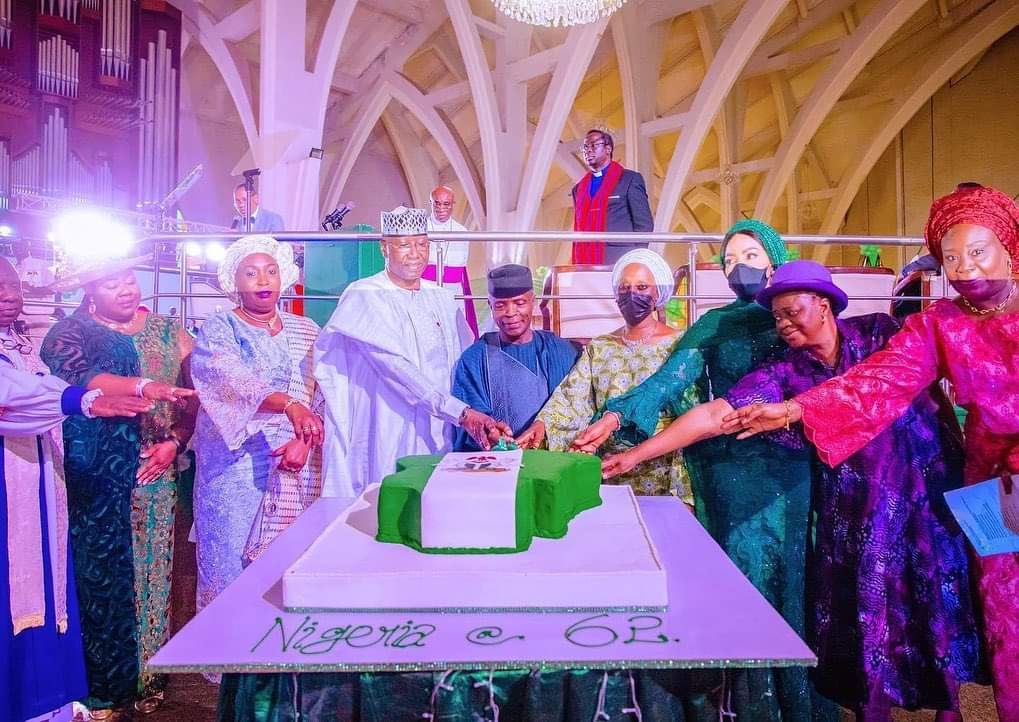
Instead of grappling with the elevating issues of development, the country’s over 200 million population and more than 250 ethnic nationalities are smouldering with dissatisfaction about the present, and anxious about a precarious future. Now, the grand promise and hope of “unity in diversity” lie in bloody ruins, and separatist agitations have again taken a centre stage in national politics. If the years of military dictatorship are seen as “years eaten by locusts,” then the inhumane descent of Nigeria today can be said to be “more years eaten by the locusts.”
Every sector of our national life has been affected, from governance to the economy, security and national cohesion. Setbacks and deficits in each area of development define the country. Traumatised, abused and oppressed, young people have lost hope in the country. Just like in 1966, Nigeria is once again on the fast track to the point of no return. All Nigerians should be well-meaning enough to embark on conscientious sober reflection on the state of the nation.
Successive leaders have abandoned our founding fathers’ dream of Nigeria and replaced it with a motive for self-aggrandizement. The country is torn apart, the people are poor, life and property are insecure, and life is worthless. Now and then, we witness Nigerians loathe their country and spit out the worst abuse on their homeland. While the wealthy have acquired foreign citizenship for themselves and their families, others are working frantically to do so or emigrate from Nigeria.
This is Nigeria for the next generation of leaders: a disillusioned, morally weak, socially divided, religiously lost and economically stupefied country. This is not the way of a truly independent nation. To chart a path to progress, however, Nigeria needs people with big dreams, especially those who do not want to do things the usual way. To justify any independence claim, Nigerians must first determine the basis for their assertion to independence.
Nigeria’s problems are foundational. What we have is a corporate catastrophe. The country is a complicated, intricate, and flummoxing organism where wrongs rule and doing right is impossible. Do the different people who make up the nation see themselves as Nigerians in the first place? Or do they profess allegiance to their clan or tribe as their most basic identity? Nigerians require a sense of national pride and ethos that draws on all the values, spirits, and cultures of different peoples.
To this end, the political class and ruling elite must not place one part of the country above other parts or treat other parts as second-class citizens. Leadership is not racial domination or selfish power imbalances; rather, it is a tendency to truly carry out a mission for the common good. President Muhammadu Buhari should accept that under his leadership, Nigeria has witnessed its worst reversal ever. Leaders and followers must do their best to ensure that they aspire to a new and better Nigeria.
As she commemorates the 62nd anniversary of independence, Nigeria’s top priority should be leadership in Africa and the black world. The country is naturally given this leadership role, and she has indeed played a convincing role in her past activities on the African continent and abroad. Leaders should look to the exemplary and inspiring role this country can play 50 years from now. However, this will only happen if Nigeria shakes off the incompetence, and greed ingrained in its leadership.
What is there to celebrate is the tenacity of Nigerians in their decision to have their country despite a repeated siege by various outlaws. These Nigerians include farmers and locals trapped in terrorist and bandit enclaves, schoolchildren being hunted back and forth, disillusioned women and children in IDP camps, soldiers in trenches and police officers who sacrifice their lives, and lonely Nigerians who every day hope in God that this too will pass. It is these Nigerians who hold this country together and deserve the greatest courtesy.
Economically, Nigeria has fallen behind its peers. Diversification gave way to a single product model. Agriculture was once the backbone of the country and its defunct regions, contributing more than 60 per cent of Gross Domestic Product (GDP) in 1960. Today, it is a paltry 22.13 per cent of nominal GDP by June 2021. The Central Bank of Nigeria says oil and gas contributed less than 1.0 per cent of GDP and 6.65 per cent of export earnings in 1961, but contributed 47.72 per cent of GDP and 98.72 per cent of export earnings in 2000.
Despite successive governments’ efforts to industrialise the country and achieve sustainable economic growth, stakeholders in the real sector believe that the economy is gradually declining. Industrialisation, seen as the only means to achieve economic growth and development, remains unfulfilled 62 years after the founding of the nation. The scarcity of industry, stunted growth in manufacturing, rising unemployment, and lack of food and investment, among others, remain a great challenge.
Infrastructure has failed to pace with the tremendous population growth assessed at 45.14 million by the United States Census Bureau in 1960, to the estimated 211 million in 2021. Roads, airports, ports, and power are inadequate, requiring $3 trillion to fix, says the African Development Bank. In human development, failure is writ large. Whereas the poverty level was 15 per cent at independence, it averaged 27.2 per cent from 1980 to 2010 and reached 69 per cent by 2011.
Nigerians must vote wisely in the next year’s general elections by choosing a good leader. They have to be astute in their voting and avoid elevating needless issues. Nigerians should never again elect nepotistic, tribalistic and religious fundamentalists into governance. We need to salvage and retrieve our country from imminent collapse and looming disaster. The election next year is yet another opportunity to vote candidates that can transform the country and eliminate the pains the citizens are currently going through.
The duty to save our nation is a moral responsibility. A great nation is built based on the character of its people. If Nigeria has to be great, everyone has to take responsibility; everyone has to commit to doing what is fitting. This is a fundamental moral obligation to the state. That is what true independence means.



There are moments in the life of a legislature when plain speaking becomes a public service. Senator Adams Oshiomhole provided such a moment on the floor of the Senate when he accused the Minister of Works, Senator David Umahi, of manifestly neglecting critical federal arteries in Edo and Delta States, and implored his colleagues to prevail on the Minister to adopt a more equitable and genuinely national approach to road infrastructure delivery. It was blunt, it was uncomfortable, and it was necessary.
The specifics of his complaint deserve restating. Drawing attention to the recent approval of some 20 new road projects despite the parlous state of existing ones, the former Edo State governor lamented that Nigerians cannot travel from Benin to Warri, Benin to Asaba, Benin to Auchi, or Auchi to Okene without encountering severe distress. He alleged a deliberate omission of these corridors from the national budget in the last three years, save for palliative interventions directed by President Bola Tinubu through tax credit arrangements. His question — “What have we done wrong?” — resonates far beyond the chambers of the National Assembly.
We lend our full and unequivocal support to that call. The Auchi-Benin Road, for instance, has been in a deplorable and near-impassable condition for several years, turning what should be a two-hour journey into an all-day ordeal of broken axles, extortionate fares, and despondent commuters. The media have, on multiple occasions, chronicled the suffering of motorists, traders, and students who ply that route. To describe it as a federal road today is to stretch the meaning of the term beyond recognition.
This pattern of sidelining is not confined to Edo or Delta. Even here in Rivers State, the disposition of the Federal Ministry of Works has left much to be desired, particularly along the Eleme axis of the East-West Road. That road, which ought to be a flagship of federal presence in the Niger Delta, has remained in a wretched state for long. Those who use it daily — workers at the Eleme Petrochemical Complex, the two refineries, Onne Port, and the countless ancillary industries — can attest to its deterioration. Work has proceeded in fits and starts without the sustained urgency such a strategic road demands.
The Eleme stretch is not a mere intra-state byway. It is the gateway to the nation’s economic jugular. According to the Federal Ministry of Works and Housing’s 2023 Highway Condition Survey, only about 35 per cent of the country’s 36,000 kilometres of federal roads are rated as being in good or fair condition, with the remainder classified as poor or very poor. The East-West Road, conceived in the 1970s to bind the entire Niger Delta, remains unfinished in critical sections more than four decades after. If it had been treated as a priority, the perennial gridlock, carnage, and economic loss on the Eleme-Refinery junction would have long been consigned to history.
The irony is as painful as it is glaring. The Niger Delta remains the goose that lays the golden eggs. Data from the Nigeria Extractive Industries Transparency Initiative [NEITI 2023 Oil and Gas Audit] show that the region still accounts for over 78 per cent of Nigeria’s federally collected export earnings and about 65 per cent of total government revenue. The National Bureau of Statistics [NBS Foreign Trade Report Q4 2024] similarly confirms that crude oil continues to dominate export receipts. By every metric of equity and economic logic, a region that sustains the national purse deserves first-rate consideration in the allocation of infrastructure, not afterthoughts and tokenism.
Road infrastructure is not largesse to be dispensed by favour; it is the skeleton upon which commerce, cohesion, and citizenship hang. When contracts are concentrated in one geopolitical zone while other zones are left to contend with craters, it erodes trust in the federation itself. The World Bank’s Nigeria Development Update [June 2023] estimated that poor transport connectivity inflates the cost of moving goods by up to 40 per cent and costs the Nigerian economy an estimated $1.5 billion annually in lost man-hours and vehicle maintenance. If we profess to be one country, then equity must be the compass that guides key institutions before any project is executed. Development must spread round, not pool in one place as though other regions do not matter.
There is also a grave security dimension that can no longer be ignored. The deplorable condition of federal roads has become a veritable enabler of criminality. The NBS Crime Experience and Security Perception Survey reported over 2.5 million incidents of kidnapping-related occurrences nationally, with transport workers identifying bad road spots as prime ambush points. When vehicles are forced to crawl at 10 kilometres per hour through failed sections at Auchi, Sapele Road, or Eleme, they become sitting ducks for armed gangs. Fixing bad roads, therefore, is not merely about convenience; it is about safeguarding lives.
By his intervention, Senator Oshiomhole has hit the nail on the head and reminded Minister Umahi of a fundamental constitutional truth: public office is held in trust. The Ministry of Works is not a personal estate where contracts are awarded according to whim or political convenience. It is a national institution funded by the collective resources of Nigerians, including the oil and gas rents from the very communities whose roads are now neglected. The Minister must demonstrate balance, transparency, and a pan-Nigerian outlook in the distribution of projects that impact the daily existence of citizens. Selective neglect breeds suspicion, and suspicion is corrosive at a time when the nation is preaching unity, oneness, equity, and justice.
Consequently, the National Assembly must go beyond rhetoric and assert its oversight powers with vigour. Sections 88 and 89 of the 1999 Constitution [as amended] empower the legislature to investigate and expose any maladministration in the execution of federal projects. If an office holder is not acting rightly, it is the duty of the Senate and the House of Representatives to call him to order. Oversight must not be reduced to budget approval ceremonies; it must translate to field verification, public hearings, and insistence that the Federal Character principle, as enshrined in Section 14(3) of the Constitution, reflects in road awards.
Let the Auchi-Okene, Benin-Warri, Benin-Asaba, and Eleme East-West gangways be restored to motorable dignity. Let priority be given to completing existing, economically vital roads before embarking on new ones. If those who, through their resources, sustain the federation are sidelined in the distribution of tangible dividends, it tells poorly of our nationhood. Bad roads must be fixed, and they must be fixed now, with fairness as the guiding standard.
-

 News3 days ago
RSG Targets Nine Million Residents in Mosquito Net Distribution Campaign
-

 Oil & Energy3 days ago
Aiyedatiwa Signs New Electricity Bill
-

 Oil & Energy3 days ago
NLNG Commissions Research And Innovation Centre In RSU
-

 Maritime3 days ago
Marine Minister Commends President Tinubu On NPERA Bill Assent
-

 News3 days ago
KenPoly Holds Eight Convocations, August 29
-

 News3 days ago
RMAFC Completes Revenue Sharing Review, Proposes New Pay
-

 News3 days ago
RSG Begins Another Phase of Projects Commissioning Today
-

 Maritime3 days ago
NAGAFF Petitions IGP Over Alleged Maritime Police Harassment