
News
ICC Moves To Investigate Abduction Of School Children

The prosecutor of the International Criminal Court (ICC) is set to seek authorisation from the Pre-Trial Chamber of the court to open an investigation into cases of abduction of school children in several parts of Northern Nigeria, closure of schools, and the persistent failure of Nigerian authorities at both the federal and state levels to end the abduction.
The ICC prosecutor’s decision followed a petition by the Socio-Economic Rights and Accountability Project (SERAP).
This development was disclosed, yesterday, in a statement by SERAP Deputy Director, Kolawole Oluwadare.
SERAP had in the petition dated September 4, 2021, urged the ICC Prosecutor, Mr Karim A. A. Khan, QC, to “push for those suspected to be responsible and complicit in the commission of these serious crimes, to be invited and tried by the ICC.”
In the petition, SERAP argued that, “The severe and lifelong harms that result from depriving children the right to education satisfy the gravity of harm threshold under the Rome Statute.”
Responding, the ICC prosecutor in a letter with reference number OTP-CR-363/21, and dated October 22, 2021, confirmed to SERAP that “the criteria for opening an investigation into a string of abductions and closure of schools in some parts of Nigeria have been met.”
The letter signed on the prosecutor’s behalf by the Head of the Information and Evidence Unit, Mark P. Dillon, read in part: “On behalf of the prosecutor, I thank you for your communication received on 13/09/2021, as well as any subsequent related information.
“The preliminary examination of the petition is considered complete. Under Article 53 of the Rome Statute, the next step in the judicial process is for the Prosecutor’s Office to prepare and submit a request to the Pre-Trial Chamber for authorisation to open an investigation on Nigeria.
“Once submitted, the request will be made publicly available on the court’s website: www.icccpi.int.
“Your communication will be forwarded to the relevant team to be analysed, together with other related communications and other available information, in the context of any future investigations. We thank you for your interest in the ICC.”
SERAP Deputy Director, Kolawole Oluwadare said: “By this decision, the ICC prosecutor has taken a significant step toward ensuring that those suspected to be responsible for grave crimes against Nigerian schoolchildren are exposed, and held to account.
“The victims of these crimes deserve justice. Impartial justice and reparation will deal a decisive blow to impunity of perpetrators, and improve access of Nigerian children to education. SERAP will work closely with the ICC to achieve these important objectives.”
SERAP’s petition to the ICC prosecutor, read in part: “Senior government officials know well or ought to know that their failure to prevent these crimes will violate the children’s human rights and dignity.
“The absence of any tangible and relevant investigation or prosecution in Nigeria suggests that the authorities are unwilling or unable to carry out genuine investigation or prosecution of those suspected to be responsible for and complicit in the abduction of students.
“The consequences of persistent abductions of students, closure of schools, and the failure to provide safe and enabling learning environments despite federal and state authorities yearly budgeting some N241.2billion of public funds as ‘security votes’, are similar to those of the offences in article 7(1).
“More than 10,000 schools have been reportedly closed in at least seven northern states over the fear of attack and abduction of pupils and members of staff. The states are Sokoto, Zamfara, Kaduna, Kano, Katsina, Niger and Yobe.
“Among the string of abductions in Zamfara was the abduction of over 200 schoolgirls in the town of Jangebe in February. The latest abduction comes after widespread reports of abduction of students and closure of schools in many states of Nigeria, including in North-Central Niger State where some 91 school children were abducted.
“An estimated 1.3million Nigerian children have been affected by frequent raids on schools by suspected terrorists. Some 13million Nigerian children are out of school nationwide. According to the United Nations Children’s Fund (UNICEF), more than 1,000 students have been abducted from schools in northern Nigeria since December 2020.
“Families and parents have reportedly resulted to paying the terrorists thousands of dollars as ransom to secure the release of their children. An estimated $18.34million was reportedly paid in ransoms between June, 2011 and the end of March, 2020.
“Nigerian authorities have also failed and/or neglected to satisfactorily address the abduction of 276 schoolgirls from Chibok in 2014, which prompted the #BringBackOurGirls campaign. According to reports, more than 100 of those girls are still missing.”
Nigeria is a state party to the Rome Statute and deposited its instrument of ratification on September 27, 2001, thus giving the court jurisdiction over crimes of genocide, crimes against humanity, and war crimes committed on its territory or by its nationals.
The ICC prosecutor decided to seek an investigation after undertaking a preliminary examination of the cases of abduction of children in the country.
A three-member panel of ICC pre-trial judges will consider whether to grant the prosecutor’s request, once it is submitted, to let the ICC step in as a court of last resort.
Judges will rely on the materials submitted by the prosecution to determine whether there is a “reasonable basis” to proceed.
Victims and their families may also make their views known to the pre-trial chamber.
If the investigation identifies suspected perpetrators of the crimes alleged in SERAP’s petition, prosecutors can ask judges to issue international arrest warrants, which can remain under seal to help authorities apprehend those charged.
As an international court of last resort, the ICC is mandated to bring to justice people suspected to be responsible for war crimes, crimes against humanity, and genocide when national courts are unable or unwilling to do so.



President Bola Tinubu has charged the newly decorated acting Inspector-General of Police, Tunji Disu, to make the Nigeria Police Force better than he met it, as the country grapples with banditry, terrorism, and other criminal activities.
The President, who personally decorated Disu with his new rank at the State House, Abuja, said the appointment comes at “a defining moment for our nation’s security,” expressing confidence in the new police chief’s ability to restore public confidence in the Force.
“The commitment that I expect from you is for you to make it better than you met it. And I’m sure you can do it. Nigeria is challenged right now with banditry, terrorism and all sorts of criminal activities,” Tinubu stated during the decoration ceremony on Wednesday.
The President, who drew on his personal knowledge of Disu from his tenure as Lagos State Governor, said he believes in the dedication the new IGP exhibited while serving in Lagos.
“I know your record. I believe in the dedication that you’ve exhibited while you were in Lagos and I was the Governor of Lagos State.
“Now you assume this responsibility at a defining moment for our nation’s security,” the President said.
Tinubu outlined specific expectations for the new police chief, emphasising discipline, professionalism, and inter-agency collaboration.
“I expect you to strengthen the discipline, enhance inter-agency collaboration, and restore public confidence in the Nigeria Police.
“Lead firmly but fairly, demand professionalism at every level and ensure that safety of lives and property remains your highest priority,” he charged.
Acknowledging the magnitude of the task ahead, the President assured Disu of his full support.
“It is a daunting challenge. I know you can do it.
“You have my full support as you advance the security pillars of the Renewed Hope agenda.
“You are a straightforward individual, committed and respected. You have sufficient discipline,” Tinubu stated.
The President urged the new IGP to draw from the experience of his predecessor, Kayode Egbetokun, who attended the ceremony.
“You can draw from the experience of Kayode Egbetokun who had been there before you.
“You have been part of the thinking, and you’ve been part of the innovation.
“The challenge as you hold the baton of this leadership is the belief that you will excel and Nigeria will prevail,” he said.
Tge President expressed gratitude to the former IGP, Kayode Egbetokun for his service while linking his legacy to the success of his successor.
“To the outgoing Inspector-General of Police, I extend the gratitude of the entire country.
“Nigeria, we are a grateful nation to you for your dedication in service, expression of good leadership attributes within the Force.
“You have served with commitment and distinction, and Nigeria appreciates your contribution to maintaining law and order in our country,” the President said.
He added, “What you should look back and remember is this: you have not succeeded without a good successor.
“Therefore, the success of Tunji Disu as IGP, when confirmed, is part of your responsibility and the joy you should look forward to.”
Tinubu noted that Disu’s previous role as Principal Staff Officer to Egbetokun positioned him well for the new assignment.
“Having been part of your Principal Staff Officer, I have no doubt he understands the ins and outs of the operation.
“He will only improvise. He’s an operational person from what I know,” the President stated.
The decoration ceremony, which took place at 4:00 pm at the President’s office, had in attendance Chief of Staff to the President Femi Gbajabiamila, and other senior government officials.
President Tinubu personally pinned the new insignia on Disu’s uniform, marking the formal transfer of leadership of Africa’s largest police force.
In his response, Disu pledged to justify the confidence reposed in him, vowing to end impunity and enforce zero tolerance to corruption within the Force.
“The President mentioning a lot of activities about me, mentioning areas I’ve worked, mentioning successes I’ve recorded as a policeman, brought emotion to me, almost brought me to tears,” Disu told State House correspondents.
He added, “I will let them know that the era of impunity is over. I will ensure that I train them and encourage them to follow human rights. I will ensure that they know that I will try to follow a regime of zero tolerance to corruption.”
The new police chief emphasised that Nigerian citizens are the ultimate bosses of the police.
“One of the first lectures I’m going to have with my men, I’m going to talk to them, let them know that the citizen, the citizen of the country, are the boss. No police anywhere in the world can succeed without the cooperation of members of the public,” Disu stated.
Egbetokun, in his remarks, expressed confidence in his successor’s ability to surpass his achievements.
“I invested in likely successors in the Nigerian Police Force, and I’m happy that one of those that I’ve invested in has been found most suitable for the job. I have so much confidence that he would surpass what I have done,” Egbetokun stated.
The decoration came barely 24 hours after Egbetokun submitted his resignation letter on Tuesday, citing family issues that require his undivided attention.
The new Police Chief later proceeded to the Police Headquarters to assume duty following his decoration by President Tinubu earlier in the day.
He took his first salute as Inspector-General from members of the Quarter Guard and other officers at the Force Headquarters after returning from the Presidential Villa at about 4:15 p.m. He thereafter proceeded to the official handover ceremony with Egbetokun.
Disu outlined three priorities for his tenure: professionalism and modernisation; accountability and integrity; and community partnership.
However, multiple Presidency sources told our correspondent that Egbetokun was asked to step down during a meeting with the President on Monday evening at the Presidential Villa.
Disu’s appointment came just 48 days before his scheduled retirement on April 13, 2026, when he would have reached the mandatory retirement age of 60 years.
However, under the amended Police Act, which allows Inspectors-General of Police to serve a four-year tenure regardless of age, Disu may remain in office until 2030.
According to the Special Adviser to the President on Information and Strategy, Bayo Onanuga, President Tinubu will convene a meeting of the Nigeria Police Council shortly to formally consider Disu’s appointment as substantive Inspector-General of Police, after which his name will be transmitted to the Senate for confirmation.
Born on April 13, 1966, on Lagos Island, Lagos State, Disu joined the Nigeria Police Force on May 18, 1992, and has served for over three decades across multiple operational and leadership roles.
He rose to national prominence as Commander of the Rapid Response Squad in Lagos State, where he served for six years. Under his leadership, the unit won the Best Anti-Crime Squad award in West Africa in 2016.
On August 2, 2021, he was appointed to head the Intelligence Response Team, replacing the suspended Abba Kyari.
Before his elevation to IGP, Disu was Assistant Inspector-General of Police in charge of the Force Criminal Investigation Department Annex, Alagbon, Lagos. He was also a Commissioner of Police in Rivers State and the Federal Capital Territory, Abuja.

President Bola Tinubu has appealed to the leadership of the 10th Senate to amend the constitution to provide a legal framework for the establishment of State Police to tackle insecurity nationwide.
President Tinubu made the appeal during an interfaith breakfast with senators at the Presidential Villa in Abuja, yesterday.
The president said that the creation of State Police has become urgent to address Nigeria’s evolving security challenges, strengthen grassroots policing, and enhance states’ capacity to respond swiftly to threats within their jurisdictions.
He noted that a decentralised policing structure would complement existing federal security architecture and promote intelligence-led, community-focused law enforcement.
“We are facing terrorism, banditry, and insurgency. But we will never fail to make a right response to this cause. What I will ask for tonight is for you (Senators) to start thinking how best to amend the constitution to incorporate the State Police for us to secure our country, take over our forests from marauders, and free our children from fear,” he said.
The president commended the cordial relationship between the Executive and the Senate, saying that unity is needed to defeat terrorism and banditry in the country.
“It is a good thing that we are working in harmony, we are looking forward to a country that evolves, a country that takes care of its citizens and protects all.
Tinubu thanked the Senate for its unflinching support towards achieving various economic reforms of his administration, especially the fuel subsidy removal and tax reform policy.
“I have a lot of credit for bold reforms. Without your collaboration and inspiration, those reforms would not be possible. We are reformists together. What we gave up and what we stopped is monumental corruption in the subsidy system. We don’t want to participate in monumental corruption and arbitrage foreign exchange.
You don’t have to chase me for dollars; you could see what Nigeria is today. You should be proud, and I am glad you are. What we are enjoying is a stable economy, and prosperity is beckoning us. We need to work hard, and this attendance means a lot to me,” the president said.
President of the Senate, Godswill Akpabio, commended the president for hosting the leadership of the Senate to the Interfaith breaking of fast.
He commended President Tinubu for providing the visionary leadership the nation needs at this critical time, stating that the administration’s bold reforms have now brought more revenue to governors at the sub-national level for the development of critical infrastructure.
The Senate President prayed for the administration, and for the nation’s peace and prosperity.
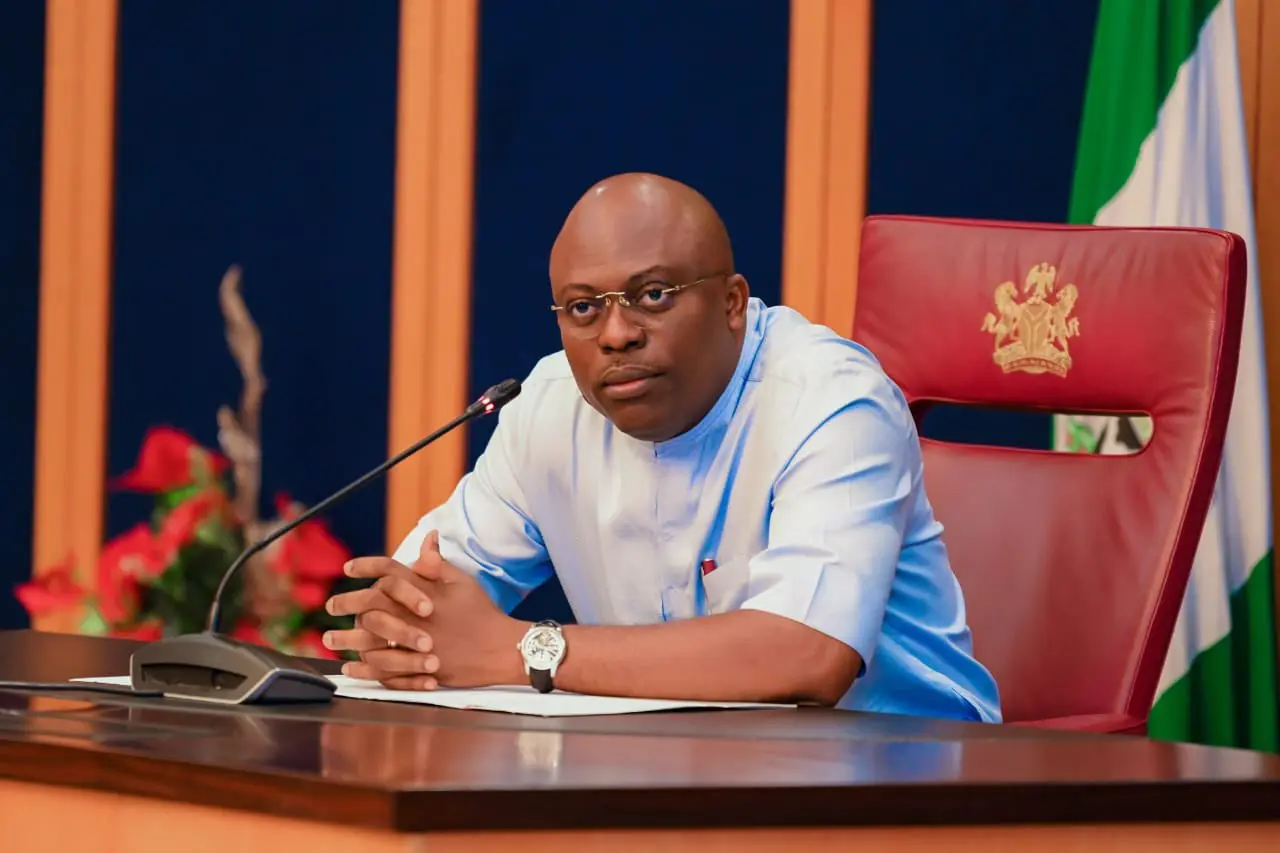
Rivers State Governor, Sir Siminalayi Fubara, has declared that his administration has made significant strides in the health sector in the past two and a half years.
Fubara, who stated this on Tuesday at the Government House, Port Harcourt, listed some of his notable achievements to include the revamping of health facilities, the establishment of the health insurance scheme and the employment of over 2,000 health workers to boost the manpower and efficiency of the sector.
The governor further disclosed that the administration has revived and expanded several abandoned health facilities, including the Zonal Hospitals in Bori, Omoku, Ahoada, and Degema.
He explained that the Ahoada Zonal Hospital is a 105-bed secondary facility that has capacity to cater for the health needs of the people in its catchment area.
In addition to the Zonal Hospitals, Fubara stated that his administration has also paid very close attention to the Primary Healthcare Centres across the state to ensure that citizens of Rivers State, especially those in the rural areas, have easy access to healthcare within their communities.
According to him, the administration approved the remodeling of 153 primary healthcare centers across the State to ensure their functionality.
“As an administration, we are very passionate about the health of every citizen and resident of Rivers State. When we realised that many people have been under stress as a result of economic hardship, we decided to introduce mental health services at the primary healthcare level. We are not just catering for those down with the common diseases such as malaria fever, we want to ensure that our people get the right attention to their mental health at the right time.
“At the tertiary level, we have also revamped the Intensive Care Unit of the Rivers State University Teaching Hospital and provided it with modern equipment, including monitors, ventilators, and scanners. Most of these innovations are massive and unprecedented,” he said.
On staff welfare, Fubara also disclosed that he approved the promotions for over 400 staff of the Rivers State University Teaching Hospital and recruited an additional 500 staff.
In the same vein, the governor said the number of scholarships for indigenes of Rivers State studying at the PAMO University of Medical Sciences has been increased from one hundred 100 to 150 under his watch.
-
 News2 days ago
Amend Constitution To Accommodate State Police, Tinubu Tells Senators
-
 Politics2 days ago
Senate Urges Tinubu To Sack CAC Boss
-

 News2 days ago
Disu Takes Over As New IGP …Declares Total War On Corruption, Impunity
-
Business2 days ago
President Tinubu Extends Raw Shea Nuts Export Ban To 2027
-
Business2 days ago
Crisis Response: EU-project Delivers New Vet. Clinic To Katsina Govt.
-
Business2 days ago
President Tinubu Approves Extension Ban On Raw Shea Nut Export
-
Business2 days ago
FG Pushes Cassava Bioethanol Drive To Boost Industrial Growth
-
News2 days ago
25 Killed In Adamawa Jihadist Attacks