
Niger Delta
Delta Govt Strategises On Renewal Energy Roadmap

The Delta State Government says it is strategising to ensure the successful implementation of its renewable energy policy roadmap 2022- 2027, aimed at providing access to electricity to all residents of the state.
Mr Daramfon Bassey, the Project Manager, Clean Technology Hub (CTH) disclosed this at a stakeholders meeting on renewable energy policy roadmap for the state yesterday in Asaba.
Bassey said that the project was being sponsored by Heinrich Boll Stiftung; a German organisation.
He said that the meeting was aimed at exploring areas of collaboration between the private sector and the government towards successful implementation of the project.
According to him, this policy will serve as a blueprint to achieve the state government’s vision for universal access to electricity, climate resilience and economic growth beyond oil in the state.
“This policy will also help to complement the social and economic development aspirations of the state as part of the Delta Medium-Term Development Plan (DSMTDP) between 2022 and 2027.
“As the world moves cleaner and more sustainable forms of energy, and as the Federal Government implement its national renewable energy policy, it is important that Delta is not left out behind,” he said.
Bassey said that the policy and inputs from the meeting would be shaped, molded and championed by the state Ministry of Energy, adding that the policy would be adopted by the state government.
According to him, the policy resulting from the meeting is expected to reflect the sectoral needs and targets of the state, drive sustainable development and stable energy access as well as reduce carbon emissions.
In his presentation, a Consultant working with Clean Technology Hub, Mr Abel Gaiya, said that the meeting was meant to receive feedback from the stakeholders on the renewable energy policy roadmap.
Gaiya noted that the information from the National Bureau of Statistics ((NBS) showed that the present national grid capacity and power distribution system is inadequate to supply Delta state’s electricity needs.
According to NBS, 78 per cent of the households in Delta were electrified by 2014, and that the figure was higher than that of the South South zone household electrification percentage of 63.
He, however, said that due to the limitations of the national grid, more than half of the state’s population was either off-grid or highly underserved by the national grid.
Gaiya therefore stressed the need for transition from an oil-based economy to a more diversified one in which renewable and clean energy plays a more prominent role.
He explained that the goal of the renewable energy is to improve the electrification rate as well as replace existing sources of energy that are not climate change and health friendly in the state.
On his part, the representative of the Rural Electrification Agency (REA), Mr Mohammed Dukku, explained that in the South-South region, the agency currently has 63 new capital projects and that six of them are ongoing.
Dukku said that as part of the agency’s ‘Energizing Education Programme’, the project is being implemented by the REA in phases, adding that the first phase of the programme is fully funded by the Federal Government.
“Within this phase, nine beneficiary institutions to be powered by solar hybrids are benefiting from funding from the Green Bond issued by the FGN.
According to him, Delta is one of the benefiting institution as well as the Federal University of Petroleum Resources Effurun (FUPRE).
The News Agency of Nigeria (NAN) reports that a total of 125 persons from both public and private sectors attended the two-day programme.



The two leaders made the assertion during the public presentation of Elder Braeyi Ekiye’s book titled, “Redefining Nigeria: Essays on State, Nation, Leadership and Democracy”, at the Chief DSP Alamieyeseigha Memorial Banquet Hall in Government House, Yenagoa on Thursday.
The Tide gathered that the author, Elder Ekiye was Speech Writer to Second Republic Governor of Old Rivers State, the late Senator Melford Obienne Okilo between 1979-1983.
In his remarks, Jonathan described the book as a bold and timely contribution to the national discourse, emphasizing that the work was a testimony of a life dedicated to service and the development of the nation.
Jonathan, who was represented by the former Governor of Adamawa State, Hon. Boni Haruna, said Elder Braeyi Ekiye had served Bayelsa and the country in various capacities with integrity, humility, wisdom, diligence and distinction, noting that the book was a product of experience, and pivotal to national discourse.
“Since independence, the nation has been in search of a true definition of who we are and what we want to be and how we want to live together as a people”, Jonathan said.
He noted that the footprints of the book, which revolves around state, nation, leadership and democracy, were the exact issues Nigeria has been grappling with today as a nation, maintaining that no nation could grow beyond the quality of the conversations it has about itself.
“This book represents a bold and timely contribution to our national discourse. At his age, if Elder Braeyi Ekiye could still find the energy and clarity to write and publish a book such as this, it is a testimony of a life dedicated to service and national development.
“He has served this state and this nation in various capacities with integrity, humility, wisdom and distinction. This book, therefore, is a product of experience and not just theory.
“The title, Redefining Nigeria, is profound and timely. We are gathered here to discuss how to redefine the Nigerian state. Of course, since independence, Nigeria has been in search of a definition – who we are, what we want to be and how we want to live together as a people.
“The state we have is not yet the nation we desire, and the nation we desire cannot emerge without a purposeful leadership, and a purposeful leadership cannot thrive without deepening our democracy”, the ex-President added.
Diri, who spoke at the event through his Deputy, Dr. Peter Akpe, stressed that Brayi Ekiye’s book asked questions every serious-minded citizen should ask, noting that the questions of state, nation, leadership and democracy were fundamental to building a just, equitable and progressive nation every patriotic Nigerian deeply yearns for. According to the Bayelsa helmsman, the issues raised by the book resonated in the findings of the Bayelsa State Oil and Environmental Commission, which stands as a reference point for justice for the Niger Delta that continues to carry much of the nation’s economic burden.
He described the evolution of the book as quite timely, and maintained that engagements which strengthens democracy, good governance and nation-building were always encouraged by his administration.
“Redefining Nigeria asks questions that every serious-minded citizen must confront. What binds us together as a nation? How should power and resources be shared among the various units of our federation? What does a citizen owe the state and what do leaders owe the people who entrust them with power?
“These are the questions of state, nation, leadership and democracy that the subtitle promises, and the author approaches them not as an outsider but as one who has watched our national journey closely and cared about where it leads.
“For us in the Niger Delta, these are not idle questions. Our region has carried much of the nation’s economic weight while bearing its heaviest environmental cost. Our creeks, farmlands and fishing waters tell that story more eloquently than any statistic.
“We have insisted that the restoration of our environment and the dignity of our communities must be at the centre of any honest conversation about the future of Nigeria, and why the findings of the Bayelsa State Oil and Environmental Commission remain a reference point for justice in our region. Our people have earned a voice in shaping the federation, and books such as this one help to make that voice heard”, he said.
In his presentation, the book Reviewer, Prof. Godini Darah, described Elder Ekiye’s 413-page work as encyclopedic and thought-provoking and emphasized the need for people to document their experiences and knowledge to guide others.
According to him, the 413-page book, which has three sections, highlight issues arising from petroleum resources in the Niger Delta, examines Nigeria’s democracy and managing the polity in the interest of the people.
Making reference to a comparison drawn by the author between political elites of the South East Asian countries and those of Nigeria, Prof. Darah opined that the nation has failed to make appreciable progress due to lack of real patriots and nationalistic leaders.
“The Asian elites are developing their countries to meet up the standard of America, Canada, Britain, Belgium, Germany, Italy and so on. So, their politics is concerned about how their own multinational companies can match Julius Berger, Coca-Cola.
“In contrast, the Nigerian political elites are not struggling to put our products in the world market. They are rather struggling to be agents of Shell, ExxonMobil, Chevron, and they are ready to sell this country for nothing”, he alleged.
In his welcome address, the Chairman of Pan Niger Delta Forum, Amb. Godknows Igali, praised the author for translating his reflections about the country into a book which will outlive him and benefit posterity.
While underscoring the deprivations the Niger Delta region has suffered despite its huge contributions to the national coffers over the years, Amb. Igali expressed hope that Nigeria could be built as a united and prosperous country on the basis of equity, fairness and justice.
The Chairman of the Bayelsa Elders Forum, who doubled as Chairman of the occasion, also congratulated Elder Ekiye on his efforts and stressed the importance of books towards the development of individuals and nation-building.
In his remarks, the author of the book described his work as part of ongoing efforts to chart a progressive course of the evolution of a new Nigeria that could proudly stand as a united, secured and prosperous nation in the world.
The Minority Leader of the House of Representatives, Dr. Fred Agbedi, represented by Chief Kelvin Tawari, the Pere of Kabowei Kingdom, His Majesty Peremobowei Erebulu, the Special Adviser to the State Governor on Political Matters, High Chief Collins Cocodia, were among notable figures that launched the book.
By: Ariwera Ibibo-Howells, Yenagoa
Deaconess Oborevwori made the commitment while speaking at the 3rd edition of the Delta State Food Bank Initiative, held at the event centre, Asaba, on Wednesday.
The initiative, aimed at alleviating food insecurity and improving the welfare of vulnerable households, impacted 2,500 women across the 25 Local Government Areas (LGA) of the state, with 100 beneficiaries drawn from each of the LGAs.
In her address, the First Lady emphasised the importance of supporting women, noting that they often bear the responsibility of ensuring that food was available for their families.
She explained that the food bank initiative was introduced out of her passion for improving the welfare of women and families, particularly those facing economic hardship.
According to her, supporting women has a wider impact on society because of their central role in family welfare and development.
She said the initiative was designed to put smiles on the faces of women across Delta State while providing practical support to those struggling to meet their families’ basic needs.
The First Lady also stressed that development goes beyond the construction of roads and other physical infrastructure to include human capital development and programmes that directly improve people’s lives.
She called on individuals to extend a hand of compassion to the less privileged by offering support within their means, while urging beneficiaries to utilise the assistance judiciously to meet their families’ essential needs.
Beyond the food bank initiative, the First Lady highlighted her commitment to supporting vulnerable residents through the You Matter Charity Foundation, which also conducted free medical outreaches across the federal constituencies in Delta State.
She said efforts must be made to create opportunities for all residents to benefit from government programmes and social intervention initiatives.
In her welcome address, the wife of the Deputy Governor of Delta State, Ezinne Kathrine Onyeme, spoke on the importance of compassion and care for women and families.
She acknowledged the entire families. enormous responsibilities women carry in providing food and meeting the needs of their households, stressing that supporting women ultimately means supporting entire families.
She commended the initiative for reaching out to women in need and providing assistance that could ease some of the challenges they face in caring for their loved ones.
Delivering a message on the theme, “Whatever You Do for Others, You Do for Christ”, Pastor Solomon Nathaniel highlighted the importance of compassion, generosity and service to humanity.
He encouraged participants to extend kindness to others, particularly vulnerable members of society, noting that acts of service and assistance to those in need reflect the values of Christian faith.
The Commissioner for Women Affairs, Princess Pat Ajudua, commended the First Lady for sustaining the food bank initiative and remembering women across the state through programmes designed to improve their welfare.
She acknowledged the importance of interventions that address the needs of vulnerable women and their families, describing the initiative as a demonstration of concern for their well-being.
A major highlight of the event was the symbolic handover of food items to the chairpersons representing the 25 local government areas of Delta State which were distributed to the beneficiaries at the venue.
Through the third Delta State Food Bank Initiative and the activities of the You Matter Charity Foundation, the Office of the First Lady has continued to emphasise the importance of addressing the needs of vulnerable residents through practical social intervention programmes.
The initiative highlights the role of community support and targeted assistance in strengthening families and improving the well-being of women across Delta State.
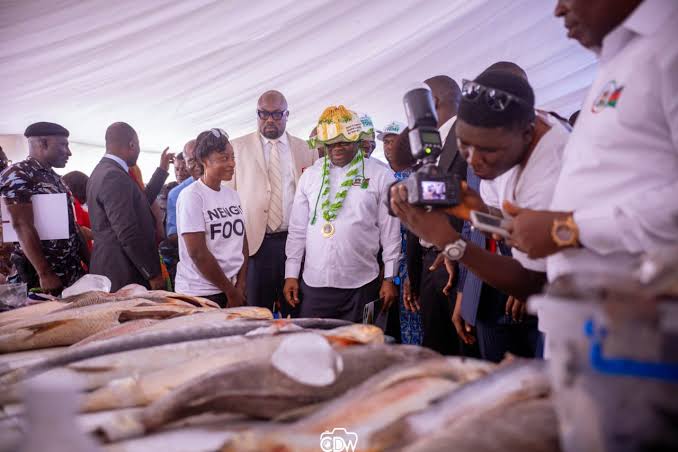
He stated this at this year’s World Food Day (WDF) celebration with the theme: “Innovate Today, Nourish Tomorrow,” at the Chief DSP Alamieyeseigha Memorial Banquet Hall, Yenagoa.
Represented by his Deputy, Dr. Peter Akpe, the Bayelsa Governor said the global theme could not be more fitting and called on the youths to embrace agriculture as a career, instead of staying idle and waiting for white collar jobs.
He also encouraged civil servants and families to take up backyard farming and urged financial institutions to make credit accessible to smallholder farmers in the state.
While appreciating the grant beneficiaries and agripreneurs who shared their success stories, Diri described them as living proof that agriculture in Bayelsa was not only a way of life, but also a business that could create jobs and wealth.
According to him, the State was blessed with water and fertile land and that his administration has secured some strategic partnerships to ensure food security.
He noted that the State flagged-off its maiden dry season farming programme at its Otuasega Farm in Ogbia Local Government Area, and in partnership with the Central Bank of Nigeria installed rice mills at the Niger Delta University and the Federal University, Otuoke.
The Governor explained that the intention was to enable made-in-Bayelsa rice move from the fields to the markets and that thousands of farmers from across the eight rm inputs.local government areas of the State have received seedlings and farm inputs.
The Bayelsa helmsman further stated that through partnership with the CSS Integrated Farms, young people have been trained in modern farming methods.
He, therefore, encouraged the youths to embrace innovation considering the state’s peculiar terrain, plant flood-tolerant seed varieties, as well as apply modern aquaculture to complement the wild fisheries that pollution has depleted.
Diri also tasked them to engage in soilless farming, partnerships, ensuring processing, storage, and cold chains to prevent food wastage.
He commended the International Fund for Agricultural Development (IFAD) and the LIFE-ND programme for building agribusinesses among young people, as well as the Peremabiri Farmers Cluster for demonstrating what well organised and innovative farmers could achieve.
On the need to protect farmers, the Governor cautioned herders against attacks on farmers in the state, saying that the state’s law which criminalises open grazing was still in force.
Commending the Ministry of Agriculture and Natural Resources for organising the celebration, the Governor charged it to work towards meeting the targets set by the government to enable the people of the state buy Bayelsa rice during this year’s yuletide season.
“Let me be frank, government cannot do it alone, and it should not try to do so. Our role as a government is to create an enabling environment and provide access roads.
“Our focus on roads cannot be derailed. We must construct bridges to farms and support farming settlements. We must also continue to improve security for farmers and their crops.
“The actual farming must be done by our people. I, therefore, call on our youths to see agriculture as a career, not a punishment.
“We are already witnessing some changes. In fact, many people from outside the state are taking advantage of the beauty and productivity of our soil, and are engaging in fishing and farming.
“We are calling on our youths in Bayelsa to return to agriculture and increase their participation, so that they can also account for a significant proportion of those registered under the relevant agricultural programmes.
“The grant beneficiaries and agripreneurs sharing their stories with us today are living proof that agriculture in Bayelsa is not only a way of life but also a business that can create wealth and jobs”, he said.
In his address, the Commissioner for Agriculture and Natural Resources, Prof. Beke Sese, said since 2020, more than 17,300 farmers have received direct support through various programmes, including the Accelerated Agricultural Development Scheme, Diri BOOST, and the Prosperity Farmers Grant Scheme.
He noted that this year alone, 2,106 farmers, fishers and processors across all eight local government areas have received grants and that beneficiaries were expanding their cultivation efforts and laying a strong foundation for statewide agricultural prosperity.
According to Prof. Sese, the state’s 410-tonne-a-day rice milling plant was now fully operational and performing at optimal capacity, turning paddy into polished, made-in-Bayelsa rice.
“We are cultivating 106 hectares of rice and buying paddy from the communities we supply, so that while you plant, you know a buyer is waiting.
“The Bayelsa rice plant is currently undergoing laboratory analysis for food and nutritional certification and will soon be launched into the market.
“The Governor has charged us to produce 300,000 kilogrammes of made-in-Bayelsa rice by the end of 2026, so that Bayelsa can feed Bayelsa, and we are, of course, working towards that goal. Bayelsa is indeed strengthening its drive towards food sufficiency and economic prosperity”, the Commissioner said.
In his remarks, National President, All Farmers Association of Nigeria (AFAN), Dr. Farouk Rabiu Mudi, said the association was pleased with the State Governor’s strides in the agricultural sector .
Accordingly, Dr. Mudi, on behalf of AFAN, presented an Award of Excellence to the State Governor as the Best Governor in Agricultural Connectivity and Farmers’ Support in the country.
He explained that the award, launched in August, was being presented by AFAN to 12 state governors, two from each geopolitical region after conducting its research and assessment of the state governments agricultural programmes.
Dr. Mudi also presented a crown-shaped trophy to Diri, stating that it was being presented to only six governors in the country, and urged all communities and farmers’ associations that have not registered to do so and become members of the All Farmers Association of Nigeria (AFAN).
By: Ariwera Ibibo-Howells, Yenagoa