Connect with us

Business

FG Refineries Post N406.62bn Loss In Two Years

Published

on

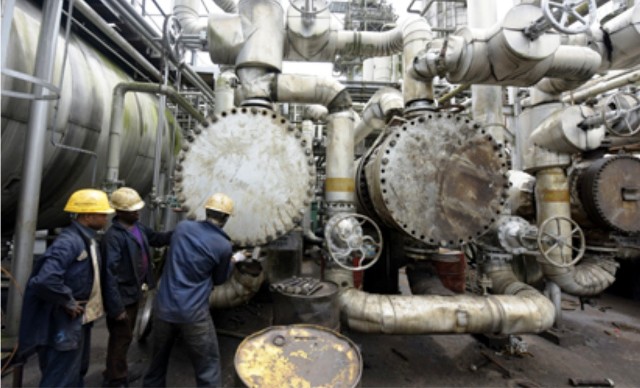
The four refineries owned by the Federal Government made a total loss of N406.62bn in two years, the latest audited financial statements of the plants have shown.
The refineries, which are located in Port Harcourt, Kaduna and Warri, have a combined installed capacity of 445,000 barrels per day but have continued to operate far below the installed capacity.
The country relies largely on importation for refined petroleum products as its refineries have remained in a state of disrepair for many years despite several reported repairs.
The Kaduna refinery recorded a loss of N64.34bn in 2018, down from N111.89bn in 2017, according to its financial statement.
Warri refinery posted a loss of N44.44bn in 2018, compared to N84.60bn in the previous year, while Port Harcourt lost N55.76bn in 2017 and N45.59bn in 2018.
The Group Managing Director, NNPC, Mallam Mele Kyari, said last week that the refineries were all idle.
At a summit organised by Seplat, he had said, “Today, unfortunately, all our four refineries are down.
“In Nigeria today, we are importing practically every petroleum product that we consume in this country.
“We are working to make sure that we are able to fix our refineries.”
In the first term of the President, Major General Muhammadu Buhari (retd), the NNPC had planned to rehabilitate the refineries to attain a minimum of 90 per cent capacity utilisation.
The plan was to use third-party financiers and the original refinery builders to provide the requisite funding and technical support.
However, after over one and a half years, negotiations with financiers were stalled in December 2018 due to varying positions on key commercial terms.
Kyari, who took over the NNPC leadership in July 2019, had reiterated his plan to revamp the refineries and end fuel importation by 2023.
The NNPC said in April that it had secured funding for the rehabilitation of the ailing refineries.
Kyari said the corporation was pursuing “a different model” for the refineries, including the type used by the Nigeria LNG Limited.
The NLNG is jointly owned by the Federal Government, represented by the NNPC (49 per cent), and three international oil companies, namely Shell (25.6 per cent), Total (15 per cent) and Eni (10.4 per cent).
Kyari said the corporation would no longer be involved in running the refineries after their rehabilitation.
He added that upon completion of the ongoing rehabilitation, the services of a company would be procured to manage the plants on an operations and maintenance basis.
The NNPC boss said last month that the issues around market structure had prevented private investors from building refineries in the country.
He said with the deregulation of the downstream petroleum sector, companies would be able to invest in the construction of refineries.
While 44 refinery licences have been given to private investors over the years, only a few projects, including the one being built by Dangote Industries Limited in Lagos, are underway.
There are a total of 38 proposed modular refineries with capacity ranging from 5,000 barrels per day to 30,000bpd, and six conventional plants with a total capacity of 1.35 million bpd, according to the Department of Petroleum Resources.
Aliko Dangote, Africa’s richest man, is building a refinery with a capacity of 650,000bpd, described as the world’s biggest single-train facility.


Continue Reading

Business

Association Woos Govt, Coys On  Boat Operators  Employments

Published

on

The leadership of Bonny Maritime Boat Association has called on Rivers state Government and oil companies operating in the state to provide sustainable employment to unemployed boat Operators.
The Association also want the government, companies and other relevant employers of labour to provide trainings for boat Operators to enhance their skills
Safety Officer of the Association, Comrade Kingdom Kingsley made this known in  a  telephone interview with  The Tide.
He noted that most of the boat Operators and owners plying Bonny route lacks jobs due to the fleets of boats introduced by Bonny Road Transport that had taken over the passengers to the Island
He noted that passengers are no longer patronizing boats owned by the Association, thereby rendering the operators redundant
“Most of our operators can not afford to feed their families due to no jobs, we don’t want to indulge in crime, government should fix our members with  sustainable jobs to take care of their immediate needs”
He called on oil companies operating in the state to engage their skilled boat Operators in their companies to reduce the sufferings faced by the Association.
The Safety Officer called on the state government  to made funds available to unemployed youths in the state to start up business than roam the streets.
He noted that provision of funds to youths would reduce crime rates and reposition their mindsets for a better life
“The  youths of Rivers state are suffering, have no job to feed their families, thereby indulging in criminality daily”
“The youths need empowerment,  jobs,  recreational facilities and better things of life as citizens of this Nation”, Kingsley said.
CHINEDU WOSU
Continue Reading

Business

FG Approves $1 Bn AFCFTA Credit Facility For Nigerian Exporters

Published

on

The Federal Government has approved a whooping $1bn credit facility to support Nigerian exporters and small scale businesses to take advantage of the African Continental Free Trade Area (AfCFTA) in order to boost production, competitiveness and intra-African trade.
The $1bn AfCFTA Adjustment Fund Credit Facility is also expected to address some of the financing gap being faced by Nigerian exporters and enhance the competitiveness of African businesses within the continental market.
The Minister of Industry, Trade and Investment, Jumoke Oduwole, disclosed this  during the second quarter 2026 meeting of the AfCFTA Central Coordination Committee held in Abuja.
According to a statement issued by the ministry’s Head of Press and Public Relations, Obilor-Duru Okechi, Oduwole said the financing facility represented a major opportunity for Nigerian businesses seeking to expand operations, modernise production processes and increase exports to African markets.
The statement partly read, “?The Federal Government has reaffirmed its commitment to accelerating Nigeria’s export-led growth agenda under the African Continental Free Trade Area, unveiling opportunities for businesses to access a US$1 billion AfCFTA Adjustment Fund Credit Facility aimed at boosting production, competitiveness, and intra-African trade.”
She noted that despite the progress Nigeria had made in implementing the continental trade agreement, many local businesses continued to face obstacles that limited their ability to take advantage of the single African market.
?
“Many businesses still face challenges relating to export documentation, certification, standards compliance and market access,” the minister said.
She explained that the Federal Government was addressing these bottlenecks through enhanced trade facilitation measures, simplified AfCFTA guidance tools, stakeholder engagement programmes and stronger collaboration with institutions such as the Nigeria Customs Service and the Nigerian Export Promotion Council.
Oduwole stressed the need to strengthen Nigeria’s legal and regulatory framework by domesticating key AfCFTA protocols, particularly the Digital Trade Protocol, to position the country as a major player in Africa’s growing digital economy.
The minister also highlighted some of the gains recorded in Nigeria’s AfCFTA implementation efforts.
According to her, the expansion of Nigeria’s Air Cargo Corridor Initiative to Rwanda, increased collaboration with development partners and private sector players, as well as sustained engagement with state governments, were helping to deepen awareness and participation in the continental market.
In her welcome address and first-quarter update, the National Coordinator and Chief Executive Officer of the Nigeria AfCFTA Coordination Office, Mrs Patience Okala, provided details of the financing initiative.
Okala said the $1bn AfCFTA Adjustment Fund Credit Facility was targeted at large African businesses with a minimum financing capacity of $10m.
She revealed that the National AfCFTA Coordination Office was working closely with fund managers to facilitate access for eligible Nigerian companies and had begun assembling a pilot group of businesses to ensure that Nigeria maximised the opportunities provided by the facility.
Nkpemenyie Mcdominic, Lagos
Continue Reading

Business

NIWA Harps On  Avoidance Of Leaking Boats

Published

on

The National Inland Waterways Authority (NIWA) has advised Nigerians against boarding boats that require constant bailing of water in the interest of their safety.
 NIWA Area Manager for Cross River and Ebonyi, Mr Stanley Onuoha gave this warning in an interview with Newsmen in Calabar.
Onuoha who spoke on waterway
safety, said that passengers should take responsibility for their safety by inspecting boats before embarking on any journey.
According to him, repeated scooping of water from a boat is a clear indication that the vessel may be leaking.
“If you are entering a boat and see people using a bailer to remove water, it is the first signal that the boat is leaking,” he said.
He urged passengers to check the integrity of boats, including seating arrangements and other visible safety features.
The Manager restated the importance of using safety jackets, saying that damaged jackets may fail during emergencies.
He further said that passengers should ensure that safety jackets were appropriate for their body sizes in order to guarantee effective flotation.
 Onuoha reiterated the need for passengers to fill manifests before departure to aid accountability during emergencies.
The NIWA official further advised travellers to monitor weather conditions and avoid boarding boats when the weather is unfavourable.
According to him, poor weather conditions can trigger strong tidal waves capable of affecting small boats commonly used on inland waterways.
He said that waterway journeys should be embarked upon between 6.00a.m and 6.00p.m for clearer visibility.
Onuoha said  the Authority had continued to sensitise riverine communities to the need for safety precautions during waterway journeys.
He stated that sustained awareness campaigns and enforcement measures had contributed to safety waterway safety in Cross River.
CHINEDU WOSU
Continue Reading

Trending