
Opinion
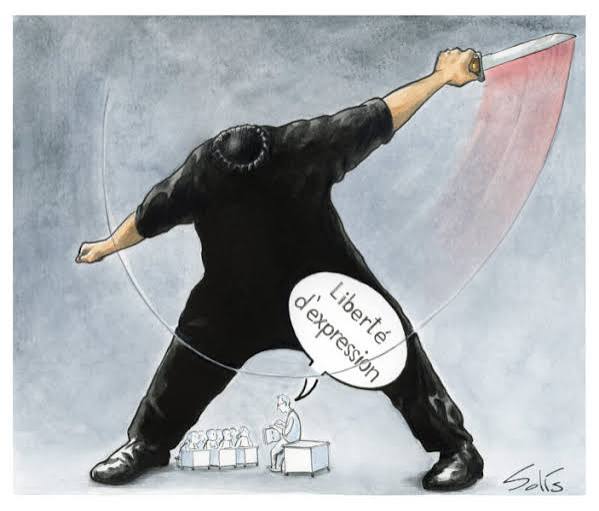
Social Media Regulation And Free Speech

The Universal Declaration of Human Rights (UDHR) which was proclaimed by the United Nations General Assembly in 1948, and adopted as the African Charter on Human and Peoples’ Rights 1981 is a milestone document in the history of human rights.
Accordingly, Nigeria as a member-nation domesticated it as Chapter 4 of the 1999 Constitution, Federal Republic of Nigeria (as amended). Amongst them is the right to freedom of expressions and the press enshrined in Section 39 of the Constitution.
Section 39(1) provides, “Every person shall be entitled to freedom of expression, including freedom to hold opinions and to receive and impart ideas and information without interference”. Subsection 2 expansively provides, “Without prejudice to the generality of Subsection (1) of this section, every person shall be entitled to own, establish and operate any medium for the dissemination of information, ideas and opinions”.
On the other hand, the Criminal Code (Laws of the Federation – 1990) criminalized provoking breach of peace by offensive publication in Part 2. Section 88A (1)(b) provides, “Any person who publishes or circulates publications either in the form of newspapers, or leaflets, periodicals, pamphlets or posters, if such publications are likely to provoke or bring into disaffection any section of the country shall be guilty of an offence…” Similarly in subsection (1)(c).
Emphatically, the Criminal Code includes sedition as an offence under the law. Section 51(1) provides, “Any person who – (b) utters any seditious words; (c) prints, publishes, sells, offers for sale, distribute or reproduce any seditious publication; shall be guilty of an offence ….., and any seditious publication shall be forfeited to the State”.
By the way, what is sedition? It simply means organized or deliberate incitement of rebellion or civil disorder against authority or the state, usually by speech or writing.
In R v Sullivan (1961) US 254, the word ‘sedition’ was described as, “a comprehensive term which embraces all practices, whether by word, deed or writing, which are calculated to disturb the tranquility of the State”. And in IGP v Anagbogu (1954) 21 NLR 26, it was held that the act of writing an article with a seditious intention is tantamount to the offence of sedition.
Now, the crux of the matter is whether the right to freedom of expression and press is an absolute or qualified right? Under permissible circumstances such as is necessarily expedient for public order and security, arguably, freedom of expression and the press cannot be absolute rights instead must be exercised with restraint subject to law.
Article 29 (2) of the UDHR 1948 provides, “In the exercise of these rights and freedoms, everyone shall be subject only to such limitations as are determined by law solely for the purpose of securing due recognition and respect for the rights and freedoms of others and of meeting the just requirements of morality, public order and general welfare in a democratic society”.
Synchronically, Section 45 (1) of the 1999 CFRN provides, “Nothing in sections 37, 38, 39, 40, and 41 of this Constitution shall invalidate any law that is reasonably justifiable in a democratic society (a) in the interest of defence, public safety, public order, public morality or public health; or (b) for the purpose of protecting the rights and freedom of other persons”.
In the civil jurisprudence, the freedom of expressions and the press, interestingly, are constrained by libel and slander. Logically, freedom of speech is not an unconditional right.
The right to life, for example, can be encumbered by judicial death sentence; right to free movement can be hindered by lawful arrests and jail terms, and the right to own movable property cannot be exercised by theft or stealing. Ditto on others. In other words, human rights are fundamental but not absolute rights.
Suffice it to say that putting restraints on social media activities through regulations cannot fairly lead to brouhahas. Events, in recent times, have shown that such intervention is indispensable, and without regulations, social media will do more harm than good to the society in no distant time.
Overtime, sensitive information, including falsified national reports and private issues, had been disseminated only for people to subsequently discover they were fake news. This is condemnable.
If the established media industry; audio, visual and print-media outlets with trained journalists are regulated, why should there be uproars on regulations on social media with unskilled operators? Likewise, SIM cards must be compulsorily registered and intermittently updated to assist in the onerous battle.
Any society where people can freely fabricate falsehoods, including invasive information and disseminate to the public, is in decay and, therefore, must not be encouraged to stay. Nonetheless, citizens have unparalleled rights to fairly criticize their leaders and governments on policies at any time.
Instructively, the quality of criticisms determine if oppositions are actually in existence. There is a wide difference between criticisms and incitingly feeding the people with falsehoods. No doubt, civilization opened up the world of innovations but mustn’t be subjected to extreme abuse, otherwise, it will tear the nation in pieces.
In sum, a situation where disgruntled elements would fabricate fake stories or videos to mislead the public is dangerous. It’s a threat to national security, and sensibly, cannot be permissible under the guise of exercising right to free speech and press.
Umegboro, a public affairs analyst, wrote in from Abuja.
Carl Umegboro



Quote: “Ogoniland does not
The latest attack by Chief
Instead, the gathering and
The proposal for a unified
The question should be: who
It is easy to criticise
The people are looking beyond
onest people can reach
Society must therefore
Quote: “Privilege should
There is an old saying that
While motivations cannot
A person who benefits from a
This is why citizens should
We must not assume that
By: Michael Abraham

Quote:”Although the Federal
The recent outburst by the
The senator also alleged
They connect ports, airports,
To address these challenges,
Rwanda and Morocco, for
FERMA should also prioritize
Many Nigerians have asked
-

 News2 days ago
RSG Targets Nine Million Residents in Mosquito Net Distribution Campaign
-

 Oil & Energy2 days ago
Aiyedatiwa Signs New Electricity Bill
-

 Maritime2 days ago
Marine Minister Commends President Tinubu On NPERA Bill Assent
-

 Oil & Energy2 days ago
NLNG Commissions Research And Innovation Centre In RSU
-

 News2 days ago
KenPoly Holds Eight Convocations, August 29
-

 News2 days ago
RMAFC Completes Revenue Sharing Review, Proposes New Pay
-

 News2 days ago
RSG Begins Another Phase of Projects Commissioning Today
-

 Maritime2 days ago
NAGAFF Petitions IGP Over Alleged Maritime Police Harassment