
Health
UHC: ‘Nigeria Needs 155,000 Additional Doctors’

Nigeria needs additional 155,000 doctors at the ratio of one doctor to 1,000 people to achieve the Universal Health Coverage (UHC), Prof. Usman Ahmed, Provost, College of Medicine and Health Sciences, Federal University, Dutse has said.
According to World Health Organisation (WHO), Universal Health Coverage aims to ensure that all people have access to the needed services of sufficient quality without exposing persons (recipients) to financial hardship.
Ahmed, who is also a Professor of Health Sciences, University of Manchester, UK told newsmen on Tuesday in Abuja that data from the Federal Ministry of Health shows that there were 45,000 doctors registered and practicing in Nigeria, which is a ratio of one doctor to 4008 people.
“Even if we take it as one doctor to 4000 people and we want to have UHC, meaning a minimum of one doctor to 1000 people, we will need to have at least 200,000 doctors in Nigeria today.
“ It also means that we will need nearly a million nurses because for each doctor we need several other nurses, physiotherapist, occupational therapist, audiologist etc. and we don’t have them complete in Nigeria,’’ he said.
He said Nigeria should realise that WHO recommended one doctor to 600 people, adding that “if we use WHO’s recommendation, we may need more than 155,000 doctors today.’’
The don recommended one doctor to 1000 people to replicate a model used in India, adding that India had 840,000 doctors in a ratio of one doctor to 1800 people.
He said the Indian Universal Health Care Commission recommended that the country should migrate from one doctor to 1800 people to one doctor to 1000 people to UHC .
“They call it Modicare. Therefore to achieve that they need additional 200, 000 new doctors to add to the existing 840,000 doctors; they also plan to achieve the required doctors in 10 years by opening more medical schools,’’ he said.
Ahmed said: “If we want to look after ourselves, we need to be serious about UHC through remodelling the National Health Insurance Scheme Act and the National Health Act 2014.’’
He said the transformation of the two Acts and establishment of pilot universities of health sciences would provide a good framework for UHC in Nigeria.
The Tide reports that on Sep 21, Minister of Health, Prof. Isaac Adewole, during 38th Annual General Meeting and Scientific Conference of the National Association of Resident Doctors of Nigeria (NARD) at Ibadan, Oyo state, said there was “no serious shortage” of doctors in Nigeria.
“The data obtained from the Medical and Dental Council of Nigeria shows that as of May 30, only 45,000 are currently practicing and that gives us a ratio one doctor to 4,088 persons,” he said.
Adewole noted that what was perceived as a shortage of doctors was actually the uneven distribution of practicing doctors within the country.
According to him, the ratio of one doctor to 4,088 patients in Nigeria is better compared to other African countries.
“Compared to many other African countries the ratio is not bad, for example, in South African it is one (doctor) to 4,000; in Egypt it is one to 1235;
“in Tanzania it is 1: 14,000; in Ethiopia, it is one to 1 to 118,000, in Kenya, it is one to 16,000 and in Cameroon it is one to 40,000,” he said.



The Federal Government has begun a scheme to battle malnutrition in children.
Tagged, “Nutrition 774 Initiative”, the programme was unveiled by Vice President Kashim Shettima as it falls within a framework for the Federal Government’s comprehensive vision for a nationwide nutrition programme to address malnutrition and food insecurity in Nigeria.
The proposed programme, “Nutrition 774 Initiative,” aims to improve nutritional outcomes across all 774 local government areas (LGAs) in the country.
Speaking yesterday during a roundtable with development partners at the Presidential Villa, Abuja, VP Shettima said the initiative aligns with President Bola Ahmed Tinubu’s broader focus on food security and availability across Nigeria.”The priority with which His Excellency, President Bola Ahmed Tinubu, has pursued food availability has gone hand-in-hand with our commitment to eradicating malnutrition.
“Our aspiration as a nation goes beyond the mere abundance of food in our barns and warehouses. We cannot claim victory unless there is certainty that each household across Nigeria has access to the preferred and prescribed diets essential for a healthy life,” the vice president stated.
It would be recalled that the 144th meeting of the National Economic Council (NEC) had in September endorsed the Nutrition 774 programme as a primary platform for combating malnutrition within Nigerian communities.
The council encouraged development partners to provide financial and technical assistance to support this initiative.
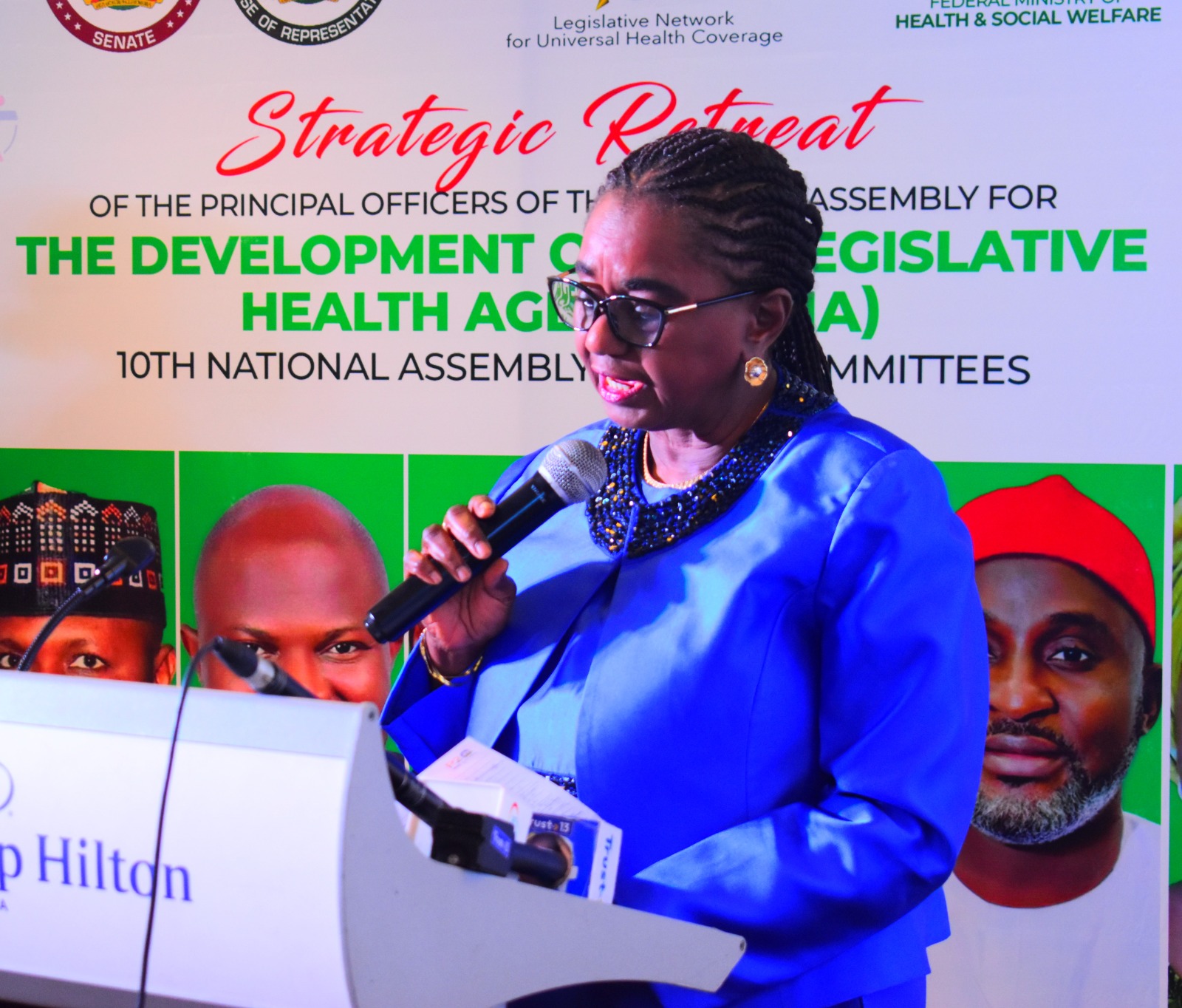
The importance of e-Health devices and digital health solutions in improving Nigeria’s healthcare system has been emphasised by Senator Ipalibo Harry Banigo, Chairman of the Senate Committee on Health, Secondary and Tertiary.
She also stressed that health is a multilayered activity and a multisectoral collaboration that requires legislators to work together to provide legislation, implement policies, and track funds effectively.
Banigo, who represents Rivers West Senatorial District in the National Assembly, made these remarks at the 5th Annual Legislative Summit on Health in Abuja, themed “Improving Legislative Stewardship and Accountability for Universal Health Coverage.”
She highlighted the potential of eHealth devices, especially given Nigeria’s large population and limited healthcare professionals.
“We can develop platforms that can be accessed through simple phones, even in remote villages, to provide health education and interventions,” she said.
“We are not talking about highfalutin things; we are talking about what will impact communities at the grassroots level, particularly pro-poor initiatives that will benefit vulnerable populations.”
Banigo also emphasized the importance of accountability and effective care, encouraging legislators to share knowledge, engage in peer reviews, and exchange information to achieve better health outcomes.
She recalled the cholera outbreak, where basic health education and interventions could have been delivered via mobile phones, preventing preventable deaths.
The 5th Annual Legislative Summit on Health brought together federal and state legislators, the Coordinating Minister of Health and Social Welfare, Prof. Muhammad Pate, the World Health Organisation’s representative in Nigeria, Dr. Walter Mulombo, and other dignitaries.
-

 News2 days ago
RSG Targets Nine Million Residents in Mosquito Net Distribution Campaign
-

 Oil & Energy2 days ago
Aiyedatiwa Signs New Electricity Bill
-

 Maritime2 days ago
Marine Minister Commends President Tinubu On NPERA Bill Assent
-

 Oil & Energy2 days ago
NLNG Commissions Research And Innovation Centre In RSU
-

 News2 days ago
KenPoly Holds Eight Convocations, August 29
-

 News2 days ago
RSG Begins Another Phase of Projects Commissioning Today
-

 News2 days ago
RMAFC Completes Revenue Sharing Review, Proposes New Pay
-

 Maritime2 days ago
NAGAFF Petitions IGP Over Alleged Maritime Police Harassment